
Comments
-
The Philosophy of Language and It's ImportanceAlso, I wonder what the best way to proceed would be. In the old forum, there were official debates. Not that it needs to that exact format. What would we hope to accomplish?
You, and those who agree with you, would explain and attempt to show how the philosophy of language encompasses all of philosophy.
Those of us who disagree would attempt to show that it doesn't. Assuming "philosophy of language" is defined in a definitive matter that means something more than just philosophy. IOW, that philosophy is actually the philosophy of language for any domain being discussed that falls under philosophy. -
The Philosophy of Language and It's ImportancePhilosophy of Language is, in the end, the whole of philosophy. — Banno
No, just no. That's wrong. -
The Philosophy of Language and It's ImportanceFor example, some philosophers have come up with a sense/meaning of knowledge that doesn't fit within the ordinary use of the word. Thus, they use the word completely out of it's home. — Sam26
Does this apply to ancient or medieval philosophical problems in addition to more modern ones? Because various philosophical problems have been expressed in Greek, Latin, Hindi, Chinese, English, French, German, Arabic, etc.
On an abuse-of-language view, different languages would probably present different forms of abuse. Or so we might expect.
We might also wonder if there's something about ancient Greek that gave rise to ancient metaphysics and epistemology. -
The Philosophy of Language and It's ImportanceMaybe my emphasis on Wittgenstein is overblown. If you think that, then explain why, but don't do it if you don't understand Wittgenstein. — Sam26
Isn't the emphasis on language pretty much the entire analytical enterprise of the past century? The idea that if we can get clear on language, then many philosophical problems can be adequately addressed, and philosophy can be turned into a respectable pursuit, similar to science.
If so, a question arises as to how successful that emphasis has been. -
The Philosophy of Language and It's ImportanceSounds like a rehash of the ancient skeptical position in modern garb.
-
The Philosophy of Language and It's ImportanceYa, it would be interesting to divide the problems up into various kinds. — Sam26
Would also be interesting to see what sort of agreement/disagreement we got on the classification of different problems. -
The Philosophy of Language and It's ImportanceAnd you're sure what an 'essence' is? Have you read no debates on the meaning of 'subjective? — Pseudonym
Essence was just my word for the nature of subjectivity. It's not a word typically used in the debate.
So tell me how linguistic analysis can help if nobody agrees on the meaning of the terms? -
The Philosophy of Language and It's ImportancePhilosophy of time: presentism, block universes etc. — fdrake
Agreed, and this could be resolved by physics at some point.
Metaphysics of science: emergence, character of natural law — fdrake
Right, and this is regarding the nature of the world, not language.
Political philosophy: the vast majority of issues in it. — fdrake
Yep, obviously political differences can't simply be resolved by analyzing political language. There are issues people disagree on, and some of them are ideological in nature. Some of them relate to a kind of philosophical outlook on how society should function.
Logic: foundations of mathematics — fdrake
Certainly outside ordinary language analysis.
Ethics: real world ethical issues — fdrake
Yes, ethics relates to how we should live. That's not a matter for linguistics. -
The Philosophy of Language and It's ImportanceIs that just wishful thinking, or do you have some reason to think this? If you could provide an example of some philosophical terms whose meaning you think is widely agreed on (with a rough idea of what that agreed meaning is), that might help. — Pseudonym
I updated my post to include qualia, with the ongoing dispute between Chalmers and Dennett as a specific example.
Qualia is understood to be the essence of subjective experience. This isn't a matter of dispute. It's what the term means. Whether qualia exist, and if so, how they can be accounted for, is open for dispute. The term itself isn't in dispute. -
The Philosophy of Language and It's Importanceto understand 'the philosophy of language' is to have to understand a great deal more than language. — StreetlightX
Such as culture, sociology, cognition, politics, even biology, depending on the nature of the problem. -
The Philosophy of Language and It's ImportanceIf you can describe a philosophical problem and then define each word you just used in a way that will gain even a substantial minority of agreement then I'd be prepared to concede this. Thus far, I've not found such a thing to be possible — Pseudonym
That sounds like no amount of linguistic analysis will fix the problem since people won't agree on what the terms mean.
But I don't think this is actually the case for every problem in professional philosophy, just discussion forums where the rules of engagement are a lot more lax, and people can play loose and fast with terms to try and win the argument.
If you look at the debate over qualia, the different sides mostly agree on terms, they just don't agree on the issue as to whether qualia present a hard problem. And thus it's not a linguistic issue.
The dispute between Dennett and Chalmers, for example, is not a matter of language, since they both understand each other and use the same terms. They're not having a semantic dispute over how to use the word consciousness or qualia, rather they're having a substantive dispute. -
The Philosophy of Language and It's ImportanceThe question is, which or what philosophical problems are we talking about. — Sam26
Would be interesting to try and divide them up:
1. Philosophical problems dissolved.
2. Clarified.
3. Potential to be clarified or dissolved.
4. Resistant.
Or what have you. Of course the problem here is people won't necessarily agree on what constitutes dissolving or clarifying a problem, and which ones are resistant. Even coming up with a framework for classification will be controversial.
That reminds me of David Chalmers book on scrutability where he attempts to give a framework for metaphysics given whatever basic premises one wants to start off with. -
The Philosophy of Language and It's ImportanceOne of the reasons I've spent so much time studying philosophy of language, is, obviously, that language is the medium in which philosophical discourse takes place. It seems to follow, that having a good understanding of the way language works, in terms of concepts and meaning, is crucial to having a clear understanding of not only philosophy, but other subjects as well. — Sam26
Sure, but I'm skeptical that analyzing language is some sort of cure for philosophical problems in general. That may be the case in some instances, but I'm of the opinion that the majority of philosophical problems are not primarily linguistic in nature.
By example, consider health problems. We use language to discuss health, but health issues are biological and social, and not primarily a matter of language usage (although it can be sometimes in certain situations). -
Bias in newsBut there can be nothing objective about this, this basic act of telling a story (true story, or not). This is the realm of narrative, not objectivity. — hypericin
That's just going too far. There's nothing subjective about a Typhoon hitting Japan. Of course there is a selection process on what constitutes events worth reporting. And that's what tends to attract viewers. Disasters, conflicts, controversies and scandals are always good bets, because most people who pay attention to general news want to hear that stuff. -
UniversalsWhereas, in consequence of nominalism, which was in many respects the precursor to empiricism, this distinguishing characteristic of the ‘faculty of reason’ is generally no longer recognised, with considerable consequences for modern philosophy of mind and especially theory of meaning. — Wayfarer
Where does science fit in this? Science is empirically-based, but theory is equally important. Science seeks to tie related observations together into an explanatory whole. Physics highlights how importation rationalism and imagination are in a addition to doing experiments.
Event experimental setup requires a good deal of creativity and reason. -
Bias in newsI don't agree with the notion that news reporting should not strive for objectivity. You ditch that, and then you get propaganda like Fox News in it's place.
Humans can't be objective in the ideal sense, but they can certainly strive for it, which is much better than intentionally trying to persuade the public about a certain ideological outlook.
The difference between imperfect reporting and propaganda is huge and important. Also, there is a very real difference between fake news and real news, even if real news doesn't capture all the facts perfectly. -
Living and DyingRationality always works within a delimited field. Death is outside that. Its beyond rationality/irrationality. — csalisbury
It's after finitude, for sure. -
UniversalsThere are people who believe there is a "language of thought." I reject the notion because it leads to an infinite regress. — Dfpolis
Do you reject that there are neural mechanisms behind word formation in the brain that have something to do with understanding word meaning? -
UniversalsIf you think that ideas are merely words we speak internally, then you are more likely to be a nominalist. — Dfpolis
Words typically express concepts. Names would be an exception, as they're often arbitrary labels. Does anyone disagree that many words are conceptual? I have a sneaking suspicion about the meaning-is-use people here, but even with that concept of meaning, there is still a cognitive component to understanding the use, which explains why humans are capable of language.
Perhaps there is a nominalist on the forum that would like to provide a stronger defense of his/her position. — Dfpolis
Oh, there's a few. Whether this topic interests them is another matter. -
UniversalsUnless there is something real to connect universal ideas/concepts to their instances, there is no reason not to call anything by any universal name. For example, I can decide to call my dog a cat, while I call yours a turtle. — Dfpolis
This would be a major problem with nominalism if that's the case, because clearly there are differences between dogs and cats, while there are similarities among dogs unique to dogs. That's why we have universal categories. Because we recognize that particulars have similarities and difference which allow for grouping/classifying them, and this is non-arbitrary. It's an empirical fact of dogs, cats, stones, stars, etc. -
UniversalsNominalism says universals are only names, with no foundation in reality. Conceptualism says they are only concepts, with no foundation in reality. — Dfpolis
Right, but I'm unclear as to the difference between names and concepts in this debate.
If the only universal things are names, then they exist, but only as conventional signs -- as human inventions. — Dfpolis
Sure, but by that token, anything exists that's in language, including unicorns, present day bald kings of France, and the IPU. -
UniversalsThe big question for nominalism is whether something other than universals can be used to explain the similarity between particulars.
Possibilities include tropes, properties and bruteness (sameness has no explanation, it just is). -
UniversalsPerhaps a less confusing way to put it is that nominalism doesn't necessarily have to be committed to the denial of universals as such. What it denies is rather the 'reality' of universals; it says that that universals only exist, insofar as they do exist, as names, as nominata, and not as something substantial - — StreetlightX
I'm confused as to the difference between nominalism and conceptualism. Also, saying that universals are just names is pretty much denying the existence of universals. The nominalist is basically pulling a Dennett and redefining the term to mean something else, while saying it still exists, in a fashion (to the extent Nominalists say they aren't committed to denying universals). -
An Outline Of Existential DependencyIsn't that cartoon a parody of your position that beliefs and justification are shortcuts for actions?
-
The snow is white on MarsHave I misunderstood the OP? — Hanover
I think Apo's post captures my intuition that language can't be reduced to something as obvious as defining "X" as Y in order to arrive at truth. -
The snow is white on MarsSo is there supposed to be an essence of snowness, had by, and only by, all snows? And the discussion here is to try to work out what that snow-essence is?
Or are you all just disagreeing about how to use the word "snow'? — Banno
Both. We want to be able to use the word "snow" in accordance with something that has snow-like properties. We might limit it by including the chemical composition found on Earth, or we might not. -
An Outline Of Existential DependencyDismissing this view as behaviourism might appeal to some; including those who are more interested in winning than thinking. — Banno
A swampman, a philosophical zombie, and a BIV go into a bar ...
Are your beliefs to be found between your ears? — Banno
Take an atheist in a devout Christian society. Wanting to avoid certain undesirable consequences, they go to church, confess their sins, and stay within acceptable conversation. Where would you locate their disbelief? -
An Outline Of Existential Dependencythought and belief are not things, but shorthand in a word game about explaining our actions. — Banno
Surely they are more than just actions. The stuff between our ears is what is responsible for our actions. It sounds like another form of behaviorism. -
Stating the TruthThat's good. One other possible distinction occurred to me. What about things like Humean causation or Kant's things in themselves? We can't help but talk of causation or think there is something out there responsible for our sense impressions, but neither are part of our empirical data, according to those skeptical accounts.
-
The snow is white on MarsYeah, they have a tendency to invade upon being the slightest bit provoked.
-
The snow is white on MarsSo conventionally we mean H2O. But there's nothing prohibiting a different usage. Is there a problem here? — Andrew M
Maybe not. It's a question of whether deflation needs to take into account meaning. -
The snow is white on MarsOrdinary language use is ambiguous and thrives on that fact. — apokrisis
But why is ordinary language ambiguous? Does that reflect something about the world, our perception of the world, or just the usefulness of ambiguity in natural language? -
The snow is white on Mars
-
The snow is white on MarsNice fluffy 6 sided crystals of H2O = snow. What do the crystals on the south pole of Mars look like? Cubes. — Bitter Crank
Didn't know that. So would it be false to say that every snowflake on Mars is unique? -
An Outline Of Existential DependencyThere are other kinds of beliefs that are pre-linguistic. — Sam26
Such as having two hands? -
The snow is white on Marsthe scientific image of something can change depending on how you're capturing it in various descriptions, models, applications, theoretical explanations, etc. — John Doe
So you don't accept Nagel's view from nowhere as the scientific image? -
The snow is white on MarsBut if we had snow of different origins here (and we probably have, but I have no idea of their kinds), the word would be "naturally ambiguous" (like sand) rather than just, er, "philosophically ambiguous" :D. — Mariner
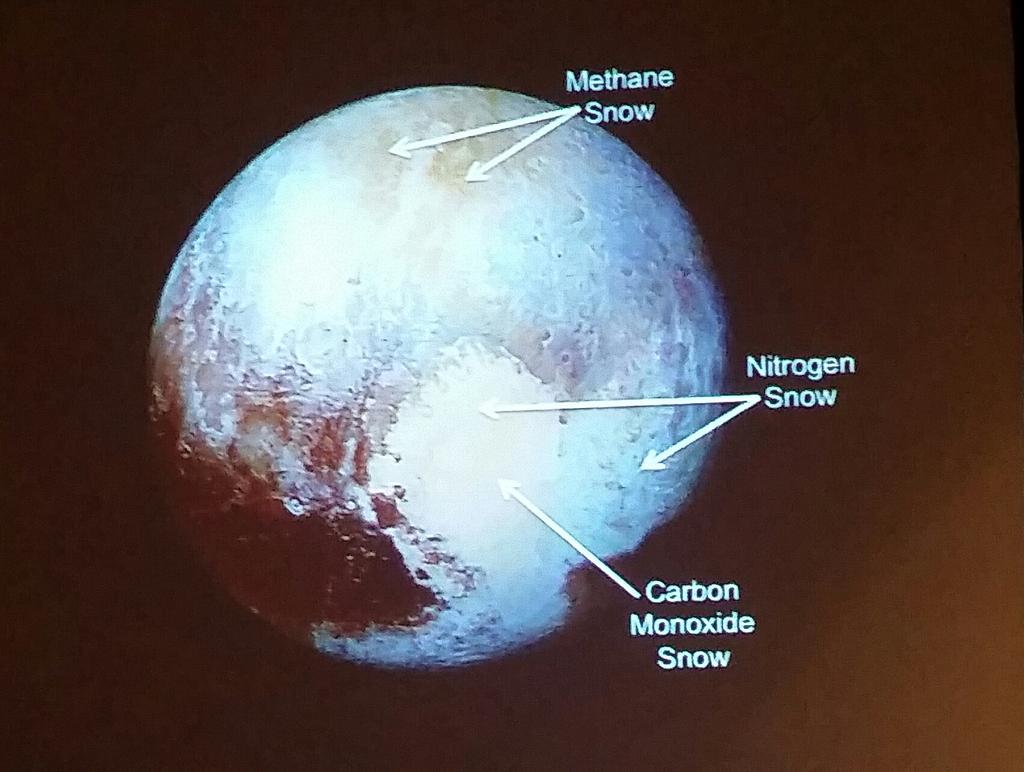
I was going to relate that Eskimos have 20 different words for snow, but now I see that's a controversial claim, involving a dispute over linguistic relativity.
But yeah I imagine that if we grew up on Mars and encountered both water and carbon dioxide snow, we might have two related but different words for snow.
Marchesk

Start FollowingSend a Message
- Other sites we like
- Social media
- Terms of Service
- Sign In
- Created with PlushForums
- © 2026 The Philosophy Forum