
Comments
-
On AntinatalismActually, an even better version of the time machine argument is that you don't create a separate time line unless you do time travel and step on a prehistoric butterfly. If you do, then you've automatically duplicated humanity's sufferring (on average - history might go a bit differently).
So would you create another world of human history? -
On AntinatalismKeeping in mind, of course, that effective, reasonably priced, and widely available contraception - a prerequisite for anti-natalism - wasn't available until about 60 years ago. — T Clark
Okay, but you take some back with you, or bring a doctor to sterilize. With their consent after you've convince them, naturally. No reason to not start things unethically. -
On AntinatalismIt is too late to be antinatalist. If one were going to nip child-bearing in the bud, one would have to have been actively promoting antinatalism to the immediate descendants of Homo Erectus. The day we became Homo sapiens -- hundreds of thousands of years ago -- was the day you should have been out and about preaching antinatalism. Now with 7.2 billion people, it is just too late. It is impossible to convince 7.2 billion people of ANYTHING. — Bitter Crank
That leads to a thought experiment. Say you stumbled across a time machine in your neighbor's garage, activated it and found yourself among the first modern human beings. You're also aware that like the Avengers, you can't actually change the future, you can only effect a different timeline. So here you are with the first humans, who naturally think of you as the great ancestral spirit come to give them advice. Now's your chance to preach antinatilism, which will be so persuasive that it works.
Do you convince them to not have kids knowing what's in store for the human race? Granted it's different time line but still good likelihood for war, genocide and capitalism. Also, reality tv.
The question is has it been worth it? Now that we're here, we make the best of it. But if you're Captain America, do you skip Peggy Carter and go back to talk the first humans out of procreating, so all the terrible things in history are avoided? Or do you think that hundreds of years of slavery are worth your doppleganger's enjoyment of sipping on some wine while watching The Bachelor? -
Neurophenomenology and the Real Problem of ConsciousnessI think it's worth asking why are people who think that there's an "explanatory gap" likely to accept explanations that are "mapping between rich conscious descriptions and brain processes"? — Terrapin Station
Because many of them like Chalmers want a science of consciousness where it's taken seriously, and they think there is a strong correlation between brain activity and consciousness, so it would be informative to map that out. Also, I think philosophers like Chalmers would change their mind on the hard problem if science showed them a way the gap might be explained.
Presumably, proponents of the hard problem became convinced there was a gap because of arguments in favor of a gap, so they could become unconvinced. That's how it should work. We should change our views when good arguments/evidence become available. -
Seeing things as they areAs Kant noted, all we can reference is the phenomena, that which we perceive. We cannot even coherently discuss the noumena or the things in themselves. It makes no sense to ask what something really looks like without referencing what I subjectively see it to look like. — Hanover
But yet somehow we can come up with the wavefunction and talk about black holes and quarks. -
Are philosophical problems language on holiday?To say that there are no independent things is to say there are no distinctions, then why is my mind full of distinctions? — Harry Hindu
Exactly. A mind-independent world makes sense of the variety of experiences we have, including having a body moving about in a world with many other things, people and animals in it. Also, it accords with science which doesn't put human beings at the center of everything.
We've only been around for a short while, and we only occupy a small space. The world is much bigger and older than us. -
Are philosophical problems language on holiday?We cannot say what the wave function "really is" any more than we can say what a tree "really is" above and beyond our experience of, and thoughts about, it. — Janus
But people do guess at what it is. Thus the different interpretations of QM, and someday a clever experiment might provide evidence in favor of one of them.
Are we really going to say for example that Bohm's pilot wave theory or the Many Worlds Interpretation are meaningless just because nobody has figured out a way to test them?
I would suggest that at the border of accepted physics were new theories are being churned out before they can be put to the test, you will find metaphysics. -
Are philosophical problems language on holiday?More on really's role in language.
He seems like he cares. But does he really? Maybe he's just pretending and only cares about himself.
The stick looks bent in water, but is it really? Maybe the water does bend sticks. Or maybe the light is bent by the water.
You say that humans couldn't have built the pyramids, but did ancient aliens really build stone structures on Earth? Or are you underestimating human ingenuity?
Really's role is to question the potential difference between how something appears to be, or is said to be, and how it is.
The temptation here might be to say there is no "how it is", only how things appear to be. But that raises problems. For one, it means we can't say whether the stick is bent by the water or the light is refracted. For another, we can't explain why there are discrepancies in appearance.
If there is no "how it is", then there should never have been a question of appearance versus reality. -
Are philosophical problems language on holiday?So given all that, what is your response to the Wittgenstein approach that metaphysics is an abuse of language? That the Greeks used nouns for everything and we have a tendency to view concepts as things?
-
Are philosophical problems language on holiday?@Banno @Janus "Really"
Let's take three medieval monks discussing the Lucretius' poem on atomism. One defends the atomistic metaphysics, arguing that the world is really made of atoms and the void, a second is skeptical, saying it doesn't appear that way, atoms aren't part of our experience. And a third, being a pre-Witty Pyrrhon skeptic says the discussion is bunk, because we can't know any metaphysical truths.
Turns out the atomists were basically correct, at least regarding ordinary matter. So the discussion was meaningful. Even the part about atoms "swerving" randomly has its parallel in quantum indeterminism.
From this, we might be led to conclude that metaphysics is meaningful if future science either confirms or falsifies the basic ideas of said metaphysics. -
Are philosophical problems language on holiday?the wavefunction is theoretical, but so were atoms at one point. This becomes a question of scientific realism. If the wavefunction is only theoretical, then what is it that causes in these experimental results?
-
Are philosophical problems language on holiday?then how does physics work? I certainly don’t experience the wave function.
-
Are philosophical problems language on holiday?Notice that these are physical issues, not metaphysical. — "Banno
Yes, but they weren’t always. -
Are philosophical problems language on holiday?physics places limits on what we can know, while allowing for the world beyond our knowledge. A good example is the universe beyond our light cone. We know the universe is bigger than our light cone, but we can’t know anything specific about that region of space.
-
Are philosophical problems language on holiday?I understand your line of reasoning, but yes I can still understand Wayfarers statement as it’s possible that we’re limited in our investigation of the world as it appears to us.
It’s the same thing as saying it’s intelligible that there could be things we can’t know about. We’re only human. -
Are philosophical problems language on holiday?The world is like chairs and desks and particles and space. What is it that remains a puzzle? — Banno
The world is also like the sun moving through the sky on a flat, stationary land at the center of the cosmos. What remains a puzzle?
The puzzle is the difference between how the world appears to us and how it is. -
Are philosophical problems language on holiday?It's perhaps only metaphysicians that get confused into thinking we can't. — Banno
The issue here isn't whether we language is practical. The issue comes up when you take your first physics class and learn that the world is a lot stranger than everyday experience would suggest. But this goes all they way back to noticing the appearance/reality distinction that got people asking metaphysical questions.
So I think this sort of dissolving is missing the point. I want to know what the world is like, not whether ordinary concepts are useful. Of course they are and we can continue to talk about and move chairs regardless of the physics.
And that would be true if we lived inside the Matrix. But it would completely miss the point when we're asking what sort of world we live in. -
Are philosophical problems language on holiday?But I think you want to say something deeper... — Banno
We're moving about a single chair, and some annoying shit wants to point out that since the chair is made up of molecules, and those molecules don't have a determinate boundary, that we can't say exactly which molecules make up the chair. So there are 1 million chairs for each different collection of molecules that could make up the chair.
But that's a problem since we're only moving one chair. The deeper issue is that our use of "chair" includes a determinate boundary where we can clearly say it's a single chair. But the physics makes the boundary indeterminate. So we have a conflict with how we use chair and it's physical constitution. -
Are philosophical problems language on holiday?But there is no incompatibility here. We can talk about the chair in terms of moving it around the table, and then in terms of it's chemistry. We are still talking about the chair. — Banno
We can, but then some pedantic person might point out that the chemistry entails the possibility that we're moving about more than one chair, since the molecules making it up don't have clear boundaries. -
Are philosophical problems language on holiday?The concept 'existence' applied to 'chairs', or 'molecules' or 'gods' implies nothing other than the functional utility of those concepts which varies according to context and user. — fresco
Going back to this particular sentence. Many religious believers do not understand God or gods existing as fulfilling some functional utility, anymore than they think that about other people existing. I speak as a former believer.
Some more nuanced or philosophically inclined religious believers might phrase things along those utility lines where God is inside us or some principle of the universe, taking into account the lack of empirical supports for gods. But your average believer, to the extent they believe, probably think in terms of God as existing like a person. -
Are philosophical problems language on holiday?And there are words like molecules and quanta. — Banno
Yes, and these have a more technical use than chairs and tables. -
Are philosophical problems language on holiday?Unfortunately I have a bad habit of editing after I post instead of taking the time to reread and edit beforehand. So you quoted something I replaced, but that works.
-
Are philosophical problems language on holiday?Okay, so there is how we use words like chairs and tables.
-
Are philosophical problems language on holiday?SO is a concept something in the brain - or should I say mind - that is different to the word and the thing? — Banno
This is difficult question, because we might want to locate concepts in culture. Being pedantic, I wanted to differentiate between the sounds we say or print and the meaning they denote. But our ability to understand and generate concepts is definitely in the brain (or mind). -
Are philosophical problems language on holiday?OK, now to get bit pedantic. You've given me the difference between "democracy" - the word, note the quote marks - and democracy - the thing. — Banno
Being pedantic here, I understand "word" to be the symbolic form we use in some language to denote the meaning which is also the concept, and in order for there to be concepts, which although social in nature, depends on having brains that can cognate (form concepts). -
Are philosophical problems language on holiday?Let's look at... democracy. How does the concept of democracy differ from democracy? — Banno
One is a word that has meaning and the second is the actual political organization that some countries use in a mixed manner which the word is about.
Or... how does the concept of 2 differ from 2? — Banno
That is a tricky question. Two things or mathematical two? -
Are philosophical problems language on holiday?What sort of thing is a concept? — Banno
I don't know a good definition. It's a way our cognition organizes our experiences into understandable units, I guess. So the world is full of objects and events that we can recognize and do useful things with, such as survive. -
Are philosophical problems language on holiday?No, I see them as problems with our conception of ordinary objects which philosophical inquiry and science reveals.
Consider the notion of material solidity of ordinary objects before atomic theory was accepted. Take a standard materialist arguing against an atomist. It's clear our everyday notion of solidity did not include particles and space. -
Are philosophical problems language on holiday?That's not the only funciton exists serves. Consider the question whether life exists elsewhere in the universe. That's not a functional question. It's asking whether we're alone.
Anyway, I've always understood exists in ordinary language to mean whether something is real. Do dragons exist, no. Do dinosaurs? They did in the past. Elephants? Yes, today they exist. What about life on Mars? We don't know, but it's a possibility, either now or sometime in the past. -
Are philosophical problems language on holiday?When the physicist tells us that the chair is made up of particles and space, he is making a statement about the chair. So yes, our notion of normal objects fits with their being made up of particles and space. — Banno
So then there should be no paradoxes from fitting our notion of normal objects with what the physicist tells us. -
Are philosophical problems language on holiday?The notion of real has been misused here. — Banno
However, notice the difference if someone asks whether the world consists of pictures, like we might ask whether the universe is populated by ordinary objects. In this context, the meaning of real is contrasted with that of appearance.
When the question is asked, "Do ordinary objects like tables and chairs exist?", the question is asking whether our conception of normal objects fits with being made up of particles and space. -
Are philosophical problems language on holiday?Good that you're trying to argue with me when you're not even understanding and don't particularly care about what I'm saying, haha. — Terrapin Station
You're an ass. -
Are philosophical problems language on holiday?You ignored clarifying if you're claiming that and tried to redirect. — Terrapin Station
I'm not saying anything about what scientists said. Jesus man! This is an issue in metaphysics.
Some philosophers noticed that our concepts of ordinary objects result in paradoxes when combined with our scientific understanding, leading to a metaphysical discussion of whether ordinary objects exist as we conceive them. -
Are philosophical problems language on holiday?orget trying to support the claim that philosophers are perpetuating a particular misunderstanding of science rather than computer techs etc. who like to talk about philosophy online. — Terrapin Station
I supported the claim with links to philosophical sources, not computer techs talking about philosophy. You can do a Google search yourself if you're not satisfied.
The issue isn't one of misunderstanding science, btw. -
Are philosophical problems language on holiday?Are we changing the subtopic from whether it's philosophers who are misunderstanding what science is doing? — Terrapin Station
The subtopic is whether philosophy questions, particularly metaphysical ones, but could also are an abuse of language. -
Are philosophical problems language on holiday?ol - in other words, you stated it as if there's some implicational relationship, but there isn't. — Terrapin Station
Let me give an example. Here is an image of ancient Hebrew cosmology:
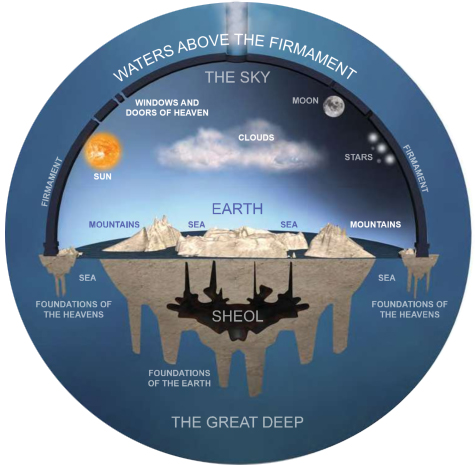
Now given what we know from science, do the waters above the firmament exist? If human beings get things like that wrong, isn't it possible that our notion of everyday objects is also mistaken?
Let's be clear what is being claimed. It is not that the chair-stuff doesn't exist, only that our concept of a chair does not map onto the physical reality. -
Are philosophical problems language on holiday?
https://plato.stanford.edu/entries/problem-of-many/
https://www.youtube.com/watch?v=C-h6L-pBG7o
https://people.umass.edu/lrb/files/bak08metM.pdf
Why would you even doubt something so easily proven? Do you require more links? -
Are philosophical problems language on holiday?Huh? What do the two have to do with each other? — Terrapin Station
Ontology. -
Are philosophical problems language on holiday?What I said was that anyone who thinks this is a problem doesn't understand what science is doing. — Terrapin Station
I think they understand well enough. The question is whether they properly understand what language is doing, and whether focusing on language can dissolve this inquiry.
Marchesk

Start FollowingSend a Message
- Other sites we like
- Social media
- Terms of Service
- Sign In
- Created with PlushForums
- © 2026 The Philosophy Forum