
Comments
-
PROCESS PHILOSOPHY : A metaphysics for our time?
The Ontological problem may be insoluble, but that doesn't stop us "silly phillies" (amateur philosophers) from trying to solve the problem of existence. For most people, for most of the time, the ultimate answer to "God, the Universe, and Everything" is elliptical . . . . Brahman . . . . God . . . . Multiverse . . . . 42. So they just presumed that some unknowable physical thing or metaphysical force is out there in the dark creating worlds.I don't see how this could solve the problem*1. Isn't it the case that information, or "EnFormAction", is itself a property of something, a system or something like that. So it doesn't really solve the problem, it defers it. You simply replace one property (energy) with another (information). This is similar to replacing the property of motion with the property of energy. In one context we would say that the thing has motion, but in another context we'd replace "motion" with "energy", and say that the thing has energy. Likewise, you now replace "the thing has energy" with "the thing has information". But you do not solve the problem of there needing to be a thing which has the said property. — Metaphysician Undercover
In the early 20th century, Astronomers attempted to trace causation back to its source, and their physical First Cause was a mathematically-infinite Singularity, which some wag dubbed the "Big Bang". Which again was elliptical : where did the Energy & Laws manifested in the explosive emergence of the observable elements of the universe come from? . . . . eternal God or infinite Multiverse . . . . ?
I suppose that most philosophical "problems" can be resolved by further analysis (what are its elements?) or by rational generalization (who or what caused it?). Both approaches eventually reach a point of diminishing returns. In which case we make a leap of inference across the chasm of ignorance. So, Whitehead assumed that some ultimate source of order, structure, and novelty in the world was a God of some kind, which he defined as the "actual entity". In my own little thesis, I also punt and say "G*D did it"*2. :grin:
PS___ I won't go into detail here on the Information is Energy concept that is currently being processed by cutting edge science. Here's a link to a book on that topic :
https://link.springer.com/book/10.1007/978-3-658-40862-6
*1.
Note A --- Kant defined (but did not explain) the appearance/substance problem in terms of Noumena and Phenomena. Do you have a better explanation?The basic problem of process philosophy is to explain why processes, activities, appear to us as substantial objects. This problem forces Whitehead to employ mysterious concepts like concrescence, and prehension, which generally imply a form of panpsychism. — Metaphysician Undercover
Note B --- My version of Panpsychism (all mind) is it's all Information/Causation (Mind/Energy) . . . everywhere all the time. Energy is not a thing, but a process. Can you wrap your mind around that?
*2. G*D :
An ambiguous spelling of the common name for a supernatural deity. The Enformationism thesis is based upon an unprovable axiom that our world is an idea in the mind of G*D. This eternal deity is not imagined in a physical human body, but in a meta-physical mathematical form, equivalent to Logos. Other names : ALL, BEING, Creator, Enformer, MIND, Nature, Reason, Source, Programmer. The eternal Whole, of which all temporal things are a part, is not to be feared or worshiped, but appreciated like Nature.
I refer to the logically necessary and philosophically essential First & Final Cause as G*D, rather than merely "X" the Unknown, partly out of respect. That’s because the ancients were not stupid, to infer purposeful agencies, but merely shooting in the dark. We now understand the "How" of Nature much better, but not the "Why". That inscrutable agent of Intention is what I mean by G*D.
https://blog-glossary.enformationism.info/page13.html -
PROCESS PHILOSOPHY : A metaphysics for our time?
Yes. But, in my personal philosophical thesis, Enformationism, Energy is a property/qualia of generic Information (the power to transform, or to cause change). Again, Information (or EnFormAction as I call it) is not a material Thing, but a Process and a relationship : cause/effect. The primary property of Whitehead's Process is Causation*1."Energy" is a property, it is not something independent. We can speak about energy as if it is causal but we still have to account for the thing which the energy is a property of. That's why the problem is ontological. — Metaphysician Undercover
In my thesis, a more general term for evolutionary causation is Enformy*2 (negentropy). Which again is not a thing, but a quality of the process labeled by scientists as "Thermodynamics". We humans observe the effects of the metaphorical flow of Energy, and infer an unobserved ultimate source or spring. Which philosophers may label as the Ontological Cause. Some call it "God", but Plato referred to the Source as "Logos" (reason), and Aristotle described it (a non-thing) as "The Unmoved Mover".
Yet Plato's ontological origin of Being was the mysterious potential state of "Forms"*3. Which is also the root of "Information" and "EnFormAction". Form is the logical structure of an object of scrutiny, as distinguished from its material substance. :smile:
*1. Causality :
Alfred North Whitehead, a mathematician and philosopher, believed that causality is a fundamental aspect of experience.
https://www.google.com/search?client=firefox-b-1-d&q=a.+n.+whitehead+causation
*2. Entropy vs Enformy :
A quality of the universe modeled as a thermodynamic system. Energy always flows from Hot (high energy density) to Cold (low density) -- except when it doesn't. On rare occasions, energy lingers in a moderate state that we know as Matter, and sometimes even reveals new qualities and states of material stuff, such as Life .
The Second Law of Thermodynamics states that, in a closed system, Entropy always increases until it reaches equilibrium at a temperature of absolute zero. But some glitch in that system allows stable forms to emerge that can recycle energy in the form of qualities we call Life & Mind. That glitch is what I call Enformy.
https://blog-glossary.enformationism.info/page8.html
*3. Plato's theory of forms is an ontology, or theory of being, that posits the existence of a Realm of Forms that is independent of human experience. Plato believed that the physical world is a shadow of the Realm of Forms, and that knowledge of the Forms is the only true knowledge.
https://www.google.com/search?client=firefox-b-1-d&q=plato+forms+ontology -
PROCESS PHILOSOPHY : A metaphysics for our time?
That phrase caught my eye, so I Googled "democratic dogma". It seems to be true that a democratic society cannot function without Truths-Facts-Principles handed-down from above. That's because the masses, as noted by Plato, are not philosophers, hence incapable of deriving Universals from Particulars. So, the flocks are motivated and influenced by the Leading Lights of their society. When those influencers go off the doctrinal deep end (MAGA), the sheep are bound to follow. :smile:Biggest problem with Dogma is that it can't die in a democratic setting, it is required to reign in control of the masses. — DifferentiatingEgg
The Degradation of the Democratic Dogma :
Adams argues that democracy has been corrupted by the rise of capitalism and the concentration of power in the hands of a few wealthy individuals and corporations.
https://www.goodreads.com/book/show/745920.The_Degradation_of_the_Democratic_Dogma -
PROCESS PHILOSOPHY : A metaphysics for our time?
A scientific resolution of such "problems" is over my untrained head. But in my own amateur thesis, the commonality between Processes (energy ; causation) and Objects (matter ; substance) is generic Information (the power to enform). I won't go off-topic on that notion in this thread, but my thesis and blog go into some detail, if you're interested in such unorthodox speculations. Basically, the post-Shannon understanding of "Information" is both Noun (objects) and Verb (processes). It's both causal Energy and sensable Concrescence.↪Gnomon
The basic problem of process philosophy is to explain why processes, activities, appear to us as substantial objects. This problem forces Whitehead to employ mysterious concepts like concrescence, and prehension, which generally imply a form of panpsychism. — Metaphysician Undercover
Panpsychism has become fairly popular among modern philosophers. But I tend to agree with Whitehead's associate, Charles Hartshorne, to view the world-mind in terms of PanEnDeism. From this perspective the world-creating mind-process is both transcendent and immanent, but not in the sense of Judeo-Christian theology. :smile:
As systems theory is currently practiced, it is primarily substance-based. But on the fringes of systems science, Information-based*1 holistic theories are emerging. I happen to find them generally compatible with Process Philosophy. Again, that is off-topic, and would be a contentious concept for a thread of its own. :smile:This leaves systems theory as substance based, and inadequate for understanding process philosophy. — Metaphysician Undercover
*1. What is complex systems science? :
It presents many foundational topics such as networks, scaling laws, evolution, and information theory, along with a complexity theory based on a universal statistical mechanism.
https://www.santafe.edu/what-is-complex-systems-science -
PROCESS PHILOSOPHY : A metaphysics for our time?
It's not a disagreement, but a distinction between worldviews. Newton and Aristotle have their place in philosophy and science, but Whitehead was trying to show a different way of looking at the world, that might resolve some of the apparent paradoxes of the New Physics.I would agree with your disagreement with Newton and Aristotle in fsvor of Kant and Whitehead, although Descartes was right to say matter was extension. Matter is spirit; in fact, matter is Love. God is the mind of it all. Do you know Teilhard? — Gregory
Teilhard deChardin and A.N. Whitehead came from different religious backgrounds, but reached similar philosophical conclusions about how the world was teleologically evolving. Apparently, "both were influenced by Bergson's temporal metaphysics", where "time is a dynamic flow in which past, present, and future are intertwined". My understanding of such notions is superficial, but I can agree with them in general. :smile: -
PROCESS PHILOSOPHY : A metaphysics for our time?
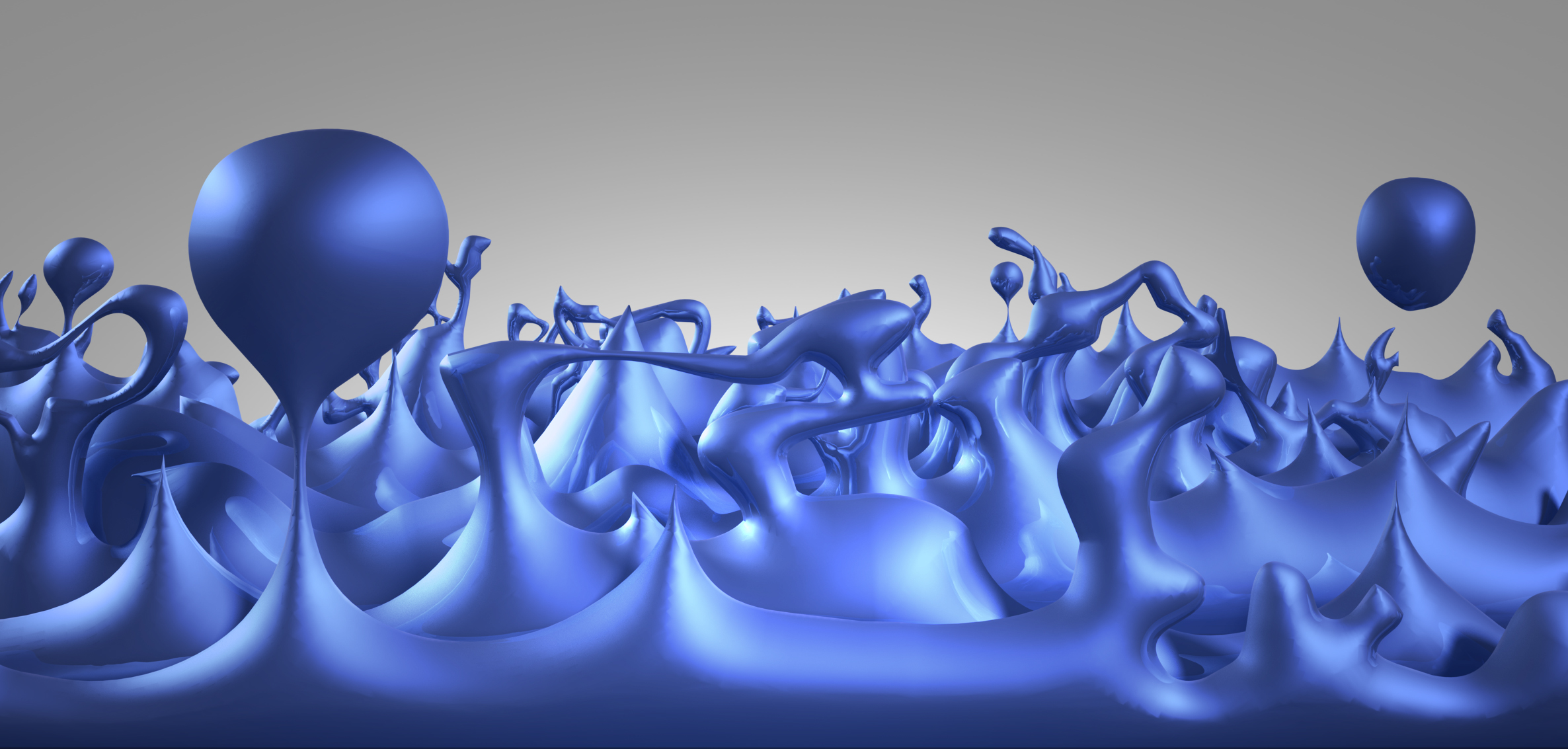
This stanza reminds me of descriptions of Quantum Foam, where waves of energy meet and produce peaks that we interpret statistically as particles of matter (substance). But their existence is fleeting, as the local disturbances move-on and vanish without a trace. The only stability is in probability, that allows some particle partners to dance together for a period of time. :smile:What we call things are but the meeting place
Where different systems cross in time and space;
The dance between them is what truly lasts,
While substance slips away without a trace. — PoeticUniverse
-
What exactly is Process Philosophy?
Why do you bother to respond? You seem to be offended by Whitehead's ideas, as you mistakenly interpret them. in the next post says: "you're asking the wrong question". But I think it's a proper question to ask of any worldview*5, but based on erroneous assumptions.I don’t know why I bother responding when it’s evident you know nothing of which you speak. — Darkneos
I took the OP as a sincere attempt to obtain help in understanding the unorthodox philosophical worldview of an acknowledged genius, whose "magnum opus" is over the heads of most of us mortals. But instead of a philosophical dialog, this thread has become a political diatribe, on a work that you admitted you don't understand*1. Ironically, you portray Whitehead as an idiot who didn't understand Quantum Physics in the manner you prefer. And you have haughtily & sarcastically rejected all proffered opinions that don't match the world model that you are looking to support. Of course, Whitehead had little influence on modern Science, because his philosophy is mental (hypothetical) instead of material (pragmatic).
I don't know how you would characterize your personal worldview, but it sounds like matter-based Scientism (what you see is all there is), which would indeed be in opposition to Whitehead's process-based worldview. Your my-way-or-the-highway prejudice might be better served by posting on a Science forum. However, at least one poster on Philosophy Stack Exchange seems to share your literalistic mis-understanding of Process Philosophy*3. Pioneering sub-atomic physicists*4 were forced to describe the non-classical paradoxes of quantum physics in terms of metaphors, which those coming from a classical background may interpret literally and materially. FWIW, a human is not "just processes" (on-going life), but also a person (body & mind), worthy of ethical treatment.
If you would like to share philosophical opinions on interpretations of Whitehead's work, instead of denigrating them, I'm open to continuing this thread. But I suspect that some TPF posters have already been turned-off by the political us-vs-them antagonism. Most of us are not scientists, and don't offer scientific opinions. :cool:
*1. What does Process Philosophy mean exactly?
Sorry for the confusion but I guess it just highlights my lack of comprehension of the subject. I've met maybe two people who subscribe to it and seem to live regular lives, though when I asked them to explain they couldn't, which gave me doubts about it.
https://philosophy.stackexchange.com/questions/121885/what-does-process-philosophy-mean-exactly-and-the-ethical-implications-of-it
*2. Scientism is a philosophical position that claims science is the only way to obtain truth about the world. It's often used as a pejorative term to describe an exaggerated belief in the scientific method
https://www.google.com/search?client=firefox-b-1-d&q=scientism+philosophy
*3. I would think just seeing “things” as processes would shift the morality for folks since there wouldn’t be any reason to treat “others” well since they’re just processes. The same would go for human relationships as well. ___ Boltstorm
https://philosophy.stackexchange.com/questions/121885/what-does-process-philosophy-mean-exactly-and-the-ethical-implications-of-it
*4. Alfred North Whitehead and Werner Heisenberg were thinkers in different fields, but their work is connected in the realm of quantum mechanics and the nature of reality.
https://www.google.com/search?client=firefox-b-1-d&q=whitehead+and+heisenberg
*5. Whitehead's Moral Philosophy :
Belaief depicts Whitehead’s view as a self-realizational ethics which reconciles the conflict between the individual interest and the general interest by appeal to morally preferable "true self-interest."
https://www.religion-online.org/article/whiteheads-moral-philosophy/ -
What exactly is Process Philosophy?
I'm beginning to see why Whitehead's process philosophy bothers you so much. He seems to have formulated a worldview that is closer to that of indigenous people around the world than to western science & physics. It's based on cycles & flux instead of linear time & static things.Do you not think it’s dehumanizing because according to process philosophy humans don’t exist? Because that’s my point pretty much. — Darkneos
My background was in the western traditions of both religion and science. But in my later years, I am trying to understand other ways of viewing reality. I'm currently reading a book written by a British quantum physicist, David Peat, who has studied the cultures of indigenous Americans (I'll call them Indigians instead of Indians). He says "our western minds desire to sort things out, to arrange knowledge in a logical fashion and order the world into categories. . . . it is not so much the questions themselves that are the problem, but the whole persistent desire to obtain knowledge through a particular analytical route".
He seems to find some commonalities between his sub-atomic world-model and the worldview of non-western humans. Just as quantum entities have properties of both waves and particles, human persons are both individuals and immersed in larger Holistic systems. He notes that "quantum theory stresses the irreducible link between observer and observed and the basic holism of all phenomena". That may sound like nonsense or BS to you. But it makes sense to some professional physicists --- admittedly a minority --- such as David Bohm ; whose notion of Implicate and Explicate orders of reality is not accepted in mainstream science. Probably because it is more philosophical than scientific, more holistic than analytic.
In Peat's book, he compares the two worldviews by noting that "in modern physics the essential stuff of the universe cannot be reduced to billiard-ball atoms, but exists as relationships and fluctuations at the boundary of what we call matter and energy". Also, in Whitehead's Process and Reality, he prefaces his Gifford lectures with "these lectures will be best understood by noting the following list of prevalent habits of thought, which are repudiated, in so far as concerns their influence on philosophy : 1. The distrust of speculative thought". You may consider Indigians to be ignorant savages, but Peat finds their holistic science to be compatible with his own non-mechanical, probabilistic Physics.
Apparently, your "habits of thought", and to some degree my own, make it difficult to understand the non-classical non-western holistic worldview of Quantum Physics and Indigenous peoples. Richard Feynman expressed his own "distrust of speculative thought" by advising his students to "shut-up and calculate". But this is supposed to be a Philosophy forum, in which speculative thought is de rigeur. So, if you find Whitehead's speculations to conflict with your Newtonian classical worldview, perhaps you should ignore the meaning & implications & ethics of Process philosophy, and stick to calculating abstract countable values. :wink:
Alfred North Whitehead (1861-1947) believed that humans are part of a fabric of reality that includes nature.
https://www.google.com/search?client=firefox-b-1-d&q=whitehead+human+existence
Whitehead's theory of human personhood is formulated within the fabric of his highly original western metaphysical vision. Rejecting the Aristotelian doctrine of substantive being, Whitehead embraced instead an ontology of becoming that sought to categorize the things of this world within a naturalistic continuum. . . . . The focus of this paper is personal selfhood and personal identity in the philosophy of Alfred North Whitehead.
https://www.bu.edu/wcp/Papers/PPer/PPerYong.htm -
What exactly is Process Philosophy?
I can't say with any authority, what Whitehead's "point" was. But my takeaway is that he was inspired by the counterintuitive-yet-provable "facts" of the New Physics of the 20th century --- that contrasted with 17th century Classical Physics --- to return the distracted philosophical focus a> from what is observed (matter), to the observer (mind), b> from local to universal, c> from mechanical steps to ultimate goals. Where Science studies *percepts* (specifics ; local ; particles), the New Philosophy will investigate *concepts* (generals ; universals ; processes). The "point" of that re-directed attention was the same as always though : basic understanding of Nature, Reality, Knowledge, and Value*1.So, what is the point of 'Process Philosophy'?
What are its ethical implications? Or any other kind, for that matter? — Amity
Our senses & intuitions are "tuned" to macro-scale Newtonian mechanics. Which is why quantum things & processes seem weird. During the 19th century, Physical Science had been very successful in allowing one species to take control of their environment. Consequently, the pragmatic victories scored by Matter-manipulating Physics & Chemistry, had put theoretical Philosophy in a bad light. And, when their former role as the captains of academia diminished in market value, philosophers began to suffer from "lab coat envy". Consequently, today, on this very forum, speculative & argumentative philosophy is often disparaged as useless, unless it can point to empirical evidence. Many TPF posters seem to have taken the attitude : if you can't beat them (science) join them (Scientism).
On the other hand, Whitehead seemed to envision, in the light of quantum physics, a new direction for Natural Philosophy. Instead of continuing the ancient quest of Atomism (the ultimate particle of matter), philosophers should now turn their attention to Wholes instead of Parts. From this new/old perspective, the Cosmos is not just a swirling mass of matter/energy, but an evolving process metaphysically moving toward some future state. Exactly what that Omega Point might be is of course unknown, but its direction can be inferred from the trajectory of its history.
Modern materialistic Science has been superbly successful in wresting control of Nature for the benefit of a few featherless big-brain bipeds. But Metaphysical Philosophy is not concerned with such practical matters. Instead, it studies intellectual questions of Meaning & Value. By contrast, Science per se is not interested in Ethics other than Utility : such as the very successful Atom bomb project, aimed at annihilating cities. So, the Ethics of Science*2 seems to be a philosophical endeavor tacked-on after the fact : as when Oppenheimer lamented, "I have become Death, destroyer of worlds".
Whitehead's philosophy can be labeled as Spiritual*3 (intellectual instead of physical) in the sense that it recognizes invisible forces & fields*4 at work in the world. But, unlike the traditional scientific notion of local cause & effect, he speculates on universal causes that control the direction of Evolution. So, whatever Ethics is associated with Process Philosophy will be global in its effects, and teleological in its aims. :nerd:
*1. Point of Philosophy vs Science :
# Science deals in evidence while philosophy deals in arguments
# Science looks for empirical knowledge and facts, while philosophy often focuses on abstract ideas and values
# Science is about descriptive facts; philosophy is often about that, but is also about normative and evaluative truths
# Science looks at what is, while philosophy looks at why it exists.
*2. Ethics of Materialism :
Materialism is a philosophy that prioritizes material things over spiritual or intellectual ones. Materialistic ethics are ethical theories that are based on the idea that the only things that exist are matter, energy, and physical forces.
https://www.google.com/search?client=firefox-b-1-d&q=ethics+of+materialism
Note --- By contrast, Process Philosophy understands that whole systems also exist as the "more than" matter. The whole is more than the sum of the parts.
*3. Ethics of Spiritualism :
The ethics of spiritualism are a system of moral philosophy that considers the relationship between evolution and the existence of the human spirit after death. Spiritual ethics can also refer to the principles that guide how people use their spiritual beliefs and practices in the world.
https://www.google.com/search?client=firefox-b-1-d&q=ethics+of+spiritualism
Note --- Unlike theological religions, Whitehead's philosophical theology was not primarily concerned with an afterlife, but in our evolutionary adaptation to the evolving world.
*4. Quantum Fields are philosophical theories tacked-on to the new physics, when the long-sought ultimate particle remained elusive, and the inter-relationships of entanglement became undeniable.
"Quantum fields are not made of anything as far as we know. They just exist in the universe based on quantum field theory." https://www.quora.com/What-are-quantum-fields-made-of-and-when-were-they-formed -
What exactly is Process Philosophy?
seems to have a thing about Things, and dismisses Processes that are not things. I'm not sure where he's coming from, but a focus on Substance seems to be inherent in Materialism : "what it is instead of what it does". Based on my experience on this forum, the antithesis of Materialism may be Spiritualism : the obvious building blocks (Substance) of the world versus the invisible causal power (Change ; Evolution) in the real world.But to write it off as a process just makes it seem like it's not a human being, an entity, or a thing. It's nothing, because processes involve things but aren't things themselves. — Darkneos
Fine, so what is the fundamental static substance on which these processes run and operate? Is it like little solid balls or objects like the atoms of Democritus? — punos
Ironically, the ancient Atomists imagined the fundamental elements of reality as tiny balls of hard stuff, but they reluctantly added the non-stuff Void in order to allow Atoms to move and change form. But then the question arises : what Force holds minuscule atoms together in the macro scale objects that our senses perceive?
For Democritus, the material Atoms were viewed as more real than the Void (empty space). Yet, he didn't seem to have a concept of our modern notion of Energy or Forces, and motion was just taken for granted. So, his worldview was basically rigid, static & geometric instead of fluid, dynamic & amorphous. However, modern science has been forced to make allowances for immaterial Forces that move things around and hold them together.
Apparently Whitehead was intrigued by the importance of the non-things of the world, as exemplified in Quantum Physics. So, his focus was on Change & Causation (becoming) instead of just plain Being. I find it surprising that the OP questioned the Ethical implications of Process theory (subjectivity?), presumably as contrasted with the Ethics of Objects (objectivity). Apparently, Materialists interpret Process philosophy as a non-sensical (immaterial) religious & spiritual worldview. I can see the spiritual & theological implications*1, but I'm not aware of any practical religion based on the Process Theory.
I was inspired by this thread to dig deeper into Whitehead's philosophy, that seemed to be be compatible with my own non-religious worldview --- which was also based on the New Physics of quantum theory, plus the New Metaphysics of Information theory --- not on any particular religious tradition. I call that worldview Enformationism, as an update of both Materialism and Spiritualism, that have been scientifically outdated since the 20th century. Now I have uploaded a new post to my blog, as a brief summary of how Process and Reality compares with Enformationism. If you can find the time to read and review the two-page essay*2, I'd appreciate any constructive criticism you can offer. :smile:
*1. "Process and Reality" is a philosophical work by Alfred North Whitehead that explores the concept of reality as a dynamic, interconnected web of "actual occasions" where everything is constantly becoming, essentially presenting a spiritual perspective that views the universe as a process rather than a static structure; this is often referred to as "process philosophy" or "philosophy of organism."
___ Google A.I. Overview
*2. Evolutionary Process and Cosmic Reality :
"Alfred North Whitehead’s book, Process and Reality, is a philosophical thesis, not a scientific essay. But it challenges the philosophical implications of Darwin’s mechanistic theory of Evolution. Instead of a simple series of energy exchanges, the Cosmos functions as a holistic organism. Hence, the eventual emergence of subordinate living creatures should not be surprising."
http://bothandblog8.enformationism.info/page43.html -
What exactly is Process Philosophy?
may be just playing dumb, in order to troll forum posters who are dumb enough to take the bait : "I don't understand, and you're not smart enough to explain it to me".Probably true, but i would need to really understand where you're coming from to make any headway. Although its not my job to make you care, and i don't care if you care or not. I'm simply entertaining myself. — punos
Apparently, the "it" is some arcane ethical wisdom in Process and Reality. But I didn't take-away any particular ethical principle from the book, other than to be open to change in a dynamic world. He seems to be looking for a Process guru --- which I am not --- to reveal some abstruse Truth. It shouldn't take a genius to know that our world evolves, both physically and ethically. The Golden Rule never changes, but the evolving nature/culture does.
I did find this thread to be "entertaining", in the sense that it gave me incentive to get deeper into Process Philosophy, and to understand how it applies to my own personal worldview : where I'm coming from. Dark's dumb act just led me deeper into the rabbit-hole of a Reality that won't stand still for me to catch it. Like the Red Queen, you have to run faster & faster to avoid falling behind. :smile:
Process philosophy ethics is a school of thought that emphasizes the importance of change and becoming over permanence and being. It suggests that ethics and morality should be situational and adaptive, and that harmony can be achieved through evolving relationships
___Google A.I. Overview -
What exactly is Process Philosophy?
That's pretty sad. I suppose living in a dimly-lit world explains your choice of screen-name.So once again you don’t or rather can’t answer my questions. Seems like no one actually understands this enough to answer me. — Darkneos
I'm sorry you didn't get any enlightenment out of this thread. But after this review, I now think I understand much better Whitehead's philosophical interpretation of the unorthodox New Physics. Process Philosophy is amenable to my personal worldview, but obviously not to yours. You can lead a horse to quantum philosophy, but you can't understand it for him.
Since my immaterial mind was already open to the possibility of a combination of Quantum Physics and Metaphysics, I've enjoyed this one-sided dialog. Despite the frequent razzberries --- which I ignore as a sign of childish incomprehension --- this new outlook has brightened my day. :razz:
Process philosophy rejects the doctrine of scientific materialism and substance-based metaphysics that entities can only influence each other by means of external relations.
https://journals.sagepub.com/doi/10.1068/d13195p
PS___ Understanding anything new & different requires an open mind. But if you don't believe in a metaphysical Mind, you might take the metaphor of an open-mind literally, so it takes a jack-hammer to bounce new ideas off your skull. :cool:

PPS___ If it was not obvious, I've been using your original incredulous post as a quote to further my own end of understanding Process Philosophy. Not to answer your covert materialist put-down of metaphysical philosophy. I've had many dialogs similar to this, and they all end as they began, with the Materialist claiming victory over the ignorant Mentalist. :smile: -
What exactly is Process Philosophy?
Actually, although I am not an expert on Whitehead's philosophy, I did give you the same answer that the Physics Stack Exchange offered : the ultimate reality is Process not Substance*1. If your worldview is based on Materialism, that won't make sense. I also discussed some of the Ethical Implications of his theory. Yet again, the ethics of Materialism*2 would consider anything immaterial as just so much noise. :wink:You also never answered my original questions about it from my first post. All this you’ve posted is just noise. — Darkneos
*1. What does Process Philosophy mean exactly and the ethical implications of it?
"Process philosophy has as its fundamental ontological entity the process, not the substance. Hence process philosophy attempts to explain and to understand the phenomena from their interaction, their dynamics and their changing, not from an idealized static state."
https://philosophy.stackexchange.com/questions/121885/what-does-process-philosophy-mean-exactly-and-the-ethical-implications-of-it
*2. Materialism Ethics :
Materialists judged immoral acts done by the self and others more differentially. Materialists' preference for moral rules is more contingent on their self-interest.
https://www.sciencedirect.com/science/article/abs/pii/S0092656622000812
Note --- This definition sounds like Trump ethics : he who dies with the most gold, wins. -
What exactly is Process Philosophy?
Just as I suspected, from your line of questioning, you are more interested in Physics than Philosophy. I assume that the Physics Stack Exchange would give you more satisfactory feedback, that agrees with your orthodox belief system. However, the Philosophy Stack Exchange might give you a different perspective*1. But why bother with philosophy, when it only asks stupid questions and never produces anything useful : i.e. physical? :joke:↪Gnomon
gotta say your sources of Quora and google AI is a red flag. They don’t really understand it enough, physics stack exchange is a good one. It’s where I learned they are real and not in a probability sense. — Darkneos
*1. What does Whitehead mean by calling science anti-rational?
In Science and the Modern World, Whitehead writes:
Science has never shaken off the impress of its origin in the historical revolt of the later renaissance. It has remained predominantly an anti-rationalistic movement, based upon a naive faith. What reasoning it has wanted it has borrowed from mathematics which is a surviving relic of Greek rationalism, following the deductive method. Science repudiates philosophy. In other words, it has never cared to justify its faith or to explain its meanings; and has remained blandly indifferent to its refutation by Hume.
https://philosophy.stackexchange.com/questions/36955/what-does-whitehead-mean-by-calling-science-anti-rational?rq=1 -
What exactly is Process Philosophy?
Allegedly! On what basis do you assert that Quantum physics does not agree with Eastern metaphysics?*1 Obviously, Eastern philosophy has not created atomic bombs and lasers. But it does allow humans to peacefully coexist with Nature*2. Physical Science is certainly superior to Philosophical Reasoning, for giving humans power over Nature. But Philosophy is intended to give us control over Human Nature which is interconnected with Nature on all levels. :smile:. Werner Heisenberg : “What we observe is not nature itself, but nature exposed to our method of questioning.”
Note --- What we conceive is not necessarily what we perceive. — Gnomon
allegedly. Though QM has come a long way since his time and turn out it doesn't agree with eastern philosophy. — Darkneos
*1. While both quantum physics and Eastern philosophy explore fundamental questions about reality, the key difference lies in their approach: quantum physics uses scientific experimentation to understand the physical world at the subatomic level, while Eastern philosophy primarily focuses on spiritual and metaphysical concepts through introspection and meditation, often presenting a view of reality that is interconnected and non-dualistic, which some see as aligning with certain aspects of quantum mechanics.
___Google A.I. Overview
*2. Non-Duality and Interconnectedness: Eastern philosophies emphasize the non-dual nature of reality, suggesting that everything is interconnected and part of a unified whole. Quantum physics, with its principles of entanglement and non-locality, also suggests an interconnectedness at the fundamental level of reality.
https://www.linkedin.com/pulse/interconnection-between-eastern-philosophies-quantum/ -
What exactly is Process Philosophy?
So your unnamed "physicist" is saying that the pioneers of quantum physics didn't understand the philosophical implications of statistical (versus deterministic) quantum mechanics. Bohr, Planck, Heisenberg, Schrodinger, etc, all used philosophical metaphors in their attempts to make sense of the non-classical results of their experiments. That Quantum Theory works is not disputed. But what it means, in terms of philosophical worldview*1, remains open to question a century later.Apparently, the philosophical implications of this revolutionary New Science created perplexities that jolted his old viewpoint and informed his new worldview. — Gnomon
Based on what the physicists told me there are no philosophical implications, just people who don’t understand it saying there are. — Darkneos
For example, Einstein debated Bohr hoping to prove that Bohr's interpretation of quantum events was wrong. History records that Bohr was vindicated*2. Whitehead's Process Philosophy*3 was an attempt to create a new non-classical worldview that would take into account the Statistical Uncertainty and Indeterminate Mechanics of the New Physics, which eventually became the most validated scientific theory*4, despite it's unorthodox philosophical implications.
Apparently your understanding of quantum physics is closer to Einstein's. But Whitehead was also a certified genius. His "understanding" had little effect on the practical science of physics, but his philosophical interpretation is still discussed on this forum. Is pragmatic Science more important to you than theoretical Philosophy? If so, why do you waste time posting on a philosophy forum? :nerd:
*1. The Copenhagen interpretationis a collection of views about the meaning of quantum mechanics,
https://en.wikipedia.org/wiki/Copenhagen_interpretation
*2. Quantum Philosophy Debate :
Einstein and Niels Bohr began disputing Quantum Theory at the prestigious 1927 Solvay Conference, attended by top physicists of the day. By most accounts of this public debate, Bohr was the victor.
https://www.amnh.org/exhibitions/einstein/legacy/quantum-theory
*3. Quantum process philosophyis a philosophical approach that combines process philosophy with quantum mechanics. It views the world as a collection of processes that are constantly changing, rather than a collection of static objects.
Quantum mechanics challenges traditional ideas of time and causality. For example, it describes scenarios that make it difficult to understand how cause and effect work at the quantum level.
Quantum process philosophy can be used to describe consciousness, which is a complex phenomenon that is difficult to explain using traditional scientific methods.
___Google A.I. Overview :
*4. Quantum Physics isn't as weird as you think. It's weirder.
It is one of the best-tested theories of physics, and we use it all the time. On the face of it, however, the quantum realm is extraordinary: Within it, quantum objects can be “in two places at once”; they can move through barriers; and share a connection no matter how far apart they are.
https://www.scientificamerican.com/article/quantum-physics-isnt-as-weird-as-you-think-its-weirder/ -
What exactly is Process Philosophy?
That assertion depends on how you define "real". If your interest is in statistical mathematical predictions, picturing the wave crests of a quantum field as billiard balls will work. But if you define material objects in terms of definite location & mass, those mathematical particles seem to be more like waves of energy.That’s a common misunderstanding on quantum physics and not actually what it says. Particles are real. — Darkneos
Note that in the description below, "to consider" means "to imagine" an object to have a specified quality that is useful in a specific context. Events (processes) in the quantum field do have measurable effects on the macro level. And if you like to visualize those invisible events as little spherical particles, the math will still work. But billiard balls and cannon balls are "real" in a different sense. :smile:
Quantum particles are considered "real" in the sense that they are the fundamental building blocks of matter, as described by quantum mechanics, and their existence is confirmed by numerous experiments which accurately predict their behavior and interactions, even though their properties like superposition and entanglement may seem counterintuitive to our everyday experience at larger scales
___Google A.I. Overview
Are Quantum Particles Real? :
It depends how you define “real”. If you define reality as what is “really” macroscopically observable, than particles are real. Quantum Field Theory cannot predict the “value” of an observable quantity except probabilistically. Just like with “normal” Quantum Mechanics pure “quantum” is not describing reality. . . . .
Talking about particles is a way to talk about fields but in different terms.
https://www.quora.com/Are-particles-actually-real-or-is-everything-ultimately-just-composed-of-fields -
What exactly is Process Philosophy?What exactly is Process Philosophy?
This is a continuation of my previous post. In which I noted that Whitehead's book seemed to be arguing in favor of Idealism/Mathematical Platonism, and against Materialism/Empirical Realism. Since those conflicting categories (physics vs metaphysics) are commonly cussed & discussed on this forum, I was motivated by your OP to look more deeply into what Whitehead was trying to say. Were you approaching the book from a scientific/materialistic perspective? If so, the book might be contrary to your personal "common sense".But the answers I get make even less sense than the wikipedia entries on it and so I figured I'd try to ask it on here to see if anyone knows what it is and what it means, because I just get more lost on it. — Darkneos
In my search, I came across this webpage : Asking Terrence Deacon about Whitehead’s Reformed Platonism*1. One comment caught my eye : "Deacon praises Whitehead for defiantly pursuing a realist philosophy despite the tide of nominalism rising all about him during the first half of the 20th century." I was generally familiar with the contrasting worldviews of Idealism vs Realism, and Forms (mental abstractions) vs Materialism (physical objects).
I identified Realism with Materialism, but Nominalism was not in my vocabulary, so I Googled it*2. Apparently, Nominalism --- numbers are mere names, not real entities --- is the standard viewpoint of modern "hard" science, in that it prefers to focus on particular things, and to leave generalizations & universals ---such as Qualia (redness) and Geometry (relationships) --- to feckless philosophers and number-loving chalk-pushers. Unfortunately, pragmatic science in a complex world is seldom that black & white.
Personally, I'm not an empirical scientist. So I don't see why we can't have both real things and ideal concepts about things. But a language problem arises when Plato & Kant claim that conceptual Ideals are in some sense more "real" than perceptual Objects. A similar categorical difficulty emerges from Quantum Physics, which concluded that physical particles of Matter (quanta) are ultimately waves of Energy (processes). Again, which is more real or useful depends on your perspective*4.
Another Real vs Ideal problem is concerned with Whitehead's Panentheistic notion of Nature as a manifestation of God. Yet, again the quantum pioneers reached similar conclusions in order to explain some of the quantum queerness that didn't fit their deterministic and materialistic presumptions*5. Their god-models were not amenable to the Judeo-Christian traditions, but closer to the Cosmos-organizing Logos of Plato.
Again, although my first philosophically-naive reading of Process and Reality challenged my mostly materialistic worldview at the time, I have since come to accept that the Real World can be viewed from two different, but valid perspectives : Scientific materialism & Philosophical idealism. The notions of Compatibility & Complementarity ; Holistic & Systems Thinking are essential to my BothAnd*6 philosophy. And I suppose that Whitehead had come to a similar compromise between Scientific Objectivity and Philosophical Subjectivity. After all, his specialty of Mathematical Logic did not claim to study physical material objects, but meta-physical mental subjects : inter-relationships. :nerd:
*1. Whitehead’s Reformed Platonism :
Deacon doesn’t seem to have much patience for theology. The idea that God conditions Creativity, shaping it according to some primordial valuation is obviously not attractive to him. He would rather seek an explanation for value that finds it emerging later on in the creative advance, perhaps about the time life emerges. He quotes Nietzsche approvingly, and perhaps there is some Nietzschean sense in which he finds the will to live is the ultimate source of value.
https://footnotes2plato.com/2012/04/27/asking-terrence-deacon-about-whiteheads-reformed-platonism/
*2. "Realism and nominalism are philosophical theories that differ in their views on the existence of universal concepts. Realists believe that universals are just as real as physical things, while nominalists believe that universals are not real in the same way as physical things."
___Google A.I. Overview
Note --- It would make more sense to me to label the "realists" above as "subjectivists" or "mentalists" or "Idealists". The two kinds of Reality are basically Material vs Mental. Are ghosts "real"? Is PI a real thing? Seems like we have a language confusion, not a philosophical problem.
*3. "Idealism and nominalism are philosophical theories that differ in their views on the nature of reality. Idealism holds that reality is mental, while nominalism holds that reality is made up of particulars"
___Google A.I. Overview
*4. Werner Heisenberg : “What we observe is not nature itself, but nature exposed to our method of questioning.”
Note --- What we conceive is not necessarily what we perceive.
*5. Werner Heisenberg : "Not only is the Universe stranger than we think, it is stranger than we can think" and "The first gulp from the glass of natural sciences will turn you into an atheist, but at the bottom of the glass God is waiting for you."
*6. Both/And Principle :
My coinage for the holistic principle of Complementarity, as illustrated in the Yin/Yang symbol. Opposing or contrasting concepts are always part of a greater whole. Conflicts between parts can be reconciled or harmonized by putting them into the context of a whole system.
https://blog-glossary.enformationism.info/page10.html
-
What exactly is Process Philosophy?But the answers I get make even less sense than the wikipedia entries on it and so I figured I'd try to ask it on here to see if anyone knows what it is and what it means, because I just get more lost on it. — Darkneos
One way to understand an obscure philosophical opus is to learn what prompted it, or what it is arguing against. A few years ago, since I never fully understood what Whitehead was going on about, I just accepted that some of what he said sounded vaguely like an oriental worldview, such as Taoism. I have no formal academic indoctrination or experience in Philosophy --- other than what I get on this forum. So I often Google perplexing questions in order to get a quick dumbed-down overview : what-it's-all-about-Alfie?*1.
According to the summaries below, it seems that Whitehead was presenting a worldview in opposition to Substance Metaphysics (Materialism) and religious Monotheism (divine omnipotence)*2. Ironically, this wishy-washy position is likely to piss-off both hard-nosed Materialistic Philosophers and dogmatic Religious Believers. For example, modern science, since Newton"s Principia, took Materialism and Mechanism for granted. But then, Quantum Mechanics came along and made a mishmash of step-by-step deterministic mechanisms at the foundations of physical reality. And Quantum Uncertainty made even the existence of subatomic particles appear probabilistically fuzzy & conceptually immaterial*3. More like processes than particles. Apparently, the philosophical implications of this revolutionary New Science created perplexities that jolted his old viewpoint and informed his new worldview.
Whitehead also watered-down the certainty of traditional Monotheism, by noting that the physical world shows no signs of Omnipotent once-and-for-all creation. Instead, the cosmos seems to be both Logical (mathematics) and Irrational (capricious). And yet he reserved a place for a God in his worldview*4. His Deistic god-model is also similar to my own in some ways. So now, I'm gradually coming to a general understanding of his Evolutionary Process worldview. BTW, his contemporaries, Henri Bergson (Creative Evolution), and J.C Smuts (Holism and Evolution) also wrote subversive books on how the world progresses from simple primitive forms to the complexities of today. :smile:
*1. The opposite of process philosophy is typically considered to be substance metaphysics; this is because process philosophy emphasizes the fundamental nature of change and becoming, while substance metaphysics views reality as primarily composed of static, unchanging substances, like the idea of a "thing" with fixed properties"
___Google A.I. Overview
*2. Materialism : Whitehead believed that reality is made up of processes, not material objects. He rejected the idea that reality is made up of independent bits of matter.
Divine omnipotence :
Whitehead rejected the idea that God is all-powerful. He believed that God is necessary for everything that happens, but not in the traditional sense of omnipotence.
___Google A.I. Overview
*3. Whitehead's Mission :
In light of the rise of electrodynamics, relativity, and quantum mechanics, Whitehead challenged scientific materialism and the bifurcation of nature “as being entirely unsuited to the scientific situation at which we have now arrived”, and he clearly outlined the mission of philosophy as he saw it:
. . . . Philosophy is not one among the sciences with its own little scheme of abstractions which it works away at perfecting and improving. It is the survey of the sciences, with the special object of their harmony, and of their completion. It brings to this task, not only the evidence of the separate sciences, but also its own appeal to concrete experience.
https://plato.stanford.edu/entries/whitehead/
*4. Alfred North Whitehead's concept of God is a unified actual entity that is necessary for his metaphysical system. Whitehead believed that God is the source of order, novelty, and wisdom in the universe. . . .
Whitehead believed that God's nature is primordial and unified. He also believed that God is present and immanent in the world. . . .
Whitehead believed that God is the Principle of Limitation, giving structure and order to the universe. He also believed that God provides an aim for all entities
___Google A.I. Overview
Note --- "Source of order" = Logos???
"Primordial" = First Cause???
"Aim" = teleology???
No "independent existence" = Holism???
-
What exactly is Process Philosophy?
Yes. The architect of our cosmic habitation apparently was designing for non-divine inhabitants who are subject to the same natural laws as the house itself : gravity, entropy, cause & effect. If humans were supposed to be angels, we would be walking on clouds in heaven. Instead we are temporary tenants, not owners. We are no more divine than the other tenants, including rats & roaches. But we do have an extra clause in our lease : we get to complain to the landlord. And self-maintenance is in the contract. But you-break-it-you-fix-it is the rule. :halo:Whatever cosmic architect drew up these plans
Clearly wasn’t thinking about the tenants; — PoeticUniverse -
What exactly is Process Philosophy?
The First Cause concept may seem like Dualism from your perspective, but it's Monism*1 from mine.:roll: Here we go again... dualism on a runaway train. How does a system not subject to natural laws become a source of those laws? — Harry Hindu
I can't tell you "how" it happens. That's a job for physical science. But I may be able to suggest "why" : temporal Natural Laws are a subset of eternal principles. From a physical scientific viewpoint, this notion will sound like non-sense ; which it is literally : beyond the scope of physical senses. Yet, from a philosophical metaphysical viewpoint, we can trace what is (Being : Ontology) back to its Origin. The Big Bang theory was an attempt to do just that. Unfortunately, the receding physical evidence disappeared into a Black Hole Singularity that is invisible to our eyes. So, we can never know (Epistemology) via our physical senses, what lies beyond that point of beginning.
Fortunately, our philosophical minds can extend the trail of evidence (conjecture) beyond the instance of Causation toward its inception. Imagine an arrow passing by your face, then try to discover "where did that come from?" When you look in the direction of the assumed Source, you may only see dark bushes. But your reasoning powers can conclude that an intentional human agent with a bow was hiding in the underbrush. Similarly, philosophers, from time immemorial, have looked for the Source of our Cosmos in the bushy stars.
Those attempts at understanding where our temporary world came from have yielded a variety of other-worldly models : from ancient Brahman (ultimate reality underlying all phenomena), to an anthro-morphic god-head (pantheon), and eventually to the monistic notion of Monotheism. More modern notions are Multiverse (infinite regression of what is) to Many Worlds (Schrodinger's Cat metaphysics). Yet, another modern worldview is based on the ubiquity of Information*2 (power to enform), in many different forms : Energy, Matter, Mind. My thesis provides links to scientific evidence for this non-sense.
I won't belabor this theme in a forum post. But the bottom-line is that a single creative force, EnFormAction (negentropy), operating in this world as Energy & Matter & Mind can be traced back to a Casual Principle that Plato called First Cause, and Aristotle labeled Prime Mover. These are not Gods in the traditional sense, but hypothetical explanations for the impetus that jump-started our evolving world on its journey through Space-Time. Nothing in this theory violates any laws of physics. But it gives us some idea about how an explosion of space-time came to be governed by logical laws. :smile:
*1. Mind/Body Problem :
Philosophers and scientists have long debated the relationship between a physical body and its non-physical properties, such as Life & Mind. Cartesian Dualism resolved the problem temporarily by separating the religious implications of metaphysics (Soul) from the scientific study of physics (Body). But now scientists are beginning to study the mind with their precise instruments, and have found no line of demarcation. So, they see no need for the hypothesis of a spiritual Soul added to the body by God. However, Enformationism resolves the problem by a return to Monism, except that the fundamental substance is meta-physical Information instead of physical Matter.
https://en.wikipedia.org/wiki/Mind%E2%80%93body_problem
https://blog-glossary.enformationism.info/page15.html
*2. Enformationism :
A philosophical worldview or belief system grounded on the 20th century discovery that Information, rather than Matter, is the fundamental substance of everything in the universe. It is intended to be the 21st century successor to ancient Materialism. An Update from Bronze Age to Information Age. It's a Theory of Everything that covers, not just matter & energy, but also Life & Mind & Love.
https://blog-glossary.enformationism.info/page8.html
Note --- Spinoza described his "God" as the infinite eternal substance. But he knew nothing of the singular Big Bang theory or infinite Multiverses, so assumed that the material world was infinite & eternal.
It's traditionally called Creation Ex Nihilo. But in my non-dual version it's called EnFormAction : the power to create something new, not from nothing, but from infinite Potential. We don't know anything about infinity or omnipotence, but we have the mental power to imagine such non-things as Zero, Infinity and Mathematics (e.g. transcendent functions). Again, nothing dual here, just a finite world existing as a limited-but-integral component of an infinite singular non-physical whole : the Monad*3. According to Leibniz, you can't get any simpler than Unity. But according to Virgil, you can get e pluribus unum. I feel sure that such philosophical profundities are not too "complicated" for you ; if you think outside the physical box (metaphysics). :nerd::roll: Here we go again... dualism on a runaway train. How does a system not subject to natural laws become a source of those laws? — Harry Hindu
*3. "“Monad” means that which is one, has no parts and is therefore indivisible."
https://iep.utm.edu/leib-met/ -
What exactly is Process Philosophy?
Thermodynamics is not a problem for "my god"*1, because it is not a physical system subject to natural laws, but the source of those laws. This Platonic First Cause*2 did not exist as a real thing, but as an Ideal Potential. Potential doesn't do anything until Actualized. Aristotle's Prime Mover doesn't move, because it's the Unmoved Mover. Infinite Eternal Potential --- not limited by space-time --- is, by definition, an "inexhaustible source of energy". Space-time energy is doomed to entropic anihilation ; so where did our limited supply come from?This would be a problem for your god as well. As I pointed out before, for you god to exist eternally prior to the universe it would have to have done something, move, think, etc. to exist at all, which would require an inexhaustible source of energy. It seems to me that you're saying that god did not exist until it created the universe. — Harry Hindu
These First Principles are not Gods, in the usual anthro-morphic sense, but fundamental logical Necessities to explain the ontological origin of the finite material & thermodynamic world we live in. Do you have a better philosophical answer to the Cause of the Big Bang? My "god' is more like Spinoza's 17th century pantheistic deity, except that it takes into account the 20th century evidence for a Big Bang beginning. If the physical world is temporal instead of eternal, his all-god requires a creation story.
Are you aware of a scientific answer to the Big Bang ex nihilo problem? The Multiverse Conjecture is not scientific because it has no physical evidence. Instead, both Multiverse and Many Worlds are philosophical conjectures that are no more empirically valid or explanatory than my own notion of Infinite Potential. Besides, they may be bound by their own definitional Paradox*3. Since our brains are physical systems subject to the given laws of Nature, we are baffled by the notion of anything outside of space-time. And yet, the Big Bang was the birth of space-time. So we go in circles trying to make sense of timelessness and placelessness. :smile:
*1. G*D :
This eternal deity is not imagined in a physical human body, but in a meta-physical mathematical form, equivalent to Logos. Other names : ALL, BEING, Creator, Enformer, MIND, Nature, Reason, Source, Programmer. The eternal Whole (panendeism) of which all temporal things are a part is not to be feared or worshipped, but appreciated like Nature.
I refer to the logically necessary and philosophically essential First & Final Cause as G*D, rather than merely "X" the Unknown, partly out of respect. That’s because the ancients were not stupid, to infer purposeful agencies, but merely shooting in the dark. We now understand the "How" of Nature much better, but not the "Why". That inscrutable agent of Entention is what I mean by G*D.
https://blog-glossary.enformationism.info/page13.html
*2. Platonic Potential :
In Platonic philosophy, the "first cause" or "potential" is often understood as the realm of "Forms" - perfect, unchanging, and eternal ideas which serve as the ultimate source and blueprint for everything that exists in the physical world, including the potential for all things to manifest and become actualized; essentially, the Forms act as the underlying cause of all existence, without themselves being directly created or caused by anything else.
___Google A.I. Overview
*3. The Multiverse Paradox :
Physicists say the multiverse saddles us with a paradox. Multiverse cosmology builds on cosmic inflation, the idea that the universe underwent a short burst of rapid expansion in its earliest stages. Inflationary theory has had a wealth of observational support for some time but has the inconvenient tendency to generate not one but a great many universes. And because it doesn’t say which one we should be in — it lacks this information — the theory loses much of its ability to predict what we should see. This is a paradox. On the one hand, our best theory of the early universe suggests we live in a multiverse. At the same time,the multiverse destroys much of the predictive power of this theory.
https://bigthink.com/hard-science/paradox-stephen-hawking-cosmology/
Note --- Cosmic Inflation is not a scientific theory because it has no possible empirical evidence to support interpretations of abstract arcane mathematical calculations. -
What exactly is Process Philosophy?
When bullied by a forum troll, the best thing to say is nothing. That's why I long ago stopped responding to my own philosophical gadfly, who doesn't know what he doesn't know. Since he considers himself to be superior, he doesn't need my opinions anyway. My role now is to warn others being browbeaten to use the best pest control : silence. It doesn't affect him, but leaves him isolated in an echo chamber. :cool:Although i agree with you, i'm not sure what to say or how to say it. — punos -
What exactly is Process Philosophy?
On a philosophy forum we expect to have disagreements. But we also have a right to expect the disputes to be articulated in calm rational counter-arguments ; instead of infantile schoolyard name-calling with big words, such as "Dunning-Kruger", as a supercilious way to call someone an idiot, and get it past the forum censors, who frown on ad hominems.Really great post! — PoeticUniverse
Thank you, although i'm sure others might not agree. :smile: — punos
A more acceptable response might be : I don't understand ; please define "X", or explain "Y". But mutually exclusive worldviews, such as Atheism vs Theism and Immanentism vs Transcendentalism, have ancient dug-in roots. And for those with dogmatic positions, no amount of reasoning would be persuasive. Even moderate positions, such as Deism or Preternaturalism, would be unacceptable for those who style themselves as defenders of Truth & Science. :grin:
TIP : Be on the lookout for a forum ID image of a mean 'widdle kid ; they bite with sarcasm! :angry:

-
What exactly is Process Philosophy?
Perhaps, prior to the 20th century, a self-existent universe may have been plausible. But the astro-physical evidence of a singular point-of-origin for space-time made our cosmos seem contingent upon some outside force. Also, the laws of physics indicate that our evolving space-time world, began with high energy and low entropy, and will eventually end in a Big Sigh*1. Moreover, "Perpetual Causation" is an illicit violation of the second law of Thermodynamics, unless an inexhaustible source of Energy can be found outside the finite physical system we find ourselves dependent upon.God is a something from nothing and isn't necessary as the universe could be eternal without intelligent design. God just complicates the matter. I find it easier to contemplate a perpetual causation than the idea of something from nothing. — Harry Hindu
So, apart from non-empirical speculations, the before & after states are missing from our current scientific model of reality. Hence, philosophers are free to theorize about those gaps in the empirical facts. Personally, I long-ago gave-up on the Hebrew Genesis model of creation. But the Greek notion of First Cause*2 and Prime Mover are still in play, logically. Also, the emergence of human intelligence, has yet to be explained in terms of Biology & Physics. So, some kind of apriori creative Mind is a philosophically reasonable account for that explanatory gap.
We can dismiss these non-empirical conjectures as God-of-the-Gaps-guesses, until science fills-in the lacuna in our understanding of how physical evolution could produce human beings and worldwide culture from chaotic random mutations without an algorithm of Intelligent Selection criteria. But there's no law against philosophical speculation is there? Is it pseudoscience or merely creative thinking? :smile:
*1. The Second Law of Thermodynamics states that the state of entropy of the entire universe, as an isolated system, will always increase over time. The second law also states that the changes in the entropy in the universe can never be negative.
https://chem.libretexts.org/Bookshelves/Physical_and_Theoretical_Chemistry_Textbook_Maps/
*2. Plato (429-347 BC) was an early proponent of intelligent design (ID), a pseudoscientific idea that posits an intelligent cause for certain features of the universe
___Google A.I. Overview -
I Refute it Thus!
Yes. Biology & Physics give us a look inside the skull of an observer. From those facts we can construct a mechanical model of how the brain produces ideas. However, there remains an unexplained gap, between neuronal networks and mental functions, that Meta-physics can bridge with reasoning & imagination*1. :smile:I do agree the world is a construction of the mind. We don't even need metaphysics to establish this, — Manuel
Note --- See the modern definition of Metaphysics and Wayfarer's link Eddington's Two Tables in my post above.
*1. In philosophy, reasoning with imagination is a type of reasoning that uses imagination to draw conclusions from existing evidence. It's a distinct way of reasoning that's not the same as reasoning with doxastic {belief} states
___Google A.I. Overview -
I Refute it Thus!
Yes. There's only one table, but there are two different ways of looking at, or thinking about, the table. One perspective is scientific (particles & forces in space) and the other philosophical (appearances & phenomena). Scientists use artificial extensions of human senses in order to study the hidden world beyond surface appearances. Philosophers use the scientific information to look inside the human mind, and to imagine how meta-physical ideas relate to physical reality. :smile:What I'm trying to say here is that the "appearance of solidity", and the sensation of weight, and the visual image of a rock, are all mental functions. If you see a gray mass, and you believe it to be solid & massive, you will refrain from kicking it. Unless, of course, you are trying to demonstrate that something is there "that is not solely mental". You know from personal experience that your mind/body requires a door in order to "pass through a wall". — Gnomon
Eddington's Two Tables — Wayfarer
PS___Since I often get negative feedback for my unconventional use of the term Metaphysics, here's a more modern definition :
Mental Meta-Physics : Beyond the physical :
Metaphysics, by definition, deals with concepts that go beyond the physical world, so "metaphysical mental" implies examining the mind in a way that isn't solely limited to its neurological functions
___Google A.I. Overview -
I Refute it Thus!
That comment is true, but the "something" is not necessarily Matter, and may even be a form of Mind. If the notion of mental matter sounds odd or woo-woo, it's understandable. So, I'll try to explain, but Science and Philosophy tend to focus on opposite sides of this equation. Therefore, this post is a cross-over.I cannot pass through walls, something is there that is not solely mental. — Manuel
According to modern physics, the something blocking your attempt to pass through the wall is not Matter per se, but Atomic Forces interpenetrating the space between sub-atomic particles : electrons, protons, etc. Those binding & repelling forces are what gives the "appearance of solidity to pure wind"*1. It's the sensation of push-back that makes the wall seem solid, even though its atoms are now known to be 99% empty space. Therefore, Johnson's rock and his shoe were mostly matterless, yet those invisible binding forces cause his foot to bounce-back without penetrating the apparent surface of the stone.
But, what is a Force or Energy? It's not a material substance, but a positive (push) or negative (pull) relationship (statistical ratio), and exists in Potential (available) or Actual (causal) forms*2. And the knowledge of conceptual relationships (yes/no ; on/off ; hot/cold) is what we mentally interpret as meaningful Information*3. Potential (theoretical ; imaginary) energy has no sensable form, but Actual energy can even take on the form of Matter : E=MC^2. Yet we sense Matter directly only as the sensation of weight due to mathematical Mass, or indirectly by the stimulus of reflected light from the force field around the atoms, or by repulsion of a foot, when it attempts to pass between a material rock and an apparent hard place.
What I'm trying to say here is that the "appearance of solidity", and the sensation of weight, and the visual image of a rock, are all mental functions. If you see a gray mass, and you believe it to be solid & massive, you will refrain from kicking it. Unless, of course, you are trying to demonstrate that something is there "that is not solely mental". You know from personal experience that your mind/body requires a door in order to "pass through a wall". And yet, Quantum Physics has revealed that the subjective Mind can be a causal force*3*4 in sub-atomic physics.
A New Age interpretation of quantum subjectivity --- as illustrated in the movie The Men Who Stare at Goats {video below} --- concluded that since the wall is nothing-but emptiness, it's only an obstacle to those who believe in matter. Conveniently ignoring the real world role of forces. Mass is indeed an abstract mathematical concept, and Matter is a lump of information relationships, but Physics is more-than just an illusion : it keeps us from falling through the floor.
The bottom line here is that Energy/Force/Causation may be a primitive relative of what we understand as Mind*5. Hence, Mind & Matter may both be forms of essential Energy. This Energy-Mind relationship is not well known*6. But, as the 5b link says : "This theory has implications for transforming states of mind and the ethical treatment of all living beings". I apologize for getting so technical, but the relationship between Matter & Mind is a fraught question on this forum. So it might help to get down to fundamentals. Or not . . . :nerd:
*1. Politics . . . according to Orwell, "is designed to make lies sound truthful and murder respectable, and to give an appearance of solidity to pure wind"
https://en.wikipedia.org/wiki/Politics_and_the_English_Language
*2a. A force is simply the transfer of energy between kinetic and potential. Energy can exist in so many forms, but the only way between those two is with a force.
https://www.reddit.com/r/explainlikeimfive/comments/wyrmvk/eli5_what_is_the_difference_between_a_form_of/
*2b. Force is what accelerates a mass. Energy is a completely different thing, the potential to create a force across some distance.
https://www.reddit.com/r/explainlikeimfive/comments/wyrmvk/eli5_what_is_the_difference_between_a_form_of/
*3. Energy is the relationship between information regimes. That is, energy is manifested, at any level, between structures, processes and systems of information in all of its forms, and all entities in this universe is composed of information. . . . . Information is a statistical concept, also in telecommunication engineering, say. It captures the scientific aspect of information, though not its subjective value for human beings.
https://physics.stackexchange.com/questions/22084/how-is-information-related-to-energy-in-physics
*4. Quantum subjective causality is a philosophical and theoretical framework that explores the role of causality in quantum physics. It combines ideas from quantum information, computer science, and general relativity to explain how causality and time work in the quantum realm.
___Google A.I. Overview
*5. The statement "mind is energy" means that our thoughts, feelings, and consciousness can be understood as a form of energy, as the brain's activity generates electrical impulses and chemical reactions which are essentially energy in action, allowing us to think and experience the world around us; essentially, our mental processes are not separate from physical energy within the body.
___Google A.I. Overview
*5b. The mind is viewed as energies of relationships, with no beginning and no end, that give rise to consciousness in an observer processing change or information from the universe.
https://researchoutreach.org/articles/mind-as-energy/
*6. Interactionism :
In his 1996 book The Conscious Mind, David Chalmers questioned interactionism. In 2002 he listed it along with epiphenomenalism and what he calls "Type-F Monism" as a position worth examining. Rather than invoking two distinct substances, he defines interactionism as the view that "microphysics is not causally closed, and that phenomenal properties play a causal role in affecting the physical world." (See property dualism.) He argues the most plausible place for consciousness to impact physics is the collapse of the wave function in quantum mechanics.
https://en.wikipedia.org/wiki/Interactionism_(philosophy_of_mind)
*6b. Type-F monism is the view that there are phenomenal or at least protophenomenal properties that underlie physical properties like mass and charge. This is a version of panpsychism.
https://philarchive.org/archive/BRODCO
-
I Refute it Thus!
Did Berkeley in the 18th century have any empirical evidence upon which to base his foresight of "modern subatomic physics" view of Matter? Or was his Idealism a> just intuition or b> expansion on Plato's metaphysics?The composition and nature of the stone is a matter for physical chemistry and physics. And it is nowadays well known that minute analysis of the stone reveals ever-smaller components or particles from which it is composed, until the sub-atomic level is reached, at which point the nature of the so-called components of matter, if that is what 'material substance' is supposed to comprise, becomes quite ambiguous. In fact modern sub-atomic physics has not done much to support the kind of 'argument' that Johnson is proposing. — Wayfarer
We now know that the table before us, that seems to be solid wood, is mostly empty space*1. So the solidity of the "substance" is a sort of illusion conjured by the mind ; but a "stubbornly persistent illusion"*2 that all humans share. That Johnson's rock will resist the impact of a foot is due to immaterial force fields*3, not to Matter in the Democritean sense. Could those invisible-yet-powerful forces & energy & gravity be interpreted in terms of the Mind of God (Universal Mind) binding the world together, perhaps by perceiving or conceiving*4 the cosmos as an integrated whole?
I don't mean to put you on the spot. I'm just riffing on a theme, and going beyond my scope of meager philosophical knowledge. :smile:
*1. Atoms are not the ultimate particle: they are nearly all empty space. This space is filled with electric and magnetic force fields. These fields are incredibly powerful, and hold electrons in their atomic prisons. The fields govern potential energy, and are strong enough to mean that atoms resist like a solid medium.
https://academic.oup.com/book/985/chapter-abstract/137840897?redirectedFrom=fulltext
*2. Albert Einstein wrote: “The distinction between the past, present and future is only a stubbornly persistent illusion.”
https://www.spudart.org/blog/einstein-time-stubbornly-persistent-illusion/
*3. A force itself isn't "made of" anything tangible, but rather is a concept describing the interaction between objects, resulting from the exchange of particles called bosons, and is mathematically defined as mass multiplied by acceleration (F = ma).
___Google A.I. Overview
*4. According to George Berkeley's philosophical theory, God is the ultimate perceiver, meaning that the world only exists because God is constantly perceiving it; essentially, "to be is to be perceived," and since God always perceives everything, even when humans aren't, the world continues to exist even when no human is observing it
___Google A.I. Overview -
What exactly is Process Philosophy?
I too, postulate a philosophical god-like First Cause*1 as an explanation for the something-from-nothing implication of Big Bang theory. The Multiverse hypothesis just assumes perpetual causation, with no beginning or end. But what we know of physical Energy is that it dissipates. So, I find the open-ended Big Bang theory to be adequate for scientific purposes.Whitehead invokes God as a fundamental part of his metaphysical system which, I believe, is why he uses the term, "becoming" in describing the behavior of processes. — Harry Hindu
Although it could be interpreted in various ways, the notion of becoming*2 does not necessarily imply moving toward a specific destination. But, if an intelligent designer initiated the process, some teleological destination would make sense. :smile:
*1. What is the Whitehead concept of God?
Moreover, Whitehead understands God as the Principle of Limitation in the sense that it is God who gives structure and order to the universe. In the Whiteheadian understanding God is the source of potentiality and source of novelty and the wisdom that permeates the universe.
https://egyankosh.ac.in/bitstream/123456789/35371/1/Unit-3.pdf
Note --- I would interpret the "principle of limitation" as the Natural Laws that limit infinite possible states to the few that we humans view as "structure & order".
*2. In philosophy, becoming is the process of change, growth, and evolution. It's a way of understanding reality as dynamic and ever-changing, rather than fixed or static.
___Google A.I. Overview
Yes. I interpret the use of "acausal" in quantum physics to mean simply "no known cause". On the macro scale, sudden Phase Transitions, such as water to ice, also seem mysterious because there is no instantaneous change in the gradual inflow or outflow of energy. So, the potential to transform a liquid to a solid or gas state may be inherent to the geometry of the system, not to a particular cause. :nerd:Faster processes will appear as blurs of change (waves?) and may appear to have no cause at all from our perspective. — Harry Hindu
Some scientists object to the Big Bang theory, primarily because of its implication of a creation event. But they have not yet found a better alternative. The current rate of expansion can be measured, and is called the Hubble Constant. Yet some scientists hypothesize that the early rate of inflation was faster than the speed of light, then suddenly slowed down to its current leisurely pace of "67.4 kilometers per second per megaparsec." But the exponential inflation rate is theoretical, not measurable. :grin:I still have not completely bought into the Big Bang theory. How do we know that the rate of expansion has been the same through time? — Harry Hindu
Evolutionary "forces" are metaphors*3 based on the physical forces of nature. And the "mechanisms" --- mutation, genetic drift, gene flow, and natural selection --- are also metaphors, not directly observable procedures. Would you prefer to call them "meta-physical"? :wink:I don't like the term, "physical". Evolutionary forces are natural forces. — Harry Hindu
*3. “Force-Talk” in Evolutionary Explanation: Metaphors and Misconceptions
https://evolution-outreach.biomedcentral.com/articles/10.1007/s12052-010-0282-5
Yes. The sun is a blob of stored energy from the big bang, and is the source of anti-entropy (Enformy) for our local system, including Life & Mind. Since Sol's stores of energy are finite, those living & thinking beings may need to find a new home in about 5 billion earth years. So, Elon Musk needs to step-up the pace of his Starship program. :joke:It seems to me that the sun's energy is the biggest player in the battle against entropy, here in our local area of the universe. The sun won't last forever. — Harry Hindu -
What exactly is Process Philosophy?
Whitehead's Process philosophy is over my head. But it seems to be describing a worldview that is similar to my own. For example, reductive physical Science tends to use the word "substance" to mean composed-of-static-stable-immobile-Matter. But quantum Science has found that Matter is fundamentally a process of energy & form exchanges*1. So Aristotle's definition of "substance"*2 may be more appropriate for our understanding of Nature's fundamentals. On the sub-atomic level of reality, nothing stands still, and formless Energy (causation ; E=MC^2) is the essence of the material substances we see & touch, and depend-on to stay-put when we leave them alone.Here's the response from Google A.I. Overview : "Process philosophy is often compared to substance metaphysics, which is the dominant paradigm in Western philosophy. Process philosophy differs from substance metaphysics in its focus on becoming and change, rather than the static nature of being." — Gnomon
What is a substance. What is a process? Which one is more difficult to define?
We've discussed our ideas before and I think we share a lot in the way we view the world. I would add that process and relations can be used interchangeably here, and information is another relation or process - a causal process/relation.
I personally do not like to invoke the term, "becoming" as that seems to imply some sort of goal, or intent, and nothing lasts forever, so becoming nothing would essentially be the case for everything and "becoming" becomes meaningless. — Harry Hindu
Therefore, our world is not a finished product, but an evolving process. Yet classical Newtonian*3 Physicists tend to dislike the notion of progression toward some future goal, as in Teleology. I don't know what that final denoument will be, but I doubt that the end-state of this process will be heat-death. That's because disorderly Entropy is off-set by a tendency toward order (Negentropy) that I call Enformy*4. And the root of Enformy is Information : knowledge of inter-relations as both frozen snapshots and dynamic movies.
The Big Bang universe is typically portrayed as an open-ended expansion from almost nothing (singularity) to a lot more of nothing {image below}. But my Enformationism thesis describes it as Progression {image below} instead of just Expansion. That's because the original Singularity of big bang theory is an immaterial mathematical concept, so where did all the organized Matter and sentient Minds come from? Some scientists think the Big Bang ex nihilo notion is erroneous --- implying a Creation event and Teleonomy --- but so far no other First Cause concept has taken its place as a scientific Theory of Everything. :smile:
*1. Quantum form change refers to the transition of a quantum system from one state to another, such as a phase transition.
___Google A.I. Overview
*2. In Aristotle's metaphysics, essence is what makes a thing what it is, while substance is what makes a thing a general thing. Aristotle believed that primary substance and essence were essentially the same.
___Google A.I. Overview
*3.Newtonian forces push and pull physical bodies in specifiable spatiotemporal directions. But, in an important sense, evolutionary forces do not “act” like physical Newtonian forces. Evolutionary forces push and pull populations of organisms (not bodies) in evolutionary space, not in space and time.
https://www.jstor.org/stable/10.1086/605799
*4.Enformy :
In the Enformationism theory, Enformy is a hypothetical, holistic, meta-physical, natural trend or force, that counteracts Entropy & Randomness to produce complexity & progress.
https://blog-glossary.enformationism.info/page8.html
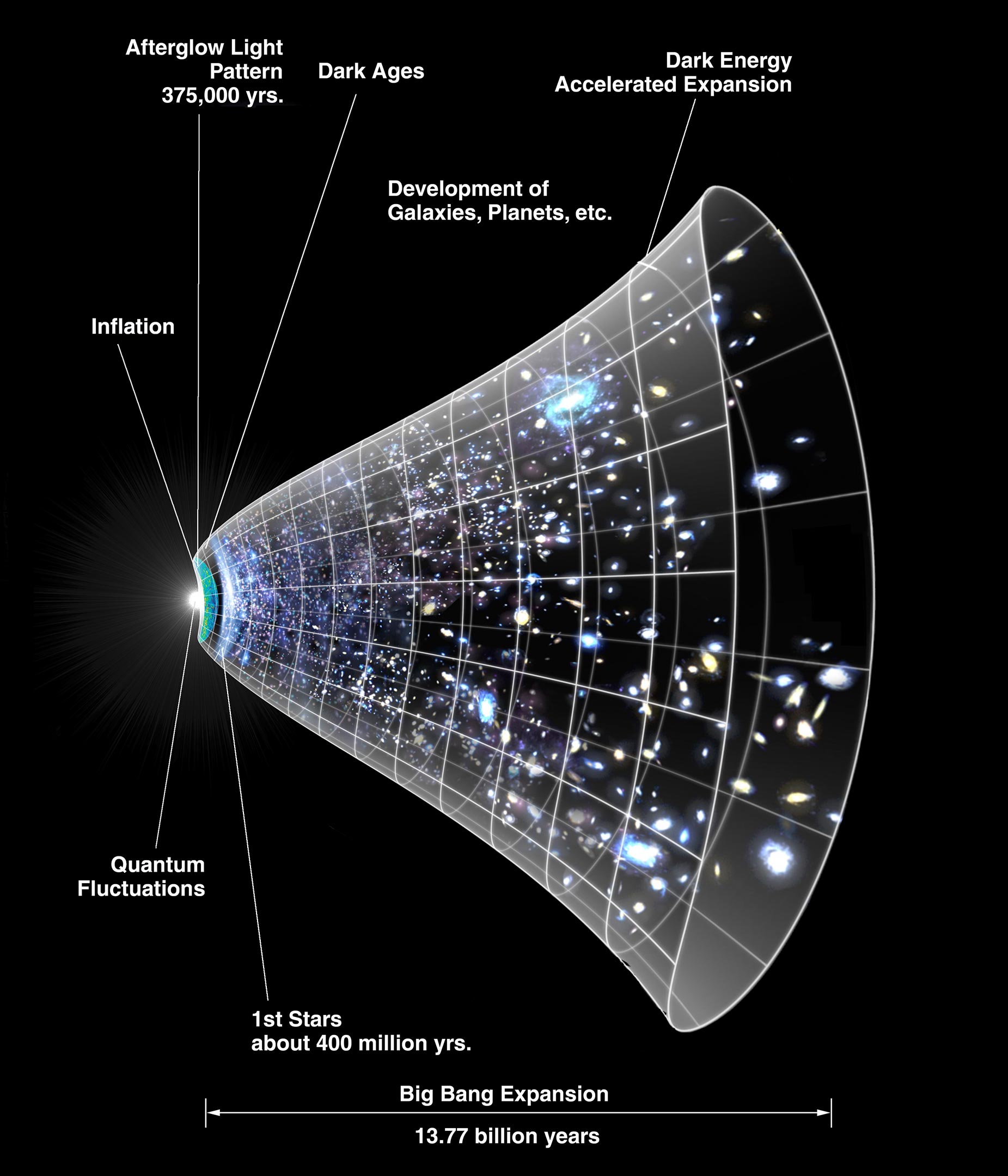
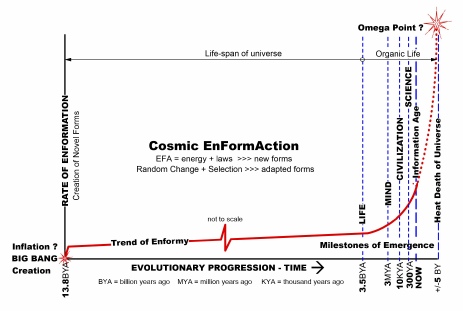
PS___Since the notion of Dissipative Systems*5 has been raised --- presumably to deny the possibility of cosmic or social Progress --- I here note that what some scientists dismissively call "Negentropy" is what I call positive "Enformy", in order to emphasize the role of Information (power to enform or transform) in physics. The depressing prediction of ultimate Heat Death, due to triumphant Entropy, ignores the subtle ways in which thermodynamic digression can be transformed into progressive forms, such as Life & Mind & Technology.
The dominance of information-sharing humans on Earth is merely one sign of Enformy at work, converting world-destroying Entropy into a world-conquering species of Information consumers and Entropy expellers. Purpose is the paddle by which we propel ourselves into the future (telos). Enformy is the fuel of Progress and Entropy is the exhaust. Elon won't make it to Mars --- in his dissipative rockets --- if he surrenders to Entropy. :wink:
*5. The maintenance of the structural, non-equilibrium, low entropy, order involves continuous entropy production, which is exported to the outside the system (its environment). In other words, dissipative structures import negentropy (“negative entropy”) and export entropy to maintain internal order.
https://www.frontiersin.org/journals/sustainable-cities/articles/10.3389/frsc.2020.523491/full -
What exactly is Process Philosophy?What is Process Philosophy?
Years ago, I too, got lost in Whitehead's complex & convoluted abstract & abstruse explication of Process and Reality. So, although the general gist seemed to be agreeable to my own Holistic & Information-based amateur worldview, I couldn't answer your question. Therefore, I was prompted to do a Google search on : "process philosophy compared to what?"But the answers I get make even less sense than the wikipedia entries on it and so I figured I'd try to ask it on here to see if anyone knows what it is and what it means, because I just get more lost on it. — Darkneos
Here's the response from Google A.I. Overview : "Process philosophy is often compared to substance metaphysics, which is the dominant paradigm in Western philosophy. Process philosophy differs from substance metaphysics in its focus on becoming and change, rather than the static nature of being."
I suppose "substance metaphysics" is the modern scientific worldview : reductive and materialistic. But Whitehead's dynamic "process" of the universe may be more like a living evolving Organism than a soulless cycling Mechanism. I'm still not sure what "transient occasions of change" might be in a more vernacular expression. It may refer to the perplexing Phase Changes of Physics, or to the unmeasurable exchanges of energy & information (Entanglement) on the quantum level of reality. The Information Philosopher says : "in PNK Whitehead calls the instantaneous and infinitesimal points of special relativity "event-particles." Not much more enlightening.
Even the quantum pioneers, who inspired Whitehead, didn't understand what was going-on in the basement of the world. Heisenberg called that essential mystery & unpredictability "The Uncertainty Principle". :nerd:
"Process and Reality" by Alfred North Whitehead is a philosophical work that presents a system known as "process philosophy," arguing that reality is fundamentally a process of becoming rather than a collection of static objects, where the core concept is "creativity" as the driving force behind this ongoing process of actual entities coming into existence; it emphasizes the interconnectedness and relational nature of all things within the universe, with each "actual occasion" (moment of experience) drawing from past events and contributing to future ones, essentially viewing the world as a dynamic flow of becoming rather than a fixed state.
___ Google A.I. Overview
Note 1 --- In my own thesis, I refer to that creative "driving force" as EnFormAction : Energy + Form + Actualization. It's basically aimless Energy combined with a program of Information --- like a guided missile --- to convert static Matter into dynamic substance (Life) and sentient stuff (Mind). Does any of that make sense?
Note 2 --- The Big Bang, as described by physicists, would be like a bullet : powered by momentum, but otherwise unchanging. Yet if the power was EnFormAction, the material bullet might transform into a living butterfly along the way : a Process of Becoming. The universe began as formless Plasma, and eventually became the living & thinking organism we call Our World. It's a philosophical metaphor, not a scientific fact to be taken literally. -
AXIARCHISM as 21st century TAOISM
Has that been your experience in this forum? I started this thread by announcing my ignorance of a new-to-me philosophy. And I suppose most of the posters who lent their opinions were also ignorant of Axiarchism. But that didn't stop them from adding their invited opinions to the thread. Most of those proffered thoughts may be based on familiarity with analogous concepts such as Taoism. But I have learned, from some of those erudite opinions, related ideas to fill-in the gaps in my ignorance of the "Ruling Values" of the Cosmos. :smile:Typically, ignorance makes people less eager to give their opinions. — T Clark
Ignorance & Opinion :
A fact is information minus emotion. An opinion is information plus experience. Ignorance is an opinion lacking information. And stupidity is an opinion that ignores a fact. Which of these do you think might apply in this scenario?”
https://sjrnews.com/my-cave-my-view/fact-opinion-ignorance-stupidity
From the net : "Opinions are like farts; everybody has them, and their's stink". -
AXIARCHISM as 21st century TAOISM
Thanks. I didn't mean to characterize Gautama as a doctrinal Agnostic, but merely as one who didn't claim to have knowledge of gods or supernatural beings. In modern terms, a secular teacher instead of a religious priest or preacher*1. Ironically, some of his followers seemed to imagine him as something like a demigod*2, who founded a religion instead of a Zen-like (or stoic-like) philosophical practice. I view the Mahayana Buddhists as similar to the imperial Catholic Church, which departed from the humble & local Jewish mission of Jesus.I will say something about the connection between Buddhism and agnosticism. — Wayfarer
Although I am open to the logical possibility of a transcendent First Cause, that caused the cosmological Big Bang, I have no experiential or revealed knowledge of such a hypothetical notion. Hence, I am a secular agnostic, who includes transcendence in my philosophical worldview. I suppose Hindu-born Gautama assumed the physical world itself was eternal & cyclic, and saw no need to speculate on the original Cause of space-time. :smile:
*1. Secular Buddhism—sometimes also referred to as agnostic Buddhism, Buddhist agnosticism, ignostic Buddhism, atheistic Buddhism, pragmatic Buddhism, Buddhist atheism, or Buddhist secularism—is a broad term for a form of Buddhism based on humanist, skeptical, and agnostic values, valuing pragmatism and (often) naturalism, ...
https://en.wikipedia.org/wiki/Secular_Buddhism
*2. Is Buddha considered to be a God?
Was Buddha God or Human? - Tricycle: The Buddhist Review
What then is the status of the Buddha? Technically, he is a human, among the five other rebirth destinies (sadgati) in samsara: gods, demigods, animals, ghosts, and denizens of hell. But he is unlike any other human, both in his relation to the gods and in his physical and mental qualities.
https://tricycle.org/article/buddha-god-human/ -
AXIARCHISM as 21st century TAOISM
I assume you are implying that I am "demonstrating" my own ignorance. But this thread is not attempting to "demonstrate" anything about Buddhism or Buddahood. I'm sorry if some of my incidental references to Buddhism offend you. But as I said in the OP : "Since Axiarchism is new to me, I may have misunderstood its meaning. And my understanding of Taoism is superficial". Likewise, my knowledge of Buddhism is lacking in depth. Yet, I'm learning more about oriental "philosophical religions" from your posts on TPF. Please forgive my ignorant blunders. :worry:Perhaps the way to Buddhahood is to know what you don't know. — Gnomon
Not something you're demonstrating in this thread :-) — Wayfarer -
AXIARCHISM as 21st century TAOISM
Perhaps the way to Buddhahood is to know what you don't know. :cool:And what do you think that might be? ‘Buddha’, after all, means ‘knowing’ or 'one who knows' whereas ‘agnostic’ means ‘not knowing’. How would you reconcile that? — Wayfarer
Rumsfeld : there are knowns, known-unknowns, and unknown-unknowns. -
AXIARCHISM as 21st century TAOISM
The Tao Te Ching does not specify a purpose to the natural world, but its metaphor of "flow" does bring to mind the course of a river that simply follows the path of least resistance from mountaintop to valley to sea. In the natural world the engine of flow is Gravity, which affects all things equally. Rivers meander against environmental resistance, in the closest possible approximation of a direct line toward peaceful equilibrium in the bosom of the ocean. But galaxies & planets influence each other and flow endlessly in circles around the center of gravity of the system. Seeking, but never reaching, parity with gravity.I agree with this:
Ziporyn argues that Daoism believes in no ultimate purpose, intention, principle, morality. — Joshs
However, some translations of the TTC appear to suggest that there is a goal, with aims. An example: — Amity
The flow of a river has only one purpose : to fulfill its attraction to gravity, by journeying to the center. Meanwhile, humans adapt the river's flow to their own purposes, like hobos hitching a train. So it is with Nature : no apparent purpose, only thermodynamic flow. Yet humans prosper when they "go with the flow" as far as it will take them toward their own goals.
Perhaps Energy (causation), which is neither created nor destroyed, is the invisible God of Taoism. :smile: -
AXIARCHISM as 21st century TAOISM
I suppose the ancient oriental philosophies & religions were originally Naturalist, in the sense that most aboriginal (uncivilized) societies lived like animals at the mercy of their natural environment : Animism. But eventually, they became civilized, and developed technologies to give them power over nature. So, they pridefully began to make a conscious distinction between human Culture and non-human Nature. Hence, humans began to "transcend" their animal dependency, and to think of themselves as little gods. No longer needing to follow the Way (Tao) of Nature.Again, non-theistic. But is it atheist, in the contemporary sense? That's the question I want to pose. — Wayfarer
But, since even civilized people remained subject to the positive & negative vagaries of general & inanimate natural forces (e.g. disasters), they needed some help that was not available from other humans. So they imagined metaphorical beings who were like humans, only more powerful in their control of natural forces : Nature Gods. Those "other" entities transcended humanity in a manner similar to the human domination over animals. And deserved to be worshiped and entreated. Thus, evolved Religionism from ancient roots in Naturalism.
A further development from the religious impulse, to understand and gain control over Nature, was Philosophy (physics & metaphysics), which eventually evolved into modern Science. And that technological power over Nature made us less dependent on gods, and even on impersonal Nature-in-general. Maybe Lao Tse viewed the emerging Science of China as a departure from long traditions of humanity's obedience to the Omnipotence of Nature. So, like most religious leaders, he warned against human hubris, and advised a return to the old reverence for Nature, but more in positive attitude than in groveling practice. Similarly, Axiarchism emphasizes general internal natural values over specific overt rituals & practices & gods.
This Zen-like philosophical reformation was neither Theistic nor Atheistic, but perhaps closer to the Agnosticism of the Buddha. Ironically, Lao Tse's "washed" followers eventually "returned like pigs to wallow in the mire", and converted his generalized philosophical personal worldview into a religion of particular prayers & practices for the masses, even to the point of deifying the Teacher himself. :halo: -
Tao follows Nature
Since you didn't want to talk about Taoism, except in traditional authoritative doctrinal terms, I have refrained from adding the Axiarchism post to this thread. It's a new, non-traditional worldview, that the article compared favorably to Taoism. For a faithful follower of the Tao, such modern notions might be "needlessly confusing" and even profane. :smile:I want to talk about metaphysics and you want to talk about meta-physics, a term which I don't find interesting or useful and which you've made needlessly confusing by naming it what you did. I don't see that we have anything to talk about. — T Clark
PS___I don't recommend that you look at it, because the OP quickly prompted a variety of contradictory & confusing views of the science/philosophy of Taoism. But, just in case, here's the link :
https://thephilosophyforum.com/discussion/15732/axiarchism-as-21st-century-taoism
PPS___ My notion of Meta-Physics is actually about "the fundamental structure of reality". I view ultimate reality as a combination of Physics (Materialism ; Objective ; impersonal) and non-physical Life/Mind (Idealism ; Subjective ; personal). As I view it, Taoism seems similar : Nature itself is lawful-but-mindless, like a flowing river. Yet the rational or intuitive human mind can find a way to cross the river, not by swimming against the current, but by finding the balance between human purpose and natural tendency.
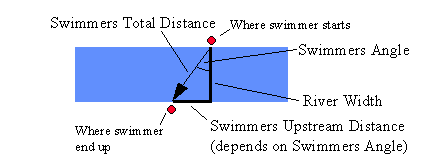
-
Tao follows Nature
Maybe we can shift our view of The Point (the context). I spell it with a hyphen --- meta-physics --- to indicate that I use the term to mean "non-physical" or "mental vs physical". The distinction is essential to my personal worldview of Enformationism. I don't have any formal training in philosophy, so I tend to be very free & informal in my use of the language. I think our alternative definitions are actually compatible, according to my BothAnd philosophy {see below}, which accepts that words may have more than one meaning, depending on the context. :smile:Your understanding of the meaning of "metaphysics" is completely different from mine. It's pointless for us to have a discussion about it. — T Clark
.
Regarding the Tao of Physics books listed in my post above, I view them as dealing with the challenge to scientific metaphysics since the advent of Quantum Physics. Since quantum uncertainty undermined the macro determinism of Newtonian physics, some of the pioneers interpreted the "new reality" in oriental terms (e.g Taoism, Buddhism, Hinduism), and were accused of spreading religious woo. Yet, it's simply a case of clashing worldviews, to which some scientists reacted like the Catholic priests, who tried to force Native Americans to change from their traditional fluid natural religions to a western formal doctrine.I'm right in the middle of another book recommended by Wayfarer - "The Metaphysical Foundations of Modern Science" by E.A . Burtt. I am really enjoying it. Burtt gives much more concrete examples of the metaphysical basis of the early science guys, e.g. Copernicus, Kepler, Newton. — T Clark
The contrasting worldviews depicted in The Tao of Physics and Fire in the Mind reminded me of the ancient Aesop's Fable about the rule-bound City Mouse and the laid-back Country Mouse, who lived closer to Nature. For example, by the time of Lao Tse and Confucius, China had been civilized & citified & imperialized for centuries. So the sages preached a more traditional set of peasant values & virtues to the kings, but were ignored. Ironically, the Chinese peasants & cityfolk created a formal traditional religion from Lao Tse's self-help advice, and elevated him to a fatherly deity*1.
In Blackfoot Physics, the author described the difference between the New Physics and Newtonian Physics by comparing them to the worldviews of Native Americans and European Catholics. He says, "Where Western science has always sought fixed laws and ultimate levels, Indigenous science deals in flux, change, and transformation". He doesn't mention Taoism specifically, but he does use Buddhism to compare & contrast the Western & Eastern notion of Causation.
"But not all the world's philosophies view causality in the same way. . . . The Buddhist notion of causation transcends the more limited scientific notions involving the outcome of a purely mechanical application of force. . . . Wolfgang Pauli introduced the notion of . . . . an acausal connecting principle." Yet, in my own worldview, I am able to reconcile those apparent differences --- city/country, science/religion, artificial/natural --- in reality by following the Tao of the BothAnd principle*2, which is essentially Yin/Yang Holism. ☯︎
Google A.I. overview is a recent enhancement of their search engine, which summarizes ideas from various sources. The overview is merely an abstract of published human expert opinions, not technically A.I generated, but more like an abbreviated Wikipedia entry. I find it helpful for my non-academic posts on an informal forum. A.I. may be taking us away from Nature, but you can only go back-to-nature by trashing your computer. :cool:We're not supposed to use AI generated content. — T Clark
*1. Confucianism focuses on societal rules and moral values, whereas Taoism advocates simplicity and living happily while in tune with nature.
https://en.wikipedia.org/wiki/Three_teachings
*2. Both/And Principle :
My coinage for the holistic principle of Complementarity, as illustrated in the Yin/Yang symbol. Opposing or contrasting concepts are always part of a greater whole. Conflicts between parts can be reconciled or harmonized by putting them into the context of a whole system.
https://blog-glossary.enformationism.info/page10.html
Gnomon

Start FollowingSend a Message
- Other sites we like
- Social media
- Terms of Service
- Sign In
- Created with PlushForums
- © 2026 The Philosophy Forum