
Comments
-
What makes something beautiful?Okay, so you're just telling us something about yourself and not beauty in general then? — Terrapin Station
No, you were doing that with your response to my comment on morality and beauty. That comment was in the context of a larger paragraph where I explained a little bit of my thoughts on beauty/morality.
But I'm saying it wouldn't be ugly to me in that context. — Terrapin Station
So if "the work overall is beautiful in [your] view", then the ugliness isn't ugly to you? Or what does "overall" indicate in that sentence? -
What makes something beautiful?but just because the stuff that other folks are calling "ugly" I'm not going to think is ugly if the work overall is beautiful in my view. — Terrapin Station
I agree, the ugliness can contribute to what makes a piece beautiful. They aren't necessarily so binary. -
What makes something beautiful??? I don't think about morality at all in connection with beauty. — Terrapin Station
?? I do. -
What makes something beautiful?
I see what you mean here (12 tone being a hidden form of beauty? Not readily apparent?) But I'm thinking in much simpler terms, actually. It has more to do with your state of mind than anything else. I live in a large city; there's countless beautiful, fleeting human interactions to witness as you walk down the street, but I tend to just be annoyed by the crowd.
I'm not into 12 tone music by the way. I am into some weirder harmonies, and I love noise, distortion, and weird sounds in music. I think that's more of an acquired taste than a hidden form of beauty. -
Are women generally submissive to men?The biggest barrier to running for president is monetary. — Terrapin Station
Yup.
https://www.opensecrets.org/pacs/superpacs.php -
What makes something beautiful?
You're right, I agree. I've had those experiences too. Probably just my contrarian nature rearing it's head. But I think both experiences of beauty are possible; intrusive beauty and hidden beauty; exoteric and esoteric. -
What makes something beautiful?
I'm not talking specifically about music, though. And I'm saying I'm as blind to the beauty in the world as anyone else, just that I've had moments where I realize how much of it I don't see, which lead me to that thought about it's hiddenness. -
What makes something beautiful?I think the Beautiful thrust itself at us, it thrust itself into the ways we understand our self (our taste) the many narratives which we tell our self. — Cavacava
I would almost say the opposite: I've aways felt, through experience, that beauty has a hidden quality; beauty is everywhere, but most of us don't have the right eyes to see it. Beauty is like light glancing off things; it's possible to perceive shades of it in nearly everything, and that's just the thing: we can't even take all of it in. If I take myself as an example, I'm usually too busy being annoyed, depressed or distracted to even see a hint of the beauty that's around. I tend to just get concentrated doses of it when I play or write music, at best. -
What makes something beautiful?
I think there's a moral aspect of beauty, what I called "right feeling" earlier. I don't know how exactly to describe it, but predictability I see as something morally neutral; the predictability of an atomic bomb, for instance is a neutral aspect to a tool that has wreaked mass murder on populations (something morally abhorrent). Beauty, on the other hand, is not morally neutral. If you find mass murder beautiful, for instance, then you have a twisted perspective on what's beautiful. The predictability of using a bomb for mass murder is just a neutral function of the tool, the use of which is decidedly not beautiful in any way. If, on the other hand, you're referring to something like scientific "elegance", I agree that it has it's own beauty to it; but the beauty of scientific elegance is more akin to a mystical or religious beauty; seeing scientific principles flawlessly work together like cogs in a machine is not unlike seeing Brahman in everything, for instance, or Christ being "all and in all". So, in my view, those are all aspects of beauty. Predictability seems different. -
What makes something beautiful?
That's not art, unless you're of the "everything is art" persuasion. But assuming you didn't mean that, so you're saying the use of the bomb is horrible, but the visual is beautiful? Doesn't the visual become associated with the horror of the act, though? I don't find the mushroom cloud particularly beautiful. -
What makes something beautiful?However, this band/artist just really doesn't appeal to me. The noise (what we can define as "music" is a whole different thread) of this artist is monotonous, hardly any change in measure, and vocals that sound like the dying screams of a Tarsier. — River
Did you get past the 1 minute mark in "Deliverance"? The point I was trying to make with that song is that "ugliness" (the first minute) can exist alongside beauty (the next minute). But I digress, I'm not trying to get you to like Opeth. I don't really listen to them much anymore, but I thought they would be a good talking point in this discussion.
Yet again, you redeem yourself by Debussy. — River
So where exactly are we drawing the line of what makes something beautiful, then? As I showed with Preludes Book II, Debussy evolved tremendously not only harmonically, but structurally. What about Book II still counts as beautiful? Is Shoenburg beautiful?
Have you listened to Aida?...Turandot? Absolutely magnificent. — River
No, where should I start?
Heavy metal...perhaps you're a young dude under 30, a characteristic of which you cannot redeem yourself. — River
I am, but I was never a true metal head. Just had a slight metal phase. Opeth has always stuck with me.
However, I feel that word beautiful does include a tangible slice of pleasantness, it encapsulates it in a way, but supersedes it most definitely. — River
I guess I agree with this if we use a different word than "pleasant"; the connotation there to me is more sensual; a pleasant touch on the arm, a pleasant aroma of fine wine, a pleasant afternoon with Mozart playing in the background. The positive association we have with beauty is more akin to "right feeling", or a form of "pleasure" that is very pointed and specific. It connects to other aspects of the human experience that come up in things like philosophical investigation, religious experience, human intimacy of all kinds. So it's a specific sort of positive association or experience. -
What makes something beautiful?
Can you think of no example of any artwork that is both disturbing and beautiful? "Disturbing" is closer to an emotion anyway. The proper dichotomy would be more like "beauty and ugliness". I think they can exist together; something can have both qualities. -
What makes something beautiful?Noble Dust's post of the song "Heir apparent" is not pleasant—at all—to me. — River
Is pleasant synonymous with beautiful? Maybe Opeth is an extreme example. But take this song instead (make it at least 3 mins in to see what I mean. But you really need to hear the whole track to get the context):
Another aspect of apprehending beauty is being willing to experience things outside of your comfort zone or preference for genre. You don't have to "like" Opeth or the progressive death metal genre, but is it possible for this music to have beauty in it? -
What makes something beautiful?
Here's a nice logical progression from what I've posted so far:
Mid-late Symbolism:
Early Modernism:
Minimalism:
Post-Minimalism:
If you can't make it through all of it, skip ahead to the last piece (John Adams) for some truly wigged out piano music (four hands). -
What makes something beautiful?
Are you familiar with the range of his music? Do you consider this piece beautiful in the same way as Prelude to The Afternoon of a Faun?
-
It seems like people blindly submit to "science"Those who haven't studied particular sciences sufficiently (and I would say that takes a great deal of study today due to the vast expansion of scientific fields) are not in a suitable position to judge as to what is true or not true in those fields. — John
The problem here is the sheer quantity of ever-splintering disciplines, not only within science, but within any aspect of knowledge. The more and more quickly new disciplines branch off, the more difficult it is for anyone (philosopher or whoever) to gather in enough knowledge to have a broad view of how different disciplines affect one another and interact with each other. Attempts like the OP to comment on cross-disciplinary problems are always criticized precisely for not having enough knowledge or expertise in a specific field (science or whatever), but if this is the criticism, then the logical result of the criticism would seem to be that any knowledge spread across two or more disciplines is virtually impossible. I do think this is a difficult task, but lack of expertise doesn't equal an inability to synthesize a broad view. I might not be an expert physicist, but it's entirely possible for me to research something in physics, and then relate what I know to another discipline. The criticism of lack of expertise doesn't lead to the conclusion that synthesis of aspects of separate disciplines isn't possible. -
What makes something beautiful?
Eh? Is this is a response to my post? Click the link, it's a recording of the piece, including a score. Feel free to follow along if you can, or not. -
What makes something beautiful?The thing is, whether it's music or buildings or poetry or people, is "beauty" one aspect of the whole, or is a summation of the whole? There are many pieces of music I love, but "beauty" isn't first in line. Sometimes it is power, or intricacy, or inspiration (as in, inspired instrumentation and melody, say). The Choral finish of Beethoven's 9th is beautiful, but as a summation of many aspects--melody, harmony, massing of voices, instrumentation, rhythm, text, etc. — Bitter Crank
I think beauty is something that's expressed in any one of those things you've observed in a piece of music: "power, intricacy, inspiration". Those are all qualities that engender a sense of beauty in the experience. As a musician, I'm a sucker for "pretty" harmonies and melodies as much as the next guy (well...), but prettiness isn't beauty. It can be an aspect of it; it elicits a certain emotion in us. I personally think beauty is an expression of the divine, so there's a "terrible" quality to beauty as well. "Holiness" means "set apart"; the offering that's set apart for the god; the god is set apart in the shrine. Holy originally signified the divine and daemonic at the same time, and I think beauty is an expression of that totality of holiness. I realize I'm probably in a minority (of 1) here, but think about those different aspects: power, intricacy, inspiration. There's a "holiness" to those aspects.
I'm working on learning this piece right now. I was only classically trained through part of high school, so it's totally kicking my ass. Power? Yes. Intricacy? God, yes. Inspiration? Yes. Beauty? All of the aspects of this piece make it beautiful.
-
The Future Belongs to Christianity?Both. — Agustino
So do I, but I'm saying that this focus on the next world to come is ingrained in Theology itself. -
God and the tidy roomIn my humble opinion, both atheism and theism suffer from a certainty that is nonexistent in their arguments. All that there is is a possibility which can neither be confirmed nor denied. Do you agree? — TheMadFool
I think it's possible to feel certainty without it being unhealthy or a negative thing in relations with people, but I think most of the time, certainty is a problem. So I sort of agree. -
The Future Belongs to Christianity?
I disagree, I don't think atheists (such a broad term!) have any sort of ulterior motive to destroy a Christian viewpoint. Some may, and some leading "new atheists" may. But I don't think the average atheist has this view.
They have made them feel that this is not their world, and they can't make a home here. — Agustino
To the contrary, I think the Christian feeling of not "owning" this world is due exactly to Christian theology. Christians of every ilk are taught that this world is fallen, and that salvation exists in a world that is beyond this world. What exactly do you want, Augustino? Do you want this world, or the world to come? This world does not belong to Christian dogma and theology, but the next one does. Which is it? -
The Future Belongs to Christianity?You know what I've found in many Christians? Fear. Fear that somehow this world doesn't belong to them, and they must adjust to that fact. Reticence. They're not willing to take action — Agustino
Yes, and what does this stem from? -
What makes something beautiful?
Is this beautiful?
Or this?
Or this? (Zdzisław Beksiński)
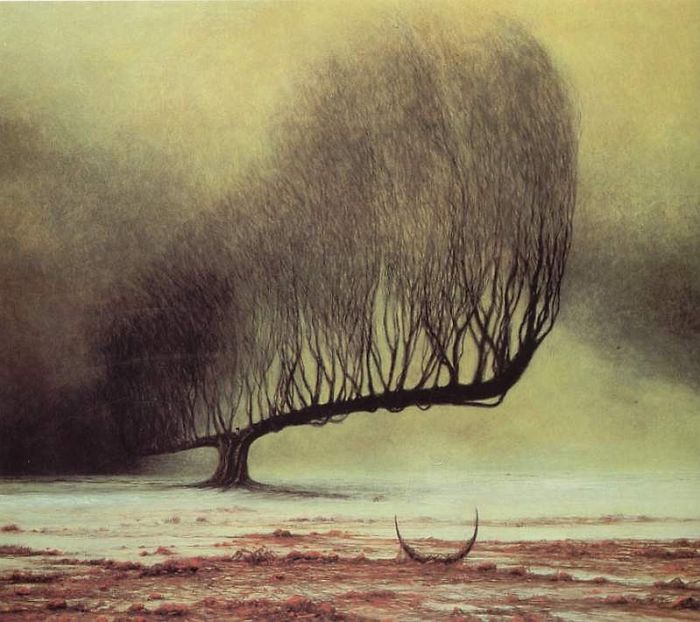
Or this? (Nicolas Roerich)
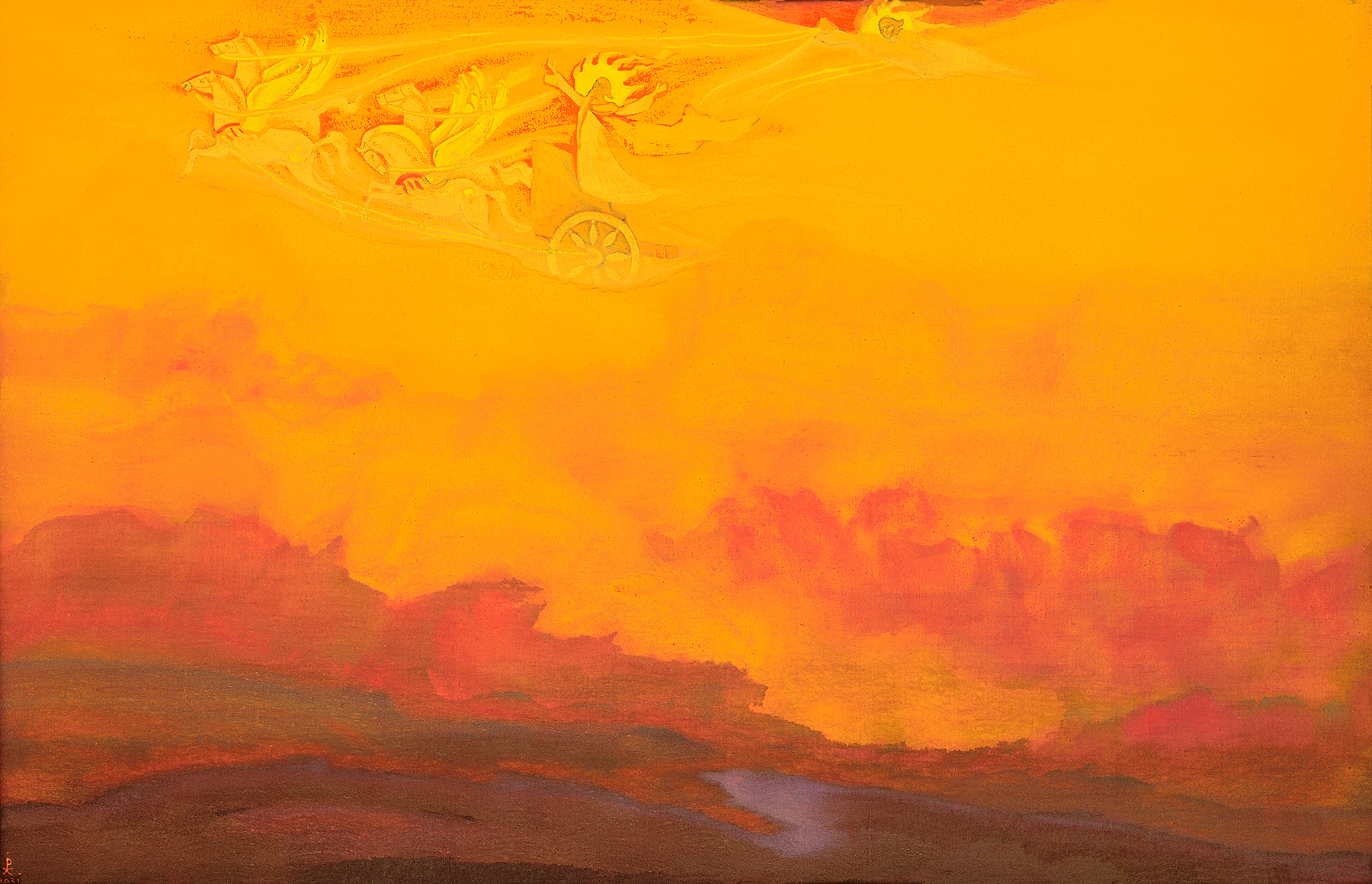
Or this? (Piet Mondrian)
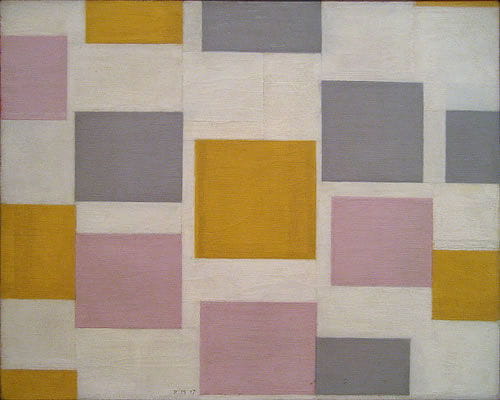
-
Is Meaning Prior To Language?In general, you can mean something by what you say, and have it be different from what you literally say. — Srap Tasmaner
Ok, so utterance is intended meaning, right?
The literal meaning is what logic deals with; the other is pragmatics or something. — Srap Tasmaner
I would go so far as to say that the other meaning is poetic, in that it says more than the logical meaning could possibly say. Poetic meaning unveils further possibilities from the standard meaning of a logical proposition. -
Is Meaning Prior To Language?I'm more or less just defending Fregean orthodoxy these days until I'm convinced to stop. — Srap Tasmaner
I'm admittedly very much an autodidact, and so I'm not familiar with Frege. Perhaps that contributes to the seemingly wide-spread confusion I tend to wreak on this forum...
There was a time when I was inclined to say that words never refer to things, but that people, by their utterances, refer to things. Only I think logic needs reference and doesn't need utterance, so I can't hand reference over to utterance. — Srap Tasmaner
Wait but what is "utterance"? Is it just verbally saying something? -
Is Meaning Prior To Language?
All good, I realize I didn't quite use the word "admonish" properly there, I was thinking of it in less critical terms. (ah, meaning! and ah, using words you have a sense of in your head, but they turn out to be not quite right! again, meaning...) I didn't at all think you were suggesting me to be a dunderhead, or whatever. All that being said, apparently we agree that "reference" and "meaning" aren't synonymous. I must have said something to suggest the contrary when I initially referenced "reference". -
Is Meaning Prior To Language?I'm not clear about this. Are you talking about the impossibility of defining everything, or about some sort of indeterminacy? — Srap Tasmaner
Again, it was just a nit-pick about "nailing down terminology", and it may be tangential to the thread. But I was just questioning your admonishment that you were "just nailing down terminology". I'm saying that I don't think we can accurately do that in an exhaustive manner. I guess that's somewhat relevant to the thread topic, but I don't want to de-rail the thread. -
Is Meaning Prior To Language?Both. Bad use amounts to incorrect meaning. — Banno
So are you saying I specifically did that, or are you using my joke in that context to illustrate your point? Fine if so, but you'd need to elaborate further (use more words!). -
Is Meaning Prior To Language?Both. — Banno
I appreciate your Wittgensteinian brevity, but your meaning would be more clear if you actually used more words. (Or should I say your "use"?) -
Is Meaning Prior To Language?Just nailing down the terminology. — Srap Tasmaner
Also, not to nitpick, but just in good faith, how accurately can we do this? Is this a deal-breaker? I could take the entire following paragraph that you wrote in your post that I just quoted and analyze the terminology, but could I nail down the terminology beyond a reasonable doubt? If we had to do this with every paragraph written and communicated, we wouldn't actually communicate anything. -
Is Meaning Prior To Language?
-
Is Meaning Prior To Language?the meaning of a word is the contribution it makes to the meaning of a sentence in which it is used. — Srap Tasmaner
Fine, I can go with that (tentatively), but then the question of the OP becomes: "Is the meaning of sentences prior to language?" We still haven't properly dealt with meaning if we just assign it to sentences. The meanings of individual words assign to sentences, but the meanings of individual sentences assign to what? Broader paragraphs or conversations, but what do those assign to? It brings up, again, the context of language itself, and we're back to square one. -
Is Meaning Prior To Language?
That said, "Hello" also refers in a context of culture. So, in a way, all language refers within it's expected context. The only way a word wouldn't refer was if it was foreign, or a specialized word that can only be recognized by specialists (Srap's reference to syncategorematic words)
Noble Dust

Start FollowingSend a Message
- Other sites we like
- Social media
- Terms of Service
- Sign In
- Created with PlushForums
- © 2026 The Philosophy Forum