
Comments
-
The End of WokeI'm in favor of fanning the flames of discontent at oppressive workplaces, but IF rebels are going to do battle with the boss, they should be prepared to get fired -- whether its just or not. Sometimes the rebels win, and get what they want and need. Lots of times they don't.
Getting fired isn't the end of the world (usually). -
The End of WokeI wasn't working when the woke shit hit the fan. It is certainly the case that there are 'party lines' which employees are expect to follow. Or else. Nothing new there.
A number of incidents that were reported in the press had in common a small, loud, aggressive, vanguard group that bullied everyone that got in their way. There's nothing new in that either, but it seemed to work especially well in good-mannered academic settings.
In the short run, woke gang tactics are successful, but in the long run, not so much. Administrators resent being bullied. Most people resent it. The vanguard group goes to extremes, making absurd claims and demanding unreasonable solutions. Later on, after the vanguard group has graduated, found different jobs, moved away, died, or gone crazy, the long-term bed rock institution reasserts itself.
Woke-gang crap doesn't fly in corporate settings. A group of disgruntled employees trying to bully the boss are likely to find themselves on the sidewalk without jobs, and persona non grata. -
Why are 90% of farmers very right wing?That is a good question, why Alaska is more conservative than average. There are only about 740,000 people there, spread out over an area 3 times the size of Spain. Fishing is big; so are oil and mining, as well as tourism. Probably "rugged individualism" is a factor as it is in many of the conservative states. Picture Clint Eastwood and similar gun slingers in movies.
I live in a "flyover" state. It means a state that elites on the east and west coast aren't interested in, so they fly over rather than it being a destination. Actually, most of the middle of the country is flyover territory, with the exception of Chicago and Texas.
The distribution of liberals and conservatives in the American population is a murky issue. Take the southeastern United States. As a group, they tend to be quite conservative. They tend to be in favor of limiting government and government spending. However, these same states receive and benefit from more federal spending than most liberal Staes, which tend to receive less federal spending.
This fetish about limiting government is long-standing, going back to pre-civil war times, when plantation owners didn't want their own states to have too much power, never mind the federal government.
Protestant religion has fueled both liberals and conservatives. It depends on the brand of protestant. The Puritans who established themselves in New England in the 17th century believed that the state (government) could be used as a vehicle to perfect society. This became an article of faith among yankees -- aka, New Englanders. As the population of the US grew, and people moved westward, the yankees mostly settled new states in the north and midwest -- Minnesota, Iowa, Wisconsin, Michigan, Illinois, Ohio, etc. They held onto their belief in the utility of an active government -- a hallmark of liberal politics. Hence, the states of the North, New England, and Midwest are generally liberal and end up on the high end of social indexes--health, education, infrastructure, welfare programs, and so on.
The South was established by a different brand of Englishman than the North was. Their brand of religion was more likely to be evangelical or Anglican-establishment oriented, and activism by the government tended to be viewed as unhealthy and interfering. The South (running from the SE coast to west of Texas) has thus had hostility toward the Federal government and has maintained low taxation and weak state governments. As a result, they have tended to end up on the low end of social indexes--health, education, infrastructure, welfare programs, and so on.
Farmers tend to be conservatives in liberal states, which is ironic since farmers are usually the beneficiaries of government farm subsidy programs. A liberal state like Minnesota can have consistently conservative congressional districts, like the SE Minnesota district I grew up in.
Swimming pools of ink have been expended trying to explain how this all works on the individual/city/county/state/national level. If it seems confusing, welcome to the club. -
Why are 90% of farmers very right wing?Your experience in the UK is, of course, going to be different than someone living in the US. Below are two maps (neither of them up to the minute current) that display the correlation between rural / conservative and urban / liberal. 125 years ago, the Prohibition amendment was passed because of the then-disproportionate representation in congress of "dry" rural voters vs. "wet" urban voters. That disproportional arrangement was later corrected through legislation. Bu Wyoming's population of 588,000 still gets the same number of senators as California's 39 million.

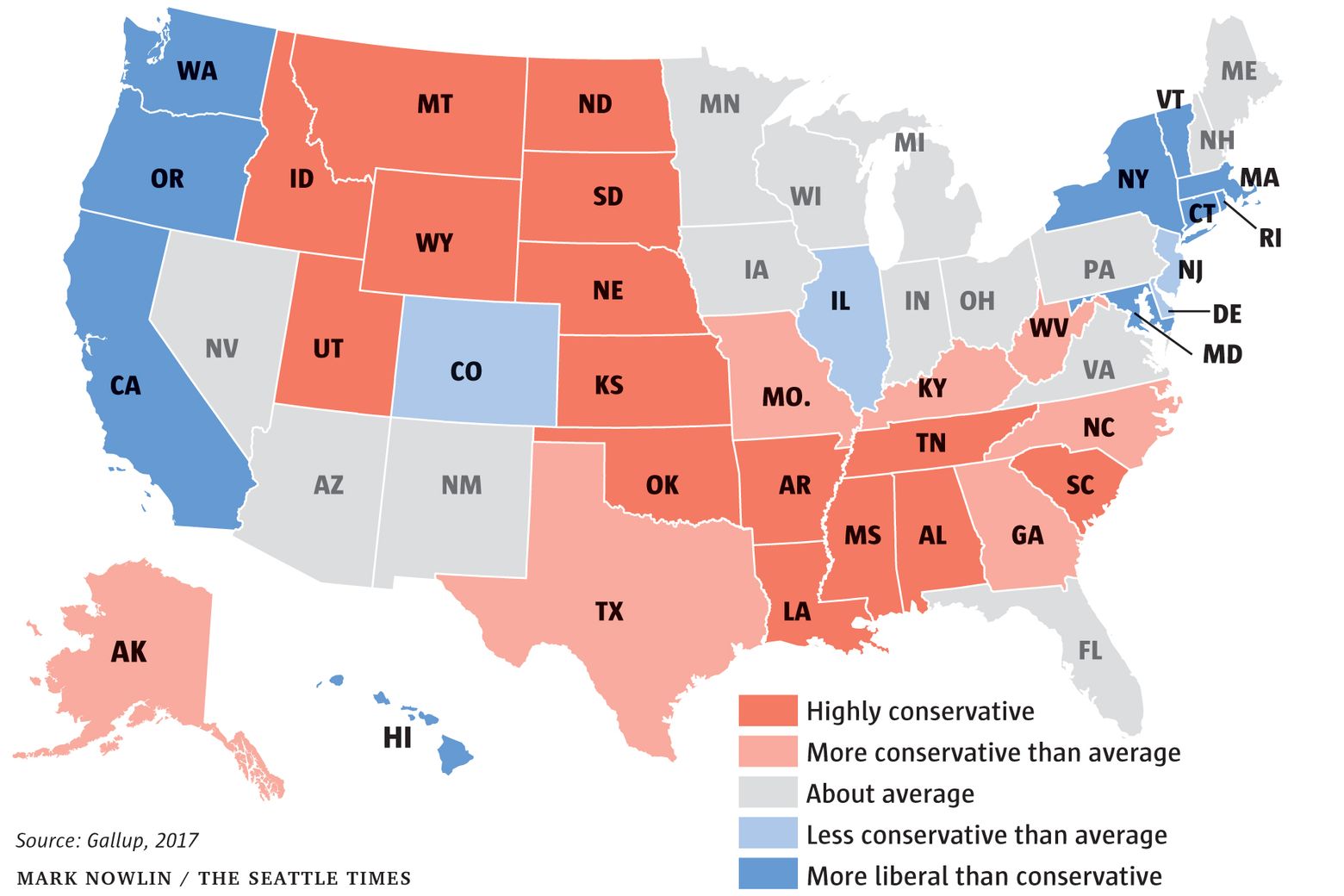
-
Some Questions I Would like to Discuss About Western Civilization/CultureIt is easy to diagnose that our civilization is extremely sick. Births are below replacement level. Real GDP per capita peaked in roughly the year 2000.* The personal savings rate right now is less than half of what it was in the 1960s and 1970s (meaning probably that people are stretched financially). Anti-depressant use is at an all-time high. Suicide rates have mostly gone straight up for as long as I've been alive. And these are only external things that are easy to measure. — Brendan Golledge
As a general rule, birth rates fall as income rises. This is true in countries that are in 'the heart of the west' and in countries that are peripheral. It IS a concern, none the less, when birth rates fall below replacement levels. As far as I know, no country has figured out a sure-fire way to get the birthrate to go up dramatically.
GDP in the OECD countries is mixed, but is certainly not robust in the US. Yes, savings drop when income and expenses balance out -- there's nothing left to save. That too is a concern. I started earning in 1971, and the 50 odd years have brought more or less continual inflation and stagnant wages. One had to be proactively frugal to save anything. However, I tend to view the economic stats as separate from stats that measure the health of various aspects of the culture and civil life.
According to Statista™, suicide rates among males in the US has risen from 17.7 per 100,000 in 2000 to 23 per 100,000 in 2022. For females, same period of time the rate has risen from 4.1 per 100,000 to 5.9. Not good, but not a straight-up increase either.
I'm not going to do it here, but if one teased out the details of who, when, where, and how men in particular commit suicide, one would see a lot of "deaths of despair" which reflects poorly on the society's ability to manage industrial (or de-industrial) change as it affects working men. A lot of semi-skilled to unskilled men were basically discarded along the way of off-shoring production, increasing automation, and efficiency drives.
One problem with industrial policy is that the jobs that disappeared will not be back. So some other social strategy will be needed, like a Universal Basic Income plan.
Look, I don't know what to do about falling birth rates, falling reading rates, rising suicide rates, rising poverty rates, etc. For myself, there is the risk of paralysis by analysis. I can go out and find, and analyze, a plethora of bad news which confirm every single pessimistic thought I have. But then what? I'm 78 and people have been dithering over all this stuff as far back as I can remember. History books tell me that the dithering was going on long before I was born.
I find western civilization in satisfactory condition. Yes, it faces challenges, as one would expect. It will change!!! whether I like it or not. But, even if I live another 10 or 20 years, the future isn't really in my hands -- it's in the hands of those non-reading, not-prosperous, depressed, and possibly suicidal young people and young adults who are not 40 years old yet. God, help them! -
Some Questions I Would like to Discuss About Western Civilization/CultureHe said that people won't read books anymore and that the level of public discourse will be very low. The few geniuses left will be isolated because most people will be unable to receive what they have to say. This seems to me to be true. I think if a person doesn't realize that the level of public discourse is low, then that probably means that person is a part of the low level of public discourse. It is objective at any rate that book reading is down. — Brendan Golledge
Hey, Brendan, all this is overly pessimistic. A whole civilization, like a forest, is both dying and renewing itself, as it must. Because our individual view of "the forest" is limited, it's difficult to diagnose the state of its health with any certainty.
It isn't the case that people have stopped reading--not even remotely. Granted, reading pulp romantic material isn't the same as reading The Great Books. But the masses have never spent a lot of time reading the great books -- they were too busy producing the economic surpluses the elites need to have the leisure to write and read great books.
According to a publishing site as of 2023, the global book publishing revenue stood at $129 billion, jumping from $122 billion in 2018. The global book publishing market will be valued at $143.65 billion in 2023 and is expected to grow to $163.89 billion by 2030. There are more books available to elites and book buying public alike than ever before.
"if a person doesn't realize that the level of public discourse is low, then that probably means that person is a part of the low level of public discourse" is a tautology. Is the opposite true -- that if one thinks the level of public discourse is good, they are a member of the elite? No.
. It has been a part of public discourse for decades that our wars are fought for oil — Brendan Golledge
WWI? No. WWII? In Germany for oil, certainly, but for everything else as well. Korean War? No. Vietnam War? No? Kuwait and Iraq War? Maybe. It isn't clear what we were fighting for. Afghan War? No. Oil is important -- no doubt about it -- even if it is killing us.
As the tallest hog in the trough, it has naturally been US Policy to maintain the status quo for the last century, +/-. Yes, that involves controlling oil, but it also involves controlling (or managing) world trade in general. So it is the American ruling class has had its fingers in many pies all over.
One point -- hired mercenaries -- is true. Thinking of the Wagner Group in Russia. Bad precedent. -
Why are 90% of farmers very right wing?@unimportant Why are 90% of farmers very right wing?
First off, age is a factor. The percentage of Brits engaged in farming is 1.4% of the total workforce. This translates to around 462,000 people, according to GOV.UK. In the United States, farm and ranch families comprise less than 2% of the U.S. population. As a group farmers tend to be aging (the number of young people becoming farmers is small).
"Farmers" and "farm workers" are not quite the same thing. The "farmer" is in charge; "farm workers" are hired help who come and go as needed. Their politics might be quite different than the farm owner.
Second, per the marxist terminology, farmers are petite bourgeoisie. They own their farm business. The petite bourgeoisie, as a group, tend to be politically and socially conservative. Social / political change may upset business and markets, for instance, as it has in the United States-- per the trade politics of the current CONSERVATIVE president and congress.
As a group, rural people -- small town residents, rural non-farm businessmen, the elderly, etc. tend to be conservative -- at least socially, if not politically. I grew up in this kind of rural, small town environment. I was very happy to leave. There is less change-seeking, change-making, change-tolerance there.
Out-flow is another factor. A lot of people born in small towns and on farms leave when they complete high school, seeking opportunity. They may go to college in a usually large city, or they may work in a large city, and never return as permanent residents. So, those most likely to be change-agents, or quite liberal, or gay, or ambitious, get the hell out of Dodge. That leaves the conservative... residue. -
The Christian narrativeThe issue regarding the fact that Jesus didn't stay dead is dealt ... — frank
In Flannery O'Connor's novel, Wise Blood, Hazel Motes proclaims his Church Without Christ where "the dead stay dead, the lame don't walk, and the blind don't see." That's one line from a novel by a Catholic writer. Hazel Motes doesn't think he has sinned or needs salvation.
Another reference, this by Norman Greenbaum, a Jewish songwriter. In his big hit, (one big hit?) Spirit in the Sky, he sings...
Never been a sinner, I never sinned
I got a friend in Jesus
So you know that when I die
He's gonna set me up
with the spirit in the sky
I'm sure there are deep, solid theologians who also think sin and punishment are overrated, but I don't have a quick reference.
If I remember, it was St. Augustine who cooked up the theory of Adam and Eve ----> Original Sin ----> Jesus ----> the crucifixion ----> salvation. Christianity might have been better if Mr. Augustine had stayed in academia as a pagan rhetoric professor. But maybe not. Paul was big on sin and damnation too. Maybe Paul should have stayed in the tent business. But maybe not.
One can put together a decent religion by taking Jesus' commandment, "Love one another as I have loved you." to heart and skipping the rest of it.
The religion in which a person is raised (pick a religion, any religion) is likely to be 'sticky' like burrs in a dog's fur, flies on fly-paper, etc. It can be difficult to extricate one's self from it. I've spent years trying to comb out the large barbed burrs of Calvinism, the dripping glue of unavoidable sin, the various mysteries and gross contradictions of Christianity. It's not the theology that's tough; it's the emotional connections.
Trinity Sunday is not popular among preachers; explaining the trinity is worse than trying to explain quantum theory. When it comes to the 3 for 1, I'm a Unitarian. Bertrand Russel said that "Believing in transubstantiation means you are ready to believe anything." I quoted Russel to a Jesuit priest; his response was "Exactly!" I was raised a protestant and didn't have to deal with bread and wine literally becoming the body and blood of Christ. -
What is a painting?A painting captures a moment in a narrative. A painted wall is not a narrative moment. Even if there is evidence of a significant event on the surface of the wall (like a large splat of dried blood) it still isn't a painting. It's a wall with a blood stain, which no doubt has an interesting story behind it but it probably wasn't produced with narrative intent.

Hopper's Night Hawks captures a moment in an urban diner at night. Whose story is this? The guy behind the counter? The person gazing into the diner? One of the customers? The city? We don't know what the story is, exactly; it might be humdrum boredom; might be tragedy. Or maybe the diner is a welcome respite from late night work. When I look at pictures like this I hear Aaron Copland's Quiet City.
A painting doesn't have to be figurative. "Composition X" by Kandinsky displays definite but abstract shapes against a black background. It is more like a musical composition than a photograph. I do not know what Kandinsky is communicating, but his work is definitely a "painting", probably produced in a manner not altogether different than any other painter's method--taking carefully mixed colors on a brush and applying them to a surface, perhaps over a pencil sketch, perhaps not. I'm not always sure what music is trying to communicate either.

Back in the day, say, 1900, what was art and what was not art was still maybe somewhat clear. The difference between art/not art began to break down when in subsequent decades artists started presenting "ready made" art -- Duchamp's Fountain being a famous example.

Ready Made and Found Art were a provocative objection by its creators to what "ART" was supposed to look like and mean. "If I say it is art, then it is art." They said.
"Fountain" isn't a painting -- it's an object; it could be a sculpture. Indeed, manufacturers employ sculptors to design bathroom fixtures. But a hardware store urinal isn't art, and isn't attempting to be art. It's a utilitarian object, and as such may be interesting, beautiful, very functional, or drab and uninteresting. But it isn't capturing a moment in a narrative. (It's capturing something else at the moment.) -
Are We all Really Bad People deep downI don't know why it took you so long to understand this — QuirkyZen
I'm trying to forward the idea that there is a difference between walking around in fear most of the time, on the one hand, and on the other hand having the normal experience of consistent mild discipline as a young child -- from whence comes a conscience, a moral backbone, and confidence that one can resist the impulse to do wrongful acts--in other words, live a decent life.
Some people have very unpleasant anxiety disorders where they often feel anxious, threatened, and fearful without any external cause. Usually there isn't any clear cause, other than brain dysfunction (neurotransmitters, etc.). A little anxiety is normal, like if you don't pass oral exams, all your work toward an advanced degree may be down the drain. Maybe a snake scares you. That's normal. But fearfulness all the time isn't normal.
The ability to feel guilt is another critical part of having strong morals, and being able to resist the temptation to do bad things that land us in trouble which we quite properly fear. As the saying goes, "Guilt is the gift that keeps on giving." I got a lot of training in guilt as a child, and it took years of effort on my part to get it under control. A little guilt is good; a lot of guilt (without any cause) is disabling.
For some people, bad acts may not lead to fear and guilt: those who regularly do bad things (drive by shootings, felony theft, felony assault, (attempted) murder and manslaughter, wife (or husband) beating -- all that crap -- have other concerns, like maintaining their standing as gang members; maintaining their reputation as 'tough'; acquiring goods that are markers of success in the culture at large, but which they can not obtain through high levels of productive behavior -- like the expensive watch. They haven't had a job in 10 years, so the gold watch is pretty much not going to happen, unless one does a smash and grab theft.
People who work in organized crime are likely to be fearful, because the Organization doesn't punish failure by firing you and giving you a bad reference. They are more likely to kill you if your performance is poor. Intermediate level drug dealers may get drugs on credit, and pay for them after sales are made. IF, for any reason, cash is not produced when it is due, the drug dealer has every reason to sweat bullets and try to find the cash, even if that means robbing a bank. No cash? No life. -
Are We all Really Bad People deep downOh come now. No innocent man has ever been framed. No bad thing has ever happened to a good person? — Outlander
Oh yes, bad things happen to the innocent and the good. And good things happen to the guilty and the bad. "The rain falls on the just and the unjust alike." That's life. Adults understand this and do not go berserk when it happens to other people. When it happens to them is another story, of course.
I don't want a fear based system but our system to such extend is fear based. — QuirkyZen
Fear of punishment and guilt is a key experience for children: it's the essential route to developing a strong moral sense. However, once the moral sense has developed (in childhood, before adulthood) the individual is likely to be consistently law abiding the rest of his life. True, there may be lapses, but billions of people go through life without becoming fearful criminals.
Psychopaths and sociopaths, however, don't develop the usual fear + guilt = moral facility the rest of do. Why don't they? Apparently, the pathways between the emotional centers of the brain and the prefrontal cortex are defective. As a consequence, they don't feel guilt, and consequently perform far more criminal acts than normal people.
Adults can manage belief and behavior to minimize fearfulness and guilt. Healthy people don't like fearfulness and are able to do something about it. Most adults will not attempt to steal the expensive watch. It isn't just fear of "punishment". It's the potential loss of 'place' in the community; the intense cognitive dissonance between their sense of moral self and criminality. The expensive watch will, in almost all cases, not become an irresistible object of desire.
What about the fires of hell? Fear-driven hellfire and damnation works if you accept the premise that a loving god will punish souls forever for sins committed. For many people hell is simply incompatible with their view of god and/or the cosmos and it doesn't work. BUT, if you like that kind of thinking and focus on it, it can be the dominant theme of one's life.
Should the usual strong guardrails fail, and the normal person commits a serious crime (like a felony with mandatory prison time), they will fear the punishment.
Not all political / legal systems are fair and just. If specific groups of people (like blacks, for instance) are subjected to arbitrary arrest and punishment, fear of law enforcement makes sense. If one is a Mexican working in a meat packing plant where many undocumented aliens work, it makes sense to fear an ICE raid.
One of the benefits of living in a more or less just political and legal system, is that the law-abiding, norm-conforming citizen need not live in fear. This doesn't work for everybody, as I just explained above. -
Are We all Really Bad People deep downbecause of fear — QuirkyZen
You want a fear-based system? Fine. Enjoy. -
Are We all Really Bad People deep downThen basically they avoid evil acts and stuff because of fear of "fear of punishment" — QuirkyZen
People who are law abiding and do not perform criminal acts need not have a fear of being punished.
In some countries, saying the wrong thing about the maximum leaders is sufficient to get one punished. People in those countries have reason to fear punishment for speaking their minds the way free people do.
I find this to be a bit of a misconception. Surely you can understand why. — Outlander
If you are consistently law abiding, Outlander, why would you fear punishment for wrongdoing? -
Are We all Really Bad People deep downJust so we are on the same page, I know I am not in the horror movie but I still find horror movies frightening.
People who have not put themselves at risk of punishment have no need to fear punishment. What many people feel when they see other people being punished is not fear, but rather schadenfreude. Others feel satisfaction that justice is being done. Some people don't give a rats ass about other people.
(Either your argument is dumb or i misunderstood it, the second being more likely) — QuirkyZen
You could have put that more tactfully. But never mind, have no fear. You will not be severely beaten for it.
Fear can be learned and unlearned, quite apart from the matter of punishment. -
Are We all Really Bad People deep downI think it is the punishment that keeps people honest and act good — QuirkyZen
There are people who continue to commit crimes after they are caught and punished. most people don't commit crimes, so do not experience punishment.
It would appear that something else affects behavior beside punishment / no punishment.
I think that properly raised children who grow up with a sense that their efforts will improve life for themselves are unlikely to commit most kinds of crime most of the time. In other words, we call them good people.
Some people do not benefit from good parenting, good schools, and a good environment and they grow up with low expectations that their efforts will benefit themselves. Not all of these people will commit crimes, but quite a few people in this group will. Growing up with bad parenting, crappy schools, and low expectations makes people unfortunate rather than bad.
People tend to maintain cognitive harmony. They try to act in conformity with who they think they are. Behaving in ways contrary-to-my-real-self creates cognitive dissonance, and people tend to avoid dissonance.
We're all people doing shit. That's all really. THe rest is window dressing (window dressing I enjoy, to be sure) — AmadeusD
Sort of like "We're All Bozos on This Bus".
Yes. We're all just people doing stuff. Goodness and badness are not our primary characteristics. We might be good. We might also be stupid; or handsome; or have bad breath; be very smart but very impractical; be a ballet star or a klutz; or maybe be a complete asshole. -
How the Hyper-Rich Use Religion as a Toolone may as well ask, what's the point? — Tom Storm
One may indeed ask, "what's the point?" But to use a religious phrase, a particular religious activity, organization, experience or belief must be "judged by its fruits". The harvest ranges from very bad, on through mediocre, and on to very good, with the largest bin being "mediocre". That's typical performance for the species. We can rejoice in the good, regret the bad (and arrest those who are actually criminal), and urge the mediocre to try harder.
Should religion be better than Real Estate? Sure, but crooked timber is the only kind at the lumberyard. Every now and then, someone manages to overcome their crooked timber and do a straightforward good job. It's also true that there are people who IF they had perfectly square planks would still make a mess of it.
As for me, I am just another pile of warped boards. -
How the Hyper-Rich Use Religion as a ToolThe poor shall inherit the earth" - used to placate the oppressed. — Truth Seeker
You seem to have conflated verse 3--"Blessed are the poor in spirit: for theirs is the kingdom of heaven" and verse 5--"Blessed are the meek: for they shall inherit the earth".
In any case, you probably don't want to be taken as a biblical literalist, so don't be too literal in your interpretation. Jesus wasn't promising a land redistribution program. Which earth will they inherit--the present land or the future Kingdom of God? Jesus was proclaiming the Kingdom of God, not a Marxist revolution.
By the way, a nice sarcastic line comes from the Broadway musical, "Camelot": in a song about the Seven Deadly Virtues Richard Burton sings, "It's not the earth the meek inherit, it's the dirt."
Billionaire-backed religious movements have pushed anti-science, anti-women, and anti-LGBTQ+ agendas to keep their base loyal and distracted from economic injustice — Truth Seeker
True, but it doesn't require billionaires backing religious movements for 'backwards' religious groups to sink into a mire of anti-science, low female status, anti-GLBT policy, and maintaining ignorance of economic injustice. Ordinary people can do this all by their ordinary selves.
Still and all, I'll grant that religion and power tend to end up in bed together and the rest of us get fucked as a result.
People are encouraged to pray rather than protest — Truth Seeker
Like the Civil Rights movement did--pray before they went out and faced fire hoses, hostile police, dogs, and hatred. I agree, though: Prayer without action doesn't do much. Here's another good quote you might like, this from a lapsed Episcopalian priest: "Nothing fails like prayer."
Religion, like every human endeavor, tends toward corruption, but every now and then humans rise above the muck and pull off sublime acts. Thinking here of people like Dorothy Day and the Catholic Worker Movement; the Southern Christian Leadership Conference; or the Dalai Lama's efforts on behalf of the Tibetan people and culture.
Emmanuel Kant said that "Nothing straight was ever built with the crooked timber of mankind." So, why expect religions to be better than anything else? -
Limits of Philosophy: IdeologyTrue. "Inflexibility" in belief is a problem. It hobbles one's capacity to deal with a world which is always more complex and contradictory than ideology allows. I don't usually associate Christian preaching with 'ideology', but some varieties of Christian teaching are extremely rigid and inflexible.
I'll also grant that some of the ideology I have read and spouted at times was undermined by its inflexibility and, sometimes, it was just plain wrong. -
An issue about the concept of deathHey, I'm just describing what changed in the conduct of war in the 20th Century. Coupled with mechanization, more powerful explosives, and new machines (tanks, airplanes, etc.) war became several magnitudes worse for everyone concerned, including civilians, and the morality of warfare that much less justifiable.
Maybe we would all be better off IF the discovery of fission in 1938 by Otto Hahn, Fritz Strassmann, Lise Meitner, and Otto Frisch at the Kaiser Wilhelm Institute for Chemistry in Berlin had never happened there, or anywhere else. But it did. And if not there by them, then somewhere else by some other physicists. Fission wasn't invented -- it was discovered.
Within 4 years Germany and the Allies were figuring out how to make use of this discovery.
True enough, the power of 1 atomic bomb is appalling. Even though the infrastructure required to make a nuclear bomb is huge, the ratio of bomb-to-death-and-destruction is terrible / horrifying / ghastly.
The morality involved in destroying a city and killing 100,000 people by dropping thousands of "conventional" incendiary and explosives bombs doesn't seem different than destroying a city and killing 100,000 people by dropping one nuclear bomb. Depending on one's moral standards, the two strategies are equally immoral or moral.
Israel has killed 60,000 +/- people (mostly civilians) in Gaza with conventional bombs over many months. That's roughly the initial death toll in Nagasaki from 1 bomb. Which case is less moral?
People usually come up with solid rationales for killing people in large numbers. A solid rationale isn't the same as a moral justification.
I can't say that war is, by its nature always immoral, but I certainly would not claim that it is often moral. but fairly soon in any war actions will be taken for expedience that are immoral. And in any war, the morality of self defense will be undermined by excess--like fire-bombing Hamburg and Dresden, for instance. (I'm citing instances of questionable Allied morality; citing Nazi immorality is too easy.). -
An issue about the concept of deathwhat rationale can be presented to justify the death of innocent civilians in Japan during WWII — Shawn
You might ask what rationale can be presented to justify the deaths of civilians during any war.
The fact is that war changed in the 20th Century, first during WWI and then more so during WWII. Swept away was the concept of restricting one's forces to shooting enemy forces. The new understanding was that civilians, rather than being innocent were essential to the conduct of war, in as much as civilians produce the matériel required by the armed forces, from bread to bullets to bombs. Civilians took care of business and also produce future soldiers.
So, leaving many millions of highly productive civilians to just carry on with war production doesn't make sense. Hitler called it "total war". There are no innocents and everybody is a potential target.
Another feature of the 20th century's two big wars is that they were "world" wars, not some limited French-German war fought within a small geographic range. Previous wars were plenty ghastly involving all sorts of horrible, awful things happening to people. Even in the American Revolution, which is taught in high schools as a relatively decent war, ghastly things happened. The American Civil War was a blood bath.
To paraphrase Chairman Mao, "war is not a tea party". Carrying out war against enemies who either are or are presumed to be existential threats involves the cold-bloody use of cruel weapons against soldiers and civilians.
Morality seems to be a lost cause on the battle fronts of war. Yes, bombing Hiroshima and Nagasaki was gruesome. But so was Germany's invasion of the USSR and the Japanese invasion of SE Asia. You will be hard-pressed to find a war policy anywhere that is not appalling, no matter on what continent you look or in what time period. -
An issue about the concept of deathI never heard of Americans defending the lives of Chinese civilians. — Shawn
The US didn't land troops in China before or during WWII, but China and the European allies were both aided by the US before and during WWII.
The Communist victory ended the Chinese Civil War in 1949, which had been going on since what ... 1927, I think. -
An issue about the concept of deathOppenheimer didn't discover fission or invent the Atomic bomb. As I understand it, he was responsible for organizing the laboratory at Los Alamos, and over-seeing its function. While Oppenheimer was one of the relatively small number of people who were able to have a "big picture view" of the Manhattan Project, the military (led by General Leslie Groves) were in charge of the Manhattan Project from the getgo.
Many people, physicists, chemists, explosive experts, metallurgists, etc. were in charge of discrete critical pieces. For the sake of secrecy, everything was on a "need to know" basis, and usually you didn't need to know anything except what you were assigned to do. So, few were in a position to know what the actual goal was -- including many of the scientists at Los Alamos, Clinton Engineer Works in Tennessee, Hanford in Washington state, and so on.
Nagasaki and Hiroshima had been selected by the military for atomic bombing well before the first two bombs had been built. These two cities had not been bombed for the express purpose of providing a "pristine" target -- not one that had already been burn over or bombed out.
"Atomic Bomb" seems to be something specially awful, but is it, really?
Atomic bombs explode. The produce a huge blast of heat, radiation, and shock waves. Conventional bombs don't emit radiation, but if you are reasonably close to a large exploding ordinary bomb, you will still be burnt and blasted apart. Incendiary bombs + explosives were used to torch Hamburg, Dresden, and Tokyo. It was a bad bad very bad experience, not radically different than Hiroshima and Nagasaki -- save for the enduring radiation harms.
One thing to bear in mind: the original target of atomic weapons development wasn't Japan, it was Germany.
Another thing to think about: The atomic bomb was invented only once, and the US did it. Other countries could eventually have worked out the physics and chemistry, but that was an expensive proposition. As I understand it, the USSR stole our secrets; the British may have given the secrets to France. China likely got some of its secrets from the USSR. Other countries later found sources. -
How true is "the public don't want this at the moment" with regards to laws being passed?The membership by invitation is fairly recent, and I think Jamal (the owner) instituted it to maintain quality. There are fewer trolls, ranters, extremists, and so on now than before. Moderators help, but it's a thankless volunteer job.
The Philosophy Forum has been around for around 15 - 20 years; its first incarnation was sold and then died soon after. The current incarnation was started by regulars from the former site. We have always aimed to have more or less serious philosophy discussion.
True, "this forum is just relatively quiet overall". Which topics will take off and run for many weeks is hard to predict.
Glad you are here. -
What are the philosophical perspectives on depression?Russian and Eastern European authors ... are helping me to open the eyes and understand the human condition. I don't want to overcome it but just to learn to live with this situation. — javi2541997
That's very wise. -
What are the philosophical perspectives on depression?I would like to find out philosophy and ideas to face depression.
I find the book of Ecclesiastes helpful. Good things and bad things will happen in life. As the gospel puts it (taking it out of context), "The rain falls on the just and the unjust alike." In other words, good things (and bad things) happen to both the deserving and the undeserving. It might help to bear in mind that the universe is NOT singling you out for bad treatment.
Of course, it is much easier to accept the unfairness of the universe just after one has received unearned benefits.
Sigmund Freud was not optimistic about people being happy. "Happiness" he said "is not in the cards." In a different context, opera star Beverly Sills was once asked if she was happy. "Let's just say I'm cheerful." Being "cheerful" amidst life's various bad experiences is perhaps more achievable than being "happy".
Is there some uniquely ideal philosophical approach for dealing with the bad stuff, like depression?
Happy philosophers are all alike, whoever they are; unhappy philosophers are all different.
I think you have to find what works for you. Maybe stoicism? Maybe pragmatism? Schopenhauer? Your favorite comic? I find Woody Allen helpful.
One cliche that has some truth to it is "If you're walking through hell, keep going."
In other words, don't dwell on the bad stuff. Look forward toward something good. And keep moving.
User Survey: On a scale of 1 - 10, with "1" being fabulous advice and "10" being a pile of shit, how would you rate this post in terms of helpfulness? -
What are the philosophical perspectives on depression?I would like to find out philosophy and ideas to face depression. I don't want to know why we experience depression in our lives. I already accepted that this comes and goes sooner or later. I believe it is key to try to live with this mental condition. — javi2541997
One approach is to consider the language used to identify and describe unhappiness. At one time or another, many people experience fairly long periods of one or more 'states' that do not constitute disease: fearfulness, loneliness, frustration, grief, self-doubt, boredom, anxiety, uncertainty, scattered attention, sleeplessness, irritability, longing, anger, jealousy, etc. Usually these states (like fearfulness or anger) are short. States like loneliness or boredom may have longer duration.
These various states can be pretty unpleasant if they are intense enough, and if we feel too many of them too often. Sometimes people who experience a combo of these unpleasant states claim to be depressed. They may meet the diagnosis requirements, and they may be taking medication.
It might be the case, however, that what one is feeling isn't "depression" per se, but rather, troubled circumstances. One is in debt, say, and one fears losing one's car or housing. One might be chronically frustrated by transportation problems to and from work -- buses that don't arrive, waits that take too long, missed hours and negative consequences at work. Perhaps one's romantic interest has suddenly found somebody else very interesting and we feel intense jealousy (and/or fear of abandonment). And so on.
One or more of these states or situations may make us feel bad (maybe very bad). "Depression" is a handy box into which to place a mix of bad feelings that are sapping the joy of life, BUT it may not be depression. Rather it may be grief, anger, fear, frustration... -- whatever is on offer.
So, getting clarity on on what one is feeling, and what may be causing those feelings, is a rational step in dealing with our emotions.
Concluding that bad feelings are not actually depression doesn't mean one is fine. It just means that the solution may not be found on a therapist's couch or in a pill.
User Survey: On a scale of 1 - 10, with "1" being fabulous advice and "10" being a pile of shit, how would you rate this post in terms of helpfulness? -
NonbinaryIt means they are considering political reassignment surgery. Does anyone have suggestions on how much to slice off?
-
How true is "the public don't want this at the moment" with regards to laws being passed?politicians pandering to the wealthy class — unimportant
Politicians are attracted to wealth like fleas are attracted to warm blooded mammals. It's the greatest source of nourishment! -
How true is "the public don't want this at the moment" with regards to laws being passed?This is probably more suited to politics and current affairs subforum than political philosophy as the content is more pop culture in substance. — unimportant
Maybe, but I don't think the subform location is all that significant. You could ask a moderator to move the thread to the Politics and Current Affairs forum.
I've never understood why one discussion takes off and another one doesn't. Most of the threads I've started have died shortly after birth. Just a few of mine have been "successes" -- meaning a lot of people participated.
If there are forum members you would like comments from you can ask them using the format @their name like @ " unimportant " but with no space after @ or ". A note will show up in their e-mail that "Unimportant mentioned you in such and such a thread". That doesn't always work, but it sometimes gets more people to comment. -
What are the philosophical perspectives on depression?I used to have a fair amount of confidence in the efficacy of good advice, therapeutic routines, positive thinking, and all sorts of other nostrums (meaning "a favorite remedy, especially one for bringing about some social goal). Some of them, like regular exercise, healthy nutrition, and good sleep seem pretty valid.
The problem with mental illness is that the mind that is supposed to make use of good advice doesn't feel well and can't just step out of itself. That fact makes overcoming depression, anxiety, obsessiveness, and so on difficult. What the somewhat-to-moderately depressed person does is figure out how to manage under the circumstances. The severely depressed person can't manage, and is disabled.
You sound like a fairly up-beat positively minded person. True enough, you have some problems, but you seem to be dealing with them reasonably effectively. It would be nice if life were perfect, but unfortunately, it isn't.
Keep reading and thinking; stay engaged with other people. I don't know what will happen, but you will probably be OK. Most people end up being OK. Of course, some don't. Some people bring trouble on to themselves, but for most people trouble comes by way of random events like a flash flood, a violent storm, a war, and so on.
Here's some psychotherapy by the eminent Bing Crosby.
-
How true is "the public don't want this at the moment" with regards to laws being passed?I have heard of Nigel Farage and it was much like hearing of Donald Trump -- bad news.
I never understood the enthusiasm for Brexit. Who did it actually benefit? Was it the wealthy class? Did it actually promote home rule? Did it actually enhance the British economy (doesn't seem like it)?
Donald Trump's tax bill that just passed is a major gift to the "haves and the have yachts" and an attack on poor people (bonafide citizens) who depend on medicaid for medical care. The Texas flash flood is terrible, but I was happy to hear a Democratic Senator from Texas pointing out that this is the sort of thing that happens when you slash the weather service's budget and cut 600 staff from the National Oceanic and Atmospheric Administration. He wasn't claiming that the cuts literally and immediately caused the deaths. -
How Will Time End?If there's ever a heat death of the universe, time would stop for all practical purposes because nothing would happen. Nothing would change. — frank
That's what I was thinking. There is time because stuff happens, things change. In the unimaginably extremely distant future, there will come a final moment when nothing more happens and time will have stopped. Alles kaput. So...
If you have something that must be done, then you should get at it pretty damn quick--given the great inconvenience of having lists of unfinished things to do just when nothing more can possibly be done ever again. -
How true is "the public don't want this at the moment" with regards to laws being passed?According to Google's AI, the UK does not use the caucus system, whereby voters in precincts (small sub-units of congressional districts) nominate candidates for consideration in district conventions. Precinct elections are ostensibly very democratic, but party officials oversee the caucuses. Candidates can run outside the party as independents, and sometimes independents form a loosely structured new party. These new parties usually die an early death, though a few have endured as minor participants (like the Green Party).
The US is, of course, geographically much much larger than the UK and has a much larger population (330 million vs. 68.3 million). Hence, it costs a lot more to campaign for national and state offices here. Minnesota, the state I live in, ranks 12th in area among the 50 states. From north to south the state measures 653 km (406 mi), and from east to west it measures 576 km (358 mi) at its maximum extent and about 290 km (about 180 mi) at its narrowest point. Reaching the 3,678,000 registered voters scattered across the 225,171 square kilometers of the state is expensive. Much more so for larger state and the country as a whole. Most elections campaigns (except for governors, senators, and presidents) are at the district level; in my case, the 5th district is basically Minneapolis.
I don't know much about the UK's political system beyond its parliamentary nature, Tory vs. Labor, and the stupidity of Brexit. -
How true is "the public don't want this at the moment" with regards to laws being passed?The US Congress passed the "Big Beautiful Bill" yesterday. The public didn't want this bill which extends previous tax cuts for the wealthy and cuts Medicaid but it passed anyway. Why?
Because there is a disconnect between individual politicians, the parties to which they belong, and the several segments that compose "the public". The system is rigged to maintain the disconnection.
Why do the parties, who require the public's votes, ignore the public's wishes?
Because the parties are funded by the most wealthy segment of the public (whether liberal or conservative) and that funding determines the parties' politics.
Currently the dominant conservative party (the Republicans) are able to pursue a right-wing agenda. In other decades the dominant liberal party (the Democrats) were able to pursue a left-wing agenda, which has included such programs as Social Security, Medicare, and Medicaid. Does that mean that the Democrats are really 'in tune' with the public's desires? Yes, but only so far. The Democrats are no more interested in slashing defense spending or raising the tax rates on the wealthy to 70% and above than the Republicans? Why not?
Because the Democratic Party collects the bulk of its funds from the same wealthy class as the Republicans, and both local and national economies are wedded to military spending whether one likes it or not.
The balance of more leftist / less leftist vs. less right wing / more right wing varies over time. We are currently in a time when a less leftist Democratic party is opposite a more right wing Republican Party which controls a majority of seats in congress. -
Why are there laws of nature ?I think the universe is intelligently ordered — kindred
"Ordered" implies an agency at work giving the universe features. Is there an organizing agency at work? God?
Matter and energy must behave they way they do. We observe them doing what they have no choice in doing--like a planet orbiting a star; like electrons in one atom interacting with atoms in another atom; like a bird laying an egg. From their behavior we devise rules which are only useful to us. Stars and birds continue on as always.
As for an orderly universe, I'm not so sure about that. At the moment of the Big Bang, matter, energy, and space began. It was not a perfect arrangement. There were clumps of stuff in the mix; matter and antimatter began to cancel each other out imperfectly -- which is why we are here; there was no flash -- there was no light at all for quite a while. The galaxies are not evenly distributed, nor are the stars in the galaxies. The momentum of universe-expansion seems to be building, rather than subsiding or being steady. And all that's just physics.
Would politics be the cluster-fuck it is in a nice, intelligently ordered universe?
God made the world in six days flat
On the seventh He said, "I'll rest"
So He let the thing into orbit swing
To give it a dry run test
A billion years went by
Then He took a look at the whirling blob
His spirits fell as He shrugged
"Ah well, it was only a six-day job" -
What is the best way to make choices?Gaol is an old-fashioned word for jail and is not commonly used here any more. — Truth Seeker
Well, that's a relief. -
What is the best way to make choices?Great; Christian attacks couples on Christmas Eve!
From my perspective, you did the right thing. The man clearly has problems, and if he might have benefited from therapy, he most likely wouldn't have gotten it in jail--are you all still spelling it 'gaol'? On the other hand, it's possible that pressing charges would have made no difference in the outcome.
I've been robbed at knife point a couple of times. it was a bad experience, and there was no arrest in either case, so I didn't have to make a choice about pressing charges. Robbing people at knife point, gun point, or by way of beating them up is not acceptable in civil society, and is common enough to degrade the quality of life in the urban core, especially.
There is a steady hum of property crime and assault which doesn't quite rise to the felony level in which criminals can expect to do time in prison--too many crimes, police can't be present at most crime scenes as they unfold, and not enough cells to put people in. Juveniles aren't subject to the same punishments as adults, of course. Doing time in prison doesn't seem to improve people. If they were bitter and resentful before they were imprisoned, they are likely to be in a bad mood after release. Plus a criminal record and prison time makes it very difficult for convicted people to return to normal employed life. More crime is sometimes their only option.
We arrest and imprison a lot of people in the United States. Prisons are usually inhumane but still manage to be quite expensive. Small jails run by small cities can be just as bad in terms of quality as the big prisons are.
Jailing prostitutes, for instance, doesn't make sense. Maybe some prostitutes work voluntarily, but for many it's coerced labor or the prostitutes are victims of trafficking. They need an intervention and recovery program, not an arrest. Rather, arrest the pimp. -
What is the best way to make choices?Right now, I am at minus two. What about you? — Truth Seeker
Right now I'm at 0. Back between 2000 and 2009 I was at a -2 and -3. I could interact with people and manage 'big picture' thinking OK, but was unable to manage detailed bureaucratic tasks like 'maintain detailed record keeping' and 'learn new benefit systems'. That's what led me to retire -- just couldn't deliver the expected performance. Medication was certainly a factor. It took maybe 3 years to return to something like normal.
In good times I bounced up to +1 or +2. I wasn't manic, but I sometimes took off on half-cocked projects which were doomed to failure.
What jobs were they? — Truth Seeker
The first job, after college, was working with college students who were getting failing grades. Some of the men didn't want to be in college (parent's choice) and some lacked basic study skills. It was basically a tutoring job. I also worked with faculty on developing and using media -- this was in 1971; what we were trying to do with difficulty then became routine later on with the internet and personal computers. That job lasted 7 years.
The next good job was 9 years later (1987) where I worked for 7 years at the Minnesota AIDS Project in AIDS prevention. It was basically education work -- getting the message out to men in bars, baths, adult bookstores, cruising parks, and the like to use condoms, and so on. The HIV epidemic got underway in the midwest a little later than on the coasts, so we didn't need to convince gay men about HIV being a threat. I'm gay and was pretty familiar with the sometimes pretty sleazy settings that I worked in. It was challenging and fulfilling work, a lot of it late night. After 4 years of that it was time for a new approach, so I switched to answering calls on the AIDSLINE. That was less exciting, and most of the calls were from the the worried well. Some of the calls presented serious problems and many were about absurd fears and weird behavior, so that was interesting.
I know it is not possible to do. What about you? — Truth Seeker
I greatly admired men who were effective change agents and critics of the capitalist system. I wanted to be one of those radicals who fit that role, but I really didn't know how to do it -- still don't, for that matter. I was fairly good at the criticism part, but that's the easier half of the job. Getting people to actually think / behave differently (ie, become socialists) is far more difficult. I admired and liked Jeff Miller, a local leader in radical circles in Minneapolis. He was a great speaker / writer and was able to attract a circle of Marxists that endured for... something like 30 years. We published a monthly broadside (a fart in the windstorm) and held weekly classes. Many people passed through the classes, but few stayed on. Jeff endured decades of poverty and privation in order to devote himself to left-political work. It was a choice; he was smart and could have been quite successful at a job. But he chose the better part.
Another group of guys I admire have kept an anarchist bookstore in business (barely) for 40 some years. A lot of the men I admired have died of old age -- you know, you live long enough and the people you knew are dead. And others have moved on or moved away. So not many of these role models left.
I tried to be like Jeff, but didn't have the 'stick-to-it' drive that it takes, and I didn't want to live just a cut or two about sleeping on the streets or in vacant space to do it. I knew several oddball guys who were living that way; they were smart, inventive, free spirits. At least that's what it looked like. That was back in the 1970s and 80s. It would be much harder to pull off that kind of life now.
So here I am. -
What is the best way to make choices?No manic episodes? Not sure about hypomania? Maybe you are not. Don't know. Mania is unmistakable -- running from abnormally exuberant energy directed at odd projects to auditory hallucinations telling you to jump in front of a car. Hypomania might be fun for a while, but psychotic-level mania is an awful experience. So! Be glad you are not.
I imagine you have talked this over with your psychiatrist? Been rediagnosed?
Antidepressants don't work for you? Actually, there is evidence that they don't work all that well for a lot of people, apparently. I've taken several different kinds, and while they helped some, I was still more or less depressed, still functioning under par. Plus, we develop dependency on antidepressants--not addiction, just dependence. I've tried weaning my self off Effexor -- which has worked the best of all -- and I find the physical challenge too unpleasant. Stuck. Why take them at all?
We don't like being depressed, for one thing. Second, there aren't many alternatives. Beer is safe and effective when used as directed, but we only feel better for a couple of hours. Too much and things can go downhill rather fast. (Maybe you saw the comedy bit posted in the Shout Box about "Slightly Less Than Two Drinks"? It's on YouTube.)
Going back to the past to fix things is, of course, dangerous and extremely difficult to pull off without causing more problems. But, fantasy aside, if you could change your life to whatever you thought would lead to happiness, what would it be?
Let's limit your options to actually doable things! I might have been happier being born into a very liberal secular New York City Jewish family, rather than the very conventional Methodist family in rural Minnesota that I got. Nice idea but not possible.
I used to think that one could have a crappy job, but that after work one could have a fulfilling and interesting life -- in between supper and bed time. Sometimes that worked for a while. Mostly, the crappy job ruined the day and one just didn't feel like undertaking interesting and fulfilling activities at the end of the day. Twice I had a job which was fulfilling and interesting -- 8 years total out of 40 years in the work force. So, "Good Work" is a critical component of the therapy of change.
I first heard of EMDR quite a few years ago, but haven't read much about it. At first I thought it was some sort of esoteric quackery. But it isn't. Hope it works for you. -
What is the best way to make choices?I was diagnosed with Bipolar Disorder on the 5th of March 1998. My parents told me to ignore the psychiatrist and not take the prescribed medications. I didn't listen to my parents. I trusted my psychiatrist and took the prescribed medications. 27 years and 3 months later, I am still struggling with depression and all the side-effects of the prescribed medications. I have gone from 65 kg to 98 kg as my medication causes weight gain. My mental illness has ruined my physical health, education, career and relationships. I often wonder how my life would be if I had listened to my parents instead of my psychiatrist. — Truth Seeker
I will presume that your bipolar diagnosis was accurate. Had you ignored the diagnosis, you might have had some serious psychotic episodes or deeper, darker depression. It seems like people with depression or bipolar disorders do much better with medication than without.
Many people -- 10% to 15% of the population -- are clinically depressed. They exhibit the physical, emotional, and cognitive features of depression. No doubt about it, depression interferes with life. Lots of people muddle through it from year to year, but their lives would be better if they were free of depression. I was diagnosed with depression in my mid 40s, and medication helped me carry on. But I wasn't performing well a good share of the time.
The Radical Therapy Group (probably don't exist any more) had a good motto: "Therapy means change, not adjustment." Absolutely! But, change has to be possible within one's ability to bring the desired changes about. I wasn't able to effect those kinds of changes in my life until I retired early (at 63), and that did bring about a liberating change. Early retirement wrecked my finances, but it also lead to a happier life.
I often wish I had made different choices than the ones I made. — Truth Seeker
Don't we all! It's one thing to think the other toaster might have been a better choice; medical and career choices are a bigger deal. I made a series of choices at 18 that seemed like good ideas at the time, but were major errors. English Literature was not a bad choice for me, but teacher training was a disaster. Should I have stayed at my job in Boston for another year? Don't know; can't tell.
Some of my job choices also looked good at the time but blew up. Sex and relationships? There were some stunning-bad choices, and some very good ones! Religion? Been dithering over that for decades.
Excessive perseverating or ruminating on a decision seems to go with the territory of depression. And it's depressing all by itself. Antidepressants help, and cognitive behavioral therapy might help with that. So I've heard, anyway.
My choice was to let the raspberry plants in the garden increase. Their choice was to take over the whole yard. They are damned hard to get ride of!
BC

Start FollowingSend a Message
- Other sites we like
- Social media
- Terms of Service
- Sign In
- Created with PlushForums
- © 2026 The Philosophy Forum