
Comments
-
Leftist forumOh god you're not even a real person you're just a transmission cable of Jordan Peterson talking points. As you were.
-
Leftist forumLet's be clear about one thing: racism is not an 'opinion'. Not liking pecan pie is an 'opinion'. Racism is active hurt from the get-go, agression against an entire class of humans - whichever class of humans, to answer your question - for their very existence. And no, I wouldn't kill them, but I'd be perfectly happy were they so shamed, stigmatized, and opressed everywhere they went that they rope themselves out of self-respect. I do not 'believe' in the 'freedom' of racist expression - I believe in it's ruthless and uncompromizing supression and rejection. There's nothing 'extreme' about this - it's basic human decency.
And before any two-bit cloud-brain vomits out the predictible 'doesn't that make you as bad as the racist?' - no, if you don't like the above, then don't be racist. -
Leftist forumNah, someone who gets their panties in a twist about a response to the equivocation of racism and disagreement - but not that egregious equivocation itself - is someone too dense to take seriously.
-
Leftist forumYou think its ok to verbally abuse others you disagree with, but racism is a big, "No-No"? Whats the fucking difference? — Harry Hindu
Oh this one's easy. People I disagree with can be wrong, be shown to be wrong, can change their minds, can sustain and support hurt and evil by means of their belief, while the color of someone's skin does none of these things. Racists should hang from the rafters and have their life slowly squeezed out of them until they choke on their own spit and blood. Next question. -
Leftist forumIs the free marketplace of ideas being mean to you again? Free speech a bit too free for your liking? Looking for a safe space? Posting a trigger warning for others?
-
Donald Trump (All General Trump Conversations Here)The cops are the same people as those who made their way into the capitol. The distinction is a costume and a badge. — StreetlightX
The cops and the protestors are the exact same people. There's no big mystery here. Both are costume donning larpers with a propensity to violence; one with an official mandate from the state, the other with an unofficial one. — StreetlightX
ACAB. -
Donald Trump (All General Trump Conversations Here)More rats jumping ship:
https://www.bloomberg.com/news/articles/2021-01-08/betsy-devos-resigns-citing-trump-s-rhetoric-in-capitol-riot
No loyalty among scum. -
The Road to 2020 - American ElectionsAnother point not made enough: for all its drama, the failed putsch is still political theatre. It effected nothing of consequence on the political scale. At best, it corroborated everything we already know:
The differential police response to wannabe fascists and civil rights movements is exactly as was expected;
That this spasm of violence was a glaring confirmation of impotence of Trump's repeated efforts at overturning the vote, and a final nail in its coffin;
That Trump - but not Trumpism - is a dying political force, especially within the Republican party, which is all but happy to throw him to the wolves, despite their complete complicity in the events that occurred;
That when push comes to shove, the cops still owe their loyalty to the state, and will gun down citizens if necessary, no matter what sympathies they have with the rioters. -
Donald Trump (All General Trump Conversations Here)One of the nice entitlements of 'free speech' is the freedom to viciously attack - with speech - those who say stupid and harmful things.
-
The Road to 2020 - American ElectionsPresumably the ministry was not 'protected' by cops who would otherwise have been rioters on their off-days.
Worth comparing the contemporary German response to their own corresponding neo-Nazi's trying to infiltrate parliament, held off by a mere three policemen.
Which is not to celebrate the sanctity of 'congress buildings' or 'seats of government', whose destruction ought to be, in certain cases, a very good thing. Especially the American congress, which is in any case soaked in blood. This is one of the things that annoys me about alot of the mainstream, liberal response to what happened. There's alot of hand-wrigning about an 'attack on democratic institutions' - as though this was the main issue. No, the main issue is the name and purpose of that attack, which was aggression in defence of a corrupt plutocrat who lost an election - all while enabled and supported by the cops, who effectively handed them the keys before murdering one of them. For many other reasons, the looting and destruction of that building would be a perfectly fine thing.
The disgust levelled at those violent cosplayers ought to be separated from the celebration of a symbol of power and bloody oppression. -
The Road to 2020 - American ElectionsA failed attempt at a putsch - certianly more so than a coup or 'insurrection' - is, I think, probably the most appropriate way to speak of it.
-
Donald Trump (All General Trump Conversations Here)These fucking rats jumping the sinking ship just when it least affects them. Cowardly vermin.
-
Donald Trump (All General Trump Conversations Here)And also have the numbers,
training, technology, equipment, weaponry, etc. — Xtrix -
Donald Trump (All General Trump Conversations Here)The cops and the protestors are the exact same people. There's no big mystery here. Both are costume donning larpers with a propensity to violence; one with an official mandate from the state, the other with an unofficial one.
-
Donald Trump (All General Trump Conversations Here)It doesn’t take much to be more progressive and bold than we have been historically, so xtrix is probably technically correct even if we’re still not VERY progressive and bold. — Pfhorrest
Biden has systematically and with intent shut out every even marginally progressive voice out of his cabinet and decision making apparatus. The idea that it would be 'more progressive and bold than ever before' is no less delusional than those idiots on the hill right now. It's Blue MAGA. -
Donald Trump (All General Trump Conversations Here)Ah yes, this is the left's fault.
Which mental gymnastic routine will be preformed next?
More after the break. -
Donald Trump (All General Trump Conversations Here)Support for Trump and his populism must be sky-high among police — Garth
That would make alot of sense. He supported them - and continues to do so - all through their continued murder spree of minorities.
Besides. The cops are the same people as those who made their way into the capitol. The distinction is a costume and a badge. -
Donald Trump (All General Trump Conversations Here)Ah right, it's just a dude in a vest clearly labelled 'police'.
-
Donald Trump (All General Trump Conversations Here)A reminder of what awaited protestors who tried to pressure congress over the (still ongoing) murder of black people by cops:
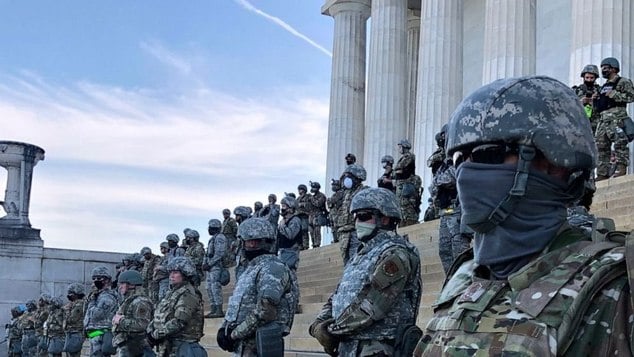
Their treatment, by comparison, of a bunch of redneck wankers upset that a corrupt plutocrat did not win their barely-there democracy:
Oh and I forgot to mention the selfies:
ACAB. -
Donald Trump (All General Trump Conversations Here)That all said this really is a fitting denouement of four years of Trump rule: loss of the white house and the two legislative chambers, along with fruits of exactly what the Republican party have been sowing for years now. You couldn't get away with fiction this on the nose.
-
Donald Trump (All General Trump Conversations Here)And real grievances? What real grievances? — tim wood
Four years and you still can't answer this question. I feel pity for you too. -
Donald Trump (All General Trump Conversations Here)Yeah, I made a small edit to the post you quoted. But yeah, in the main you're right. I guess I just see alot of wasted potential there, as it were. These people should be allies. Their fight should be the same fight any as on the left.
-
Donald Trump (All General Trump Conversations Here)This billionaire buffoon stirs up the underclass into believing their will was subverted, their election stolen, and now their guns and way of life will be taken away. I do think they really believe this and they'll speak proudly to their grandkids about how they fought for freedom like a true patriot. — Hanover
I think so too. My immediate feelings are both of pity and admiration; pity because these poor fools are being used by powers who would not give a flying hoot if they died right there and then; admiration because they have the courage of their convictions so rarely seen. These people are real people with real greviances, and they've been manipulated into being pressed into the service of some moron who would gladly watch them burn. -
There is such a thing as private language, but it’s not what you thinkHow effectively do they lock-in shared meanings? — Joshs
This isn't a question that can be answered in the abstract. How effectively for what purpose? In the capacity of what role in action? Language works - not always sucessfully - to constrain uncertainty. It works to the extent that it is 'good enough' - not unlike evolution where what survives is 'good enough'. Communication is communication of the 'good enough', not for perfect matchings of 'internal states' or what have you. The latter is a metaphysical picture of language peddled by philosophers who have never studied human behaviour outside of imagining it in their books. -
Donald Trump (All General Trump Conversations Here)
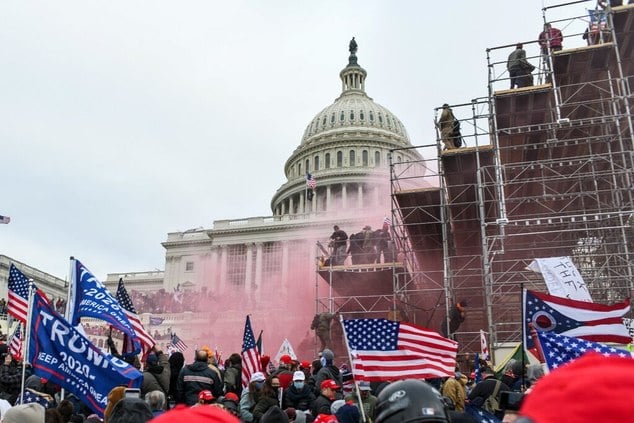
All that powerful, revolutionary energy. Channelled into defending a plutocrat like Trump. What an utter waste. -
Donald Trump (All General Trump Conversations Here)Trump would watch these people get shot by capitol cops and laugh as they do. These poor wretches are defending a man who wouldn't give a flying fuck about them if he tried.
-
Donald Trump (All General Trump Conversations Here)Sure.
The CIA must be rather upset right now. Only they get to orchastrate attempted violent coups against democratically elected governments in overexploited countries. These people are stepping on their turf. -
Donald Trump (All General Trump Conversations Here)There is of course, nothing inherently wrong with people storming capitol buildings to kick out shitty governments. When this happens in other, browner countries, it's usually hailed as some kind of exercise of democratic discontent. It just so happens that this particular attempt was orchastrated by a bunch of incompetants looking to defend a monied wanker.
-
Donald Trump (All General Trump Conversations Here)You threatening people with a good time again?
-
Currently ReadingEllen Meiksins Wood - Citizens to Lords: A Social History of Western Political Thought from Antiquity to the Middle Ages
Albert O. Hirschman - The Rhetoric of Reaction: Perversity, Futility, Jeopardy
Gilles Deleuze - Foucault -
The Road to 2020 - American ElectionsI'm glad the democrats
wonare winning the senate. Now they will have no one to hide behind when they continue to flush the US into the gutter. -
There is such a thing as private language, but it’s not what you thinkTherefore, don't we have the two incompatible functions of language? — Number2018
No, because even such an expressive use of language is still a technique, it responds and is constituted by imperatives of communication - grammar key among them - that are social through and through. To quote Reza Negarestani (form Intelligence and Spirit):
"The capacity to know, believe, or mean something rests upon certain practical know-how (i.e., pragmatism), the practical mastery of inferential roles. ... the noises or behaviours of interlocutors can only count as saying or claiming something if said interlocutors know what to do—in accordance with rules and following some standards or norms—such that they can draw inferences from each other’s claims, using such inferences as the premises of their own claims and reasoning. Here, syntactic expressions as items of language assume semantic value or meaning when they are incorporated into the interaction of practitioners of discursive practices that give inferential roles to such utterances. These are practices that adopt or attribute normative statuses, commitments, and entitlements that stand in consequential relations to one another" - which is fancy way of saying that to know what is to know how: the first is a subset of the other. They are not two different functions of language.
Or as Daniel Dor puts it, the whole point of language is to bridge what he called the 'experiential gap' between people: "
"Our experiential communicative intents very rarely, if ever, emerge in our minds as digitally demarcated intents to either say or ask something, to order, or promise, or predict, or deny, and so on. They are multi-layered, variable, vague, dynamic, analogue. We wish to express something, and what we wish to express is as complex as the experience within which the communicative intent emerged. Coupled with the foundational fact of the experiential gap, this analogue complexity constitutes a major obstacle to communication: we very often find it difficult to understand what the person speaking to us is trying to do (“is this a promise or a threat”), and our experiential histories often lead us to the wrong conclusion.
Speech-acts, then, are socially negotiated, stereotypical communicative behaviors, highlighted and isolated from the experiential continuum of communication, which, when practiced according to a set of mutually identified conventions, allow for the successful mediation of the speaker’s intention across the experiential gap. When conventionalizing a speech-act, what the members of the community agree on is this: “from now on, when we behave this way—when, in these particular contexts, we use this intonation, this word order, this gesture—we mean to ask a question (or make a promise, or tell a story).” (The Instruction of the Imagination).
Streetlight
Start FollowingSend a Message
- Other sites we like
- Social media
- Terms of Service
- Sign In
- Created with PlushForums
- © 2026 The Philosophy Forum