
Comments
-
On the Value of WikipediaOk, you don't actually have an argument against my point. I meant occult to mean simply "hidden from view behind a paywall". — boethius
Yes, that was what I understood you to mean. It isn't so much paywalls that separate the masses from the latest scientific research, but years of training and immersion in the field. I take your point about people with some scientific education, some even degreed and with a bit of professional experience, who at some point left universities, research institutes and R&D departments where they had access to scientific publications in their field (indeed, I am one of those people). But I think you overestimate their numbers and their willingness and ability to actively engage in reviewing the latest research. Very few retirees, decades out of practice, would be able to polish their rusty education, however much of it they had in the first place, get up to speed with everything that's been done and published in the intervening years, and get back into the thick of it. (And, by the way, those who live close to a good university can often get a library access for their personal research, free of charge, not to mention municipal and national libraries. I have taken advantage of that at some point.)
And this is leaving aside the absolutely bonkers conspiracy theory that you have going about scientists hiding their research behind paywalls so that outsiders, untainted by special interests, would not be able to check their work. For one thing, scientists don't have much to do with the publishing industry. They don't get to decide the business model of the journals in their field, and few of them even care. Generally, they'll try to submit their work to the highest-profile journal that will accept it, other considerations being secondary (and among those secondary considerations are publication fees, which can be much higher in open access journals, for obvious reasons). The only examples of authors exhibiting a preference among traditional vs. open access publishing that I know are actually in favor of the latter, driven by grievances against traditional publishing or ideological considerations along the lines of alcontali's.
And then of course there are all the reasons why such an insanely massive conspiracy, involving millions of researchers and even more students all around the world, working together and in absolute secrecy for many decades, could not possibly hold together. Honestly, I feel silly even arguing about this. -
History of a Lie: The Stanford Prison ExperimentNo, you misunderstood whatever snippet that you have read. You need to read the article in order to be able to comment on it.
-
History of a Lie: The Stanford Prison ExperimentWhat these attacks seem to miss, is the fact that these experiments sought to better understand events that had already happened. — Tzeentch
No, this point wasn't missed either in the cited articles or in the discussion in this thread. -
On the Value of WikipediaThis seems like a reasonable thing to say, moderation in all things, but I think is insufficient to properly address alcontali's concerns. — boethius
Is fanaticism for justice a moral blemish? Is thirst for the truth savagery? — boethius
Fanaticism for truth and justice sounds very fine and romantic. Who could object to that? The naked truth used to be allegorically depicted as a beautiful and (obviously) naked young woman, apparently in order to ensure that the visceral (or whatever) truth of the allegory would be felt by every (or at least every male) viewer:
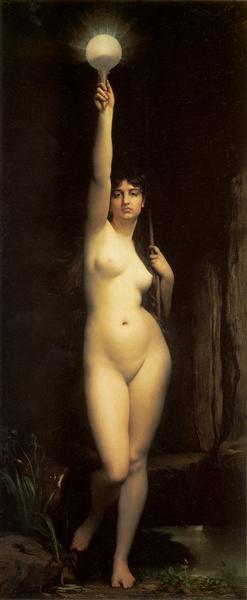
But the naked, unadorned truth is that truth in most nontrivial matters is far too messy and ambiguous and not infrequently unattractive (if not to say ugly), belying the seductive allegory. Passion is a double-edged sword (there is that dull moderation and evenhandedness again...) What a "fanaticism for justice" and "thirst for truth" often stand for is a passion for simplistic but attractive narratives - like conspiracy theories about corrupt whoever and big bad whatever - and easy fixes - "open source" this and "blockchain" that (or, to quote an earnest cri du coeur of a John Dos Passos character from much further back in time, "Why not social revolution?")
Me, I would prefer mealymouthed on-the-one-hand/on-the-other-hand, or barring that, admit ignorance and impotence, than be taken for a ride by phantoms. Maybe I am revealing my age too much here. But hey, if conspirology and populism feel right to you, then sky is the limit - or at least the so-called "most powerful office in the world," as has now been demonstrated.
Why do experts tolerate and provide non-evidence, non-good-reasoning based arguments for occult research, research that is not accessible and occulted by pay-walls, is I believe for exactly the reasons alconti is proposing: anyone can check. If data is analysed to come to a conclusion, it really is as alconti says: anyone with a computer can check if that analysis was done correctly. — boethius
The thing is, those who have the qualifications and the interest to check published research, for the most part can already do this, through their affiliation with institutions that provide subscriptions and library services. It's been a long time since I was at a university, but even back then I could get just about any paper, even from some obscure typewritten conference proceedings, if not from our own library or an online subscription, then through inter-library copy service. What makes modern science an "occult" institution is not so much physical access to scientific publications as the often high bar of competence and professionalism that is required to be even a good critic, let alone a good practitioner. Lacking that competence and professionalism, we get these "citizen scientists" posting detrended temperature graphs to prove that global warming is a hoax. (That's not an argument for hiding science from the unwashed masses behind paywalls, by the way.)
I am well aware that there exist legitimate criticisms of scientific institutions and of the publishing industry, but, for better or for worse, those criticisms usually aren't easily packageable into slogans and don't invite easy solutions. -
This has nothing to do with Philosophy sorry, but how old are you guys?maybe don't think too much into things. — Jimmy
That's gotta be the Philosophy Forum motto. -
Two Objects Occupying the Same SpaceBy "Objects", I mean physical objects. By "Cannot", I mean impossible. By "Why", I mean the reason behind that belief. I am guessing the reason behind that belief is seeing objects crash into each other or lightly bump into each other and instead of occupying the same space, they move away from each other, break or just prevent each other's movement. — elucid
In that case, the somewhat flippant answer that I gave you in the beginning still fits. There are plenty of things in our ordinary experience that fit this description (and you are not asking "why" such things exist, you take their existence and their properties for granted - which is fine, one has to ground the discussion somewhere). We refer to such things as "objects" in the English language. If we learn about certain entities that do not fit this description, such as rays of light or bosons or spirits, we may accept their existence, but we won't refer to them as "objects" in the same sense in which call chairs "objects." This is just a matter of categorizing and naming things. -
Two Objects Occupying the Same SpaceThe problem with this discussion is that no one, including, I am sure, the OP @elucid, quite knows what question is being asked, and what kind of answer is expected. Much of philosophy is about asking good questions and being alert and skeptical about assumptions, especially your own.
"why people claim that two objects cannot occupy the same space at the same time"
What is meant by "objects"? Are they bulky solid things that we can see and touch, as per one common meaning of the word "object"? Or anything to which one can refer, as per the grammatical sense of the word? Or something else?
And what does "cannot" mean in this sentence? Cannot in fact (in our world, to the best of our knowledge)? Or in principle - what principle? If we relax the grip on reality and allow other possible worlds, then we have to have a good grip on the trans-world "objecthood", lest the word loses its meaning.
And what does "why" mean? Are we looking for a reductive explanation in terms of some underlying physics? That would be a relatively easy question to answer. A metaphysical principle? Then we'll have to tangle with objecthood and counterfactuals.
In this discussion, I think the intuitive image that most of us have of what is actually being disputed is whether two pieces of actual physical matter can actually overlap while remaining distinct. As everyone who has taken high-school physics or chemistry knows, a temperature field is an abstraction that represents such things as the average kinetic energy in the particles of a gas at a given point in space. For our purposes though, we are talking about the actual stuff, the particles themselves, not a smeared-out representation of their average kinetic energy. — petrichor
Everything is an abstraction, elementary particles included. Physicalist reductionism - the position that only (some) entities posited by fundamental physics really exist, everything else being mere abstractions and pragmatic simplifications - is a defensible view, but it must not be assumed unconsciously, as a matter of fact. -
On the Value of WikipediaYou have very naive, black-and-white notions both about academia and about open-access publishing. The best of open-access journals are very much a part of the academic world that you so despise, just with a somewhat different business model than pay-for-access journals. The worst are crackpot publications like Journal of Cosmology, and what must be by far the largest open-access sector, so-called Predatory publishing - fake online journals with no real editorial or peer review that, for a modest fee, will publish pretty much any submission from naive authors who don't bother to check the journal's credentials, or unscrupulous grad students and young careerists who just want to pad their publication lists. (Do take a look at the second Wiki link for some sobering perspective.)
Like , and said, there are good and bad sides to Wikipedia and open-access publishing, as well as academic publishing and institutional science. Neither condemning them in toto nor unconditionally endorsing anything "open-source" like a bright-eyed fanatic is reasonable. You need to get informed and use good judgement. -
Two Objects Occupying the Same SpaceThere is no such physical thing as a temperature field. — petrichor
That's kind of a silly thing to say, on the one hand. A field is "a physical quantity... that has a value for each point in space-time." And temperature is, of course, a physical quantity. One can talk about temperature fields, and electron fields, and all sorts of other physical fields, and they all exist in the same place (all place) at the same time (all time). But they are not physical objects, you would object! Well, yeah, when we talk about physical objects, we usually talk about things like chairs and stuff. So don't call things that are not object-like objects, and you'll get the conclusion that objects cannot be in the same place at the same time. Or do call them objects, and you'll get a different conclusion. Whoop-de-doo. -
Two Objects Occupying the Same SpaceFundamental particles can occupy the same space at the same time. See identical particles.
I, at least, consider particles to be physical objects. — Andrew M
You are just making my point. You choose to include elementary particles into things that you call "objects." I don't think it's a conventional use of words, but whatever - the point is that your choice of whether or not to call something an "object" has no metaphysical implications.
Elementary particles are tricky if you want to talk about them being in the same place at the same time. The best you can do is talk about their quantum states and their superpositions. But then you might as well talk about superpositions of classical fields - here at least being in the same place at the same time is well-defined. If you want to call classical fields objects, then of course you will find that such objects can be in the same place at the same time, but again, this is just word manipulation, nothing more.
Here's the conventional usage:
1. A material thing that can be seen and touched.
1.1 Philosophy A thing external to the thinking mind or subject. — Andrew M
That's a different meaning of "object." Sumerian grammar can be an object of a study in this sense. -
Two Objects Occupying the Same SpaceI am referring to physical objects. — elucid
So am I. Physical objects cannot occupy the same space at the same time. Things that can occupy the same space at the same time are not called objects. It's as simple as that. -
No room for freewill?On one now defunct forum that I used to visit they even made a sub-section of their philosophy forum specifically for free will discussions. I wish we had that here. Or just merge all the free-will-cannot-exist-because-determinism posts into one thread.
-
Two Objects Occupying the Same SpaceThis is just what we mean be the word "object." If some entities - real or imagined - can be at the same place at the same time, such as fields or ghosts, we don't refer to them as "objects." There is no deep metaphysics here, it's just convention.
-
How can you prove Newton's laws?I would like to know how can you prove these laws, but not using devices that use the the same laws. — Fernando Rios
The basic hypothetico-deductive method works like this:
1. Assume that the system under consideration is described by some theory - in other words, it follows some laws, such as Newton's laws.
2. On the basis of this assumption, make predictions about the system's behavior under certain conditions.
3. Prepare the system and perform an experiment. If your observations are in line with your hypothesis, then your hypothesis, and by extension your theory, are confirmed, otherwise it is disconfirmed (falsified).
There are variations and elaborations of the above (with some, for example, prioritizing falsification over confirmation), but this is the basis of the so-called scientific method. For this method to work, you absolutely need your instruments to be predictable, i.e. to follow laws - including, yes, the laws that you are testing. You just need to consider the instruments as part of the system that you are testing and make your predictions based on that assumption. If the test fails, you could blame all or any part of the system for the failure, including your instruments. You could then try to isolate the problem by performing further tests. And if the test succeeds, and so do other tests, then you will have a high confidence that both the experimental system and your instruments act in accordance with the laws. There is no vicious circularity here.
Of course, in practice we often choose to simplify and neglect many things when modeling an experiment. Thus, we may leave the instruments and our own actions out of consideration. But these simplifications are not made willy-nilly: ideally, we make them only when our theory predicts that they will not have much impact on the result of the experiment. And when the experiment doesn't show what we expect, then one of the explanations that we have to consider is that our assumptions were overly simplistic. We may then have to go back and take into account factors that we thought we could neglect, such as the behavior of the instruments.
What are the experiments that Newton used to show their laws are true? — Fernando Rios
This question worries me a little. I hope that you are not under the impression that Newton's laws are accepted solely on the authority of Newton himself, much like a religious teaching is accepted on the authority of a prophet or a sacred text. How Newton convinced himself that his theory was correct is a question for a historian or a biographer, but it is quite irrelevant to a 21st century scientist. Newton's own thinking could be deeply flawed and his methods wholly inadequate, for all we care - his laws have been tested so thoroughly since then that it no longer matters. -
Evolution, music and mathIt is certainly an interesting question to ask how music came about, and there can be different ways of answering it. The "easy" question is the descriptive one: How did the human cognitive capacity and disposition for music in fact develop? I say "easy" because it is amenable, at least in principle, to the kind of empirical enquiry that we know how to conduct - not that actually producing anything like a definitive answer would be easy! The "hard" question is the philosophical why question that I think you want to ask, and it is hard because it is not very clear what exactly we are asking and what (and why) we would take for an answer: the epistemic standards here are nowhere as well-developed as in the case of a scientific enquiry.
But what I think is not terribly controversial is that the question of humans' musical ability does not pose any particular challenge to the evolutionary theory. (I am emphasizing this because of the way you originally framed the topic.) It is not out of the question that music-making could have some adaptive value at some point in our development as a species, but even if it didn't, its emergence shouldn't be particularly surprising. Some traits are what evolutionary biologists Gould and Lewontin nicknamed as "spandrels": side-effects of other adaptive developments that don't have any particular adaptive value in themselves. Given the enormously complex furniture of our cognitive apparatus, some unintended "quirk" like musicality wouldn't be all too surprising, I think.
by the way what kind of cats do you own? I used to have a few himalayan's and I actually had a dream about baby Lions last night haha. — 3017amen
I was a cat in my past life, a Russian Blue I think ;) -
Evolution, music and mathI know, it appears that I have fallen and I can't get up!
If someone tells me these are just extra-chance-random features of consciousness, then I ask them for what reason? — 3017amen
The fact that our blood is red does not confer fitness advantage to us, so why is it red? The color of blood appears to be "just extra-chance-random" feature. Of course, in this case we know the answer: blood is red because of hemoglobin, and hemoglobin does confer fitness advantage. But there is no reason for the color as such: it could just as soon be blue or green. So do we have a problem here that cries out for an explanation? Maybe it's a metaphysical language of sorts? -
Evolution, music and math‘Survival of the fittest’ is an extrapolation (or a broad generalisation) of the theory of natural selection. It explains a prevalence of certain forms of diversity in certain environments, but it doesn’t satisfactorily explain the emergence of all traits. — Possibility
Not only that, but the slogan is not a good representation of the theory of natural selection.
At least one point to made viz. Evolution; it's hard to see how diatonic music theory confers survival advantages in the Jungle!!! — 3017amen
You are still stuck on the idea of hyper-adaptationism - the idea that all and only those traits that confer survival advantage will emerge as a result of evolution by natural selection. This was never part of the theory of evolution, not even in Darwin's original works (and we have come a long way from there in the last century and a half). -
Is Change Possible?I will try to explain what I am saying in a different way. — elucid
You are not trying to explain it in a different way. You are repeating the exact same truism ("a thing is what it is and is not what it is not") over an over again. Despite the thread title, you have not attempted to move on from here to discussing anything relating to change. You seem to think that the implication for the impossibility of change from that basic law of identity is so obvious that you cannot even spell it out. But in actuality it's because this one tool that you are wielding is inadequate for the job. You have confessed at the outset that you don't know how to define change. That is the root of the problem: you cannot reason about something that you cannot grasp with your intellect.
Here is my crack at it. The ordinary concept of change has two aspects to it: identity and difference. Change is possible because these two aspects are not in conflict with each other: a thing can preserve its identity through time, even if something about it is different from one time to another. For this to make sense the law of identity alone won't do; we need to have (at least) two identity scales: coarse-grained identity and fine-grained identity.
When we see a cup, we readily identify it as a single gross object - a cup. In our mind, this object preserves its identity through time by maintaining its structural and compositional integrity (within reasonable bounds), as well as by maintaining space-time continuity. A small chip or discoloration may not cause the cup to lose its identity, but being crushed or dissolved in acid will. A cup preserves its identity through the passage of time and through continuous translation and rotation in space. But another cup that simultaneously occupies a separate region of space constitutes a separate identity, even if it is otherwise indistinguishable from the original. We may mistake their identities at times, but we think that there always is a fact of the matter about which is which.
Our idea of what a cup is constitutes its coarse-grained identity that subsumes inessential distinctions - fine-grained identities. In other words, the coarse-grained identity (Cup) can be seen as a (possibly infinite) equivalence class comprised of fine-grained identities: Cup yesterday, Cup today, Cup on the table, Cup on the dish rack, clean Cup, dirty Cup, new Cup, chipped Cup, etc. That we can distinguish between these fine-grained identities, while at the same time lumping them all under the same coarse-grained identity is what makes change in the ordinary sense possible. -
Why is so much rambling theological verbiage given space on 'The Philosophy Forum' ?I am neither a follower of any religion nor an atheist. From my experience here and in other places, the parties most responsible for the poor quality of the discussions are the atheists. — T Clark
Even as an atheist, I am surprised that of all the garbage threads that are started here, @fresco chooses to pick on the few religion-themed ones.
But then of course, asking why so many of the threads posted on the forum are garbage is as pointless as asking why the world is such an iniquitous place. There's simply no non-trivial and satisfactory answer to that. -
Metaphysics - what is it?Personally, I'm comfortable with A. W. Moore's take on it, from his book, The Evolution of Modern Metaphysics: "Metaphysics is the most general attempt to make sense of things." — Jack-N
That's a good way to put it, if a bit vague. It makes sense if you are already familiar with various examples of metaphysics and are trying to generalize from that, but it probably won't be very helpful to someone who really doesn't know what metaphysics is, or has a distorted idea of it, for example, as something to do with the occult. -
Obfuscatory DiscourseDon't automatically assume that what seems to you like an abstruse post is a sign of "intellectual posturing." A forum is not a school or a public service; no one here has an obligation to make their posts intelligible and accessible for the widest possible audience. All sort of people post here, with all sorts of backgrounds and motivations. If you don't understand something, just ask. Who knows, you may actually challenge yourself and learn something.
-
How Do You Do Science Without Free Will?So, in short, do think there are alternatives to the "free will" model of personal responsibility which would be acceptable to the person in the street, i.e. be easy enough to understand and seem consistent with common modern notions of justice and fairness? — Janus
If you are interested in what people in the street (and perhaps also in courts of law and ethics committees) think about "free will", then perhaps, rather than trying to invent free will from scratch, deduce it from the meanings and etymologies of individual words, or from the agglomeration of historical writings and their exegeses, and then asking whether your model is acceptable, a better approach would be to try to first find out what free will, as well as related notions like agency and moral responsibility, mean to people.
To some extent, this approach has been taken by analytical philosophers in the latter half of the 20th century, although they were mostly posing rhetorical questions to themselves and to their colleagues - but nevertheless the intention was to take into account common meanings and real-life functions. A more empirical approach has been pursued in cognitive and social sciences in the last few decades, and it is at the interface with these areas where I think the most relevant philosophy is taking place. -
Humans are devolving?We as humans have made many technological break throughs over the past decades, but having us rely on such technology is simply dulling the human brain essentially making us idiotic people who think nothing of world issues or even issues in our own government. — Lucielle Randall
It is, of course, an age-old plaint about people getting stupider, weaker, more corrupt, etc. etc. But if you are being serious and not just idly moaning, then have you actually bothered to establish the truth of this claim? -
Reasoning badly about free will and moral responsibilitySo, what is a rational intuition? — T Clark
It's the point where reasoning stops and table-pounding begins. -
Are our minds souls?And as you are more concerned with who defends a view rather than the defensibility of the view — Bartricks
I am more concerned with exploring those views, starting with learning them even in the most basic outlines. But I can see that you are not interested in that at all. -
Are our minds souls?I don't think I misunderstand it at all. Which premise in which of my arguments are you disputing? — Bartricks
I just told you, didn't I? Why not read something about this topic if it interests you? You might want to start not with the identity theory specifically but with an overview of theories of mind, which will put things in perspective.
As for panpyschism having lots of proponents - er, no it doesn't, it just has a fancy name and is associated with a philosopher who has long hair and thinks he's a rock star.
Numbers don't mean anything, it is evidence that counts. But if you're (misguidedly) interested in numbers, then my view wins hands-down. The thesis that your mind is an immaterial soul and not your brain or any other physical thing is far and away the prevailing view among reflective people, now and throughout history. — Bartricks
You persist in misunderstanding this. "Self-evident" doesn't mean the most popular. Self-evident means that it is impossible to deny. This isn't just a quibble about words, by the way. You are too blithely dismissing positions without even trying to learn about them. That is not the attitude of a philosopher. At the very least, the fact that such positions are taken seriously by people who are not stupid or insane ought to give you a pause. -
Are our minds souls?You are misunderstanding the mind-brain identity thesis. It does not say that your mind is literally a physical object that is your brain. Rather, it says that the mind is identical to the processes in your brain, and mental states are really brain states. That should satisfy your modest requirement that the mind should not be a thing that you can touch, see, smell, etc.
That said, mind-brain identity position is not as widely held as you make it sound: it is only one of a number of physicalist theories of mind and, at a guess, not the most popular. Moreover, a dualistic soul is not the corollary of denying mind-brain identity. Again, it is only one of a number of non-physicalists positions on the mind, and again at a guess, not the most popular, at least among philosophers.
Yes, I understand what panpyschism is. — Bartricks
Then you should also understand that it cannot be self-evidently false, otherwise it would not have as many proponents as it does. -
How Do You Do Science Without Free Will?And of course free-will is tainted by its theological roots - I'm not trying to 'insinuate' this: here's me being explicit about it: free-will is theological trash. — StreetlightX
Well, thank you for being so upfront, I guess - this will save me time and effort. By giving a caricature of your position I was hoping (though it wasn't much of a hope after seeing your earlier posts) that I might be proven wrong or that I might elicit a more nuanced take. But it looks like the caricature was spot-on. Oh well.
As for concepts being 'conflated with 'that which they purport to address', wtf else are concepts if not designed specifically for address 'what they purport to address'. — StreetlightX
Fortunately, that's not what I said. -
How Do You Do Science Without Free Will?Funny how an 'innate understanding' had to be invented by theologians a couple of hundred years ago before which it was nowhere to be found. — StreetlightX
It's not contentious. — StreetlightX
It's contentious, if you care to survey philosophical literature on free will, rather than just the works of one or two authors. And no, I am not going to get into a childish flame war with you over this; I am not that interested in history and exegesis, any way. My point of contention is that you are muddying the waters by conflating the intellectual history of free will as an articulated philosophical concept (and a very specific version of that concept, if you insist on tracing it to Augustin et al.) with that which this concept purports to address. What I particularly resent is the attempt to shout down the debate by the unsubtle insinuation that the concept is forever tainted and discredited by its history as an opium for the masses that was maliciously concocted by theologians. You can be critical and revisionist about free will without being stupid and dogmatic. -
My notes on the Definition of Mathematics.analytic truth truth by virtue of the meaning of the words of a statement, synthetic needs meaning and correspondence with reality as well. Here with this terminology I'm speaking about rule following which can even be of strings of empty symbols, so meaning is not involved here, however synthetic seems to be overlapping with receptive truths. I think that analytic is "meaningful consequential truths", so I think the term "consequential truth" is weaker than analytic truth, although of course you can object to this by holding that consequential truth is a kind of non-meaningful analytic truth or by saying that rule fellowship is a kind of meaning, you can call it meaning by having a role in following a rule, if so then we can subsume consequential into analytic. The new things is that KANT was saying that mathematics is apriori synthetic. Which this philosophy doesn't agree with. I more agree with Hume that mathematics is purely analytic nothing else. — Zuhair
Right, so your receptive/consequential distinction falls approximately along the same line as Hume's matters of fact vs. relations of ideas, which is now often aliased as synthetic/analytic, although one can certainly split semantic hairs and introduce further distinctions, like Kant's a priori/a posteriori. (For that matter, Hume's own treatment of relations of ideas amounted to more than just rule-following.) In any event, this is a well-trodden path - I was just wondering whether you thought you were bringing some fresh perspective and not just your personal terminology.
The idea that all there is to mathematics is manipulation of symbols according to fixed rules is true only within a comparatively limited, 18th century conception of mathematics, when mathematics was the mathematics, and it sprang from the same source as logic and rationality itself. Since then we have significantly broadened our ideas of mathematics - and for the matter, of logic and rationality as well. This is what @fdrake is getting at: the more interesting questions in the philosophy of mathematics revolve around the rules themselves, rather than the uncontroversial fact that conclusions can be deduced by following those rules. -
My notes on the Definition of Mathematics.That's a lot of words, but I am kind of struggling to understand what it is that you think is the original thought here. How is your receptive/consequential distinction different from synthetic/analytic, etc. - what has become known as "Hume's fork" (and has since been deconstructed and criticized by Quine, etc.)?
-
How Important is Reading to the Philosophical Mind? Literacy and education discussion.Unfortunately, the only Hugo I've read is "Les Miserables," which I read in French in high school. — T Clark
That's some assignment!
I read Notre-Dame de Paris as a teen, and even at that age his overwrought romanticism turned me off. The shear bulk of Les Miserables scares me. Not that I am intimidated by big books in general, but five volumes of that kind of prose... -
Bias against philosophy in scientific circles/forums"What it means" is where conceptual issues begin and end. What did you think I meant? Specifically with regard to causality, since that was the context, the issue is pretty controversial in QM. As you know, cause is not really a term in QM's vocabulary (and the same can be said about most areas of physics), so it is all about interpretation.
-
How Important is Reading to the Philosophical Mind? Literacy and education discussion.Certainly. Sorry if I've misunderstood you.
-
How Important is Reading to the Philosophical Mind? Literacy and education discussion.Reader here. I read every day, though since I am a slow reader, I don't cover nearly as much ground as some. I don't have a good idea of how much other people outside of my small social circle read, so I can't really compare myself to others. I take no personal credit for my literacy - it was inculcated in me by my parents.
I read mostly fiction - "serious" literature, with a bit of light fare for when I am too exhausted or distraught for more demanding stuff. I rarely read book-length non-fiction - I just don't value most of it enough to prioritize it over fiction. I was a bit surprised to see @Amity and others referring to reading fiction almost as if it was cheating at reading. On the contrary, I have always associated "reading" with fiction books, first and foremost.
Shakespeare’s language is, of course, “dramatic” stage language. It doesn’t make for easy reading. — Bitter Crank
I actually find Shakespeare's dramatic "high" style easier than his "low" style - all that witty banter, in which most of the witticisms and sexual innuendos you wouldn't even understand without a commentary that runs twice as long as the text itself. I think I learned (and have long since forgotten) a dozen euphemisms for penis and vagina while reading an annotated Much Ado about Nothing (starting with the title, of course). In Henry IV I struggled with Falstaff's scenes, uproarious though they might be, but when I would get to some princely monologue - whew! Smooth sailing at last! Here I could read a few lines without consulting notes. -
Bias against philosophy in scientific circles/forumsNow of course this is a single interaction. — Coben
Which is impossible to judge based on the retelling of one of the participants. For all I know, you could be right, but to a rational observer who knows only that the argument was between a non-expert with a superficial familiarity with the research and the experts who conducted the research (because even before you squabbled with someone on a forum you were in a virtual argument with the authors of the studies in question), the balance of credibility is obviously not in your favor.
But that's not the important point. What was the point of this anecdote?
I just bring it up because it is a sort of classic philosophy/science encounter. — Coben
From what you have told us, it appears that the "classic encounter" consists of you presuming that scientists in general would not know anything about isolating principal causes of a phenomenon while accounting for relevant confounders. How could they, indeed? After all, 'cause' is a philosophical term of art, so they need an amateur philosopher with little knowledge of the subject matter to set them straight.
What is particularly perplexing about this encounter is that as a philosopher you weren't problematizing a concept that is commonly taken for granted, or bringing to light an unexamined assumption, or suggesting a different conceptual framework. Rather, you were challenging the science on its own turf - perhaps without even realizing that that is what you were doing. It could be that the researchers did not do a good job of accounting for all relevant factors and evaluating alternative hypotheses - I don't have enough information and expertise to judge. But that is precisely what is expected of them as scientists.
How do you think philosophers theorize about causality? How do they evaluate their own theories? They systematize and generalize causality by examining our causal thinking and practice. But toy examples like billiard balls colliding or stones smashing windows can only get you so far. Scientific practice provides a large pool of complex examples, from Newtonian dynamics to epidemiology, and here philosophers mostly learn from scientists, rather than the other way around. If a philosophical account of causality is contrary to the best scientific practices, this is usually taken to be philosophy's deficiency.
That is not to say that philosophers cannot contribute to the discussion of causality, but that would be more in areas where science runs up against conceptual difficulties, such as in quantum mechanics, for example. As for routine problems with the quality of studies and such, scientists and mathematicians are more adept at debugging those than most philosophers. -
How Important is Reading to the Philosophical Mind? Literacy and education discussion.I thought Hugo was a Republican. — Bill Hobba
LOL you guys. Yeah, you could say that Hugo was a republican, though not in the way you think. -
Reductionism in EthicsHave you heard of "blogs"? It's a hot new thing on the Internet - you should check it out!
-
Bias against philosophy in scientific circles/forumsFrom my perspective, what you say is mistaken. Any area with a mental component has philosophy somewhere in its foundations, if you grub around enough to find it. How could it possibly be otherwise? — Pattern-chaser
Did you read just this last sentence? I don't deny the value of philosophy, nor even its applicability to science. -
Bias against philosophy in scientific circles/forumsSomebody in this thread said that part of the reason philosophy is looked down on by scientists is that the philosophers don't do or understand science. — T Clark
This situation is changing though. Just as science is no longer the province of gentlemen dilettantes, as it was until about the mid-19th century, philosophy is catching up and becoming more professional and specialized. It is not uncommon now for philosophers of science to have an honest-to-goodness science degree. And while such a formal degree is not a prerequisite for doing good philosophy, I believe that only those philosophers who demonstrate a decent grasp of their subject deserve to be taken seriously.
We should turn that around too, make people understand that so-called scientists who don't understand the intellectual underpinnings of what they do are just technicians. — T Clark
Some people here tend to arrogantly overestimate their understanding of science and scientific process and underestimate scientists' intellectual abilities. It is easy enough to find examples of uninspired or incompetent science (provided that you have the competence to judge!) just as it is easy to find examples of uninspired or incompetent carpentry, and for pretty much the same reason: when something is so ubiquitous, it can't all be excellent. (And how much excellence does hammering a nail require, anyway? A lot of research is basically hammering nails.) But there have always been outstanding intellectuals working in science, who could give the best of philosophers a run for their money, even if they didn't spend much time poring over their Aristotle and Kant. Frankly, the conceptual riches that have opened up in science and mathematics over the last 200 years make a lot of philosophy look shallow and insignificant in comparison.
I am embarrassed for those "philosophers" (not talking about you, T Clark) - nitwits and crackpots who come here to sneer condescendingly at the Borns and the Feynmans - those benighted bunglers! If only they listened to our sophomoric insights, science wouldn't have been in such a hot mess that it is nowadays! If any self-respecting scientist happened upon this forum, she would tell them where they can stuff their philosophy - and would be absolutely right. Philosophers need to step up their own game if they want to be relevant.
SophistiCat

Start FollowingSend a Message
- Other sites we like
- Social media
- Terms of Service
- Sign In
- Created with PlushForums
- © 2026 The Philosophy Forum