
Comments
-
Bias against philosophy in scientific circles/forumsBeyond that, the question in science is rather: How did you test that? How did you take care of scientific controls? Has anybody else tested it again? These anti-spam measures neatly hark back to Popperian falsificationism, which in my impression, still rules as king over the epistemic domain of science. — alcontali
This isn't so much Popperian falsificationism as just empiricist principles that were around, more or less, since Bacon's time. Falsificationism is something more technical and specific - one analytical treatment out of many that were being developed starting from around the turn of the century in an attempt to formalize and precisify those widely shared ideas. Poper, Duhem, Hempel, Ramsey, Fisher, Neyman, etc., etc. - they weren't in disagreement about the general principles (except when they were trying to exaggerate their differences, as Popper in particular was apt to do) - they disagreed about analysis.
But while such analytical work still continues, I think the era of all-encompassing analytical programmes for science has been eclipsed over the last half-century by a more historical-sociological approach of Kuhn, Feyerabend, etc. that acknowledges science's messy, complex human nature. None of the simple analytical models that have been proposed proved to be a good universal fit for science's successes and failures. Instead, there are general, necessarily vague empiricist principles, and then there are many particular methodologies, protocols, techniques and know-hows that are being gradually developed and adjusted as we go along. -
"White privilege"For myself, I am proud that I had loving parents, grandparents and grew up in a stable home with both a mom and dad present. — Teller
What exactly are you proud of? Choosing your parents wisely? -
Bias against philosophy in scientific circles/forumsUnfortunately, NY Times has a policy of endlessly nagging for readers to create a "free" account and give up lots of personally-identifying data, in order to access the information linked to. I have a personal policy that says, if the only source is NY Times, then it has no source, and then the information simply does not exist. My policy works absolutely fine. We do not "need" NY Times. How could we "need" them, if they are not even convenient to use? — alcontali
You don't need a NYT account to read this article. If somehow, despite your policy, you've exceeded their free articles-per-month limit, you can just open it in a private/incognito window or delete newyorktimes cookies.
Anyway, there is a link there to d'Espagnat's 1979 article in Scientific American, The Quantum Theory and Reality. Apparently he was pushing for a link between consciousness and quantum measurement - not a new idea even then, but one that was and still is largely rejected both by physicists and philosophers. Still, d'Espagnat is given credit for the resurgence of interest in philosophical problems of quantum theory.
Interesting link:
But, as many in Munich were surprised to learn, falsificationism is no longer the reigning philosophy of science. Nowadays, as several philosophers at the workshop said, Popperian falsificationism has been supplanted by Bayesian confirmation theory, or Bayesianism — alcontali
I don't think it's fair to say that Bayesianism supplanted Popperian falsificationism. Bayesian confirmation theory was developed by Ramsey, de Finetti and others long before Popper came on the scene, and remains with its variations, such as likelihoodism, one of the dominant quantitative treatments of theory selection. Falsificationism, on the other hand, never really took off and isn't much talked about, except in connection with Popper.
In my opinion, anything based on probability theory and statistics must be treated with utmost scrutiny, because these things are core ingredients in the snake-oil industry. — alcontali
Statistics is a very tricky and philosophically fraught subject. Nevertheless, statistics is where the rubber meets the road, as far as philosophy of science is concerned. If your philosophy has no implications for statistical methodology, then it has little relevance to science. -
The American Gun Control Debate32 mass shootings this so far this year - that's about once per week.
Looking forward to "debating" this for the next round of mass shootings! — Maw
“In retrospect Sandy Hook marked the end of the US gun control debate,” Dan Hodges, a British journalist, wrote in a post on Twitter two years ago, referring to the 2012 attack that killed 20 young students at an elementary school in Connecticut. “Once America decided killing children was bearable, it was over.” — NYT -
Bias against philosophy in scientific circles/forumsDo scientists have an irrational bias against philosophy, specifically philosophy of science? Or am I not understanding an obvious truth, such as that science doesn't seem to have anything to do with philsophy of science? — Shushi
Well, Science Forums has an explicitly stated narrow focus and tight moderation, so the fact that your thread was closed immediately and the earlier thread was short-lived as well is not an indication of anything. However, it has been my experience that people with scientific and engineering background do often display little patience for and a good deal of prejudice against philosophy. Unsurprisingly, this is mainly seen among those who know little about the field, or worse, have distorted ideas about it.
For example, outside of its specialized usage, the word "metaphysics" can mean "abstract theory with no basis in reality" (OED), and historically it has often been associated with the irrational and the occult. Is it surprising that people who are into natural sciences would tend to be allergic to such a notion? You yourself have confessed to thinking that "it was just pure speculative talk and nonsense that anyone could make up" - before you learned a little more about what philosophy was really about. And, to be fair, a good deal of philosophy has been and still is "speculative talk and nonsense" - but not all of it, as you and I agree (although to my mind, Penrose and Polkinghorne offer examples of the more disreputable kind of "metaphysics").
No doubt, some of the prejudice comes from ignorance and the sort of arrogance that people who are accomplished in their field often display for other fields (here, of course, I am talking about people like Hawking and Krauss, not just random Science Forum posters, most of whom are not even scientists). Physicists might be especially guilty of this:
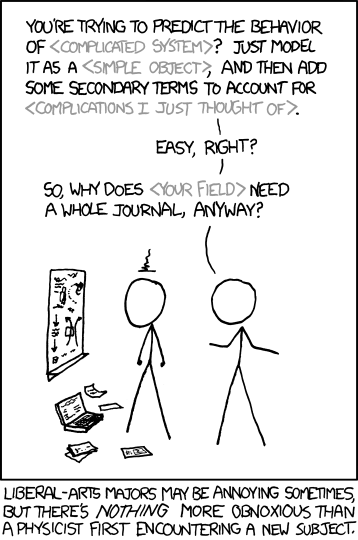
There have always been scientists with an interest in and a respect for philosophy. Off the top of my head, a few of the prominent working scientists are George Ellis, Sean Carroll, Anthony Aguirre - perhaps not surprisingly, all cosmologists. I could also think of some theoretical physicists. But it used to be - I don't know if things have changed in the recent decades - that philosophy was almost a taboo subject in science departments. David Albert, who earned his Ph.D. in theoretical physics in 1981, says that after he developed an interest in philosophy he almost got kicked out of the grad school when he said that he wanted to write his thesis on foundations of physics. In the end he was forced to do a thesis on a very technical, calculation-heavy subject picked for him by the department, but eventually, after working with Aharonov at the Tel Aviv University, he became one of the more prominent philosophers of physics. -
The Universe Cannot Have Existed ‘Forever’WTF? Will you just keep spamming these idiotic threads about infinity? One is not enough for you?
-
Free Will or an illusion and how this makes us feel.Sorry I was a little snippy in my response. That free will is undermined by a deterministic universe is an old and perfectly respectable philosophical position.
How would I feel about the free will that doesn't exist? I think it would make me happy knowing that I am fully responsible for my actions and that others would be responsible for theirs instead of being victims of circumstance we would be accountable in a similar sense you would be able to blame and be blamed for things but also take complete credit. I suppose the feeling of control is what the best thing about it would be. — AwazawA
I think the best thing about a real free will would be that I could truly be the author of my own thoughts and feelings and actions which makes them feel more real than having it all go according to a fate. — AwazawA
But don't you still feel that, when you deliberately do something, it is you acting on your intentions? Don't you still feel in control and responsible for your actions? Don't you still hold others responsible for theirs?
It is true that, when we learn about all the external factors that influenced or even forced someone's decision, we are apt to feel that they were less in control, that the decision was not fully theirs, and that they are therefore less responsible for it. Likewise, when we contemplate the environment and incidents that formed someone's character, we may blame them less for some offense that they committed, or, in opposite circumstances, tend to take for granted their good deeds. But by and large, that sense of people, ourselves included, being the source of their actions and making choices when there are choices to be made remains strong, no matter what. -
Law Of Identity And Mathematics Of Changedon't want to reject mathematical models, far from being a mere philosophical point; if I thought that I would have to change job! Specifically, I think mathematical models really do allow us to find things out about nature. What I was trying to highlight was that the use of time in mathematical models doesn't really tell us much about it, as any smooth bijective function of time could be used to parametrise them. — fdrake
Well, there is this position, to which I am somewhat sympathetic, that the abstract (mathematical) entities that we find to be indispensable in explaining (modeling) the world thereby exist. Of course, as you point out, time may not even be all that indispensable, or even if some time was necessary, there is no one definite form of it that we are forced to adopt. But then the latter problem is basically what Einstein's relativity tackles, where time is quite substantive, even if it is very much a reference- and coordinate-dependent entity.
My love of the chain rule example is that it suggests one way to exploit the arbitrarity of the time variable to 'internalise' it to other concepts; of differentials of unfolding. While time and unfolding are probably interdependent, time is often seen as unitary whereas unfolding is a plurality of links which we know have affective power in nature. It invites an immanent thought of time, whereas the times thought in (A,B) and the hypostatised 'indifferent substrate' of time are both marred by their transcendental character. — fdrake
You don't even need a smooth function in order to convey this idea: really, what it comes down to is variable substitution: expressing one quantity in terms of another. This works even for ragged and discontinuous relationships. However, to return to my reservations about this thought as a justification for what is, I think, a physical and/or metaphysical thesis, the same abstract manipulation can be applied in ways that are less physically meaningful and certainly don't warrant a parallel conclusion. For example, in the famous predator-prey example, instead of looking at populations of wolves and hares, we could look at the population of wolves and the amount of manure excreted by hares, which of course is closely related to the population of hares. Does this mean that we can therefor dispense with hares in this system? Well, we could for the sake of modeling the population of wolves (or the amount of shit, if that is what we are interested in), but surely our ability to do so doesn't indicate that hares lack substance!
(By the way, for me the Lotka-Volterra problem was one of the more memorable experiences from learning mathematics. It becomes even more dynamically interesting in 3D, if you add another variable into the system, such as grass.)
Edit-imprecise summary: time is something empirically real, not just something transcendentally ideal. The empirically real component requires different methodology to attack than the usual Kantian/phenomenological interpretive machines, and is still of philosophical interest. — fdrake
Thanks for this, I know I haven't addressed much of what you've said - but that's because I would like to think more about it. -
Free Will or an illusion and how this makes us feel.You are not answering the question. You don't need to tell me about how you think free will does not exist because I've heard this a thousand times, and so has anyone who has spent any amount of time on a philosophy forum. I am wondering, along with your OP, how you feel about the hypothetical real free will, the one you think we don't have. What would it be like? How would it be different from the one that you call "pseudo free will" and Dennett calls "free will worth having?"
-
Free Will or an illusion and how this makes us feel.Gotcha. Yes, it's a good question. But I would like to turn it around: What would a real, non-illusory free will be like? In what way would it be different from the one that is supposedly illusory? What would it take to have such a capacity (if that's what it is, a capacity)?
-
Free Will or an illusion and how this makes us feel.Currently there hasn't been a great deal of discussion about free will — AwazawA
Have you tried the search function? -
Law Of Identity And Mathematics Of ChangeThere's a lot going on in the question. — fdrake
Yes, and thank you for a comprehensive response.
From this I think we should resist saying that the progression of the physical entity of a clock depends upon a concept we have derived from the clock; as if the clock would not tick without the operationalisation of time that it embodies in our understanding. Or if it would not tick without experiential temporality stretching along with it. — fdrake
Oh but I don't think that we derive the concept of time from the clock. From the moment of the first eye opening we already have some intuitive understanding of time. Observing clocks helps us to further contextualize, structure, and quantify that understanding, and more careful observation and reflection leads to more sophisticated understanding of the structure and measure of time in terms of mathematical models and measuring devices.
So when you ask yourself, "What is time?" you can point to periodic processes or to theoretical models, but then if you ask, "What validates those explanations?" you still have to go back to the phenomenology (including, of course, the phenomenology of clocks), because what else would we go back to? That doesn't mean, of course, that we have to hang on to every prejudice and intuition, but our explanations have to be true to something, or else they just hang free, like abstract mathematical entities.
What does a clock show? What does it mean to say that this iteration is prior to that? If we reject mathematical models as inadequate for exhaustively answering empirical questions, I am afraid that an answer can only be provided by gesturing, tautologically, towards some sort of unfolding. Tautologically because, of course, our notion of unfolding is already informed by the notion of periodic processes. -
The Stanford Encyclopedia of Philosophy as a model for online informationThere is a difference between not dumbing a subject down, and explaining it in such a way that your explanation can only be understood by someone who has a sophisticated understanding of that subject already.
The following is a direct copy and paste from the article:
The following theses are all paradigmatically metaphysical:
“Being is; not-being is not” [Parmenides];
“Essence precedes existence” [Avicenna, paraphrased];
“Existence in reality is greater than existence in the understanding alone” [St Anselm, paraphrased];
“Existence is a perfection” [Descartes, paraphrased];
“Being is a logical, not a real predicate” [Kant, paraphrased];
“Being is the most barren and abstract of all categories” [Hegel, paraphrased];
“Affirmation of existence is in fact nothing but denial of the number zero” [Frege];
“Universals do not exist but rather subsist or have being” [Russell, paraphrased];
“To be is to be the value of a bound variable” [Quine]. — van Inwagen, Peter and Sullivan, Meghan
Hmm... Okay. Cool.
My personal favorites are the final three. Although "Existence is a perfection" has its charms too. — Theologian
Again, I am at a loss as to what occasioned your ridicule. Do you think that in order to understand the authors' point here, one needs to have studied all of the philosophers that they list, and understand the positions that each of those (selfconsciously crypitc) slogans designates? If you really think that, then I am sorry to say, you just don't know how to read.
What I actually said was:
an encyclopaedia article should be comprehensible to an intelligent lay person willing to put in a little effort. — Theologian — Theologian
You said that, but then you bristled at the suggestion that "an intelligent lay person" may have to put a little effort into looking something up in order to better understand what she is reading.
Note, I said "better." One thing you don't seem to understand about reading is that readers with different backgrounds can get different things out of the same text, and even the same reader can get different things from subsequent readings. You won't always comprehend everything there is to comprehend about a text, and that is OK, as long as you comprehend a fair amount. Someone who has never heard about Aquinas' Five Ways will still come away with an understanding that those arguments are a typical example of a certain kind of traditional metaphysics (as explained in the rest of the article), and if he doesn't care to look them up right away, perhaps he'll do so later with this knowledge in mind.
Try reading the article in its entirety and then get back to me. Of course, you do realize that I suggest this only because you have now earned sufficient enmity that I want to make you suffer... — Theologian
Yes, thank you, I am reading it now, and I am afraid I only have bad news for you. First, I like the article. Second, I find that it is fairly typical for SEP in rigor and style. -
Law Of Identity And Mathematics Of ChangeThe idea that a clock is simultaneously a measurement of and a definer of time is a bit weird (@Banno Luke @Fooloso4 @StreetlightX for Wittgenstein thread stuff :) ). I think it's better to think of periodic phenomena as operationalisations of a time concept which is larger than them; ways to index events to regularly repeating patterns. — fdrake
Yes, exactly, clocks (periodic processes) don't define time in the way definitions usually work, i.e. by completely reducing one concept to one or more other concepts; instead they operationalize time.
Thought experiment here - suppose that the universe is a process of unfolding itself, how can there be a time separate from the rates of its constitutive processes? What I'm trying to get at is that we should think of time as internal to the unfolding of related processes, rather than as an indifferent substrate unfolding occurs over. Think of time as equivalent to the plurality of linked rates, rather than a physical process operative over all of them. — fdrake
I agree with you here: it wouldn't do to think of time as just mathematical time of scientific models, or as an abstract metaphysical entity that exists independently of the world of physical processes. Just as there is no movement without there being moving things, there is no time without there being processes, unfoldings, etc.
And yet... how can there be processes, what could unfolding possibly mean, what are we to make of rates - without referring to the concept of time? I still insist that, although all these physical concepts in the first part of the sentence - let's refer to them as clocks for brevity - serve to operationalize time, they do not define time away; they are not more primary in our understanding than time itself is. And while we cannot understand time without referring to clocks, neither can we understand clocks without referring to time. -
The Stanford Encyclopedia of Philosophy as a model for online informationI don't know that having at least heard of Aquinas' Five Ways constitutes "technical background knowledge," but fine, let's assume that some readers don't have any notion of them. So what? Perhaps you are thinking of an encyclopedia as the sort of popular encyclopedias that used to be sold door-to-door, or children's encyclopedias? Well, this is obviously not that kind of encyclopedia. I am not even sure that complete amateurs are its intended primary readership, but in any case, it is not light entertainment. This is an adult resource dealing with a fairly difficult intellectual subject. It doesn't spoon-feed you everything; if you don't know or don't understand something, it is your responsibility to do the extra work to keep up. And I am glad that the authors and the editors neither dumb down their writing nor bloat it with details intended to explain every little thing and cover every possible gap in the reader's knowledge - and yet they manage to present their subject in a way that even a layman like myself, without any education in the field, can follow most of it.
Learning something new is always difficult when you have to start from scratch - whether it is learning a foreign language, or a scientific theory, or challenging art. Philosophy is a mature professional field, so why do you have this expectation that learning it should be effortless for everyone, no matter their background? -
The Stanford Encyclopedia of Philosophy as a model for online informationHonestly, I have no idea what you are talking about. Technical terms? What technical terms? Here is the sentence again:
"The first three of Aquinas's Five Ways are metaphysical arguments on any conception of metaphysics."
Well, I suppose if the words "Aquinas's Five Ways" say nothing to you, then you wouldn't quite know what the author is referring to, but you would still be able to infer from the context that some famous historical philosophical text is a paradigmatic example of metaphysical writing, even if contemporary metaphysicians concern themselves with different questions. And if you google those words, then in about ten seconds you can learn that "Aquinas's Five Ways" are "five logical arguments regarding the existence of God summarized by the 13th-century Catholic philosopher and theologian St. Thomas Aquinas in his book Summa Theologica." -
The Stanford Encyclopedia of Philosophy as a model for online informationPerhaps we've been reading different articles, because my impression of the SEP is the exact opposite. I am a consummate layman: never took a philosophy class, and with the exception of Russell's little History of Western Philosophy, which I read many years ago and which served more to arouse interest and respect for the subject than anything else, I've never even read a complete philosophy book. As layman, I find SEP to be a great resource for getting acquainted with whatever philosophical subjects that catch my fancy. You get a brief explanation of the issue, an overview of developments, challenges, theories, open questions and controversies - and all this is supplied with a bibliography that you can follow at your leisure if you wish. You couldn't get this kind of information otherwise, without being a specialist yourself; I imagine that professional philosophers too find such resources useful for getting into topics that they know less about.
For the most part, I find the articles pretty accessible. Some topics proved to be a drag because the topic just didn't interest me much, but I don't think I've encountered entries that were objectively badly written or too technical for an interested layman to get at least something out of them.
Quite near the beginning of this atrociously dense and technical piece of writing, the author throws in the line: "The first three of Aquinas's Five Ways are metaphysical arguments on any conception of metaphysics." — Theologian
I don't understand why you find this sentence problematic. English is not my first language, so tell me, I am curious: is it the style? Or do you really not understand what it is saying? -
Donald Trump (All General Trump Conversations Here)I mean what was referred to in those days as the First World - North America, Western Europe, Japan, Australia. The liberal democratic order in those countries is what was widely considered to be the norm - not only by people who lived in those countries, but far beyond, by those who aspired towards the same lifestyle. Towards the end of the century especially, it came to be seen as the ultimate state of the human civilization (with some room for variations and improvements, to be sure), with no credible and stable alternative.
-
Donald Trump (All General Trump Conversations Here)I wonder what this will look like from the perspective of time and distance - an aberration that was limited and corrected or something that had more widespread and lost lasting consequences. — Fooloso4
I wonder whether a few decades from now, the post-war Western liberal democratic order will come to be seen as an aberration, or yet another passing phase at best, rather than "the end of history," as many saw it at the end of the last century. -
Law Of Identity And Mathematics Of ChangeSo, since it's arbitrary for the math, you can think of time relationally; as the pairing of systems creating an index; rather than as the index by which systems evolve. — fdrake
I think you have it a little backwards. We should think of time in relation to physical "clocks," such as heartbeats, diurnal cycles, pendulums or electromagnetic oscillations - because how else can we think of it? That this can be expressed in the form of the chain rule when modeling processes using differentiable functions is just a consequence. The backwards reasoning from a mathematical model to reality is inherently perilous, because mathematics can model all sorts of unphysical and counterfactual things.
Edit: or if you want it put (overstated) metaphysically, instead of conceiving as becoming as being changing over time, you can consider time as being's rates of becoming. — fdrake
Yes, except that when you ask what "rate" is, time creeps back in. I don't think you can completely eliminate time from consideration, reduce it to something else. You can put it in relation to something else, such as a clock (heartbeats, etc.), but that relationship is not reductive: it goes both ways. Clocks are just as dependent on time as time is on clocks. -
Arguments from AnalogyDid you read this in Wikipedia Argument from analogy perhaps?
P and Q are similar in respect to properties a, b, and c.
P has been observed to have further property x.
Therefore, Q probably has property x also.
Perhaps it may help to think of a property of P as any predicate applied to P:
P is red
P works in a bank
P happened yesterday
P is wrong
etc.
The latter "property" of being wrong or right, good or bad is particularly common in rhetorical uses of analogy. So for example when someone compares refugee detention centers to concentration camps, the analogy is clearly meant to imply that treating refugees in this way is wrong. -
Kastrup's The Idea of the World1. The existence of our perceptions and thoughts is more certain than the existence of matter, since the concept of matter is constructed from our perceptions and thoughts. (same goes with energy, invisible fields, superstrings, ...) — leo
What do you think? — leo
I think that this line of thought is psychologically naive. No, perceptions, thoughts, a certain order and hierarchy of our mental architecture - these are not apodictic, a priori truths. They are very much products of an abstract, theory-laden, culturally indebted thought. I don't think it even makes sense to talk about some absolutely a priori concepts. -
Can humanism be made compatible with evolution?They can base their values on whatever they like. — Coben
An ethical system is typically named after its core value. The core value of humanism is the human being. If they are basing this value on something else, then they shouldn't be called humanists - they should be something else-ists (rationalists perhaps, if they claim to have purely rational foundations for their values). -
Can humanism be made compatible with evolution?You are making it sound like cooperative behavior is motivated entirely by self-interest, which just isn't true. I don't even care to argue the point, I think it should be obvious if you think about it for a moment.
-
Can humanism be made compatible with evolution?Yes, humanists value human beings in a way they do not value other animals, but they are unable to justify this special treatment if they base their philosophy / ideology on evolution. — Matias
But where are you getting the idea that humanists are basing their ideology on evolution (thereby committing the naturalistic fallacy)? This is not a rhetorical question: I don't know much about humanism as a contemporary movement, although I suspect that it doesn't have anything like a unified, theoretically motivated ideology.
Truly moral and virtuous people are exceedingly rare. — Tzeentch
Oh sure, No TrueScotsmenMoral and Virtuous People would be favored by evolution! Which isn't far from the truth, for what that is worth. Evolution is not so much an optimizing process as a satisficing one: it doesn't need to create a population of Truly Moral and Virtuous People, it only needs to create a population of people who are, on the whole, moral enough to get along together in common circumstances - which, not coincidentally, is just what we are.
i suppose i often dont have too much to say — Frotunes
Then don't. -
What is the probability of living now?Seems well put. There seems to be some problem with the doomsday argument, but it's not a simple mathematical problem but one that has to do with more basic considerations. You can probably say that the problem is not that the math is wrong, is that the math doesn't provide a good model for reality in this case. So if we were just talking about the graphs as graphs, it might be fine to conclude that graph 2 is more likely. — Echarmion
@fdrake pointed that out back on page one.
Of course, the matter is not so cut and dried as to be dismissed out of hand, as evidenced by decades of arguments over The Sleeping Beauty, Doomsday, Simulation, etc. And the issue is not confined to abstract philosophical puzzles either: it lies at the heart of some conundrums in modern cosmology as well (typicality, fine-tuning).
For more on the general form of the issue look into self-locating beliefs. -
Illusionism undermines EpistemologyRight, but then he uses this to argue like Keith Frankish that subjectivity is an illusion. — Marchesk
Dennett's definition of consciousness is purely objective: functional, behavioral or neurophysiological with no additional experiential properties or stuff to go along with it. The colors, sounds, feels, are a trick of the brain. — Marchesk
Dennett's objection is to reflexive ontologizing of naive psychological notions of subjectivity. In the linked essay he gives a quote of Searle (also cited by Frankish) whom he holds guilty of just such a practice: "where consciousness is concerned the existence of the appearance is the reality."
Now, being skeptical of first appearances may sound like a sound principle at first blush, but when you think about it, we hardly ever practice such skepticism, and seem none the worse for it. When it seems right to be skeptical is when first appearances suggest something totally out of the ordinary. And for a naturalist like Dennett, that is just the case with how the likes of Chalmers treat consciousness. Their ontologizing of "qualia" and other half-digested items of folk psychology seem very much like magic ("real" magic, as opposed to stage magic). And not just because of their spookiness, but because philosophically, they are nothing but lazy, magical pseudo-explanations.
Yes, he wants explanations with some meat on their bones, not just fancy names for stuff we don't understand. -
Illusionism undermines EpistemologyKeith Frankish and Daniel Dennett are too proponents that conscious experience is an illusion produced by some yet to be discovered mechanism in the brain. By this, illusionists mean that we're being fooled by a cognitive trick into believing we have experiences of color, sound, pain, etc, leading some philosophers to propose there is a hard problem of trying to explain those experiences inside a scientific framework (the terminology of physics, chemistry, biology and neuroscience or cognitive science). Consciousness is compared to a magic show, where the brain fools us using some slight of cognition we're not aware of. — Marchesk
This is a caricature of Dennett's position. Dennett does not say that conscious experience is an illusion, in the sense of being unreal. He is saying that our intuitive, unexamined folk theories of "conscious experience" should not be trusted and given a privileged status, simply because they are ours. -
Is there a more complete scientific model than Anaximander's?What Hollywood likes is Virgil's reinterpretation of the Iliad, making the Trojan Horse a clever trick rather than an ignoble deception, and ending the story with Troy's successful demolition rather than the horrible fates of the victors. Mostly now Hollywood tells Virgiil's Aeniad, with Greek names, glorifying war rather than imparting wisdom as to its folly. — ernestm
You have never read either Homer or Virgil, have you? You got it exactly backwards. Virgil takes up the Trojans' narrative (for obvious reasons), and for him Greeks are the enemy, and the story of the Trojan Horse is a story of low cunning. Later Dante, who was raised on the Latin tradition, picked up Virgil's narrative and went so far even as to put Ulysses not in Limbo, with other heroes of antiquity, but in the lowest region of Hell, with liars and fraudsters. -
Wholes Can Lack Properties That Their Parts HaveTwo cells are not identical to one cell. So you can run the same argument in that case as well: one cell has a property that two cells lack: its numeric count, for one, or the property of occupying a continuous volume of space (also its total weight, volume, surface area, etc.)
-
Wholes Can Lack Properties That Their Parts HaveYou've posted the exact same argument before. You didn't get much of a discussion, because the idea is trivial and there is not much to discuss.
If A is not identical to B then there is a property that A has and B doesn't, and conversely, there is a property that B has and A doesn't. So if a part is not identical with a whole, then it trivially follows that the part has something that the whole lacks. -
Will Polling ever recover?You cannot put the blame on polls for not getting the result right a year or two before the event. What do you think pollsters are - oracles? How would you distinguish inaccurate polling from people inaccurately predicting their choice two years into the future?
-
What's your ideal regime?Though in general I dislike the idea, sometimes I do wish for an upvote button.
-
The case for determinismThere are a few common responses to such challenges. One is to bite the bullet and deny free will. This is a very common response among amateur philosophers: free-will-does-not-exist is one of the most popular topic starters on internet philosophical forums. It seems to be much less common among professional philosophers. Of the latter, one of the most forceful exponents of this position is Galen Strawson: a typical example can be found in his 1994 paper The Impossibility of Moral Responsibility. (Here he takes on moral responsibility, but he may as well be talking about free will.) He exemplifies reasoning that you will find familiar, and takes it to the bitter end.
Libertarianism is one of the less popular alternatives. It is often caricatured and rejected out of hand in internet discussions, but the positions of some of its contemporary proponents are rather nuanced and, at the end of the day, can be seen as not that far apart from some compatibilist accounts. Timothy O'Connor is a typical representative of this cohort, and he is the author of the SEP entry on Free Will, where he, understandably, gives a sympathetic outline of libertarian accounts. If you are interested in philosophers' take on free will in general, you can start from this article and drill down from there. (Libertarianism seems to be more common among religious philosophers, and O'Connor is typical in that regard as well. But his SEP article is far from partisan and, in my opinion, well presented. He gives a helpful breakdown of constituents of free will and shows how various positions deal with them.)
Then there is compatibilism, which in its more narrow form states that free will is compatible with determinism, but often comes to this conclusion by way of a broader argument that says that the question of determinism vs. indeterminism is irrelevant to free will. Note that compatibilists are not necessarily committed to determinism; some of them do not take any position on this question, and some may even be indeterminists. This is by far the most favored position among contemporary philosophers, if the survey linked above is to be believed. You can read about it in another SEP entry on Compatibilism. -
The case for determinismRight, but still, we, with our macroscopic sense organs, would never know about quantum effects if they did not propagate to our scale. So although the world at our scale is mostly classical (for most practical purposes), it is not entirely so.
Indeed, even before quantum mechanics, some held out hope that micro-level indeterminism might rescue human free will (it is a little-known fact that indeterminism is possible, in principle, even in classical Newtonian mechanics). And nowadays some similarly speculate that the apparent paradoxes of free will can somehow be resolved via (quite real) neuronal quantum effects.
But as I said (and I am not the first to make this fairly obvious point), randomness, whether quantum or otherwise, is not a solution to the challenge to free will that is posed by determinism: if anything, it makes things worse. No, the only positive resolution of the problem (i.e. one that does not end up denying free will) is to invalidate the challenge itself, as compatibilists try to do. -
The case for determinismTo continue with my initial example - how can we actually have control of our thoughts/actions when these thoughts/actions are driven by chemical reactions at a level that we can't possibly control? For instance, I can't trigger a chemical reaction just by my will alone - it's just something that was set into motion by the close proximity of those molecules, and those molecules were where at that moment due to external impacts that I also did not control. In the end, I didn't have direct control over that chemical reaction that produced the electrical impulse in my brain that eventually materialized into a thought/action. — MattS
How would macro-level indeterminism help? It wouldn't give you any control - on the contrary, it would make your actions erratic, out-of-control. Your actions would be nominally "free" in the sense that they would not be due to anything external to you. But you still wouldn't be able to take ownership of something over which you have no control - and by definition, you cannot control random events. So those erratic actions wouldn't be freely willed by you. -
The case for determinismDeterminism has become very compelling to me. I understand that many believe determinism to not be true, and I'd like to understand better why (because frankly, I don't like the idea of free will not existing). Here is the line of thought that has made it so compelling to me: — MattS
I don't see a line of reasoning here. You just make statements to the effect that determinism is the case "in your mind" and leave it at that, without providing any reasoning.
P.S. Same goes for 's assertion of indeterminism. -
Advantages of a single cell organism over a multi cell organismI'm not sure its rational for a single cell organism to partner with other single cell organisms. I think undirected evolution is an irrational concept. — christian2017
What is irrational is this argument from ignorance. No rational conclusion can follow from "I haven't a fucking clue." -
Will Polling ever recover?I don't know how "facts and figures" help. I am sure that someone more mathematically gifted than I am could give the probaility curves for the margins of error and show how they shouldnt have come into it so often. — orcestra
Well, facts and figures are obviously of no help to you - that was my point. When the margin of victory is as thin as that, margins of error will come into play. Really, when you see polls clustered tightly around 50%, even without inquiring after margins of error, you should realize that, as far as predicting the winner, a typical poll is pretty much a crapshoot.
One interesting thing about the election polls cited above is that, while any poll on its own was not wrong (or was not too far off), their combined result was. This is because when multiple polls of similar quality are averaged, their combined error margin is smaller than that of any single poll.
So if we take the average of the latest 5 polls in the table above (discarding the earlier Newspoll result), they give 48.6% for the coalition that ended up taking 51.5% of the vote. Assuming that all the polls had a similar margin of error (2.3% in the case of Ipsos), their combined margin of error is about 1%, which results in a gap of about 2% from the actual result.
Still, like @Baden said, a gap of a couple of percentage points is nothing to be hysterical about. The lesson for you is that when two competitors are going neck and neck like this, nothing short of a time machine is going to give you a very reliable prediction.
SophistiCat

Start FollowingSend a Message
- Other sites we like
- Social media
- Terms of Service
- Sign In
- Created with PlushForums
- © 2026 The Philosophy Forum