
Comments
-
Understanding Human BehaviourOne major problem I see with your model is that all three factors on the lower tier - desire, capacity, and behavior - are equally influenced by the factors on the upper tier. — T Clark
The model doesn't have tiers. It has a sequence:
World + Others →
Genes + Environments + Nutrients + Experiences →
Desire (what we want to do) + Capacity (what we can do) →
Behaviour (what we actually do) →
Changes to Genes + Environments + Nutrients + Experiences + changes to the World and Others.
The world and others create genes, environments, nutrients and experiences, which construct the self, which has desires and capacities, which lead to behaviour, which leads to changes to genes, environments, nutrients and experiences and changes to the world and others.
As you can see from the second image:
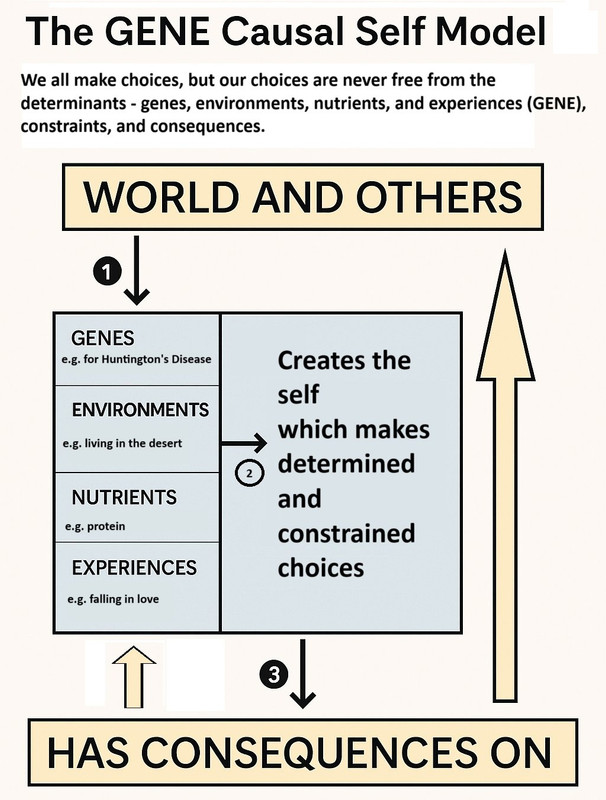
Our genes, environments, nutrients, and experiences come from the world and others (step 1). These construct the self which makes determined and constrained choices (step 2). The choices can alter our genes, environments, nutrients, and experiences and the world and others (step 3). -
Understanding Human BehaviourBut this is nonsensical. It is determinism that allows one to determine their own outcomes. — Harry Hindu
Why is it nonsensical? It is our genes, environments, nutrients and experiences that determine and constrain our choices. It is entirely evidence-based and logical.
What you're basically saying is that freedom is being able to choose to do whatever I want whenever I want. — Harry Hindu
No, I am saying much more than that. I am saying that even my wants must be free from determinants for it to be free. For example, I am thirsty right now. This want is not free from determinants. If I was a brick, I would not be thirsty. Because to be able to be thirsty, one needs to be a sentient biological organism, such as a human or a dog or a cow, etc.
But how can you make any choice without having options and how can you have options without having information? It seems to me that you must possess some kind of experiences (the acquiring of information) to be able to make a choice (free or otherwise). — Harry Hindu
I didn't say you can make choices without options and information. I already said that our choices are determined and constrained by our genes, environments, nutrients, and experiences. I agree that acquiring of information is an experience e.g. looking at a menu in the shop to see what ice-creams are available and how much they cost.
I'm using determinism to my advantage to make a choice that determines an outcome that is advantageous to me. — Harry Hindu
Yes, you can do that. So can other humans. My model supports this. The fact that you want an outcome that is advantageous to you is due to your self-serving desire, which comes from your genes, environments, nutrients, and experiences. Your desires and your capacity to fulfil your desires are both determined and constrained by your genes, environments, nutrients, and experiences. -
Understanding Human BehaviourCould you have chosen otherwise? — Hanover
If you changed the determinants i.e. genes, environments, nutrients, and experiences, then I would have chosen differently. For example, if the shopkeeper pointed a gun at my head and said that I must buy the chocolate-flavoured ice-cream or else he will shoot me in the head. This change in the variables would change my choice of which flavour of ice-cream I would buy. -
Understanding Human BehaviourNo, I am not saying what you are claiming.
Our choices are not free choices. They are determined and constrained choices. You can prove me wrong by teleporting, even though you don't have the genes, environments, nutrients and experiences necessary for teleportation.
But you just said that you did choose the flavor which you find tasty. — Harry Hindu
You have misunderstood what I said. No, I didn't choose to find the strawberry flavour tasty. I chose to buy the strawberry flavour because I found the strawberry flavour to be tasty. The reason I found the strawberry flavour tasty, instead of the chocolate flavour, is my unique mix of genes, environments, nutrients, and experiences. -
Understanding Human BehaviourWhat would a free choice look like - experiencing the option to go get ice cream when you see your child drowning in a pool and choosing that option? Are you saying that a free choice would be a random choice that comes to mind that is irrelevant to the current situation? — Harry Hindu
A free choice would be free from determinants and constraints. For example, if you behead me, I can't grow my head back. If you behead a planarian flatworm, he or she can grow his or her head back. If I had a free choice, I would have been able to grow my head back even though I lack the genes for growing my head back.
What is the self that is governed by the four factors? — Harry Hindu
The self is not just governed by the four categories of variables i.e. genes, environments, nutrients, and experiences. The self is constructed by them. If you alter them, you alter the self.
One of the four factors is experiences. Aren't my experiences my own and not someone else's? Am I not the decider of which experiences I have? Another was genes. Aren't we all genetically unique? — Harry Hindu
Your experiences are your own. Your sense of being in a body, seeing the world through your eyes, hearing the world through your ears, tasting the world through your tongue, smelling the world through your nose, touching the world through your skin, feeling sensory pleasure or pain - these are all experiences that contribute to the choices you make. You are not completely free to decide which experience you have. Could you experience being all-knowing and all-powerful at will? Could you teleport from one place to another at will? Could you go back in time and change the past at will? No, you couldn't. Could you buy an ice-cream if a shop near you sold ice-creams at a price you can afford? Yes, you could. You make choices but they are not free choices. They are determined and constrained choices. We are all genetically unique. Even identical twins are not 100% identical in terms of their genes.
Identical twins — also called monozygotic twins — originate from a single fertilised egg that splits into two embryos. This means they start with nearly identical DNA. However, they do not have completely identical genes in every cell for life. Here's why:
At Conception:
Yes, they have the same genetic code because they come from the same zygote.
After Conception:
Differences can emerge due to:
Mutations: Small changes in DNA can occur in one twin but not the other after the split.
Epigenetics: Environmental factors like diet, stress, or illness can switch genes on or off differently between twins, even though the DNA sequence remains the same.
Copy Number Variations: Sometimes, sections of DNA are duplicated or deleted in one twin but not the other.
Mosaicism: If a mutation occurs in a few cells early in development, one twin may carry a mixture of cells with different DNA.
Mitochondrial DNA:
Identical twins usually have the same mitochondrial DNA (inherited from the mother), but rare mutations can cause slight differences.
Identical twins start with identical genes, but small genetic and epigenetic differences can appear over time. These differences may explain why some twins develop different diseases or have slightly different traits. -
Understanding Human BehaviourHenry Ford built the Model T and said you can choose whatever color you want as long as it's black. Is that what you mean by choice that is not free? — Hanover
No, that's not what I mean. Let's say my friend and I go to a shop. There are two types of ice-cream on sale - strawberry and chocolate. I don't like the taste of chocolate flavoured ice-cream. I do like the taste of strawberry flavoured ice-cream. Therefore, I choose the strawberry flavoured ice-cream. My friend likes the taste of chocolate flavoured ice-cream. So, he chooses the chocolate flavoured ice-cream. Neither I, nor my friend, chose which flavour we find tasty. The fact that we find different flavours tasty is due to differences in our genes, environments, nutrients, and experiences. If I had never tasted chocolate or strawberry flavoured ice-cream before, I would buy one of each to see how they taste to me. As you can see, my friend and I made choices but they were not free choices. They were determined and constrained choices. We could not buy vanilla-flavoured ice-cream because the shop did not sell any, even though my friend and I both love vanilla-flavoured ice-cream. -
Understanding Human BehaviourIt needs an arrow from behavior going back to the other inputs, since our behavior shapes our environment, nutrition, experiences, etc. — Count Timothy von Icarus
I agree. Thank you for your suggestion. I also agree that we can learn to enjoy doing what is right.
I made another image on the 4th of May 2025 which has arrows leading from our choices to our genes, environments, nutrients and experiences and also to the world and others. Please let me know what you think of this image:
-
Understanding Human BehaviourWhich genes, environments, nutrients, or experiences, or combination of the four, gives us the capability to have or make choices? You use the word, "choice", as something we possess, but your post seems to also say that we don't have a choice. Which is it? What is a choice? — Harry Hindu
You have a choice, but it is not a free choice. It is a determined and constrained choice. A choice is the experience of choosing a behaviour from a range of behaviours, e.g. buying a lottery ticket or refraining from buying a lottery ticket.
All active genes, all environments, all nutrients, and all experiences determine and constrain our choices. I couldn't have typed these words right here, right now if I didn't have my genes, all the environments I have lived in, all the nutrients I have consumed since I was conceived and all the experiences I have experienced since I was in the womb. Just as you couldn't have read these words right where and when you are reading these words if you didn't have your genes, all the environments you have lived in, all the nutrients you have consumed since you were conceived and all the experiences you have experienced since you were in the womb. -
Understanding Human BehaviourYou have a choice, but it is not a free choice. It is a determined and constrained choice.
-
How can I achieve these 14 worldwide objectives?I think that immortality is wrong, death is of course horrible but it is also a part of life. Personally it is what I believe gives meaning to our lives. — Red Sky
I am sorry I don't understand - please explain how death gives meaning to our lives.
getting every person's support is damn near impossible. — Red Sky
I agree. I wish there was an easy way to unite everyone. -
How can I achieve these 14 worldwide objectives?Thank you very much for telling me the amazing story of Dorothy Day. I think every kind word and action makes a positive difference.
-
How can I achieve these 14 worldwide objectives?You can't. That's the job for someone with global influence. Keep your goals within your capacity to complete them. Be proud of what you've done. If 10% of folks tried what you've done, the world would be a better place. — LuckyR
You are right. I should indeed keep my goals within my capacity to complete them. Thank you very much. -
How can I achieve these 14 worldwide objectives?Unless, I guess, you are a billionaire like Bill Gates. He’s done incredible things with his money. — T Clark
No, I am not rich with money, but I am rich with love. Yes, he has saved and improved many lives. -
How can I achieve these 14 worldwide objectives?It is enough to achieve your goals though, in fact its all you can do. It seems to me the hidden problem for you is the timetable. You cannot achieve such lofty goals in a single lifetime, your goals are not something you can enforce or convince on the massive scale of the whole of humanity. Yours goals will take time. A lot of time. Look at history and you see how things, very slowly, change. It happens by leading by example, spreading your ideas and leading your life with those goals in mind.
So when I say keep doing what you're doing I dont mean because you cannot achieve your goals but rather because that is the way, the only way, to achieve your goals.
Make the best contribution you can while you're here and let the ripple effect of your hard work shape the future. Thats the only way progress to your goals that has ever been made, you just have to have the long view. — DingoJones
I see your point. I am being too impatient. I want to see rapid changes, but that is impossible. Thank you for sharing your wisdom. -
How can I achieve these 14 worldwide objectives?Sounds like you're achieving your goals... at a scale appropriate for your level of influence. Kudos to you. Job well done. — LuckyR
Thank you - sadly, my capacity is limited. Although I have managed to save and improve some lives - the world is still full of suffering, injustice, and death. How do I unite everyone to achieve the objectives together? -
How can I achieve these 14 worldwide objectives?If you're an American elector, supporting the Democratic Party would be a good start. The MAGA party seems intent on dismantling or opposing everything you're standing for. — Wayfarer
I don't live in the USA. I live in the UK. I don't agree with Donald Trump's policies. -
How can I achieve these 14 worldwide objectives?Your list covers pretty much everything that might need doing. That's the main part of your problem. You've heard of hubris? add "Diminish my hubris" to the list. — BC
I don't have hubris. I am so sad about all the suffering, injustice, and death in the world. At least 99.9% of all the species to evolve so far on Earth are already extinct. The climate crisis has placed the remaining 0.1% at risk of extinction. Humans have killed hundreds of millions of humans across the world and trillions of other species in the last 300,000 years. I long to change the past, but I can't. I long to change the present, but people keep doing selfish things, e.g. murder, exploit, rape, torture, cheat, steal, bully, etc. Less than 1% of the 8.23 billion humans currently alive are vegan. There is so much poverty, inequality, ignorance and disease in the world. I have failed to achieve my objectives.
How can I unite everyone to achieve the 14 worldwide objectives?
Look after your own actions; try to be the kind of person you wish we all were. — BC
I am already kind to everyone. It's not enough that I am kind to everyone or else the objectives would have been achieved many years ago. Everyone needs to be kind to everyone. How do I get everyone to be kind to everyone? -
How can I achieve these 14 worldwide objectives?Not by yourself. That much is clear. — Banno
I totally agree. How can I unite everyone towards achieving the 14 worldwide objectives? -
How can I achieve these 14 worldwide objectives?As a fellow dreamer of a better tomorrow whose tried more than one thing I can tell you that I, at least, had to recognize my limit as an individual. — Moliere
You are right in that I have very limited abilities. If I could unite all humans with the goal of achieving the 14 worldwide objectives, then we could make it happen. How can I unite everyone? -
How can I achieve these 14 worldwide objectives?keep doing what youre doing? — DingoJones
The problem is that living things are suffering and dying every second. Keeping doing what I am doing is not enough to achieve the goals. -
How can I achieve these 14 worldwide objectives?To the extent the problems you identify are soluble at all, it would only be through political action. — T Clark
How would I achieve global political action? -
How can I achieve these 14 worldwide objectives?You obviously can't save lives forever, do you just want a quantitative amount of lives saved? — Red Sky
Some organisms are biologically immortal, e.g. planarian flatworms, immortal jellyfish, hydra, etc. If we could genetically engineer all living things to be biologically immortal and place them in spaceships to visit other star systems, thus spreading life across the universe, lives could be saved forever.
What exactly do you mean by religious harmony? (One religion, or just coexistence and acceptance) — Red Sky
By religious harmony, I mean the peaceful coexistence of people with different religious and secular beliefs. Hundreds of millions of people have been murdered across the world over the millennia by both religious and secular people. It is still happening despite our scientific advances. I am so sad about all the suffering, injustice, and death.
I would say unless you're the billionaire batman, you will need to gain the support of many people. — Red Sky
I don't have much money. How would I get all the people to unite and work together to achieve the 14 worldwide objectives? -
What is the best way to make choices?The important thing in choice is that you are the one making it, and not others. — Red Sky
Thank you for your kindness and for sharing your experience with me, and for your advice. -
What is the best way to make choices?Getting a 2nd, 3rd, 4th, etc opinion would also qualify as getting more information before making a decision. — Harry Hindu
I didn't seek a second opinion. I wish I had. Sadly, I can't change the past.
That is an unanswerable question, and best not to waste time contemplating it as it would just make your depression worse. — Harry Hindu
I agree. Thank you for your wise advice. -
What is the best way to make choices?It's not your fault. It's not your fault. It's not your fault. — Good Will Hunting
I watched this movie many years ago. Thank you very much for reminding me of it and also for your insight. -
What is the best way to make choices?Think of trying for the best as Offense and avoiding the worst as Defense. — LuckyR
This is a very interesting idea. Thank you very much for this advice. -
What is the best way to make choices?This means I am never "second guessing" myself because everything is done to a framework, applicable at all times. — AmadeusD
Thank you very much for sharing your system for making choices. I love it. -
What is the best way to make choices?I wish you had had a better psychiatrist. — unenlightened
Thank you. CPTSD and Bipolar Disorder make a difficult combo to treat. I also wish I had better treatment than what I had. I have been on so many medications in the last 27 years and 3 months. I wish they had given me EMDR and Schema Therapy back in March 1998. I had EMDR in 2024 which helped. I am waiting to have Schema Therapy. -
What is the best way to make choices?A book that might help, "Prudence: Choose Confidently, Live Boldly." — Leontiskos
Thank you very much for the book recommendation. I look forward to reading it.
What do you see as your mistake in this instance? What is the thing you wish you had done differently? — Leontiskos
I wish I had listened to my parents instead of listening to my psychiatrist. Sadly, I can't change the past. -
What is the best way to make choices?by making choices that eliminate the worst outcome — LuckyR
Thank you very much for your advice. -
What is the best way to make choices?You made the best possible decision given the information you had at that moment. — Harry Hindu
It's not just a matter of having access to information. It's also a matter of who to trust. I chose to trust a qualified and experienced psychiatrist over my parents because I thought that was the right thing to do. I can't even come off the 600 mg of Quetiapine XL I take per night because my brain has become dependent on this medication, and I can't function without it. I am depressed even though I take such a high dose.
I meant whether my nonexistence would have been better for me, compared to the life I have lived so far, which has been mostly suffering. Also, my nonexistence would have prevented all of my negative and positive impacts on others and the world e.g. ecological footprint. I am a Vegan, Egalitarian, Sentientist.Only if you were Caligula, Hitler or Stalin. — Harry Hindu -
What is the best way to make choices?I have come through life almost scar free and I have lead an ordinary life but an enjoyable one. — Malcolm Parry
I am glad that you have had an easy life. I had many traumatic experiences from age 4 onwards. I am not going to go into the details of them because it is hard for me, and also I don't want to distress you and others. -
What is the best way to make choices?
I agree because I can't change the past. Thank you for sharing your experience and for your advice. I am exercising daily but it is hard. I have a healthy diet but my problem is that my medication causes weight gain. I am also trying to learn computer programming which I find hard because of my depression and because of my age. I am 47.you are where you are and decisions going forward are the only ones that matter. — Malcolm Parry -
What is the best way to make choices?While freedom is a curse, it is also life's greatest blessing, and I say this with total sincerity. Llfe truly wouldn't be living without freedom.
Much more to be said, but what do you think of that so far? — hypericin
Thank you for sharing your experience and thoughts. I am so sorry that you, too, have the burden of regretting taking psychiatric medications.
I don't feel free. Do you feel free?
Here are some things I have done, currently do or will do even though I don't want to do them:
1. Breathe
2. Eat
3. Drink
4. Sleep
5. Dream
7. Pee
8. Poo
9. Fart
10. Burp
11. Sneeze
12. Cough
13. Age
14. Get ill
15. Get injured
16. Sweat
17. Cry
18. Suffer
19. Snore
20. Think
21. Feel
22. Choose
23. Be conceived
24. Be born
25. Remember some events
26. Forget some events
27. Die
I really want to go back in time and prevent all suffering, injustice, and death and make all living things forever happy, but I lack the capacity to do this. -
What is the best way to make choices?Seems to me that the key is other people. Keep reaching out. And keep in mind that while you don't know what will happen next, sometimes things get better.
You are welcome to PM me. — Banno
Thank you for your advice and your kindness. -
What is the best way to make choices?I use heat therapy (e.g. electric blanket, heat patches, hot water bottle, etc.) to reduce the intensity of the pain, as pain-relieving medications for chronic nerve pain make my Bipolar Disorder worse.
-
What is the best way to make choices?More likely, you would be equally discontent but with a different set of issues. — Banno
I agree with you. Wouldn't it have been better if I had never existed at all? -
What is the best way to make choices?In terms of suicide of why you should stay alive it breaks down to practicality and it’s something out of my remit to advise on personal choices and circumstances. — kindred
My goal is to save and improve as many lives as possible. Obviously, suicide doesn't save my life, but it does end my suffering, which is a kind of improvement. Also, my donated organs will save the lives of others. Don't the needs of the many outweigh the needs of the few or the one? Although my suicide would cause suffering to those who love me. Also, it would prevent any future good deeds by me, e.g. I have donated blood many times. -
What is the best way to make choices?There are factors involved when making choices and these are often a matter of personal preference. — kindred
How would I know what personal preference I should have? It's not always clear if the outcome would be positive for me and others. For example, I am on the NHS Organ Donation Register. I have been on it since May 1997. If I were to kill myself, it would end my constant suffering (due to Bipolar Disorder, CPTSD and chronic pain) and save the lives of those who need organs to live. So, should I kill myself? I am certain that my parents would be very upset if I killed myself. That's one of the reasons I haven't yet killed myself. -
What is the best way to make choices?
This happens because I am haunted by previous errors. If I had known how things would turn out, I would have chosen differently.Do you know why this happens? Are you haunted by previous errors? — Tom Storm
I was diagnosed with Bipolar Disorder on the 5th of March 1998. My parents told me to ignore the psychiatrist and not take the prescribed medications. I didn't listen to my parents. I trusted my psychiatrist and took the prescribed medications. 27 years and 3 months later, I am still struggling with depression and all the side-effects of the prescribed medications. I have gone from 65 kg to 98 kg as my medication causes weight gain. My mental illness has ruined my physical health, education, career and relationships. I often wonder how my life would be if I had listened to my parents instead of my psychiatrist.What would be an example of this? — Tom Storm
All of them and many more.Is it things like having children, getting married, or deciding where to live? — Tom Storm
Is this one you are mulling over or a hypothetical? — Tom Storm
This is a hypothetical.
Truth Seeker

Start FollowingSend a Message
- Other sites we like
- Social media
- Terms of Service
- Sign In
- Created with PlushForums
- © 2026 The Philosophy Forum