
Comments
-
CompassionismSo please dear friend, do not judge me and please show me compassion when I hire more police officers, build more jails, and empower more prosecutors and judges to assure safety to the citizens. — Hanover
Of course, I don't judge you. If I had your genes, environments, nutrients, and experiences, I would do as you do. -
CompassionismI'm definitely not a follower of compassionism. — Malcolm Parry
If I had your genes, environments, nutrients, and experiences, I wouldn't be a compassionist either.
No blame, no credit, only understanding and love for you and everyone else, too. -
CompassionismI’m not sure that answers the question. What you’re saying is a well-known trope, essentially, if you were me you would be following the same path.
But my question isn’t about the obvious factors of personal situations/histories/biology, but about the specific thoughts or questions that you are working to address through your preoccupation with goodness. I’m assuming you are trying to achieve something and I’m interested in what that is. But you don’t need to answer if you don’t want to. — Tom Storm
I agree that if I were you, I would be making your choices and vice versa. My goal is to save and improve as many lives as possible. The reason this is my goal is the fact that there is much suffering, injustice, and death in the world. -
CompassionismI get that you disagree with me about the Christianity reference. Disagreement is healthy. Happy to put to that to one side. The question remains: Why the preoccupation with being good in every possible circumstance? — Tom Storm
I already answered this question in my previous post. It's the inevitable outcome of my genes, environments, nutrients, and experiences dynamically interacting with each other. If you had my genes, environments, nutrients, and experiences, then you would be typing these words where and when I am typing these words. Conversely, if I had your genes, environments, nutrients, and experiences, then I would be reading these words where and when you are reading these words. We are all living inevitable lives by making inevitable choices. -
CompassionismI never said Christianity is all loving and I know the old testament God is like a violent mafia boss. I said your message was ostensibly Christian. And it certainly fits. — Tom Storm
It's not just the Old Testament God, the New Testament God is also evil. My message is very far from Christianity because my message has nothing to do with Christ. Christianity does not teach hard determinism, and it does not teach love for all. Compassionism stems from hard determinism.
Why the preoccupation with being good in every possible circumstance? — Tom Storm
It's the inevitable outcome of my genes, environments, nutrients, and experiences dynamically interacting with each other. I deserver neither blame, nor credit for anything. Nor does any other organism.
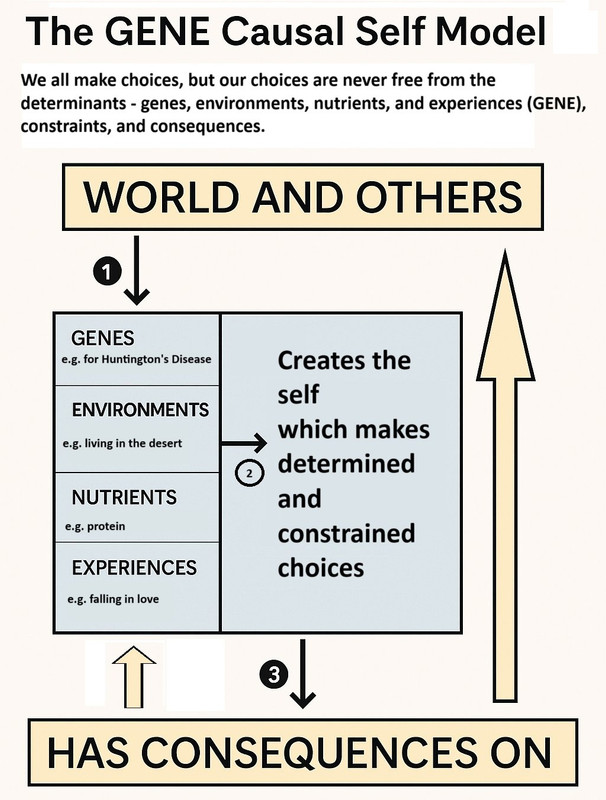
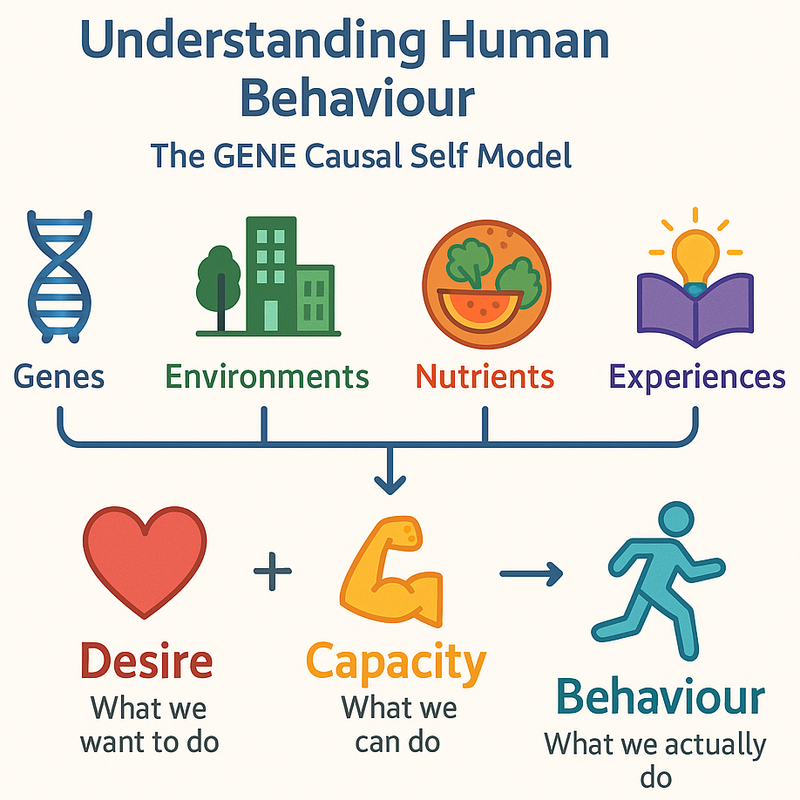
Genes, early environments, early nutrients, and early experiences play a foundational role in the lives of all living things. When my Dad's sperm fused with my Mum's egg, a zygote was formed. If I were to go back in time and replace the genes in that zygote with the genes of a planarian and change the cellular structures to match planarian cells, you would be able to behead me, and I would just be able to grow a new head and brain. Genes, environments, nutrients, and experiences don't merely influence our choices. They determine our choices, and they constrain our choices. A planarian can't post my posts to you because he or she does not have my genes, my environments, my nutrients and my experiences. This is 100% certain. It is also 100% certain that no living thing chooses to come into existence, chooses their genes, early environments, early nutrients, and early experiences. We can't be blamed or credited for the foundational variables of our lives that we did not choose at all. We all make choices, but our choices are never free from the determinants - which are genes, environments, nutrients, and experiences (GENE). Nor are our choices free from constraints. Also, our choices have consequences on ourselves, the world and others. I call this the GENE Causal Self Model. It has a sequence:
World + Others →
Genes + Environments + Nutrients + Experiences →
Desire (what we want to do) + Capacity (what we can do) →
Behaviour (what we actually do) →
Changes to Genes + Environments + Nutrients + Experiences + changes to the World and Others.
The world and others create genes, environments, nutrients and experiences, which construct the self, which has desires and capacities, which lead to behaviour, which leads to changes to genes, environments, nutrients and experiences and changes to the world and others. -
CompassionismIt's still a Christian message. You don't need God to have a Christian moral outlook, it's embedded in culture. It's often said that human rights and secular morality are Christianity and Christ. — Tom Storm
Have you read the whole Bible?
Here are some verses where the Biblical God commands genocide:
1. 1 Samuel 15:3
“Now go, attack the Amalekites and totally destroy all that belongs to them. Do not spare them; put to death men and women, children and infants, cattle and sheep, camels and donkeys.”
— God's command to Saul via the prophet Samuel.
2. Numbers 31:17 - 18
“Now kill all the boys. And kill every woman who has slept with a man,
but save for yourselves every girl who has never slept with a man.”
— Moses conveys God’s command after the Israelites' war with the Midianites.
3. Deuteronomy 2:34
“At that time we took all his towns and completely destroyed them - men, women and children. We left no survivors.”
— Description of Israel’s conquests commanded by God.
4. Deuteronomy 3:6
“We completely destroyed them, as we had done with Sihon king of Heshbon, destroying every city - men, women and children.”
5. Joshua 6:21
“They devoted the city to the Lord and destroyed with the sword every living thing in it - men and women, young and old, cattle, sheep and donkeys.”
— Refers to the destruction of Jericho.
6. Hosea 13:16
“The people of Samaria must bear their guilt,
because they have rebelled against their God.
They will fall by the sword;
their little ones will be dashed to the ground,
their pregnant women ripped open.”
— A prophetic warning attributed to God's judgment.
Here are some Bible verses about slavery:
1. Exodus 21:2–6 – Hebrew slaves can be kept for six years, unless they choose to stay permanently. Female slaves and children are treated as property.
"If you buy a Hebrew servant, he is to serve you for six years. But in the seventh year, he shall go free..."
2. Exodus 21:20–21 – If a slaveowner beats a slave and the slave dies immediately, it's punishable. But if the slave lingers for a day or two before dying, the owner is not punished.
"He is not to be punished if the slave recovers after a day or two, since the slave is his property."
3. Leviticus 25:44–46 – Foreigners can be bought as slaves and inherited as property, passed on to children.
"Your male and female slaves are to come from the nations around you... you can make them your property for life."
4. Deuteronomy 15:12–18 – Hebrew slaves are to be released after six years, with generosity, but only applies to fellow Israelites.
"...do not send them away empty-handed. Supply them liberally..."
5. Deuteronomy 20:10–14 – Women and children of conquered peoples can be taken as plunder.
"...you may take the women, children, livestock, and everything else in the city as plunder for yourselves..."
6. Deuteronomy 21:10–14 – Allows Israelites to take captive women as wives after war.
"...bring her into your home... shave her head, trim her nails..."
7. Deuteronomy 23:15–16 – Unusually, this permits escaped slaves to live freely in Israel and forbids returning them to their masters.
8. Numbers 31:17–18 – After war with the Midianites, Moses instructs the Israelites to kill all boys and non-virgin women, but keep virgin girls for themselves.
"...keep alive for yourselves every girl who has never slept with a man."
8. Ephesians 6:5–8 – Slaves are told to obey their earthly masters as they would obey Christ.
"Slaves, obey your earthly masters with respect and fear, and with sincerity of heart..."
9. Colossians 3:22–25 – Similar to Ephesians, reinforcing obedience of slaves.
"Slaves, obey your earthly masters in everything..."
10. 1 Timothy 6:1–2 – Slaves should regard their masters as worthy of full respect.
"All who are under the yoke of slavery should consider their masters worthy of full respect..."
11. Titus 2:9–10 – Slaves are told to be subject to their masters in everything, to be trustworthy and not talk back.
"Teach slaves to be subject to their masters in everything..."
12. 1 Peter 2:18–21 – Slaves should submit to even harsh masters and endure suffering as a good thing in God's eyes.
"...if you suffer for doing good and you endure it, this is commendable before God."
13. Philemon 1:10–16 – Paul sends the escaped slave Onesimus back to his master Philemon, though urges Philemon to receive him kindly as a brother.
"...no longer as a slave, but better than a slave, as a dear brother."
14. Luke 12:47–48 – In a parable, Jesus describes a master beating his slaves, with no condemnation of the master.
"That servant who knows his master’s will and does not get ready... will be beaten with many blows."
Here are some verses where Jesus speaks or acts malevolently:
1. "I came not to bring peace, but a sword."
Matthew 10:34–36
“Do not suppose that I have come to bring peace to the earth. I did not come to bring peace, but a sword.
For I have come to turn ‘a man against his father, a daughter against her mother...’”
This contradicts the image of Jesus as a peacemaker and suggests division and familial conflict.
2. "Throw them into the blazing furnace..."
Matthew 13:41–42
“The Son of Man will send out his angels... They will throw them into the blazing furnace, where there will be weeping and gnashing of teeth.”
Jesus speaks of violent eternal punishment for the wicked — a recurring theme in his parables.
3. "Bring them here and kill them in front of me."
Luke 19:27 (from the Parable of the Ten Minas)
“But those enemies of mine who did not want me to be king over them — bring them here and kill them in front of me.”
While technically part of a parable, the speaker in the story represents Jesus himself. The violent imagery is unsettling.
4. "Depart from me, you who are cursed, into the eternal fire..."
Matthew 25:41
“Then he will say to those on his left, ‘Depart from me, you who are cursed, into the eternal fire prepared for the devil and his angels.’”
Another passage affirming belief in eternal torment for nonbelievers or those who fail to do good.
5. Drowns 2,000 pigs after casting out demons
Mark 5:11–13
“He gave them permission, and the impure spirits came out and went into the pigs. The herd... rushed down the steep bank into the lake and were drowned.”
Jesus allows a legion of demons to destroy innocent animals — property of the local people.
6. "Let the dead bury their own dead."
Matthew 8:21–22
“Follow me, and let the dead bury their own dead.”
This callous-sounding response comes after a man asks permission to bury his father first.
7. "If anyone comes to me and does not hate his father and mother..."
Luke 14:26
“If anyone comes to me and does not hate father and mother, wife and children, brothers and sisters — yes, even their own life — such a person cannot be my disciple.”
A demand for total allegiance to Jesus over all human relationships — using the word hate.
8. "It is not right to take the children’s bread and toss it to the dogs."
Matthew 15:22–26
“It is not right to take the children’s bread and toss it to the dogs.”
Jesus compares a Canaanite (non-Jewish) woman to a dog when she asks for healing for her daughter.
9. Curses a fig tree for not bearing fruit out of season
Mark 11:12–14, 20–21
“May no one ever eat fruit from you again.”
Jesus kills a fig tree for having no fruit — despite it not being the season for figs.
10. "Whoever is not with me is against me..."
Matthew 12:30
“Whoever is not with me is against me, and whoever does not gather with me scatters.”
This black-and-white view implies no neutrality or middle ground — only allegiance or opposition.
As you can see from the quoted Bible verses, Christianity is not all-loving.
Compassionism stems from hard determinism and the resultant compassion for all. -
CompassionismIt's pretty much a form of Christianity. You seem to be intent on pushing yourself to be super good and significant in the world. Is this a bit grandiose; what's the motivation? — Tom Storm
I am an ex-Muslim ex-Christian Compassionist who does not believe in any God, so it is definitely not a form of Christianity. My motivation is my love for everyone. -
CompassionismYou joined on April Fools Day. Just kidding. That's great. I'm sure you're a positive influence on your community. Sometimes a little compassion makes a huge difference. — frank
I deliberately declared myself a Compassionist on April Fool's Day! I did this because the Bible (New Living Translation) says in Psalm 14:1, "Only fools say in their hearts, “There is no God.” They are corrupt, and their actions are evil; not one of them does good!" I am an ex-Muslim ex-Christian Compassionist. The heart is a pump. My thoughts, emotions and choices occur in my brain. -
CompassionismI hear you. But with some people, you're going to have to rain hell down on them to make them leave you alone. — frank
I understand what you mean. I have not met those people yet. I have met many selfish people in my life so far and I have done my best not to harm them and not be like them. I became a Compassionist on the 1st of April 2006 and have managed to practise Compassionism despite many challenges. -
CompassionismDoormatism is where a person acts like a doormat. Some people won't respect you unless you meet their aggression by making a giant fool out of them in front of everybody. After that, they'll magically respect you. — frank
Love for all is not doormatism because if you are acting like a doormat, you are not loving yourself. Loving all, is a balancing act, where one does one's best to make every interaction and transaction a win-win for everyone involved. -
CompassionismI'm afraid this might end up as door-mat-ism. — frank
I don't know what that means. Please explain. Thank you. -
How can I achieve these 14 worldwide objectives?Please report back when you have completed this literary adventure. — boethius
I will. Thank you for your interest.
Finland is the 12th country on Earth in terms of HDI: https://en.wikipedia.org/wiki/List_of_countries_by_Human_Development_Index Therefore, I am surprised by the level of corruption you mentioned. Why is there so much corruption in Finland, despite its high HDI? -
How can I achieve these 14 worldwide objectives?nearly every member of our society would pat me on the back for taking the money and demonstrate zero concern for what organized crime is doing to children and other victims all around the globe. — boethius
I wouldn't pat you on the back if you had taken the bribe. I think doing the right thing is important.
I am reading a book https://www.amazon.co.uk/Forgive-Good-Proven-Prescription-Happiness-ebook/dp/B003SE6Y28 that I bought today. I love it and recommend it most highly. -
How can I achieve these 14 worldwide objectives?It's self evident that exposing reasonable suspicion of money laundering is the right thing to do. — boethius
I agree. I despair when I think about all the suffering, injustice, and death. My depression has gotten worse. -
How can I achieve these 14 worldwide objectives?Had I taken it upon myself to coverup these illicit financial events, no one would have ever heard about them again. Forever lost to the entropy of corporate email compaction. — boethius
I think you did the right thing by blowing the whistle. Well done. -
How can I achieve these 14 worldwide objectives?Fucking with fascist police is just as exhilarating as base jumping off a mountain, but the difference is far more people benefit from fucking with fascist police than just the personal experience of jumping a long way.
For example, police had me in their little van hole for a few hours. Got to go the whole way without a seatbelt (which the van hole doesn't have for some reason). Absolutely off the hook adrenaline rush. — boethius
You are so brave. I hope you triumph against the corrupt. -
How can I achieve these 14 worldwide objectives?I am so sorry that I can't right all wrongs.
-
How can I achieve these 14 worldwide objectives?Or perhaps the harder it is to keep doing things that led to your depression in the first place, but the easier it becomes to make some radical change. — boethius
I first had depression when my younger brother died because of a doctor's error on 9 February 1988.
I was vegetarian for some years in France and as organic as possible.
However, in moving to Finland I did not feel I was maintaining the same health on a vegetarian diet.
It's not ideal, but I am not against predation and animal husbandry on principle (for the cycle of life arguments above), population density in Finland is low so animal husbandry is not as destructive as elsewhere, and we have far bigger problems to address so I decided is was best to be fully effective. The problem being little grows in Finland so most fruits and vegetables at the supermarket are imported, not so fresh, not so nutritious, super little organic options compared to France, and also really expensive. — boethius
I am so sorry. I didn't know what it was like to live in Finland. I have never been there.
"if you report money laundering to police, they won' investigate that but will put you under investigation instead and destroy your career" and then recommended I take what they agreed was a bribe to not-report-money laundering. — boethius
That's awful. Finland is supposed to be the second least corrupt country! Please see: https://www.transparency.org/en/cpi/2024 I am so sorry this happened to you. -
How can I achieve these 14 worldwide objectives?There is no proof she experiences anything at all, as you could be hallucinating this whole conversation along with this video, or then there is a world as we commonly understand it but she just appears to be be conscious but is not actually conscious.
There is no box that you can put some matter inside and it lights up green if it's conscious or red if it's unconscious. — boethius
I agree.
And you feel there is nothing in the slightest to change? — boethius
The more depressed I am, the worse I feel, and the harder it is for me to do things. I have been at minus five on the mood scale many times.
But in the meantime there is existing life that in need of protection. — boethius
Only if solipsism is false and other living things actually exist. I think solipsism is false even though I can't prove it to be false. I am a vegan egalitarian because I care about other sentient organisms. Are you a vegan egalitarian? -
How can I achieve these 14 worldwide objectives?it is only when depressed that it is possible to analyze our own ethical system — boethius
I don't think this is true. I have considered my ethical system both before being depressed and during depressive episodes. Here is a mood scale:
+5: Total loss of judgement, exorbitant spending, religious delusions or hallucinations.
+4: Lost touch with reality, incoherent, no sleep, paranoid and vindictive, reckless behaviour.
+3: Inflated self-esteem, rapid thoughts and speech, counter-productive simultaneous tasks.
+2: Very productive, everything to excess, charming and talkative.
+1: Self-esteem good, optimistic, sociable and articulate, good decisions and get work done.
0: Mood in balance, no symptoms of depression or mania.
-1: Slight withdrawal from social situations, concentration less than usual, slight agitation.
-2: Feeling of panic and anxiety, concentration difficult and memory poor, some comfort in routine.
-3: Slow thinking, no appetite, need to be alone, sleep excessive or difficult, everything a struggle.
-4: Feeling of hopelessness and guilt, thoughts of suicide, little movement, impossible to do anything.
-5: Endless suicidal thoughts, no way out, no movement, everything is bleak and it will always be like this.
I am at minus two on the mood scale right now.
You may need to reflect deeply on this and also perhaps study life systems in more detail to appreciate how life is and not what you wish it to be. — boethius
Thank you for your advice. I will do this.
Earlier you seemed to agree that this was not an achievable objective. — boethius
It is not an achievable objective. I am still thinking about it because it is so fascinating. I have no way to achieve the objective of upgrading matter-based lifeforms that need to consume air, water and food into energy-based lifeforms that can live forever without consuming anything. -
How can I achieve these 14 worldwide objectives?This near death experience maybe worthwhile to listen to: — boethius
I watched the Near-Death Experience video in full. I think her experience was a hallucination produced by her distressed and frightened brain. I have watched many NDE videos and read many NDE accounts over the years. She talks about how she chose all her life experiences as a conscious soul before she was born.
**A Rational Critique of Pre-Birth Selection of Life Events**
**1. No credible evidence supports it.**
There is no scientific or neurological evidence that consciousness exists before birth, chooses life events, or continues after death. While Near-Death Experiences (NDEs) can be vivid and life-changing, they are likely generated by the brain in extreme conditions, such as oxygen deprivation or neurochemical surges — not glimpses into a pre-birth realm.
**2. It can unintentionally blame victims.**
The idea that people choose everything before birth, including trauma, poverty, abuse, disability, or oppression, shifts responsibility away from those who cause harm or perpetuate injustice. It risks implying that:
* A child chose to be abused.
* A person chose to be disabled or ill.
* A population chose to be born to be victims of genocide or famine.
This is not only irrational — it’s deeply unjust.
**3. It can discourage empathy and social action.**
If we believe people chose their suffering during their life before they were born, we may be less motivated to help them. Why fight poverty, stop child abuse, or cure disease if these are “lessons” that souls selected? This belief can serve as a spiritual bypass — numbing our compassion and our ethical responsibility to reduce suffering in the real world.
**4. It contradicts what we know about biology and psychology.**
Our experiences are shaped by **genes**, **environments**, **nutrients**, and **events** — not by pre-birth selection of life events by conscious souls. Trauma has measurable, often devastating impacts on the brain, body, and relationships. These are not signs of soul-level "growth opportunities" — they are signs of harm needing healing, justice, and compassion.
**5. It appeals to comfort, not truth.**
Believing “everything happens for a reason” or “I chose this” can help some people cope. But comfort is not the same as truth. We must be careful not to turn tragedy into theology or fantasy, especially when it denies the lived reality of others. -
How can I achieve these 14 worldwide objectives?It is mentioned in the previous post as the protection of all life, as an example of a unifying principle; it is also what I happen to believe personally but I was not so clear about it.
It's also in the super long essay linked to previously: https://open.substack.com/pub/eerik/p/the-cromulomicon-the-book-of-croms?r=33um1b&utm_campaign=post&utm_medium=web&showWelcomeOnShare=false — boethius
Thank you for clarifying. In a previous post I had quoted the following:
“Ethics, too, are nothing but reverence for life. This is what gives me the fundamental principle of morality, namely, that good consists in maintaining, promoting, and enhancing life, and that destroying, injuring, and limiting life are evil.” – Albert Schweitzer, “Civilization and Ethics”, 1949.
My goal of saving and improving all lives is supported by the quoted words.
I am sorry but I couldn't finish reading your super-long essay. I am suffering from depression. My concentration and comprehension and thinking are all affected by my depression.
if life has value then natural systems, including predation, has value. — boethius
Life has value, but predation is against that value. Predation involves prioritising the life of the predator over the life of the prey. This is selfish. This is evil.
Pain and death are apart of life and therefore also have value. — boethius
No, pain and death diminish lives. So, they are to be prevented. I am trying to figure out how to upgrade all living things into immortal energy beings who live forever without consuming anything.
What is evil is causing pain and death to disrespect and destroy life, especially manipulating others to be harmed as that is an additional disrespect and abuse of the truth as well as life; or then to simply be indifferent to our duties to others and to life is not as bad but still definitely evil in this framework. — boethius
I agree that causing pain and death is evil. That's why I am trying to change consumption-based existence to non-consumption-based existence. -
How can I achieve these 14 worldwide objectives?Apologies for the delay, I have been fairly ill and moral philosophy was beyond my ability to focus on for the last few days. — boethius
I am so sorry that you were ill. I am glad you are feeling better now. In my previous post, I asked: How do you know what is good and what is evil? You didn't answer. Please answer this question. Thank you.
Autotrophs consume nutrients and compete with each other for nutrients. Herbivores consume plants, to the detriment of the plants. Carnivores consume other sentient organisms, to the detriment of the organisms they kill. Omnivores consume everything, to the detriment of plants and sentient organisms. Parasites consume nutrients from the hosts, to the detriment of the hosts. That's why I have called them selfish. Lions may share their meat with other lions - that's just kin selection. They have no problem with killing gazelles. Selfish genes make selfish organisms.
I thought we just agreed above that things like lions hunting are not ethical questions. But if you meant above that you meant not ethical in the same way, that lions are bad (and therefore should be stopped?) please clarify. — boethius
It is bad that lions hunt. The whole system of consuming in order to exist is evil. If I could upgrade all living things into energy beings who live forever without consuming anything, I would have done so already. -
How can I achieve these 14 worldwide objectives?What makes us different from lions that their hunting, even of their own kind, is fine and natural, but that does not apply to us? — boethius
It's not ethical, but it is what happens. Just as people kill people. That's not ethical either.
1. Direct Human-Caused Deaths (War, Violence, Homicide)
Prehistoric (~300,000 BCE to ~5,000 BCE):
Anthropologists estimate that about 10–15% of prehistoric deaths were due to interpersonal violence.
Population estimates vary, but let's conservatively estimate:
Average global population over this period: ~1–10 million.
Total deaths: ~4–5 billion over 295,000 years.
Violent deaths: ~400–700 million.
Historic Period (~5,000 BCE to 2024 CE):
Known wars, genocides, and violence (including colonialism, slavery, revolutions):
Estimated 1 billion+ deaths, including:
World Wars: ~100 million
Genocides (e.g., Holocaust, Rwanda, Armenia): ~30+ million
Colonial violence and enslavement: hundreds of millions
Murder and interpersonal violence: hundreds of millions
✅ Total direct human-caused deaths estimate: ~1.5 to 2 billion
2. Indirect Human-Caused Deaths (Famine, Exploitation, Disaster Neglect)
Famine, disease, and natural disasters are sometimes natural in origin, but often intensified by human actions:
Bengal Famine (1770): ~10 million deaths, worsened by British East India Company policies.
Irish Famine (1845–49): ~1 million deaths, made worse by British economic choices.
Soviet & Chinese famines (Stalin, Mao): tens of millions of deaths from political decisions.
Modern disasters (e.g. Hurricane Katrina, COVID-19): responses often slow, unjust, or corrupt, leading to avoidable deaths.
Estimating conservatively:
Over the last 10,000 years, at least 2–4 billion deaths from famine, disease, and disaster have human negligence, cruelty, or mismanagement as significant causes.
✅ Total indirect human-caused deaths estimate: ~2 to 4 billion
Grand Total Estimate (Direct + Indirect):
~3.5 to 6 billion humans have likely died due to the actions or inactions of other humans over the past 300,000 years.
perhaps the lion considers the consequence of killing the gazelle is that she will be able to eat. Perhaps most humans do not consider the consequence of their actions of wanton consumption that others elsewhere will not eat. — boethius
The plants, the gazelles, the lions and the humans are being selfish. All autotrophs, herbivores, carnivores, omnivores and parasites are selfish. Being selfish is evil. We should look after the interests of everyone. That's why I want all living things to be energy beings who can live forever without consuming anything.
A theory is required to go from the consideration of consequences, which I agree is the start of the problem, to what consequences are actually good and bad. — boethius
For me, killing living things and harming living things is bad. Saving and improving lives is good. What about you?
To do moral philosophy is to ask how those outcomes are known to be good or bad in the first place. — boethius
I already know what outcomes are good and what outcomes are bad. Life, health and happiness are good. Suffering, illness and death are evil. Egalitarianism and veganism, and equitable sharing of resources are good. Selfishness and omnivorousness are evil. I know these things from my experiences and from reflecting on my experiences. What about you? How do you know what is good and what is evil?
moral betrayals that involve no physical pain at all can cause life long suffering. — boethius
I agree. -
How can I achieve these 14 worldwide objectives?Thank you very much for the examples of errors in mathematical proofs.
If we do not stop the lion, if predation is natural between animals, then why stop human predators preying on other humans? Lions don't only kill gazelles but also other lions in struggles for power, why would it be any less natural for humans to likewise kill both gazelles for food and other humans for power? — boethius
Just because something occurs in nature, it doesn't make it ethical. Lions are not ethical, but lions don't have the capacity to consider the moral implications of their choices. People can consider the moral and legal implications of their actions. Humans are moral agents, but lions are not because we have the capacity to think about the moral dimensions of our actions.
But the religious people you have issue with also claim to be convinced their way is the best way to live.
How do you actually know you're not making some similar mistake in reasoning just about different things. Religious people too point to all the bad done by atheists and also other religions to justify their religion.
So knowing is the key problem. But if existence is filled with evil, then on average one would expect to fall in the category of evil people who mistakingly believe they are good. — boethius
I am all too aware that there are billions of people who are convinced that their religion is the best way to live. I am a vegan, egalitarian, agnostic atheist. For them, my position is wrong. Just as for me, their position is wrong. "There is nothing either good or bad but thinking makes it so." - William Shakespeare. -
How can I achieve these 14 worldwide objectives?you can prove to me it's raining outside if I'm willing to accept time stamped video evidence or then going outside and seeing and feeling for myself the rain; but if I doubt your video evidence is authentic or then I doubt my own senses as maybe hallucinating both you and the rain, then it's not possible to prove to me anything. — boethius
I agree.
What is not deterministic is observation of quantum events, but that's not chaos. — boethius
By chaos, I meant non-deterministic. I am not a physicist, so thank you for explaining the difference.in mathematics (a context in which there is agreed criteria for proofs), things are erroneously proven all the time — boethius
I didn't know that. Can you please give me an example?
What's the reason empathy is a good quality to have in the first place? And assuming it is good, how does empathy translate into decisions in complex situations? — boethius
Pain is painful. That's why I don't want to be in pain. In the same way, other sentient beings don't want to be in pain. If I see someone being tortured by someone else, I would intervene to protect the victim of torture from the perpetrator of torture because torture is painful for the victim.
without an ethical framework to begin with, why not empathize with the perpetrator of an alleged crime and their desire to get what they want? — boethius
There is already an ethical framework. Causing deliberate harm to living things is evil, and saving and improving lives is good. It's my ethical framework. This is why I am a vegan egalitarian. This is why I save and improve lives. A crime is called a crime because it causes harm.
Even if a tour of religions was relevant to the fundamental ontological questions, you'd need a tour of all religions, not just a couple. — boethius
I have examined the top twelve religions on Earth. My favourite is Jainism, but I am not a Jain because Jains believe in souls and karma and the reincarnation of souls according to karma. I see no evidence for the existence of souls, karma and reincarnation.
Yet in this indifferent and unfair existence where evil prospers, you happen to have the right and good feelings, right and good reasoning, that imbue you with the correct morality?
So many others are in the wrong and don't know it, mistake themselves to do good when they do not, yet you are in the right and do know it and make no mistakes in your self-evaluation? — boethius
Very few people are vegan egalitarians. Most humans don't agree with me, or else most humans would be vegan egalitarians. I am convinced that being a vegan egalitarian is the best way to live. Please see https://www.vegansociety.com/go-vegan/why-go-vegan if you want to know more about the reasons for going vegan. Please see https://en.wikipedia.org/wiki/Egalitarianism if you want to know more about egalitarianism. -
How can I achieve these 14 worldwide objectives?You haven't proved it to me though. Maybe you're a chatbot, maybe you don't feel pain and are lying, maybe you're a figment of my imagination etc. — boethius
I don't need to prove it to you. I have proved it to myself, which is enough. If solipsism is true, I am the only entity that exists. Everyone else is just hallucinations or dreams or illusions or simulations, etc. Please note, I am not a solipsist. There are lots of other things that I can prove. For example, if you behead a chicken, the chicken dies. It happens every time a chicken is beheaded. The same is true for beheading other organisms, such as humans. However, if you behead a planarian flatworm, he or she does not die.
I have zero problem with the history. — boethius
I have a lot of problems with the history of living things. At least 99.9% of all the species to evolve so far on Earth are already extinct. There is so much suffering, injustice, and death. Life is horrific, and I wish I had never existed in a world like this.
is existence ordered in a good way or a bad way or then perhaps indifferent way? — boethius
At the subatomic level, reality is chaotic. Things happen randomly. However, at the macroscopic level, quantum chaos averages out due to quantum decoherence.
Existence is ordered in an indifferent way. That's why there is nothing fair about who lives how and who dies how. Here is a list of **biological design flaws** in humans and other species that strongly suggest **evolution through natural selection**, rather than **intelligent design**. These features reflect evolutionary compromises, historical constraints, and trial-and-error processes typical of evolution:
---
### **Design Flaws in Humans**
#### 1. **The Recurrent Laryngeal Nerve**
* **What it is:** A nerve that runs from the brain to the larynx but loops down into the chest first, detouring around the aorta.
* **Why it's a flaw:** In humans and other organisms, the detour is wasteful. In giraffes, it's over 5 meters longer than necessary.
* **Evolutionary explanation:** Inherited from fish ancestors, where this route was more direct. Evolution could not rewire it completely without disrupting function.
#### 2. **Human Birth Canal and Bipedalism Conflict**
* **What it is:** A narrow pelvis for upright walking makes childbirth difficult and dangerous.
* **Why it's a flaw:** High risk of obstructed labour, especially with large-brained babies.
* **Evolutionary compromise:** Upright walking (bipedalism) came with a cost to birthing ease.
#### 3. **Wisdom Teeth**
* **What they are:** Extra molars that often don’t fit in the modern human jaw.
* **Why it's a flaw:** Commonly causes crowding, impaction, and infections.
* **Evolutionary explanation:** Our ancestors had larger jaws and more abrasive diets, which wore teeth down and made space for third molars.
#### 4. **Blind Spot in the Eye**
* **What it is:** A spot on the retina with no photoreceptors where the optic nerve exits the eye.
* **Why it's a flaw:** Vertebrate eyes are "wired backwards," so light must pass through nerve layers before reaching receptors.
* **Contrast:** Octopus eyes evolved separately and don’t have this problem — their nerves are behind the retina.
#### 5. **Back Pain and Spinal Issues**
* **What it is:** Chronic back pain and slipped discs are common.
* **Why it's a flaw:** Our spine evolved from four-legged ancestors and struggles with vertical weight-bearing.
* **Evolutionary compromise:** Bipedalism is recent in evolutionary terms, and our skeletons are imperfectly adapted.
#### 6. **Appendix**
* **What it is:** A vestigial organ, once useful for digesting cellulose.
* **Why it's a flaw:** Can become inflamed or rupture (appendicitis) without much function today.
* **Evolutionary holdover:** Remnant from herbivorous ancestors.
#### 7. **Testicles Outside the Body**
* **What it is:** Human testicles descend into a vulnerable scrotum.
* **Why it's a flaw:** Increases risk of injury.
* **Evolutionary reason:** Sperm production needs cooler temperatures than core body heat.
#### 8. **Choking Hazard in the Throat**
* **What it is:** Humans share a passage for food and air.
* **Why it's a flaw:** Increases risk of choking to death.
* **Evolutionary constraint:** Arises from the descent of the larynx to allow complex speech.
#### 9. **Poorly Designed Knees**
* **What it is:** Prone to injury (e.g. torn ACL).
* **Why it's a flaw:** Knees evolved for quadrupedal locomotion and are not well adapted to the torque of upright walking and running.
#### 10. **Menstrual Cycle Wastefulness**
* **What it is:** Shedding of the uterine lining if fertilisation does not occur.
* **Why it's a flaw:** Energetically costly and causes discomfort or anemia.
* **Not all mammals menstruate:** Most reabsorb the lining instead.
---
### **Design Flaws in Other Species**
#### 1. **Flatfish Eye Migration**
* **What it is:** Both eyes end up on one side of the body.
* **Why it's a flaw:** Awkward and inefficient anatomy reflecting a patchwork adaptation.
* **Evolutionary explanation:** Adapted from symmetrical fish ancestors to lie flat on the ocean floor.
#### 2. **Panda's "Thumb"**
* **What it is:** A modified wrist bone used to grasp bamboo.
* **Why it's a flaw:** Far less efficient than a true opposable thumb.
* **Evolutionary compromise:** Makeshift adaptation rather than a well-planned structure.
#### 3. **Giraffe’s Long Neck with Same Number of Vertebrae**
* **What it is:** Despite its neck length, the giraffe has only 7 cervical vertebrae.
* **Why it's a flaw:** Limits flexibility and increases risk of injury.
* **Evolutionary constraint:** Most mammals have 7 cervical vertebrae, and changes are highly constrained developmentally.
#### 4. **Flightless Wings in Birds**
* **Examples:** Ostriches, emus, kiwis.
* **Why it's a flaw:** Waste of resources for animals that don’t fly.
* **Evolutionary vestiges:** Wings are leftover structures from flying ancestors.
#### 5. **Male Seagull Mating Error**
* **What it is:** Male seagulls sometimes try to mate with anything that looks like a female, even dead ones.
* **Why it's a flaw:** Behavioral overgeneralization due to evolutionary pressure to reproduce quickly.
* **Not intelligent behavior:** Just evolutionary instincts gone awry.
#### 6. **Cetacean Respiratory Limitation**
* **What it is:** Whales and dolphins must consciously surface to breathe.
* **Why it's a flaw:** They can drown if unconscious (e.g., during sleep or entanglement).
* **Evolutionary constraint:** Ancestors were land mammals; complete aquatic adaptation remains imperfect.
---
### Why These Flaws Matter
If humans and other species were designed by an all-powerful, intelligent designer, we’d expect **optimal, elegant, and efficient systems**. Instead, we observe:
* **Redundancy**
* **Vestigial structures**
* **Inefficiencies**
* **Developmental constraints**
* **Painful trade-offs**
These are consistent with **natural selection**, which works by **modifying existing structures**, not by designing from scratch.
by what measure can you judge these religions you have issue with to be bad? — boethius
“Ethics, too, are nothing but reverence for life. This is what gives me the fundamental principle of morality, namely, that good consists in maintaining, promoting, and enhancing life, and that destroying, injuring, and limiting life are evil.” – Albert Schweitzer, “Civilization and Ethics”, 1949.
Joshua 10:12–14, Bible (New International Version)
“On the day the LORD gave the Amorites over to Israel, Joshua said to the LORD in the presence of Israel:
‘Sun, stand still over Gibeon, and you, moon, over the Valley of Aijalon.’
So the sun stood still, and the moon stopped, till the nation avenged itself on its enemies...
There has never been a day like it before or since, a day when the LORD listened to a human being. Surely the LORD was fighting for Israel!”
Making the Sun and the Moon stand still so that God's followers can murder more people is not loving. Why is there no record outside the Bible of the Sun and the Moon being still? Lots of people in many places on Earth had invented written languages at that time. Could it be because it is fiction? I am convinced that it is fiction.
The Bible, particularly the Old Testament (Hebrew Bible), contains several verses in which God is described as commanding the complete destruction of entire peoples — actions that meet the definition of genocide: *the intentional destruction, in whole or in part, of a national, ethnic, racial, or religious group.* Below is a list of such verses, mostly from the books of *Deuteronomy, **Joshua, **Numbers, and **1 Samuel*.
---
### *1. Deuteronomy 7:1–2*
> "When the LORD your God brings you into the land you are entering to possess and drives out before you many nations... you must destroy them totally. Make no treaty with them, and show them no mercy."
> *— Commands total destruction of seven nations*
---
### *2. Deuteronomy 20:16–17*
> "However, in the cities of the nations the LORD your God is giving you as an inheritance, do not leave alive anything that breathes. Completely destroy them — the Hittites, Amorites, Canaanites, Perizzites, Hivites and Jebusites — as the LORD your God has commanded you."
> *— Commands killing of *everything that breathes**
---
### *3. Numbers 31:17–18*
> "Now kill all the boys. And kill every woman who has slept with a man, but save for yourselves every girl who has never slept with a man."
> *— Massacre of Midianites; only virgin girls spared as captives*
---
### *4. 1 Samuel 15:2–3*
> "This is what the LORD Almighty says: ‘I will punish the Amalekites... Now go, attack the Amalekites and totally destroy all that belongs to them. Do not spare them; put to death men and women, children and infants, cattle and sheep, camels and donkeys.’”
> *— Explicit command to kill *children and infants**
---
### *5. Joshua 6:21*
> "They devoted the city to the LORD and destroyed with the sword every living thing in it — men and women, young and old, cattle, sheep and donkeys."
> *— Jericho: all inhabitants slaughtered*
---
### *6. Joshua 10:40*
> "So Joshua subdued the whole region... He left no survivors. He totally destroyed all who breathed, just as the LORD, the God of Israel, had commanded."
> *— Genocidal conquest of the entire southern region*
---
### *7. Joshua 11:11–12*
> "Everyone in it they put to the sword. They totally destroyed them, not sparing anyone that breathed, and he burned Hazor itself."
> *— Northern campaign led by Joshua*
---
### *8. Deuteronomy 2:33–35*
> "The LORD our God delivered him over to us and we struck him down, together with his sons and his whole army... We completely destroyed them."
> *— Refers to Sihon the Amorite king and his people*
---
### *9. Judges 20:48*
> "The men of Israel went back to Benjamin and put all the towns to the sword, including the animals and everything else they found. All the towns they came across they set on fire."
> *— Near total destruction of the tribe of Benjamin*
The Bible contains multiple verses that regulate, endorse, or command various forms of *slavery, including **chattel slavery* and *sex slavery. These appear primarily in the **Old Testament (Hebrew Bible)*
---
## *GENERAL SLAVERY IN THE BIBLE*
### *Leviticus 25:44–46 (NIV)*
> “Your male and female slaves are to come from the nations around you... You can bequeath them to your children as inherited property and can make them slaves for life.”
> *— Endorses chattel slavery of foreigners as permanent property.*
---
### *Exodus 21:2–6*
> “If you buy a Hebrew servant, he is to serve you for six years. But in the seventh year, he shall go free... But if the servant declares, ‘I love my master...’ then his master... shall pierce his ear with an awl. Then he will be his servant for life.”
> *— Allows indefinite enslavement of Hebrews who choose to stay.*
---
### *Exodus 21:20–21*
> “Anyone who beats their male or female slave with a rod must be punished if the slave dies... But if the slave recovers after a day or two, the owner is not to be punished, since the slave is their property.”
> *— Permits beating slaves nearly to death without punishment.*
---
### *Deuteronomy 20:10–11, 14*
> “When you march up to attack a city, make its people an offer of peace... If they accept and open their gates, all the people in it shall be subject to forced labor and shall work for you.”
> *— Allows the enslavement of conquered peoples.*
---
### *Ephesians 6:5 (New Testament)*
> “Slaves, obey your earthly masters with respect and fear, and with sincerity of heart, just as you would obey Christ.”
> *— Reinforces obedience to masters without calling for abolition.*
---
## ⚠ *SEXUAL SLAVERY*
### *Numbers 31:17–18*
> “Now kill all the boys. And kill every woman who has slept with a man, but save for yourselves every girl who has never slept with a man.”
> *— After war with the Midianites, virgin girls are taken for male use; widely interpreted as sexual slavery.*
---
### *Deuteronomy 21:10–14*
> “When you go to war... and you see a beautiful woman among the captives and become enamoured with her, you may take her as your wife... If you are not pleased with her, let her go... you must not sell or treat her as a slave, since you have dishonored her.”
> *— Allows war captors to forcefully take women as wives.*
*Genesis 2:16,17*
And the Lord God commanded the man, “You are free to eat from any tree in the garden; but you must not eat from the tree of the knowledge of good and evil, for when you eat from it you will certainly die.”
God’s Warning vs. What Happened
What was said: In Genesis 2:17, God tells Adam that eating from the Tree of the Knowledge of Good and Evil would result in death on that day.
What happened: Adam and Eve eat the fruit, but they do not die that day. Instead, they are:
Banished from Eden.
Cursed with suffering (painful childbirth, hard labor, mortality).
Told they would return to dust — implying eventual death, not immediate.
Wider Fallout: Collective Punishment
Not only were Adam and Eve punished, but all of humanity and even non-human animals suffer and die.
Eve’s punishment was extended to all women, with pain in childbirth and submission to men (Genesis 3:16).
Adam’s punishment led to a cursed ground, requiring hard labor to survive (Genesis 3:17–19).
This presents God as:
Inflicting intergenerational punishment.
Imposing suffering on billions (including animals) for a single act of disobedience.
Commanding reproduction (Genesis 1:28, Genesis 3:16) even though childbirth is cursed — a painful contradiction.
Deception: God said one thing (immediate death) but did something else.
Cruelty: Instead of just death, the punishment was lifelong and multigenerational suffering.
Injustice: All descendants and other species suffer for the mistake of two.
From an ethical perspective, punishing innocents for the actions of others — especially when omniscient and omnipotent — is morally wrong.
The Bible is the most self-contradictory, inaccurate, cruel, and unjust book I have ever read.
The Quran is the second-most self-contradictory, inaccurate, cruel, and unjust book I have ever read.
Please see https://www.skepticsannotatedbible.com which goes through the Bible, the Quran, the Book of Mormon and the Bhagavad Gita and points out the various issues with them. If you are short on time, please see https://www.evilbible.com which goes through the evil verses in the Bible.
If your moral ideas do not come from a cultural heritage at all, then from where do they come and why are they true? — boethius
My morality comes from empathy, compassion, evidence and reason. Causing deliberate harm to living things is evil, and saving and improving lives is good. -
What is the best way to make choices?From my perspective, you did the right thing. The man clearly has problems, and if he might have benefited from therapy, he most likely wouldn't have gotten it in jail--are you all still spelling it 'gaol'? — BC
Yes, he is an alcoholic and does things like this when he is drunk. We asked the police to help him to get on a program to treat his alcoholism and the police did that. I think the man is much better off getting treatment than being imprisoned in a jail for years. Gaol is an old-fashioned word for jail and is not commonly used here any more.
I've been robbed at knife point a couple of times. it was a bad experience, and there was no arrest in either case — BC
I am so sorry. I am glad you were not killed by the robbers.
We arrest and imprison a lot of people in the United States. — BC
I don't think imprisoning people is a good solution. People need help to change their values and behaviours instead of just being locked up.
Jailing prostitutes, for instance, doesn't make sense. — BC
I don't think there is anything wrong with sex work. It should be legalised and treated like any other career. It should not be criminalised. -
How can I achieve these 14 worldwide objectives?I'm going to be honest, beyond some abstract comparisons, this seems to me an unachievable goal. — boethius
I know that.
There is no way to really prove anything. — boethius
This is false. When I slap myself, I feel pain. That proves to me that pain is real.
However, I do believe there are good reasons to believe there is an afterlife. I elaborate the argument in this essay: https://open.substack.com/pub/eerik/p/the-cromulomicon-the-book-of-croms?r=33um1b&utm_campaign=post&utm_medium=web&showWelcomeOnShare=false — boethius
Not convinced. All the gods are evil and imaginary.
I foolishly believed that people I thought were genuinely concerned for alleviating poverty in Africa and empowering people with a source of energy they could build and control themselves would not tolerate our work being used to launder hundreds of millions of dollars of African diamond money for Isabel Dos Santos.
That I was alone in my disposition, made me very alone indeed. — boethius
I am so sorry. We live in an evil world where the evil prosper and the innocent perish. European Christians, and Arab Muslims colonised and killed hundreds of millions of humans worldwide for centuries and got away with murder, rape, forced conversions, torture, theft, slavery, etc. This is why Christianity is the number one religion and Islam is the number two religion on Earth. Now they are getting away with neocolonisation and causing the climate crisis through 300 years of burning fossil fuels. If you haven't read the whole Bible and the whole Quran, I highly recommend that you do so: https://www.skepticsannotatedbible.com -
What is the best way to make choices?Thank you very much for answering my questions. You have lived an interesting life and have saved and improved many lives - well done for doing this.
On 24 December 2024, my wife and I got death threats from a Christian man. He smeared our window with blood and tried to knock down our front door. We called the police. He was arrested and was released the next day. We didn't press charges because we thought that was the right thing to do. Did we actually do the right thing? -
Understanding Human BehaviourThis is why I am determined to inform others of this very fact - so that my voice might influence others to gather more information before making a decision (especially moral and political decisions), and to demand the media be less biased and simply report the facts, or that we have access to more and more varying sources to triangulate the truth - to spread the idea of freedom of thought and choice and speech. — Harry Hindu
I support your goal. -
What is the best way to make choices?No manic episodes? Not sure about hypomania? Maybe you are not. Don't know. Mania is unmistakable -- running from abnormally exuberant energy directed at odd projects to auditory hallucinations telling you to jump in front of a car. Hypomania might be fun for a while, but psychotic-level mania is an awful experience. So! Be glad you are not.
I imagine you have talked this over with your psychiatrist? Been rediagnosed? — BC
I was diagnosed with Bipolar Affective Disorder Type 2 on the 5th of March 1998, but my parents said that was a mistake. The diagnosis was changed to Ultra Ultra Rapid Cycling Cyclothymia. Then I had one auditory and one tactile hallucination on 30 January 2011 during a depressive episode. Then they changed the diagnosis to Bipolar Affective Disorder. I have never been manic. Whether I have been hypomanic or not is debatable. I have been depressed most of the time. The depth of the depression varies. Here is a mood scale:
+5: Total loss of judgement, exorbitant spending, religious delusions or hallucinations.
+4: Lost touch with reality, incoherent, no sleep, paranoid and vindictive, reckless behaviour.
+3: Inflated self-esteem, rapid thoughts and speech, counter-productive simultaneous tasks.
+2: Very productive, everything to excess, charming and talkative.
+1: Self-esteem good, optimistic, sociable and articulate, good decisions and get work done.
0: Mood in balance, no symptoms of depression or mania.
-1: Slight withdrawal from social situations, concentration less than usual, slight agitation.
-2: Feeling of panic and anxiety, concentration difficult and memory poor, some comfort in routine.
-3: Slow thinking, no appetite, need to be alone, sleep excessive or difficult, everything a struggle.
-4: Feeling of hopelessness and guilt, thoughts of suicide, little movement, impossible to do anything.
-5: Endless suicidal thoughts, no way out, no movement, everything is bleak and it will always be like this.
I may have gone up to plus two on the mood scale, but it is not clear.
I have been down to minus five on the mood scale. Right now, I am at minus two. What about you?
if you could change your life to whatever you thought would lead to happiness, what would it be? — BC
I would like to prevent all suffering, injustice, and death and make all living things forever happy. That would make me happy. I know it is not possible to do. What about you?
Maybe you saw the comedy bit posted in the Shout Box about "Slightly Less Than Two Drinks"? It's on YouTube. — BC
I didn't know about it. Thank you for telling me. I watched the video - it was funny.
Twice I had a job which was fulfilling and interesting — BC
What jobs were they?
EMDR is Eye Movement Desensitisation and Reprocessing. It is used to treat PTSD and CPTSD. I have CPTSD due to many traumatic experiences from age four onwards. -
What is the best way to make choices?I will presume that your bipolar diagnosis was accurate. — BC
This is debatable. My parents think that I have recurrent depression. I have had many depressive episodes. I have never been manic. I may or may not have experienced hypomania - it is not clear. My parents wanted me to stay with them in Aberdeen and study Computer Science. I wish I had done that. My depression began on 29 September 1997, when I moved from Aberdeen to Dundee to go to medical school. My first symptom was insomnia which began on my first night in Dundee. When I was diagnosed with Bipolar Disorder on 5 March 1998, my parents said to leave medical school and Dundee and return to Aberdeen to live with them and study Computer Science. I wish I had done that.
Excessive perseverating or ruminating on a decision seems to go with the territory of depression. And it's depressing all by itself. Antidepressants help, and cognitive behavioral therapy might help with that. — BC
Antidepressants didn't help me. Cognitive Behavioural Therapy, which I got in 2024, helped a little. EMDR, which I got in 2024, helped a lot. I am waiting to get Schema Therapy.
I am so sorry that you suffered, too. Ever tried building a time machine so you can go back in time and change the past? I tried, but it didn't work. -
Understanding Human BehaviourThen you agree that having more information allowed her to make a more informed decision. You agree that more information gave her a choice whereas before there wasn't a choice to either accept that God is benevolent or not, which may lead to other choices like choosing to become an atheist or not. — Harry Hindu
I agree that having different information, i.e. God's commands to commit genocides, rape, slavery, and non-Christians going to spend eternity in hell, etc. caused her to make a different choice, i.e. she left Christianity and became an agnostic. -
Understanding Human BehaviourOk, then her environment did not change, but the information she had did. — Harry Hindu
Yes. The Children's Bible is sanitised to exclude God's commands to commit genocides, rape, slavery, and non-Christians going to spend eternity in hell, etc. This is why she was shocked and horrified by the adult version of the Bible. -
Understanding Human Behaviour
Perhaps I should redraw it.So maybe you should redraw your diagram to show the environment as the foundation that determines everything else — Harry Hindu
Your friend had a change of environment from one where there was only the children's version to one where there was both the children's and adult versions. Our environment is where we get information from so by changing environments (like changing the channel to a different news source) we get access to new information. — Harry Hindu
No, she didn't have a change of environment. She still lived in the same house in England with her parents. She just chose to read her parents' Bible instead of her own due to curiosity about the adult version of the Bible. -
Understanding Human BehaviourI would have thought that religion falls under environment. What does it mean to be brought up to be Christian if not that they were raised in a Christian environment? Doesn't one's environment dictate one's experiences? What would an experience divorced from the environment one finds themselves in look like if the environment is a determining factor on one's choices? Wouldn't the environment be a determining factor of one's experiences? How does one acquire experiences if not by living in a particular environment? — Harry Hindu
I think I should make some clarifications.
By genes, I mean active genes. Genes can be switched on or off due to epigenetics.
By environment, I mean physical environment, e.g. growing up in the Amazon jungle in the year 1200 versus growing up in the desert in the year 700 versus growing up in London in the year 1900 versus growing up in Mumbai in the year 2025 versus growing up in a colony on Mars in the year 2100, etc.
By nutrients, I mean protein, carbohydrate, fat, vitamins, minerals, etc.
By experiences, I mean all experiences, e.g. the taste of mango, the experience of being told that Jesus is the only way to Heaven when you are four years old, the experience of having your face deformed by acid, the experience of being told that Islam is the only true religion when you are four years old and that only Muslims go to heaven and everyone else goes to hell forever, the experience of being raped when you are fourteen, the experience of winning a Maths competition when you are ten, the experience of watching what happens in slaughterhouses, the experience of inhaling the scent of red roses, the experience of being tortured, the experience of learning English, the experience of having malaria, the experience of coming fourth in the 100 metre sprint in the Olympics, the experience of being told that you have Schizophrenia due to bad karma in your previous life by your Hindu parents, the experience of falling in love when you are fifteen, the experience of being constipated, the experience of having an injection, the experience of being beaten by your parents for years and years, etc.
One's physical environment inevitably affects one's experiences. It also affects what nutrients are available to one. For instance, if you abduct me and jettison me in space without a spacesuit, I won't have any oxygen, water, food or heat. Hence, I will die within minutes. The physical environment also affects which genes are switched on due to epigenetics.
Your friend acquired more information outside of her current experiences. She acquired new experiences, which allowed her to actually make a choice. Before, she had no choice because she didn't have access to new information. — Harry Hindu
No. She made determined and constrained choices since she was in the womb. We all make determined and constrained choices every second from being in the womb until we die. Most of our choices are unconscious. Her choice changed (i.e. she left Christianity and became an agnostic) as a result of a new experience, i.e. reading the whole of the adult version of the Bible, which horrified her. -
Understanding Human BehaviourBut you used religion as an example of a determining factor of one's current choices. So how can you say they are not free from determinism if I just showed that one of your own examples did not have a determining factor in their current choices? — Harry Hindu
Religion is not a determining factor on its own. There are four categories of determining factors: genes, environments, nutrients and experiences. Religion comes under experiences. For example, someone I know was brought up to be a Christian, but when she was a teenager, she read the adult version of the Bible instead of the children's version of the Bible. She was horrified by the cruelties, contradictions, and injustices in the Bible and consequently left Christianity and became an agnostic. Many Christians never read the whole Bible. They read only the cherry-picked nice verses selected by priests. If you haven't read the whole Bible, I recommend that you read this: https://www.skepticsannotatedbible.com -
Understanding Human BehaviourWould you agree that having access to more information equates to having more experiences? — Harry Hindu
I would agree.
Some information is irrelevant to the current goal. I am talking only about relevant information in some specific instance or issue. — Harry Hindu
I agree.
So we can say that the person that was raised in a religious environment acquired more information outside of the environment they were raised in to make a more informed choice. In essence, more information "freed" themselves from their upbringing. Their ideas are no longer constrained by their upbringing. — Harry Hindu
I agree, but they are still not free from determinism. They are only free from the religion they were born into. Most humans remain within the religion they were born into. Only some humans either change religion or become secular. -
Understanding Human BehaviourI have defined defined free choice as having access to information. — Harry Hindu
I disagree with your definition of free choice because having access to information does not make a choice free from the determining and constraining effects of genes, environments, nutrients, and experiences.
do you agree that having access to more information is a good thing for an individual? — Harry Hindu
Yes, as long as the individual can process the amount of information. Let's say, you are driving a car. While you are driving it, the passenger sitting next to you shows you videos on the laws of physics, the manufacturing process of cars, etc. All these information would overwhelm you and make you a worse driver. You don't need all of these information to drive the car well. You need to pay attention to the road to drive the car well and you need to know how to use tools such as the steering wheel, the gear stick, accelerator and clutch and brake pedals and mirrors, etc.
Do you agree that the culture, the religion, and the traditions we are born into is not the only source of information about the world? — Harry Hindu
I agree. Science is a much better source of information than cultures, religions and traditions. Cultures, religions and traditions often perpetuate ignorance, superstition and harmful practices.
Truth Seeker

Start FollowingSend a Message
- Other sites we like
- Social media
- Terms of Service
- Sign In
- Created with PlushForums
- © 2026 The Philosophy Forum