Comments

  • A new home for TPF
    In my experience a traditional Shoutbox or "live chat" is generally at the very top of the forum index (though this can—usually—be altered and even "collapsed" or outright hidden per user preference) and is roughly 5 - 10 lines of text "tall". Though it can be scrolled up. This discourages all but simple pleasantries and spontaneous "what's everybody up to" or perhaps the occasional "thoughts on today's topic of XYZ?", which is wholly sufficient, sure..Outlander

    See the above. Chatrooms can be expanded to fill the main page panel.

    As it is now, sometimes the Shoutbox takes a few days to reach a new page (10 replies), sometimes it creates more than one page in 15 minutes. From my experience live chat permanently truncates a certain number of older replies based on however many new replies are made. It's nice to be able to go back and see what was said a day or two ago.Outlander

    We can configure this. Right now I've got it saving the chat messages forever.
  • A new home for TPF


    I actually only just realized that you can search within a discussion here on PlushForums, I mean without going to the Advanced Options page. Doh!
  • A new home for TPF
    There are three Jamals. That's enough.javi2541997

    Yeah :grin:

    Perhaps—another different feature I am thinking of—each thread would not be ordered with pages, as in PlushForums, but just a single page where all the comments and replies are posted. Then, if I wanted to reread a response from you, I would have to scroll until I found it; not go to page 261 as we do here.javi2541997

    Yep, no paging, either in chat or in regular discussions. But there are other ways of navigating within a discussion, and you can easily search within it too (for chat as well):
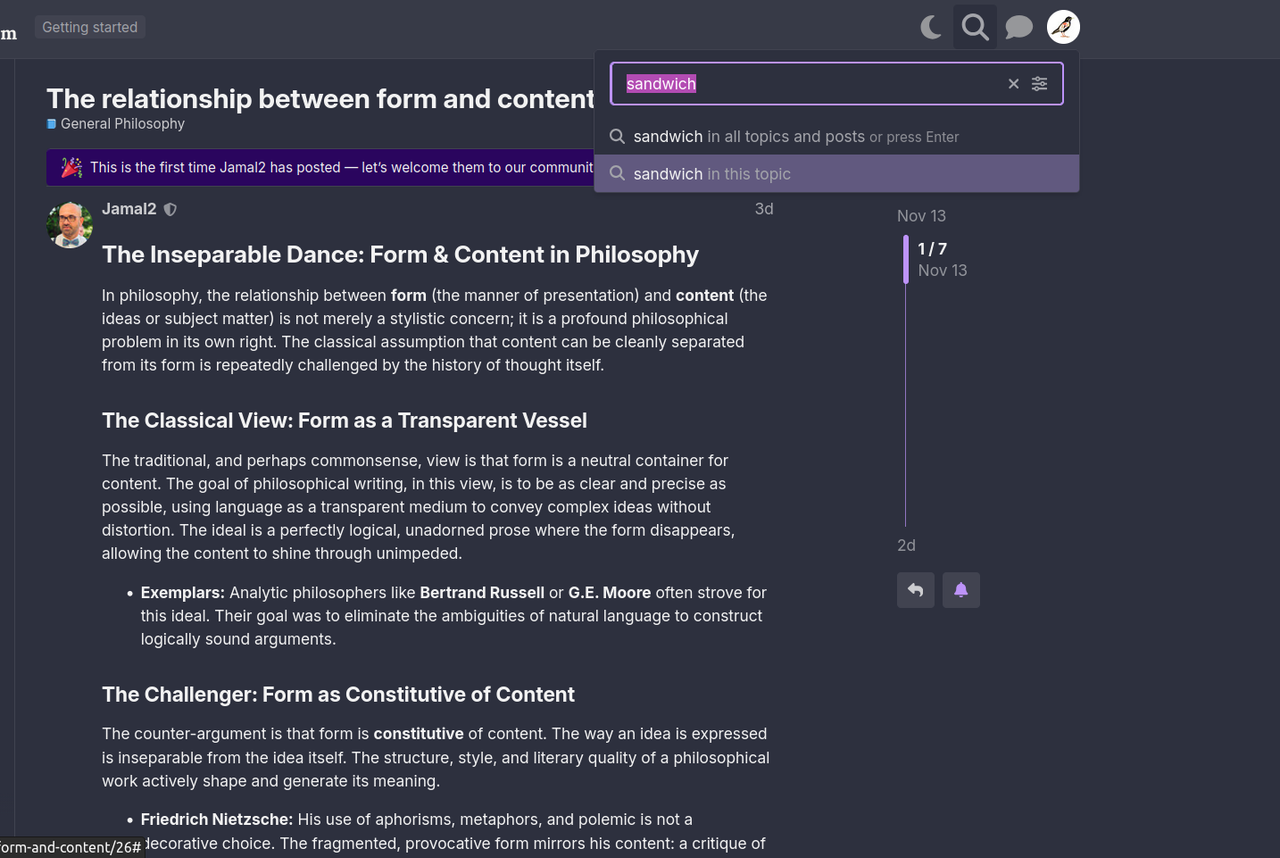

    Screenshot-from-2025-11-16-17-45-19.png

    Screenshot-from-2025-11-16-17-46-17.png
  • A new home for TPF
    :up:

    The Shoutbox won't be the same, but in my opinion it won't be worse. It never really belonged among the discussions, and this has caused problems.

    Here are some screenshots of the Shoutbox, one expanded and one floating in the bottom right corner.


    Screenshot-from-2025-11-16-08-42-45.png

    Screenshot-from-2025-11-16-08-42-22.png

    As you can see, it's pretty lonely there at the moment.
  • A new home for TPF
    You're probably right. But even what's his name likes the idea of a "community posting room", likely for the reasons I've suggested.Outlander

    I don't get it. How could a live chat not function as a "community posting room"? Granted, I don't really know what it means.
  • A new home for TPF


    I want the sites to be separate so I'll transfer thephilosophyforum.com to the new site and use something else for the archive.
  • A new home for TPF


    The number of posts will be visible on the user's profile, but not within discussions.

    Incidentally, aside from the number of posts we will have other things like badges, trust levels, and upvotes, though I'm not sure how we'll use them yet.
  • A new home for TPF
    Understood. I appreciate that you will keep the site as a read-only archive. There are many memories here, and it would be a pity to lose them forever.javi2541997

    Indeed :up:

    I guess we have to wait until you set up the new TPF to create our profiles in this new software, right?javi2541997

    Well, I've made progress in setting it up already, but unfortunately I can't open it up until everything is sorted out legally, I have a business bank account connected to the subscription system, and stuff like that.

    I'm in. I hereby agree to the costs, investment and other features to keep things going.javi2541997

    Thank you for the support Javi. :up:
  • A new home for TPF
    I wonder what some folk are going to think about having their post count reset to 0. Will that happen? How "fresh" will the new start be? Don't want to clutter up the public thread with my idiosyncratic bouts of curiosity.

    Will we have to sign up again as if joining a new site? Or will we just load up TPF one March day and be on an empty new forum? Will new membership admittance be the same as it is now (ie. no temporary "open enroll" to get the initial numbers up, etc.)?
    Outlander

    Existing members will have to sign up to join the new site. This is essential for legal compliance, because this is where you will agree to the new Acceptable Use Policy.

    So far I don't have a definite plan for how to get existing members over to the new site. Probably I'll make a list of members who have been active over the past year or so, and send an email. Otherwise, there will probably be a permanent announcement on the archive site.

    And yes, I think we should probably open up the new site, to allow anyone to sign up, though with admin approval to activate accounts.
  • Reading group: Negative Dialectics by Theodor Adorno
    And so, what are we to make of this concept of philosophical responsibility?Pussycat

    An interesting question, PC. Maybe you could start a dedicated discussion topic.
  • Reading group: Negative Dialectics by Theodor Adorno
    This is quite nice, more ... humane than ND, meaning Adorno there speaks like a normal person, unlike the convoluting language employed in his theoretical work, I can actually understand him on first reading!Pussycat

    Yes, I find all his lectures are like that.

    Do you think it is because he only wants to be critical that he doesn't develop his philosophy into an ontology and epistemology? Wouldn't the development be ideological, or lead back to ideology via reification?Pussycat

    Yep. Being critical or negative is a necessity, not just an evasion of philosophical responsibilities.
  • What should we think about?
    There are around 270 million citizens of countries with a king, and this is an international site. Please do not presume that your "we" covers everyone here.

    EDIT: I promise I'm not anti-American, but this habit of Americans of assuming everyone is American is infuriating.
  • Climate change thread on the front page
    We have a climate change thread on the front page which tends to degenerate into personal attacks. Maybe it's a topic that would be better suited to the Lounge?frank

    Yes, we already closed the Politics & Current Affairs category and moved the active discussions to the Lounge, so to be consistent we should do the same with the thread in question. I'll move it.
  • Reading group: Negative Dialectics by Theodor Adorno


    :up:

    If you're interested, there's a book of his 1965 lectures on metaphysics, which seems to be mainly about Aristotle: Metaphysics: Concept and Problems.
  • Reading group: Negative Dialectics by Theodor Adorno


    Good stuff. Since Adorno believes that in the interdependent subject-object relation, the interdependence is asymmetrical—the object has primacy, in that it always exceeds the subject logically and historically—you might say that his philosophy implies an ontology, because this priority is simultaneously an ontological one, establishing the irreducability of the object to the subject and the condition for the possibility of the subject.

    The trouble, from your point of view, will be that refuses to develop this into a positive ontology, instead using it as part of a critical move to reveal the shortcomings of all ontology ever attempted.

    And there's also the fact that his materialism, like Marx's, is not a metaphysical materialism, so it doesn't really concern itself with the ultimate nature of reality.

    But let's see how it goes. :up:
  • Reading group: Negative Dialectics by Theodor Adorno
    Yet what I see in Adorno is a form of systematization around an opposition to "identity-thinking." I want to say that there is no thought that is not susceptible to systematization, and that every thinker is more or less systematic. But the curious question asks whether a thinker like Adorno who is emphatically opposed to "philosophical systems" in a thoroughgoing way could ever himself avoid a system erected around this goal—a goal that he energetically devotes himself to.

    System-thinking is a form of monomania, and therefore anyone who is especially devoted to a singular cause will tend to be a system-thinker in one way or another. I would argue that the only way for the devoted person to avoid this is by devoting themselves to a cause that is not singular, and this is what the analogia entis or the coincidentia oppositorum attempts to provide. Causes which are negative and therefore act in opposition have an especially difficult time avoiding monomania. Adorno's cause is not only negative, but the thing that he opposes (identity-thinking) itself strikes me as being singular. At the same time, it does involve a certain ambiguity and subtlety which makes it vaguely familiar to Przywara's or Rommen's approach, but I think it will fail to avoid systems-thinking precisely because it is insufficiently ontologically grounded.

    But again, I think the ultimate test here has to do with the way of life of the philosophers in question. Figures like Przywara or his student, Josef Pieper, intentionally lived lives that were resistant to systematization. Their activities, engagements, readings, and relationships were all significantly varied, which is what ultimately leads one away from monomania. Supposing that Adorno desperately wanted to oppose the Holocaust and its (logical) pre-conditions, the point here is that one can actually want to avoid the Holocaust too much, strange as that may seem. One can be led into a form of monomania even in their project to oppose pure evil (and this is a basic reason why evil is so pernicious). In order to avoid systems-thinking one is required to engage systems and even evil systems in paradoxical ways (e.g. Luke 6:29). Totalitarian thinking is very likely to breed totalitarian thinking, either by propagation or, more likely, by opposition. When one says, for example, "This must never happen again!," they inevitably commit themselves to a coercive and systematizing approach. They are forced to offer a program which will guarantee a certain outcome, and guarantees require systems.
    Leontiskos

    Thanks Leon, this is beautifully expressed, erudite, full of interesting ideas, and fundamentally misguided.

    I'm reminded of the famous charge that relativism is self-refuting, which Adorno criticized:

    The popular argument ... that relativism presupposes an absolute, namely its own validity and thus contradicts itself, is wretched. It confuses the general negation of a principle with its own ascent to an affirmation, without consideration of the specific difference of the positional value of both. — Negative Dialectics Against Relativism

    In other words, this popular argument against relativism mistakes a critical stance for a positive, universal proposition. Similarly, in your criticism of Adorno you mistake his critical focus on identity thinking for some first principle or originary ground—something that might function as the foundation of a system. But it's not that, and I don't think your performative-contradiction gotcha works. (It's not a temperamental fixation either, and I might come to that)

    1. Adorno is not anti-system in any simple way. He regards system as a necessary or inevitable moment in, or element of, all significant philosophical thought, one that he has to pass through himself. Relatedly, he is not simply against identity thinking or classificatory concepts. These are all part of a process. Note that I do not mean that he uses them just to later on throw them away like Wittgenstein, rather that he uses them dialectically, such that they are always in play. Used like this they articulate what they cannot capture alone. The "system" of negative dialectics, if you want to call it that, is not a positive edifice but a set of critical movements designed to fail productively so as to demonstrate the priority of the object negatively, i.e., not by stating it but by showing the failure of the subject to fully constitute it.

    2. System is not best characterized psychologically as monomania, but as a form of thought, one that tends to comprehensiveness and closure, synthesis and reconciliation, and the subsumption of the non-identical under identity. System, Adorno might say, is a conceptual expression of the social compulsion towards unquestionable authority. Reducing it to temperament misses its historical and structural character, basically that it's philosophical and sociological rather than psychological. The question is not whether a thinker is devoted or balanced, but whether their thought fits the conditions and reproduces or resists the social compulsion.

    3. Adorno himself is not monomaniacal. His focus on identity thinking is not a singular fixation or cause that he is devoted to above all else. Identity thinking isn't just one thing among others or, quoting myself from above, a first principle or originary ground. Rather, it's the general form of conceptual thought in its historical actuality—the way of thinking, under concrete conditions, which assimilates the object to the subject. His critique is not pushing a specific doctrine but is focused on this tendency, which he analyzes from within rather than opposing from without.

    4. Your comments about the Holocaust don't do justice to the role it plays in his thought. To say it must never happen again is not a moral program or the foundation of a system, but the basic condition under which philosophy can still justify its existence, given the new conditions. For Adorno, the Holocaust reveals a basic defect in the Enlightenment and modernity, one that cannot be ignored. Thus he refuses to prescind from Auschwitz and carry on philosophizing as though it were just an aberration or temporary setback. To accuse him of monomania is therefore to miss the point entirely: what looks like obsession might in fact be philosophy's overdue awareness that it can no longer prescind from the catastrophe that defines the modern age. (I should also note that when Adorno mentions "Auschwitz" he means it to stand for all instances of industrial mass-slaughter, not just the Holocaust).

    As for totalitarianism, I think it's too easy, or perhaps superficial, to say that an anti-totalitarian philosophy might itself become totalitarian if it goes too far. I just don't agree that Adorno's focus is unhealthily obsessive or that it risks trampling over reality on the way to the guaranteed outcome of a program. The more common complaint is that Adorno doesn't offer anything at all that can function as a program, nor any projected outcome beyond the minimal hope of an end to suffering and domination. On the contrary, he is painfully aware of how the revolutionary program led to totalitarianism in the USSR and in his own country (I mean East Germany).

    Your suggestion that philosophers ought to live lives of variety and balance, and stop making such a fuss about the Holocaust, reminds me of something Terry Eagleton wrote:

    Those who speak of harmony and consensus should beware of what one might call the industrial chaplain view of reality. The idea, roughly speaking, is that there are greedy bosses on one side and belligerent workers on the other, while in the middle, as the very incarnation of reason, equity and moderation, stands the decent, soft-spoken, liberal-minded chaplain who tries selflessly to bring the two warring parties together. But why should the middle always be the most sensible place to stand? Why do we tend to see ourselves as in the middle and other people as on the extremes? After all, one person’s moderation is another’s extremism. People don’t go around calling themselves a fanatic, any more than they go around calling themselves Pimply. Would one also seek to reconcile slaves and slave masters, or persuade native peoples to complain only moderately about those who are plotting their extermination? What is the middle ground between racism and anti-racism? — Why Marx Was Right
  • Reading group: Negative Dialectics by Theodor Adorno
    I suppose, as I said, this is the point where I disagree with Adorno. That's not to say that I am judging either one of our perspectives to be true or false, in any absolute sense. I think that I simply believe that "ontology" has a different nature from what Adorno believes. Since, as I said, ontology is speculative, I cannot claim to be confident that I am right.

    However, as I said a few days ago, I believe that the goal of ontology is to determine the immediate. True certainty can only be produced in this way. So to insist that there is mediation all the way down, I believe would be a self-defeating ontology. It's like saying that we might as well stop seeking certainty because we can never have it.
    Metaphysician Undercover

    Thank you MU, this is very good and clear. You and Adorno certainly disagree here, but I'd like to emphasize some things about his position with a view to achieving general agreement of interpretation. His "mediation all the way down" as I called it is not nihilistic. It's not saying we can never reach the truth, but proposing a search for truth which is very different from first philosophy, of which Heideggerian fundamental ontology is a newer version, according to Adorno. In a nutshell, he is against ontology as such. Now, I can respect that you cannot accept his position here, but maybe we can agree that this is what he thinks.

    Not that it will change your mind, but I think the key might be to see that for Adorno, mediation is not an obstacle to truth, but rather its constitutive condition. This way of putting it is structurally similar to one of the ways I used to argue against indirect realism, phenomenalism, etc (BTW I haven't changed my mind about it, just left behind the debate): the sensorium is not a distorting medium between ourselves and the world, but is the condition for the world to appear to us at all, and is the means through which we are engaged with it. Just as indirect realists seem to regard only a suppositional perception without the senses as allowing us to get beyond ourselves to apprehend the Real, so ontologists in their own striving for immediacy regard only a non-sensory "intellectual intuition", a pure grasp of being, as sufficient for attaining the truth of what is.

    So that's just an important reframing, away from mediation as distortion/contamination/corruption and towards mediation as constitution. The upshot is that truth is found in the totality of mediations. Or maybe better put: an object's truth-content is found in the totality of its mediations.

    In terms of the history of philosophy Adorno goes something like this:

    He is against all first philosophy, the traditional search in metaphysics for a foundational principle. He sees this as the paradigm in philosophy of coercive identity thinking. He therefore accepts Kant's verdict on metaphysics and the limits of reason, while rejecting the details of his system as hypostatizations of the bourgeois subject. He then embraces Hegel's dialectical method while rejecting his totalizing system, the synthesis of the Absolute, and so on.

    Heidegger and others—Adorno uses "neo-ontology" to group them—attempted to find a way between German idealism, which they saw as another flawed philosophy of consciousness, and positivism, which they dismissed for its reductionism and scientism. The crucial way through was to accept Kant's critique of the attempt to know things-in-themselves while arguing that Kant had totally ignored a deeper question, that of the Being of those things. Adorno saw this as regressive, an escape from concrete mediation into a new mythology, another pre-critical first philosophy in disguise.

    Regarding certainty, it would be interesting to examine Adorno's attitude to it. I expect it would look a bit like Wittgenstein's, insofar as it would reject absolute certainty but also avoid total relativism.
  • Reading group: Negative Dialectics by Theodor Adorno
    I think I see the point, I just don't agree. I think the nature of ontological questions is such that they transcend all social and historical conditions. That's why I said the same questions are asked throughout history and by every different culture. What varies is the formulation of the question. So the questions appear to differ but they really ask the same thing, i.e. how do we approach the unknown. The unknown has a different appearance depending on the social historical mediation, therefore the question has a different formulation depending on these factors.Metaphysician Undercover

    What did you think of my proposal of how to make my perspective consistent with Adorno's? If we recognize that since the formulation of the question is always going to be mediated by social and historical conditions, and we know that this is going to make the question asked, the wrong question, then we can conclude that the answer is always already within the question. The answer being that the question itself is mistaken, or the wrong question.Metaphysician Undercover

    My perspective is that the reason why the question is more important than the answer, is due to the need to determine the appropriate question. To be consistent with Adorno, maybe that's the answer which inheres within the question, that the question itself is wrong.Metaphysician Undercover

    I appreciate the effort, but since you still adhere to the promise of a transcendently correct question, I don't think it works. This implies that concrete conditions merely contaminate an attempted purity, whereas Adorno's point is that they're constitutive, that it's mediation all the way down.
  • Bannings
    I noticed that Pieter R van Wyk’s account has been deleted. Are you deleting all accounts for banned people now or was that a request by him?T Clark

    I don't usually do it unless I'm asked to do so but on this occasion I wanted to remove as many traces of him as possible without actually removing his posts, which woud be unnecessarily destructive.
  • Bannings
    Jamal...so if i'm understanding you correctly, you don't tolerate any type of self-promotion? Could you be more specific about the self-promotion you can't deal with?ProtagoranSocratist

    For example, if you fill your posts mainly with quotations from a book you have written, and mention that book in every post, that counts as self-promotion. But in fact, Pieter was banned not just for self-promotion but also for evangelism and crackpottery, since he appeared to believe that his book held all the answers.

    Generally, putting links to your work in every post is the main thing we don't allow.

    Site guidelines
  • Reading group: Negative Dialectics by Theodor Adorno
    I do see that he is proposing some form of empiricist perspectiveMetaphysician Undercover

    It's not anything I recognize as empiricism. The idea is rather that questions are socially and historically mediated, never completely separable from their formation. And they are also mediated subjectively in the intellectual experience of the philosopher, whose thinking is shaped by their situation. The concrete social and historical conditions produce certain questions, so we understand and attempt to answer the questions partly through understanding these conditions.

    The person asking the question may not know the answer, but the question itself is not a blank slate. A question like What is freedom? asked in 5th century Athens and 18th century France are different questions. The historical context, the social struggles, the available language all mediate the question and pre-structure the field of possible answers.

    Anyway, I know that many philosophers would object to this approach, but that's what Adorno is saying.
  • Bannings
    I think I'll be staying in the Shoutbox for a while. Juust in caseOutlander

    You have one thing the crackpots don't have, which is humility. You don't claim to have all the answers, so don't worry.
  • Bannings
    I banned @Pieter R van Wyk for self-promotion and crackpottery.
  • Reading group: Negative Dialectics by Theodor Adorno
    Although I think he wants to target all phenomenologists including Husserl with this, just to make that explicit (not that you said otherwise), and not just Heidegger -- but Sartre, and Bergson, and anyone who might lay claim to "the things themselves" absent ratio: this being a sort of "flip side" to Hegel who claimed everything is "analytic" --- the idea goes from one to the next as any philosopher could judge -- where now by looking to the non-identical we are trying to set aside our desiderata in favor of the things where we cannot do so without some sort of ratio for the things themselves to be mediated by.

    EDIT: I finished Being, Subject, Object and see I was following along with the general pattern of thinking -- he notes the difference between these thinkers there while grouping them.
    Moliere

    :up:

    Yes, totally. It's not just about Heidegger, but he is in a way paradigmatic.

    I'm still struggling slowly through "Question and Answer".
  • Reading group: Negative Dialectics by Theodor Adorno


    I'm totally on board with what Adorno is saying in this section, so maybe I can explicate it. For the moment I'll just address the bit about answers being included in philosophical questions.

    Adorno is accounting for the ontological need, the dissatisfaction with neo-Kantianism and positivism that prompted the creation of philosophies such as Heidegger's:

    That is why ontology has surrounded itself with its miasma. In keeping with an old German tradition, it considers the question more important than the answer; where it owes what it has promised, it has raised its failure for its part to a consoling existential.

    So one reason the need continues to be felt is this idea in philosophy that the question is what is most important. You often see this even today, and not just in this German tradition: the fetishizing of the question.

    BUT!

    In fact questions [ do ] have a different weight in philosophy than in the particular sciences, where they are abolished through their solution, while their rhythm in the history of philosophy would be more akin to duration and forgetting. This does not mean, however, as in the constant parroting of Kierkegaard, that the existence of the questioner would be that truth, which searches in vain for the answer. Rather in philosophy the authentic question almost always includes in a certain manner its answer. It does not follow, as in research, an if-then pattern of question and answer. It must model its question on that which it has experienced, so that it can catch up to it. Its answers are not given, made, produced: the developed, transparent question recoils in them.

    I've added the bolded "do" to make it clear what Adorno is saying. He is saying that the idea has some truth to it.

    First, I think we can all agree with Adorno that philosophical questions are generally/often not "abolished through their solution." That is, what appear as solutions are not really solutions at all, and the questions become reformulated or perhaps discarded as uninteresting, never solved with the gathering of data as in science. This is why "their rhythm in the history of philosophy would be more akin to duration and forgetting." The rhythm is not question -> data/proof -> solution.

    Now, the way that a good philosophical question "almost always includes in a certain manner its answer" is that a good philosophical question already shows us what we are looking for; it tells us the kind of answer that will satisfy us—but unlike science this is not external. The question embodies a particular experience, one rooted historically and socially. So the answer is not external to the question, as it is with empirical data in science, but immanent to the genesis of the question. This is the meaning of "It must model its question on that which it has experienced, so that it can catch up to it."

    None of this is meant to imply that we can immediately read off the answer straight from the question. Nor does it mean that the answer can be deduced in the manner of mathematics or formal logic, as if all philosophical questions implied the whole philosophical system of the world in microcosmic tautology.

    Take for example this question: "How do body and soul interact?"

    Descartes had a hypothesis:

    The part of the body in which the soul directly exercises its functions is not the heart at all, or the whole of the brain. It is rather the innermost part of the brain, which is a certain very small gland situated in the middle of the brain’s substance and suspended above the passage through which the spirits in the brain’s anterior cavities communicate with those in its posterior cavities. The slightest movements on the part of this gland may alter very greatly the course of these spirits, and conversely any change, however slight, taking place in the course of the spirits may do much to change the movements of the gland. — The Passions of the Soul

    If you can imagine this role of the pineal gland having been empirically confirmed, the question would have then disappeared. It would have turned out to have been a scientific question.

    But as a philosophical question—which we now see that it is—it expresses the conditions of its genesis, defining a horizon of meaning. It presupposes that there are two distinct things and that they are problematically related. This expresses a worldview which is already part of the kind of answer that might satisfy the question. The answer would be the answer it was owing to its dualism, and this was in the question already.

    Incidentally
    Incidentally, Descartes probably didn't recognize the distinction I'm making between science and philosophy. We can now ask, "how do science and philosophy relate?" and that would express our historically situated experience. It is not a question that would have made sense to Descartes, so the formation of the question is, not identical to, but the key to its answer.


    The situated experience that constituted the genesis of the body-soul or mind-matter question would be one of feeling divided. I won't fill in the details but one can see how this feeling could be a result of social forces: we experience ourselves as thinking and willing agents, but also as objects in a world of mechanism and calculation; and because of the division of labour we see manual and intellectual work as entirely distinct. Adorno and Marx might put this in terms of alientation.

    So Adorno isn't saying that asking a question magically gives you the answer, rather that in philosophy, the way a question is framed already expresses an insight into what it seeks. The question is not a neutral, disinterested request for information but the expression of an experience. Thinking it through, not importing information, is what brings answers to light.

    So for Adorno, philosophy's task is to make questions transparent enough that they reveal their own truth-content.

    EDIT: This is related to what I was saying elsewhere on TPF recently about genesis and validity. In a nutshell, the validity of a philosophical idea is never entirely unrelated to its genesis.
  • Reading group: Negative Dialectics by Theodor Adorno
    The Ontological Need: QUESTION AND ANSWER

    The ontologies in Germany, particularly the Heideggerian one, remain influential to this day, without the traces of the political past giving anyone pause. Ontology is tacitly understood as the readiness to sanction a heteronomous social order, exempted from the justification of consciousness. That such considerations are denied a higher place, as misunderstanding, a falling astray into the ontic, and a lack of radicalism in the question, only reinforces the dignity of the appeal: ontology seems all the more numinous, the less it solidifies into a definite content, which the impertinent understanding would be permitted to get a hold of. Intangibility turns into unassailability. Whoever refuses to follow suit, is suspected of being someone without a fatherland, without a homeland in being, indeed not so differently from the idealists Fichte and Schelling, who denigrated those who resisted their metaphysics as inferior. In all of its mutually combative schools, which denounce each other as false, ontology is apologetic. Its influence could not be understood, however, if it did not meet an emphatic need, the index of something omitted, the longing that the Kantian verdict on the knowledge of the absolute ought not to rest there.

    Adorno, here very much on the side of reason, begins by attacking Heideggerian irrationalism and accusing it and other such "fundamental ontologies" of tacit complicity with fascism.

    For Heidegger, asking for justification for his ontology is already to have gone wrong. Thus he sets up his ontology as exempt from justification, and this is presented as proof of its profundity.

    Notice Adorno says that Heideggerian philosophy exempts itself not just generally from justification, but specifically from the justification of consciousness. The point here is to assert consciousness against Heidegger's rejection of consciousness-centred philosophy and thus to emphasize that justification, and therefore also reason and critical autonomy, is constitutively subjective—or is always subjectively mediated. In all of modern philosophy it is from consciousness that reason arises and from there is imposed intersubjectively to achieve objectivity. Every philosopher in his own subjective reasoning must submit to the agreed rules of justification—but after all it is the subject who reasons. This attitude is most obvious from Kant through to German Idealism, in which the subject is elevated to a universal "I".

    The appeal to unmediated access to Being is irrational because only through subjective mediation is reason applied, and in asking us to deny our own conscious reason Heidegger clears the ground for an uncritical acceptance of heteronomous authority, i.e., the social order imposed from outside consciousness in the name of "Being".

    Moving on from his cursory assertion of neo-ontology's ideological function as fascist apologetics, he considers why this philosophy seems so attractive. It would not have been so influential, he says, had it not met a need.

    But before I continue, I'm going to do this:


    Heidegger's fundamental ontology & what Adorno doesn't like about it

    I only know Being and Time from secondary literature and lectures; I have not read the work itself. What follows then is at best a rough sketch, but I think it'll be enough for an understanding of Adorno's casually delivered accusation of support for fascism, if not for an adequate assessment of it.

    Heidegger in B&T begins with a revival of the question of the meaning of Being. Philosophy has spent most of its time investigating beings and their properties, not Being itself. This is the ontological difference; the investigation of beings is concerned with the ontic, whereas Being itself is ontological.

    To begin his investigation of Being he focuses on the one particular being for whom Being is an issue, namely the human being. His name for this being is Dasein, which means "being-there". This analysis is entitled "The Analytic of Dasein".

    Dasein is special because it already has a direct, pre-theoretical familiarity with Being. So instead of building a theory built on justification, Heidegger lays out the structures of Dasein's existence, giving us an "existential analytic". That this is all beyond the reach of rational critique is the central problem for Adorno.

    EDIT: To be more precise, the central problem is that Heidegger's ontology is based on or consists of a rejection of rational critique. The traditional language of justification and the subjective is held to be superficially ontic. Since the ontology is therefore exempt from intersubjective reason, what you end up with is a new dogmatic philosophy.

    According to Heidegger the nature of Dasein's existence means that the subject-object framework is wrong. Dasein is not a detached spectator but is rather characterized by being-in-the-world, where Dasein's world is a context of significance. Heidegger's account of being-in-the-world describes two ways Dasein encounters things: ready-to-hand, meaning they are made use of practically as familiar unquestioned parts of our world; and present-at-hand, meaning things are observed in a detached, theoretical manner, as in science.

    Also part of what it is to be Dasein:

    - Care: Dasein's basic structure, the condition of being concerned with its own being, projecting itself towards the future.
    - Thrownness: Dasein always finds itself thrown into a context it didn't choose.
    - The They: the conformist public which blocks Dasein's authentic potential.
    - Authenticity: via anxiety and confronting one's own mortality one can act independently of The They.

    These structures, the Existentialia, are presented by Heidegger as neutral insights which apply transhistorically to human existence. But for Adorno, rather than the eternal truths of Being, they grew out of a specifically German and conservative context and played an ideological role. And they were able to do this, and to pose as eternal and natural, because they were from the outset abstract, drained of substantive content: what does Dasein care about, and why? Into what kind of society is it thrown? Granted that Dasein's existence is one of being-in-the-world, but why should we just accept the given state of that world? Heidegger brackets the social and material conditions that shape it, treating them as ontologically neutral, so as to get at Dasein's being. But Adorno points out that this very effort and this crucial bracketing is to abandon the central philosophical task of critiquing all that exists. The result can only be social conformism and ideology, no matter how appealing and partially true Heidegger's analysis is.

    But the real ideological danger is that the Existentialia are not as abstract and empty of content as they pretend to be. Although they're presented as formal structures, they're actually saturated with conservative, specifically German content: Thrownness implies Volk, Fatherland, and destiny; The They is part of an anti-Enlightenment critique of liberal modernity; etc. This move allows Heidegger to universalize what is actually a particular German Romantic worldview, giving it the authority of ontological necessity.
  • A debate on the demarcation problem
    This is just self-promotion. I'm closing it.
  • Reading group: Negative Dialectics by Theodor Adorno
    I'm really enjoying the first section of "The Ontological Need". It's Adorno as we don't often get to see him so clearly, as staunch defender of the Enlightenment. He pretty much comes out and says it in the first few lines: Heidegger's ontology is philosophical support for fascism.

    I'm still working through it though.
  • Reading group: Negative Dialectics by Theodor Adorno
    I'll say some more about the introduction, particularly the linguistic angle.

    1. Isn't the emphasis on expression a subjectivization of cognition? Doesn't it elevate personal perspective over truth, or even---which is worse---equate them?

    He actually addresses this objection in the introduction itself, where he says that what is contingent and subjective is not mere, by which I mean that the contingent and subjective cannot be legitimately cast as the inferior pole of a Socratic opinion vs. knowledge dimension. This is because the subective is objectively determined, and the contingency of perspective is not a random anything-goes contingency:

    This contingency meanwhile is not so radical as the criteria of scientivism would wish. Hegel was peculiarly inconsistent when he arraigned the individual consciousness, the staging-grounds of intellectual experience, which animated his work, as the contingent and that which is limited. This is comprehensible only out of the desire to disempower the critical moment which is tied to the individual Spirit. — QUALITY AND THE INDIVIDUATED

    It [individual experience] would have no continuity without concepts. Through its participation in the discursive medium it is, according to its own determination, always at the same time more than only individual. The individuated becomes the subject, insofar as it objectifies itself by means of its individual consciousness, in the unity of itself as well as in its own experiences: animals are presumably bereft of both. Because it is universal in itself, and as far as it is, individual experience also reaches into that which is universal. Even in epistemological reflection the logical generality and the unity of individual consciousness reciprocally condition one another. This affects however not only the subjective-formal side of individuality. Every content of the individual consciousness is brought to it by its bearer, for the sake of its self- preservation, and reproduces itself with the latter. — QUALITY AND THE INDIVIDUATED

    This is quite Kantian, but none the worse for that: objectivity via the subject. What it comes down to for Adorno is a refusal to accept the primacy, characteristic of science, of the view from nowhere and the abstraction which attempts to reach it. It might have been fruitful for science, but applied to philosophy it is a fundamental mistake, since critical insight is inseparable from the subject and understanding has in actuality been impoverished across the board by the purported objectivity of abstraction, classification, and mere signification, under the imperatives of economy and bureaucracy.

    Or as Roger Foster puts it:

    [Adorno] is arguing that the subject-neutral perspective cannot reflect, within itself, on what kind of truth it is. That is to say, it cannot reflect on its own dependence on historical experience. For Adorno, this is not merely an oversight; it is rather structural, because the denial of its dependence on history is in effect built in to the subject-neutral perspective. — The Recovery of Experience


    2. Isn't it an argument for philosophy as poetry, sacrificing logical justification?

    Adorno is very aware of this objection, which is why in the introduction and in the lectures he emphasizes that negative dialectics rigorous, stringent, and so on.

    The way I think about it is that argument and expression have to work together (this is along the same lines as the "Argument and Experience" section, though that was about experience more generally, whereas here we are looking at language).

    So argument is most successful when the material it works with is most truthful, which means rich in the qualitative content revealed best by linguistic expression. And expression is most successful when it is answerable to and motivated by the compulsion of logic.

    But that's all I have right now on that question.


    3. What does it mean in practice to use concepts expressively? What does the Darstellung of negative dialectics look like?

    The obvious answer is to point to ND and his other works. But this doesn't tell us much.

    It helps to see that within concepts themselves there is a reflection of that non-identical remainder which belongs to things. We can use concepts in a way that allows their contextual associations to speak, associations that exceed or are suppressed by the concepts' definitions. It's like poetry: there are no true synonyms---every word has its special associations and sounds, and flattening these out or thinking of them in terms only of their defintions would be a regression from understanding and truth. Adorno maintains that the same is true in philosophy for concepts.

    One thing this means in practice is a refusal to state or settle on definitions or on a single conception of an object or state of affairs. This would explain his tendency to circle around a topic, using different concepts along the way. It is in the interplay of concepts and their associations that we catch glimpses of the truth.

    Adorno believes that the task of philosophical writing is to reverse the tendency of concepts to detach themselves from the nuances of contextual significance. Making concepts receptive to the moment of expression is therefore to allow the context in which a concept is experi enced to inform its cognitive significance. — Roger Foster

    I actually don't know if any of that constitutes an answer to the question, but it goes some way towards it.
  • The Aestheticization of Evil
    For me, the earliest such example was Nabokov with "Lolita." There you have it, page after page of aestheticization of pedophilia.Astorre

    Thereby showing the emptiness and potential manipulativeness of aestheticization, since Humbert is not the author's mouthpiece.
  • Reading group: Negative Dialectics by Theodor Adorno
    From what I've gathered, the introduction in ND is a reviewed version of an essay Adorno has written to accompany his lectures, which is featured in LND. This might explain why there are parts missing in the LND translation, and also why some parts are different: the LND appendix translation in based on a different original material. I spent hours trying to validate this for sure, I gave up, it is what I think.Pussycat

    Yes, it's clear the texts are different, even though the differences are quite minor. We can't quite treat them as alternative translations.

    EDIT: Actually I was under impression that the version in the lectures was an amended version of the introduction. I think ND was finished by the time he did the lectures.
  • Reading group: Negative Dialectics by Theodor Adorno
    The introduction is not so much an introduction as the heart of the whole work. It's an essay outlining the problem and the program of negative dialectics, namely how to approach the world philosophically in conditions that have eroded the fullness of intellectual-spiritual experience---in other words how to fulfil the promise of philosophy in conditions where conceptuality itself hinders the search for truth.

    The centrality of language in this program only became clear to me at the end, and that sent me back to the "Speculative Moment" and "Darstellung" sections:

    The need to give voice to suffering is the condition of all truth. For suffering is the objectivity which weighs on the subject; what it experiences as most subjective, its expression, is objectively mediated.
    This may help to explain why portrayal [Darstellung] is not a matter of indifference or external to philosophy, but immanent to its idea. Its integral moment of expression, non-conceptually-mimetic, becomes objectified only through portrayal – language. The freedom of philosophy is nothing other than the capacity of giving voice to this unfreedom.

    This is then reiterated and emphasized at the end, in the "Rhetoric" section, where he switches from suffering to utopia. So the dimension that language must illuminate expressively, using concepts to reveal their own inadequacy, is the dimension with suffering at one end and utopia on the other. The search for truth is inseparable from ethics (and politics?).

    Other important aspects of the introduction are:

    - Identity thinking and the consequent failure of idealism and other philosophies
    - (Negative) Dialectics
    - Anti-system but preserving the spirit of system
  • Bannings


    Thank you and others for the support.

    If we are not allowed to question the sexual ethics of Western Europe, then we will not question the sexual ethics of Western Europe. But that sort of a rule should be made explicit. I don't see how those who question the sexual ethics of Western Europe can simply be threatened or banned for "abandoning reason." There are lots of people from other regions of the world on TPF.Leontiskos

    Questioning the sexual ethics of Western Europe is one thing; stating that gay people are degenerate and immoral (or that they behave immorally) is something else. Debating sex and gender is one thing; denying the identity or dignity of transgender people is another.

    We won't tolerate intolerance. We want to ensure we have a shared foundation of mutual respect and the equal dignity of all participants regardless of sexual orientation or gender identity.

    Well, I say we don't tolerate intolerance, but in reality sometimes we do. I am inclined now to be more strict.
  • The Predicament of Modernity
    A comment I read about the distinction between the New Left and the conservative religious critique, was 'For Adorno and Horkheimer, myth and Enlightenment are dialectically intertwined: Enlightenment arises from myth but reproduces myth’s structure of domination in a new, “rationalized” form. Thus, the way out is neither regression to pre-rational faith nor blind progress through science, but a self-reflective form of reason — one that is conscious of its limits and its entanglement with power.'Wayfarer

    Well, it's a reasonable summary of DoE, sure.

    But I still sense a lack in their spiritual anthropology, so to speak. I think, for the religious, humanity has a cosmic signficance with which it seeks reconciliation.Wayfarer

    Something akin to this is very strong in Adorno's works, though without the actual religion. However, that "lack," i.e., the impossibility under certain conditions of a spritual experience worthy of human beings is often precisely their point, since they do not exempt themselves.
  • Bannings


    If you think Harry was in the same league as The Great Whatever and StreetlightX, I can only assume you didn't interact with him much.
  • Bannings
    To some of us, this is much more than a website to waste time or "shoot the shit" on. More than a casual hobby or past time but an active part of one's life and between some of us almost like a club of distant pen pals (I'm trying to avoid saying "like a family" because that's simply not accurate for the majority of posters). My point is, participation on this site is important to some people more so than you might think. We're all real people with real lives and real feelings. Please remember that JamalOutlander

    What do you think follows from this? That I should never ban anyone? On the contrary, it is because I want to maintain and improve the community that I have to get rid of members who make the experience of being here worse.
  • Bannings


    To exclude or demean others is to abandon reasoned inquiry for dogma or prejudice. You are lucky you are still here.
  • Bannings
    Part of Harry's last comment (now deleted).

    The big mistake you make is not to catch that this is the trick that is going on. You are caught in the Cartesian representational understanding of what it is to be a mind...apokrisis

    Blah blah blah blah-blah bl-ba-blah blah. — Harry Hindu
  • Bannings


    I did. Low quality and obnoxious.