
-
The End of WokeDo you think the concern some have regarding woke is simply a continuation/development of this? — Tom Storm
In the states it’s been heavily politicized in recent years, and quite successfully.
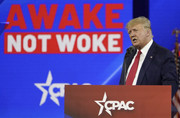
Three pages back in this thread I asked one of the ‘Awake’ folks if they thought wokeists should ignore the American Eagles jeans ad. Answering the question was apparently a struggle.
It’s just a stupid ad, why not say what you think—that they’re probably capitalizing on culture war hot buttons or whatever.
Deeply ironic that you can’t say “white supremacy“ anymore. :lol: -
The End of Woke
I can’t tell if you’re serious. Assuming you are, you wrote “Earnestly critiquing something is not mockery. If you feel its mockery., maybe just notice how earnest critique makes it look. Silly.” in reference to the Kids in the Hall skit.
Earnest critique aims to identify strengths and weaknesses to improve understanding or quality. Even if it's harsh, the goal is constructive or truth-seeking. Mockery is about belittling, often using sarcasm, exaggeration, or tone to make the target look silly.
The skit was designed to make PC culture look silly in a comical way. -
The End of WokeAbsolute bullshit. Earnestly critiquing something is not mockery. If you feel its mockery., maybe just notice how earnest critique makes it look. Silly. — AmadeusD
Oh, sorry, I assume calling it satire is acceptable or at least less offensive. -
The End of Woke
They were mocking PC culture. Today, people like Andrew Doyle practically make a career out of mocking woke culture. -
The End of WokeI think Jesse Lee Peterson is one of the most outrageous commentators out there. But he is obviously correct about some things. — AmadeusD
Wow, okay! :grimace: -
The End of WokeThe logic of why we have rules around adults access to children is the same logic as why we restrict male access to females. — AmadeusD
Surfing is not a contact sport and locker rooms or whatever are also a non-issue.
Btw, the woman who made a fuss about it didn’t compete as a longboarder. She’s a Christian and just happened to be selling her conservative themed children’s book at the time. -
The End of Woke
:lol: Who would you rescue first?
1. A child being abused.
2. Someone involved in an industrial accident.
3. A woman being sexually assaulted.
4. A woman competing with a trans-woman in a longboard competition.
It seems to me that there's a rather large gulf between 3 & 4. -
The End of WokeI take issue with trying to frame the opposing side as unreasonable in this particular way (its not always a sin). A single male surfer taking a female accolade is enough, on the "anti-woke" side (though, that's misleading of a label). A single harmed child will have us looking at child abuse law. A single dead engineer will have us overhauling H&S. A single female being abused or harmed by a male in the bathroom should have the same response, to be consistent, or discuss why they aren't similar. — AmadeusD
It seems like a stretch to compare longboard surfing, something that doesn’t even qualify for the Olympics, to child abuse, industrial safety, and sexual assault. -
The End of WokeThe divide between woke and not is so large I still am not sure if people are actually upset about this ad or whether this is American Eagle contriving outrage for publicity, with perhaps a few confused people buying in. — Hanover
To date American Eagle is being tight lipped about it. When looking for their response just now I found this interesting tidbit from former Levi’s brand president Jennifer Sey, who said, “They’ve [the woke] lost their power. They just haven’t realized it yet.”
Jean branders have realized it, apparently. :lol: -
The End of WokeSo they can be intelligent people, even skilled at logical argumentation, but the objects they argue about or judge to be important are just not always apt. — Fire Ologist
I’m curious if you think it would be appropriate for wokeists to ignore something like this:

-
Opening Statement - The Problem
Poor Pieter, a modern day Galileo forced to endure to endure the TPF Inquisition—so heroic. :lol:
I was thinking what a shame it would be if your work did have the potential to help solve the worlds problems but never got off the ground because you’re such a terrible marketer. -
The End of Woke
There was a big controversy about a transwoman being allowed to compete a couple years ago. Last year the world surfing league tightened up the requirements though, to appease the anti-woke. All that over 1 surfer, and a longboarder at that. -
The End of WokeWhy not surfing? That is precisely the sort of question you need to answer. If you can propose boards for no reason at all, then why can't I propose surfing for no reason at all? If we've done away with reasons then what's the difference? — Leontiskos
A similarity in the two is that both a surfer and a board can decide to hang 10. -
What is a painting?
Deeper down the rabbit hole, and assuming the AI is not hallucinating, iron is far more available than the elements which are historically used to make the other primary pigments, namely yellow and blue. Iron is also more bioavailable to species for the job of carrying oxygen in the blood. Iron is reported to be better at the job though some species use copper and vanadium and those critters got blue blood.
Red/iron has organic weight? -
What is a painting?I think you are just assuming this is a representation of how attracted we are to particular colours where it could be more to do with economics and the textile industry, or even religious symbolism. — I like sushi
I looked into it a bit further online just now and it appears that red, the first chromatic color mentioned in early writings across cultures, is strongly associated with blood. Given this correlation, it seems reasonable to speculate that if our blood were blue instead of red, for example, we might find ourselves more drawn to the color blue instead of red. Correlation is not causation of course, but this may indicate that red has more of an organic weight than a socially constructed weight. -
The End of WokeI think it is a strawman to impute bad intentions here, as if "power stratification" is the desired end. — Leontiskos
Of course the belief that values are baked into reality in a particular order is not just about power stratification. It helps to uphold the order nevertheless. — praxis -
Opening Statement - The Problem
Who needs enlightenment when you’ve got freshly popped popcorn and a good seat in the cave. -
The End of WokePlus you are placing an interest in egalitarianism over and above an interest in hierarchy - thereby creating a hierarchy. — Fire Ologist
The religious hierarchy is fixed. Good reason for the separation of church and state in a democracy. -
The End of WokeMy point is that the idea that hierarchical thinking is an evil bogeyman is a strawman. Anyone who admits that some values are higher than others is involved in hierarchical thinking. — Leontiskos
I’m not attacking a strawman or anything else. I’m merely voicing the opinion that the fundamental conflict is between hierarchical vertical thinking and egalitarian horizontal thinking.
It's just not about power stratification.
Of course the belief that values are baked into reality in a particular order is not just about power stratification. It helps to uphold the order nevertheless. -
The End of Woke
We can probably skip paleolithic economic theory and simply acknowledge the absence of a state and organized religion, yes? This, in my opinion, loosens the rigidity of the bishop's hierarchy of values because it indicates that their fixedness is not natural. -
The End of Woke
What do you have to say about the fact that for 95% of human history we lived in hunter-gatherer egalitarian societies—without a state and organized religion?
This flies in the face of what the bishop claims is natural. -
What is a painting?
If I remember correctly, they examined the earliest written documents in various languages and looked for color names. They found that across languages the order of appearance was the same—red always showing up before blue, for instance. -
What is a painting?Ah! I see. Not sure how relevant that is but it is something at least. — I like sushi
It’s highly relevant.
Imagine two abstract paintings of similar composition side by side on a wall. One of the paintings is colored with large blocks of black, white, red, and a little yellow. The other painting is only colored with large blocks of light blue and dark blue.
We may like the blue painting more but our eye will be naturally drawn to the ‘boldly’ colored painting. Why would that be if we can look at paintings with a “view from nowhere.” -
The End of WokeI think it's fairly difficult to gainsay the Bishop on this point and claim that diversity, equity, or inclusion are absolute values. — Leontiskos
There is no gainsaying the Bishop on this point, and that’s half the point.
This inversion where one places secondary things into the first place is key to wokism.
Rather, the fixed hierarchy is key to power stratification that wokeness aims to reduce. -
What is a painting?Really! What on Earth do they base that on? — I like sushi
Simply the order that the names for colors begin appearing in written language.
If you asked someone who didn’t yet have a name for blue what the color of the sky is they would likely say something like black. That doesn’t mean they can’t actually see blue. -
What is a painting?
I thought it interesting that it’s blue because according to the Berlin–Kay color term hierarchy theory blue is the latest primary color, or maybe to think of it differently, the least important primary.
According to the theory (or study?) colors were added in about the same order across languages. That order being:
Red
Green or yellow
Both green and yellow
Blue
Brown
Purple, pink, orange, gray, etc.
It may not indicate anything of course and be purely coincidental. -
What is a painting?
I wonder if that's the case of blue particularly or for most or all colors. I'll read more myself when I get time. -
The End of WokeThe idea that wokeness is heretical is intriguing, especially since, on the surface, both wokeness and religion share a common concern for supporting disadvantaged communities. I think the core of the issue lies in where their interests diverge: wokeness is fundamentally egalitarian, oriented horizontally in its social vision, while religion—particularly as articulated by figures like Bishop Robert Barron—is inherently hierarchical, oriented vertically.
In the video linked on the previous page, Bishop Barron refers to an 'objective hierarchy of value'—a structure he sees as embedded in the very fabric of reality. While that may be a compelling theological claim, it also implies a preference for maintaining a vertically structured society. And in any vertical structure, there is always a lower class. -
What is a painting?We never just relate to things as things; they are also objects of projected meaning. — Tom Storm
In my experience, that projection can deepen the aesthetic. Whether or not that’s a vice or a virtue… I tend to think aesthetic experience is beneficial in nature. -
The End of Woke
Thank you for the clarification. I’ve read books and articles that are critical of trans activism, so I’m familiar with some of the negative aspects.
I understand how some people might feel that the negative impacts outweigh the positive gains made for the trans community, and therefore see resistance to trans activism as necessary. Personally, I don’t know enough to say that such resistance is essential, down to the last beer can anyway. -
The End of WokeThis leapfrogs the point — AmadeusD
Seriously, why not, as Fire put it, let Bud Light drinking be taken over? -
The End of WokeBut you could also see it (and I think you did) as a reaction to seeing wokism as the institution and the entrenched position, so entrenched it took over Bud Light drinking - on that case, it was activism and pushback. — Fire Ologist
Why not let Bud Light drinking be taken over? According to Anheuser-Busch most their market segment didn't care, and there are many other brands to choose from. Modelo Especial took the lead after the incident, if I remember correctly. It's good, at least compared to Bud Light. -
What is a painting?The question for me then is if someone literally created a physical representation of a river that could be easily mistaken for a natural river then has that person produced Art? I guess for you you see no disparity other than in the creation (which does not fit into your definition of Art as an object). — I like sushi
I don't see a contradiction. I do a lot of painting and the activity is unquestionably aesthetic. Think of an art form like music, it can be an aesthetic experience for the performer and the audience simultaneously.
So, you literally call the appreciation of natural beauty that moves someone Art but the Art 'is in the eye of the beholder' rather than the beauty? — I like sushi
If art is a social construct then it's in the eye of beholder's, I suppose.
What I think is interesting is the idea that the recognition of art may trigger 'aesthetic mode' in a conditioned response/constructed emotion sort of way. -
The End of WokeIs this to note an irrational position? — AmadeusD
It’s not irrational to reject another’s perspective, no. -
The End of WokeWhat I am saying is, part of the woke methodology of reasoning seems to be avoiding anything on its face that appears anti-woke, and instead analyzing for sub-text, the dog-whistle, looking for virtue signaling or lack thereof. Maga types and conservatives and tradition-lovers, are objects of incredulity, whose behavior and speech can only be examined from the outside, not engaged with directly, (as we are engaged here so you are the exception).
See my conversation with Praxis - that is how it typically goes. — Fire Ologist
My aim, as I said, is to try avoiding useless bickering. My interest is something you brought up: looking into the character of the anti-woke.
You asked me if resistance is essential and I said that I wasn’t sure how to answer. I think it’s a good question, if extremely broad in scope. I tried to narrow the focus to the Bud Light fiasco and asked, if you regard it as a form of resistance, whether or not pushing back on that was essential. I didn’t think that I needed to say that the gesture was inessential.
Do you think the pushback was essential? -
Opening Statement - The Problem
I looked for a possible outline (rather than a puzzle piece) on the Amazon sample and was disappointed. To my surprise I did find this nugget of wisdom in your preface though:
-
“If one cannot state a matter clearly enough so that even an intelligent twelve-year-old can understand it, one should remain within the cloistered walls of the university and laboratory until one gets a better grasp of one's subject matter.”
-
The End of WokeI wouldn’t say “even wokeness” - I would say clearly wokeness is a money maker. It is highly funded, lobbied, commercialized, packaged, tee-shirted, gas-masked, etc etc…. — Fire Ologist
I forgot to include anti-woke, which is also quite influential.
Interesting you said wokeness is resistance. Can you elaborate - is resistance essential, like awareness is? — Fire Ologist
If Bud Light’s gesture didn’t feel like a push there wouldn’t have been pushback.
Awareness is essential when navigating from a weak position. I understand the origins of “woke” was from an old song with a cautionary theme.
I’m not sure how to answer if resistance is essential. I think awareness is essential because it can be a matter of life or death, or some form of ruination, for those in a weak position.
If the Bud Light gesture is a form of resistance, is it essential to push back?
praxis
Start FollowingSend a Message
- Other sites we like
- Social media
- Terms of Service
- Sign In
- Created with PlushForums
- © 2026 The Philosophy Forum