
-
Is communism realistic/feasible?
Perhaps the dream is to go back to the articles of confederation. That worked out wonderfully.
Before getting too worked up, just remember that this entire “philosophy” is regurgitated propaganda from the ruling class that says the state is enemy #1. Meanwhile we have 40 years of “small government” policy results all around us, to really see what it all comes to.
“But that’s not true capitalism,” of course. Not TRUE free markets, not REALLY what was meant. China and the USSR, however, are exactly the embodiment of communism.
And on and on we go.
So the way out: forget the “ideas” of these people— it’s just pure dogmatism, in the same sense as creationists. Rather, if you need to prove to yourself that their thinking is completely irrational, look at specifics. See what they think of gun regulations, of social security, of stock buybacks, of climate change, of externalities generally, of these abortion bans, of union busting.
Low and behold, it’ll align exactly with whatever benefits the plutocrats. (In the creationists case, it’ll align with whatever proves the Bible is literal: Noah’s flood is responsible for the fossil record, carbon dating is all wrong because the earth is 6,000 years old, etc.)
My point is: don’t expect a real argument. The ideology will shift as needed. Like playing whac-a-mole. -
Is communism realistic/feasible?In the US, it seems more likely you'd be gunned down in a school shooting. — jorndoe
:blush: :up:
Indeed. But that’s not a gun killing you — it’s freedom. -
Is communism realistic/feasible?Those whining about taxes never whine about corporate exploitation. Why? It’s all justified by the pathetic “working for a company is voluntary.”
Well, living in a society is voluntary too. You can leave the country if you don’t like how its run or truly don’t like having to pay for a service you may not use. You know, just like you can “leave the company” if you don’t like their policies.
If these so-called individualists had any integrity whatsoever, the first thing they’d be attacking is private tyrannies. But like well trained dogs, they defend them to the bitter end.
Again, all of this comes out of the arguments in favor of slavery. And it leads to decisions like voting for Donald Trump, siding with gun manufacturers over children’s lives, extreme abortion restrictions, etc. In other words: it’s hifalutin bullshit to justify a very clear agenda.
Don’t look for consistency. -
Is communism realistic/feasible?@Christoffer
A good example is the constant whining about taxes. — Mikie
….
Taxes are literally taken from you at gunpoint. — Tzeentch
Case in point. -
Is communism realistic/feasible?
Yeah, like I said, individualism is a pretty stupid religious belief even without it being used as a veil for plutocrats. Mostly just a cover for extreme selfishness. A good example is the constant whining about taxes.
What it really boils down to is a rejection of the idea of democracy and a denial of human beings as social creatures. And this is why those who profess to care about “individual rights” always end up defending corporations, billionaires, Republicans, Donald Trump, neoliberalism, etc. Literally on the wrong side of ANY issue. You name it: abortion, drugs, education, voting rights…
Another important aspect is that these ideas basically grew out of the desire to own and keep slaves.
When a set of beliefs lead to such absurd and embarrassing outcomes, trying to engage it rationally is as productive as talking to a creationist about science. -
Is communism realistic/feasible?And we've also seen somewhat of a pure individualistic society through the neoliberalism movement in the 80s. Most of the Millennial generation has been formed as individualists and many of the problems today are the result of individualism, even though we've not seen a nation embracing it fully, since that would almost be anarchistic. — Christoffer
Individualism is perhaps the biggest myth and scam of modern times. Philosophically dubious at best, ignores one of human beings’ most basic traits (social creatures), accepts the illusion of “self” as a kind of irreducible entity a la the atom, and is an outgrowth of some of the worst parts of Western culture.
All that aside, the most important point is that this kind of self-worshipping fundamentalism has been adopted and used by the ruling class, since at least Von Mises and Hayek in modern times, culminating in Friedman and, to a less serious degree, Ayn Rand. Much like Christians who want to justify what they want, they cherry-pick the ideas, these ideas become the ruling ideas, and provide cover and justification for plutocracy.
We see the results of neoliberal policies, as you rightly point out. By almost every measure, the results have been egregious — except for the ruling class, to which 50 trillion dollars have been transferred over 40 years. All in the name of individualism: small government, “government is the problem,” and other “libertarian” (read: unwitting plutocrat apologists) slogans.
And when this undeniable wealth inequality, monopolization, failure of the “free markets” (another useful fantasy), financialization, bailouts, etc., is pointed out — what’s blamed? The “state,” of course.
So yeah, individualism is a complete sham. But even if it wasn’t used to rob the population to enrich .0001% of the world, it’d still be quite ridiculous. -
Is communism realistic/feasible?Supposed communist countries tend to become something else, something that (to me anyway) is not what the philosophers envisioned. — jorndoe
Yes, of course. There is no pure, official statement of communism — so it’s hard to talk about. But if we take worker control of the workplace, the means of production in workers hands — then yes, USSR and China are very different indeed. But there are different stands. Some statist, some anti-statist.
So it goes for capitalism too, incidentally. What we see today in our neoliberal era is pretty far from anything in, say, Adam Smith. -
Is communism realistic/feasible?because there's no point in trying to defend something that has been so utterly and completely poisoned by its real, real-life implementations. — Tzeentch
Yet so many still defend capitalism. Responsible for more deaths and brutality than imaginable. -
Guest Speaker: Noam ChomskyGreat questions so far guys.
Just FYI, I will be doing almost no editing beyond maybe correcting some typos or some grammar. If there comes a time when I think the question is really unclear, I'll send you a PM and see if you agree, and we can work on re-wording it, but that'll be the extent of my involvement.
Damn Mikie that's a massive catch! Extraordinary. — Manuel
I can hardly believe it myself.
You could copy this exact post, or whatever you think is best. — Manuel
Sounds good. Remind me: did you study under him? Is that why he'll know you?
One question only please.
:blush: Glad it worked out! But I'm a little nervous -- he's 94 years old!
Is there an actual date in June, you would have to get a question in by? — universeness
Good question. That hasn't been determined yet. He's especially busy right now, so we agreed on June without an exact date. I'll send him an e-mail to determine if he's ready, and give everyone here a "last call" for questions as a heads up before sending them along. I imagine that'll be in early June. -
The Fall and Rise of PhilosophySo, religion, with its gods and myths, largely replaced philosophy. — Art48
I carve it up a little differently and, admittedly, idiosyncratically. I take philosophy to mean a kind of thinking, defined by its questions. Religion — at least taken in a broad sense to include things like beliefs, faith, spirituality, a sense of one-ness or unity — therefore overlaps to a large degree. It too asks questions about, for example, the meaning of life, what happens when we die, and so forth. It does differ when it becomes dogmatic and rigid, but I don’t think it controversial to say it’s something like a cousin of philosophy, at least in antiquity.
Starting with a semantics like this, the above statement seems backwards. If anything, I think philosophy was an alternative to animism and the like. -
Zizek's view on consciousness - serious or bananas?
Both very popular guys. Peterson in my view is a complete charlatan, yet he’s often cited and borderline worshipped by his followers.
I see some parallels with Zizek — but he at least seems more sincere. -
Zizek's view on consciousness - serious or bananas?For anyone into Hegel, Marx, or Lacan at the very least he can't but be interesting. I think you would be surprised if you dived in. — Baden
I have no reason to, because no one can tell me what he’s working on. But yeah, maybe it’s interesting. Maybe Peterson is interesting too — lots of people seem to be drawn to him as well. But there’s only so much time. -
Zizek's view on consciousness - serious or bananas?Proudly declaring your ignorance. Not a good look. — Jamal
I’ve heard him giving debates and interviews and lectures. Haven’t read his books, but yes — ignorant of his substance that his followers insist is there, yet never explain or give examples of. Which is exactly what you’re also doing, incidentally. Also not a great look. -
Zizek's view on consciousness - serious or bananas?Which of his books have you read? — Baden
None by Zizek; I’ve scanned some of Petersons in Target. -
Zizek's view on consciousness - serious or bananas?He's written dozens of substantially philosophical books. — Baden
He’s written books. I’ve yet to hear one of his followers explain what the substance is.
Jordan Paterson has written lots of books too, incidentally. Likewise, I’ve yet to see anything interesting there. -
Zizek's view on consciousness - serious or bananas?Regarding Zizek - I am by no means an expert, but it seems to me that he always has different opinions than the rest of the world, — Eugen
I have yet to hear one interesting thing this man has said or done, what work he’s done on anything, and why anyone should care about his thoughts on anything.
Like Paris Hilton, he’s famous for being famous. Has an accent and makes jokes that adolescent boys can understand — fits the image of a hip “philosopher,” so very cool and edgy.
So I guess what I’m saying is: what exactly is his view on consciousness? And why should we care? -
Martin Heidegger“In Being and Time, Being is not something other than time: "Time" is a preliminary name for the truth of Being, and this truth is what prevails as essential in Being and thus is Being itself.”(What is Metaphysics) — Joshs
Woa. I missed this one. Nice quote. -
Heidegger’s Downfall
Thanks for those. :up:
Similarly, there is no doubt that the the "definition" of being Heidegger offers is insignificant compared to the "meaning" of being that Heidegger intends to and does articulate. — Arne
True, definition and meaning aren't necessarily the same thing. But this started with:
But as for what being is? Heidegger, as far as I’ve seen, never really says. — Mikie
I never said anything about definition or meaning. So if you're going to now make a sharp distinction between "definition" and "meaning," and claim that the one well-known sentence in the introduction counts as "definition" but says nothing about "meaning," it seems rather odd -- given that I didn't necessarily ask for a definition. I asked what it is.
But OK -- I'm willing to be done with this too. Seems moot now. -
Heidegger’s Downfallwas markedly influenced – though of course not exclusively determined – by his (early) Jesuit education — 180 Proof
I could not help reading Catholic, even biblical, concepts in between the lines of the text — 180 Proof
There's bound to be some influence. But how that translates to the text and its question is what I'm interested in. So far no one has presented anything very convincing. Likewise for the post hoc Nazi analyses.
As for reading Catholicism into the text -- what can I say? Seems like that's projection. Heidegger's language takes a lot of time to get used to, and requires serious study. He acknowledges the awkwardness of his writings, incidentally. So it's very easy to read anything you want into the text, if so inclined. I could probably come up with an elaborate explanation of the text as being related to Star Wars somehow -- being = the force, the Jedi are authentic humans, etc. etc.
I don't either. It was meant to be suggestive. It is not something I have looked into. — Fooloso4
:up:
Only a god can save us.
I always interpreted this in the context of what Heidegger writes about the Greeks and their gods. So yes, in a way I largely agree: I think our entire culture has to change, right down to our religious beliefs. The Greeks "religion" was tied up with Homeric stories, involving lots of gods and heroes, and they had a pretty healthy culture (for a while). I'm with Nietzsche (and Heidegger) on this one: perhaps we need to develop better gods. Perhaps even bringing some of the older ones back.
But that's my interpretation. I can see how one may reasonably think it's a reflection of Heidegger's remaining (subconscious) Catholicism or something like that.
Whether you consider it a "serious" definition is beside the point. — Arne
It's exactly the point. You present this one infamous line as evidence that he does indeed define being. It's extremely weak, for the reasons given above.
How serious you choose to take the definition is up to you. But the definition is consistent with all that follows. — Arne
Yeah, that's true. Like the water to the fish or the light in the room: something in the background, something that gets ignored, overlooked, hidden, "concealed."
It's not that it isn't consistent, it just seems unlikely that this is what Heidegger wants to say about it rather than describing the common (albeit tacit) understanding -- which has its importance as well. Heidegger talks much more about time, presence-at-hand, and aletheia in the writings that follow. -
Heidegger’s DownfallFirst, I do not understand what you mean when you say it is not necessarily Heidegger's claim. Whose claim is it. — Arne
Ugh, you’re gonna make me pull out B/T aren’t you? :lol:
The prior paragraph he’s talking about how being is prevalently understood, and how it’s therefore not totally unfamiliar to us. It’s the “vague average understanding” of being. He also says that we can’t yet give a clarification of the meaning of being just yet.
In this context, when he refers to being as “that which determines entities as entities,” he may be referring to this average understanding which we are all familiar with. He’s also trying to make clear that being is itself not an entity, although we have to interrogate an entity (us) to learn about it.
In this context, I think it’s much more likely that this sentence wasn’t meant as a serious definition. That would be quite weird, given the entire book is about it. To answer it with a casual aside is unlikely.
since Being and Time is about laying out the structure of being rather than defining being, the definition offered is hardly the final word. Instead, the structure is the final word. — Arne
I don’t buy this idea of structure. He’s quite clear that the question is the meaning of being. Says it over and over again. I’m not sure where he says anything about the “structure of being.”
Because I’m not able to get at an online version right now, I’ll leave you with this photo from my book as evidence:
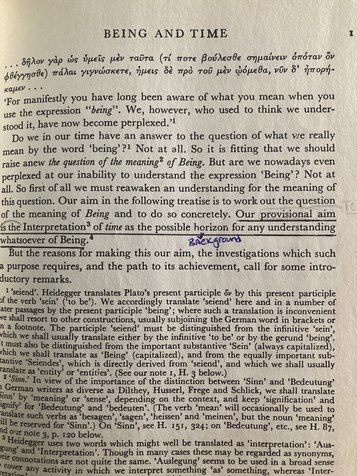
-
Heidegger’s DownfallI think that Heidegger remained open to and accepting of what comes to be because he retained belief in the notion of providence. — Fooloso4
I don’t recall Heidegger ever talking about, let alone believing in, the notion of providence.
Rather than a supreme being he says that God is the ground of being. — Fooloso4
Yes— Tillich does. Not Heidegger. So I’m still not sure why you’re convinced he sees being as God.
I think the closest we can say about Heidegger’s view of being is that it is very much related to time (in the sense of temporality) and aletheia. But that’s not saying much, of course. So it goes. -
Heidegger’s DownfallI don't think he ever is honest enough to come out and say it. Being is God. — Fooloso4
I don’t see that. He’s pretty clearly un-Christian. He says in a number of places that god as uncreated substance is simply more substance ontology, and that Christians can’t do philosophy almost by definition.
But who knows. -
Heidegger’s Downfall
Yes, I’m very familiar with that one line. Once context is put back, it’s not necessarily Heidegger’s claim. And it would be very odd indeed if this casual sentence is the final word on it. -
Heidegger’s DownfallFor Heidegger consideration of the good is replaced with the call of conscience. The call of conscience is not about what is good or bad, it is the call for authenticity. Its primary concern is not oneself or others but Being. He sees Plato's elevation of the Good above being, that is, as the source of both being and being known, as a move away from, a forgetting of Being. — Fooloso4
I’ve almost never been impressed by attempts to explain Heidegger’s notions of conscience or authenticity, and this is no exception. To determine if it’s even approaching truth would require some clear quotations from the texts and a lot of analysis. Probably not worth it.
But statements like “[The call of conscience]’s primary concern is not oneself or others but being” has absolutely no meaning to me. It may be said that thinkers (in the sense of philosophers) “think being,” or are primarily concerned with existence itself. I see that. But as for what being is? Heidegger, as far as I’ve seen, never really says. That’s worth remembering before we go on making connections between being and conscience or authenticity. -
US Election 2024 (All general discussion)Mr. DeSantis has honed an agenda that attacks progressive orthodoxies where they are most likely to affect and annoy conservative elites: gay and trans inclusion in suburban schools, diversity and equity in corporate bureaucracies, Black studies in A.P. classes and universities. None of these issues have any appreciable impact on the opportunities afforded to working-class people. And yet conservative elites treat it as an article of faith that these issues will motivate the average Republican voter.
The conservative movement has staked its viability on the belief that Americans resent liberal elites because they’re “woke” and not because they wield so much power over other people’s lives. Their promise to replace the progressive elite with a conservative one — with men like Ron DeSantis — is premised on the idea that Americans are comfortable with the notion that only certain men are fit to rule.
Mr. Trump, despite what he sometimes represents, is no more likely than Mr. DeSantis to disrupt the American oligarchy. (As president, he largely let the plutocrats in his cabinet run the country.)
Few politicians on either side appear eager to unleash — rather than contain — America’s leveling spirit, to give every American the means and not merely the right to rule themselves.
https://www.nytimes.com/2023/04/10/opinion/trump-feud-ron-desantis.html?unlocked_article_code=SiN4KOS05wzoE-zRiB4tCndC8Y4VT0L-xYpQ4aQmsueCtVMCAHPk-_0sRtLQ4etTj8LuuRUBIn_Ja7u9-KPcfljTX4b4kunJwW0gqeIMfulSiOpxyTZx3bIIMUSjW1OG4zjjWJNpmEV2Du-xuVE3G1sKY9Ff-KvJ3qtspBY_2OX9U4IIgBgvSN5Z2PqFTtZRV_czxs5N41yX6VZi2XTk6LSuEkUaw3B0L1dTTRBJQTt_hdINERMmR25S_t_Bh-48DrusQejDdNmXOqOMbzsrXX_7fxx5P9aCshYJnwkRJtAAHB-Nki4AHXUer6hUgWrEUzZDOJk-tUMB0-QE-1a9QWY&smid=url-share -
Martin HeideggerHave you looked at Braver's Groundless Grounds ? — plaque flag
I haven’t. I’ll look it up. -
Definitions have no place in philosophyI don't think God is such a concept — Jamal
God isn’t equivocal? -
Definitions have no place in philosophyIs “define your terms!” always or often or ever a legitimate imperative? — Jamal
Count me in the group that thinks it’s often very important. Countless useless digressions could be avoided if we were clearer about what we mean.
This doesn’t necessarily imply we have to come up with a precise, technical term for everything, but there are times when one assumes the other person knows what they mean, and it sets the stage for absurdities.
Two examples: “God” and “capitalism.” -
BanningsAn easy decision. An adolescent style of rigidity and dogmatism. Thought everything fit nicely into a flowchart. Constantly uncharitable, frequently insulting.
-
Martin HeideggerI do think the later Wittgenstein is compatible — plaque flag
Wittgenstein has some similarities, especially in terms of “average everydayness,” but I see little similarity with Heidegger’s conception of being-in-the-world. -
Martin HeideggerI'm a bit surprised to see Hume on the list. — plaque flag
I wouldn’t pay attention to it. Regarding in-der-Welt-sein, there’s some evidence of similarities with Daoism. That’s about it. -
Pop Philosophy and Its Usefulness
Then why talk like a mystic? There are reasons (and causes) for meditating, for philosophizing, etc. To claim otherwise, and then citing Russell, is just playing games.
I’ll ignore your hysterics. Next time take some responsibility and argue better, and clearer.
But I have to admit that sometimes it feels as if it is. — Fooloso4
Sure. I know people often talk about how when they’re “in the zone,” it feels like they’re not in control, etc.
:up: You’re probably right. -
Pop Philosophy and Its UsefulnessFollows its own instinct
Guided by natural line, — Cutting up an Ox - Thomas Merton Version
So we’re replacing “plans and intentions” with “instinct and natural line,” etc. Fine.
When I first started playing guitar, I needed to think about what I was doing and where my fingers went, etc. After years of playing, I don’t have to do that any more.
So guitar playing is now…supernatural? Beyond all understanding? Causeless? Influence-less? Done for no reason and without any motivation? I start playing, and have no memory of how or why I picked it up— I just play. Come on.
This really must be word games. Use whatever word you think is better, but let’s not descend into the nonsense.
The old Heidegger example: If I enter a room, I have to turn the doorknob— but I don’t try to turn the doorknob, have beliefs about it, have memory of it. All I know is that here I am, and I must have done it. Is this wu wei? Maybe — I think of it as more to do with skill, but it’s in the same ballpark. Unconscious or non-conscious skilled activity, of which there are many examples in life.
Analysis of habits lends plenty of evidence to the idea of non-theoretical types of behavior as well.
So I’m a firm believer in stuff like this. And meditation. But again — we don’t have to pretend that it’s magic to talk about it. -
Pop Philosophy and Its UsefulnessHere's what one noted mystic had to say in 1912: — T Clark
Russell isn’t saying actions have no cause either. Because such a view is frankly incoherent. He’s making very specific criticisms of things which I’m not claiming.
I am far from denying that there may be such sequences which in fact never do fail. It may be that there will never be an exception to the rule that when a stone of more than a certain mass, moving with more than a certain velocity, comes in contact with a pane of glass of less than a certain thickness, the glass breaks. I also do not deny that the observation of such regularities, even when they are not without exceptions, is useful in the infancy of a science: the observation that unsupported bodies in air usually fall was a stage on the way to the law of gravitation. What I deny is that science assumes the existence of invariable uniformities of sequence of this kind, or that it aims at discovering them.
I’m not arguing for anything like that.
Call them reasons, determinants, or whatever you like.
True, some actions could be magic. But that really is mysticism. I think it’s a misunderstanding of eastern thought, and as I see it happens frequently. In the same way that new agers latch on to quantum mechanics. -
Bunge’s Ten Criticisms of PhilosophyImagine thinking that philosophy follows a recipe conjured in the mind of some internet guy, and that everything not conforming to it is “pseudo philosophy.”
The forum attracts egomaniacs of all kinds. You can tell they’ve spent too much time alone, their ideas (so called) completely un-scrutinized for too long.
It’s funny to watch these homegrown ramblings have a head-on collision with the outside social world. Speaks to the power and importance of peer review. -
Pop Philosophy and Its UsefulnessYes, I do think there are uncaused actions, both in the world at large and in my personal behavior. In Taoism, the philosophy I feel most at home in, the idea of "wu wei," acting without acting, without intention, without purpose, is central to the teachings. — T Clark
Yeah, if wu wei requires that we abandon the law of causality, it really is woowoo. I don’t interpret it that way— I see it as a kind of “flow” situation.
But yes, if you think there are actions which have “no cause,” then I don’t see how we can continue.
Mikie

Start FollowingSend a Message
- Other sites we like
- Social media
- Terms of Service
- Sign In
- Created with PlushForums
- © 2026 The Philosophy Forum