
-
Are science and religion compatible?Hmmm. Your definition is the one I am using. It clearly has nothing to do with scriptures? Are you feeling ok? Dizzy or anything?
-
Are science and religion compatible?You don't get to make up your own definitions. Theism is what it is. Your definition is convenient to your argument. True Scotsman.
-
Are science and religion compatible?You are attempting to equivocate scripture and theism. And that is a red-herring. If you don't understand the explanation it's not from its not being provided, several times.
Do you actually have a larger framework within which this obsession to put down this set of non-scientific beliefs has meaning that might conceivably be of some value to the rest of the world? Why don't you just leave the poor theists alone? -
What is progress?
I'm with you there. The ecosystem has been balancing itself out over millenia. The idea that we can introduce genetic changes into the real world and have any idea what the long term effects are is just...bad science.On that note, progress= preserving life for as long as possible. Bioengineering mosquitoes out of existence rests on a crazed notion one species can determine the biogeochemical cycles of a planet and not disrupt interdependencies of delicate, complex, nonlinear systems and have them spiral out of control (butterfly effect). -
What is progress?That kind of hearkens back to Descartes' idea that science can make us "masters and possessors of nature." Personally, I see it as more of a coming into equilibrium, but in the same spirit as what you describe I think.
-
Are science and religion compatible?At that point Science believers usually react furiously, saying Science tells how the world is, Science has successes, but so do other systems of beliefs and practices, they all tell their own story of how the world is and they all have their own successes, it's simply that what counts as a success within one system doesn't always count as a success within another system
True that. I am often amazed at how dogmatic some science disciples can be. To me, the most important aspect of science is always retaining an open mind. -
What is progress?Yes, this is kind of the spirit of what I had in mind. Like Durkheim's idea of anomie...progress too far in one direction starts to become damaging in other areas, I would say. Maybe even leading to cultural decadence.
-
Are science and religion compatible?Now you are just committing multiple fallacies. Red herring, equivocation.
The definition of theism is belief in the existence of a deity. Scriptures do not even enter into the definition of theism. Is that succinct enough for you?
Sorry to be curt, but this is getting kind of childish. -
Are science and religion compatible?No true scotsman puts sugar on his porridge.
No true theist believes that scriptures are metaphorical.
You can believe there is a divine being without believing scriptures are literal or factual. There is absolutely, absolutely no reason that those two beliefs have to be interdependent. Except that you are forcing it to be so. -
Are science and religion compatible?You literally used the term "no actual theist" in exactly the paradigmatic sense of the fallacy's "no true Scotsman."
-
Are science and religion compatible?I agree that science is a well-defined field of practice, exemplified by the steps of the scientific method which are unambiguous and therefore nothing like a Scotsman in any sense of the word. Likewise, the cultural project of spirituality has a global sense that is not reducible to any individual expression thereof.
-
Are science and religion compatible?Cut the crap, I say. No actual theist believes that that's just a metaphor. They really do believe that there a Being, namely God, who literally created the universe. No actual theist really believes that the entirely of the scriptures which comprise their religion contains not a single literal passage, but instead is full of nothing but metaphor. No actual theist has a set of beliefs which are entirely consistent with atheism, or else they're a theist in name only.
You have just committed the no true Scotsman fallacy. -
Are science and religion compatible?I think the consensus is that you are conflating the opinions of individuals with principles of the systems to which those individuals declare allegiance. I certainly can easily understand the difference between those two things. Not everything a scientist says is scientific any more than everything a priest says is spiritual.
-
A Proof for the Existence of GodMost people believe it is wrong to harm another person intentionally, although there is absolutely no way to "prove" this. All you can prove is what will happen if you are caught doing that (social condemnation, retaliation, possibly punishment).
Perhaps belief in God can enjoy a similar kind of status without upsetting too many people on either side of the debate. -
Are science and religion compatible?
Thanks, this was my initial premise. You can also frame it in terms of the is-ought gap (Hume's law).Have you listened to the Rorty clip (above) ? There is no 'conflict' if science and religion are seen as operating in different domains of human necessity. -
Are science and religion compatible?Just because a person is a scientist does not make all of his or her actions scientific. Any more than claiming to be religious makes all of one's actions spiritual. I interpret the question are religion and science compatible to mean could they be compatible, not "are they currently playing well together, as currently practiced today."
-
Are science and religion compatible?That fact that things are a certain way is descriptive. The fact that they ought to be another way is normative. That's basic stuff. Religions have been debased in their application. So has science. I'm sorry, but if your best response is to ignore when science is not scientific and religion is not spiritual you're not going to be persuaded by anything I have to say (or anyone else for that matter). It's called a preconception or, more accurately in this case, a prejudice. Cheers!
-
Are science and religion compatible?I am afraid you are missing the point of that. It is NOT the business of science to make normative claims.
-
Are science and religion compatible?I was careful to say if each is true to its essence. Anything can be bastardized. Science that is true to scientific principles and religion that is not in a state of self-contradiction, two things as they ideally should be, as they purport themselves to be,are applicable to different domains of things.
-
Are science and religion compatible?The domains of science and religions are (or ought to be, if each is true to its essence) non-overlapping and perhaps complementary. Religion, particularly (what I take to be the exemplar of true religious faith) the contemplative tradition, espouses a higher moral-spiritual experience which purposely distances itself from the secular world. As such it should have nothing to say about science, or other factual domains. Possibly prescriptions about the uses of science, but that is a different thing altogether.
And science is always about facts, or what is. So any normative prescriptions about what is "right" or "wrong" to believe (i.e. Evolution is "right" therefore believing in the bible is "wrong") are NOT themselves scientific. So science and religion are or should be fully reconcilable. -
Mind development
"what is the philosophy behind discovery/invention?"
— regel
Actually, I would say the experimental method fits this bill. -
Why there must be free willWell, first, you assume that I haven't done any further reading, which I have. That fact that you would in any way denigrate the quality of a work based on it's age is, I think, very narrow-minded and suggests to me that perhaps you have not done as much reading as you might.
A few of the 'modern' books from my own library are listed below. Of course this isn't everything I have read on the subject:
Merleau-Ponty - Phenomenology of Perception
Chalmers - The Conscious Mind
Rorty - Philosophy and the Mirror of Nature
Dennett - Consciousness Explained
Churchland - A Neurocomputational Perspective
- Matter and Consciousness
Searle: - Mind: A Brief Introduction
- Rediscovery of the Mind
Kornblith(ed) - Naturalizing Epistemology
Neumann - Origins and History of consciousness
Beakley(ed) Philosophy of Mind: Classical problems/Contemporary issues
Posner - Foundations of Cognitive Science
Varela - The Embodied Mind
Valentine - Conceptual Issues in Psychology
Fodor - The Modularity of Mind
Maturana - The Tree of Knowledge: Biological roots of human understanding
I'm not including Bergson, Huxley, Dewey, you know, anyone who might be too "old" for you.... -
Why there must be free willLIke I said, Descartes, the "father of modern philosophy"
Anyway, I'm sorry that you (that is the 'you' that is the cause of the rather repetitive objections appearing here) feel so strongly in disagreement. As I said, let us (as in 'me' and whichever 'you' it is that I am attempting to dialogue with) agree to disagree. [politely ends this particular conversation]. -
Why there must be free will
It isn't a "claim" it's the definition of thinking. What you are proposing is absurd.
A reductio ad absurdum to be precise. -
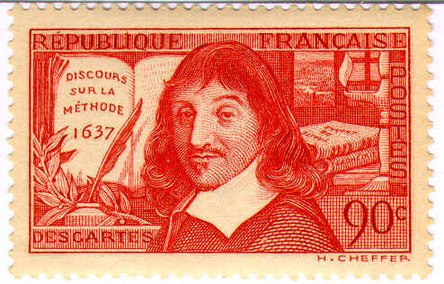
Why there must be free willDescartes is the funny little guy on the 1937 French postage stamp that is my avatar. Interesting trivia. There are two versions of that stamp. One labeled 'Discours de la method' and the other 'Discours sur la method' - I have them both in my collection. :)
-
Why there must be free willMy argument is that if the thoughts in my head were not caused by me, there would be no me to have them, ergo they would not be occurring. And it isn't my argument, it's Descartes'.
In nature, the distinction between causal sequences and objects is arbitrary. Any "thing" exists for a finite duration, or from a specific perspective of scale. Eventually, it becomes something else. Thought is toto caelo different. And from my perspective, if you are saying you are not the author of your own thoughts, then I'm not talking to you, I'm talking to whoever the author of those thoughts is.
It just seems like you're quibbling. -
Why there must be free willThe sense of the word "do" is what as at question here.
I am asserting that there is such a thing as subjective causation. I'm sure that it does 'mesh' with the deterministic schema within which your evaluations take place, but in some supervenient context. ie. Just as the deterministic processes of chemical interactions are not inferable from the laws of quantum mechanics.
The laws of quantum mechanics play out, eventually systems emerge (at a different scope and scale) in which different sets of laws dominate (baryonic matter). Again more complex systems emerge with new laws not entailed by those of the 'parent system'. Etc. Eventually you get to chemical systems, biological systems, life, consciousness. Ultimately I believe these systems can be reconciled under a broad enough theoretical framework. Intertheoretic Reduction should be possible. The process I described is, in broad strokes, an accurate depiction of how the universe has evolved.
For me, all facts are provisional, in that our knowledge is only ever approximate (a priori excluded, I'm more interested in 'experimentalism' as a philosophy of existence). One thing that history shows us is that we never know as much as we think we do. Once our context of understanding expands sufficiently some facts may assume a whole new meaning. Paradigm shift. -
Why there must be free willSo, and for the last time, I will assert: we have a fundamental disagreement about definitions. What you call the "phenomenal illusion of freedom" is a contradiction in terms in the domain in which I am operating. And I did supply an argument:
A is not free to do x; A does x - is self contradictory. To do something I must be able to do it. To be able to do it, I must be free to do it. I cannot throw a switch if my hands are tied.
I think we must agree to disagree in this regard. -
Why there must be free will
It is my opinion that, if my mind were constrained in the way you describe, I would not be capable of having the fundamental experience of consciousness. Cogito ergo sum. This was the exact point at the heart of Descartes' philosophy. 1. Doubt everything (a very rigorous way to conduct yourself epistemically). 2. What cannot possibly be doubted? That I am having this experience now.
Consciousness is the experience which is by its very nature necessarily free from compulsion.
I do believe that people can allow themselves to become subject to determinisms at various levels (as I described). Some more than others (addicts for example). But I think at its core, there is a fundamental freedom.
I hope that clarifies why I believe what I do, and reconciles it at least partly with your beliefs about determinism. I would say I espouse a variety of 'soft-determinism.' -
Why there must be free will
I'd agree entirely, we are born into a context. But it is my opinion, based on the sum total of my reading and experience, that with time, knowledge, and effort, we are able to modify or redirect the causal flows within at least some contexts. The whole reason that the experimental method works is that we are interacting with something. -
Why there must be free willAgain, I am effecting a definition of the domain which for which this assertion is fundamental. Consistent with the reality that most people, including myself, experience every day.
John Searle remarked in an interview that 'the average man on the street is a Cartesian.' There's a reason for that.
I'm certain that in our day to day experience of the executive function we are definitely not as free as we believe ourselves to be. It's well established that our minds are subject to numerous 'cognitive biases' that preformat our perceptions and decisions. As well experiments have shown that a supposedly free choice can be anticipated in the brain by as much as several seconds.
However I believe consciousness is more akin to a cybernetic system in its role as mediator of input and output. It's behaviours are essentially rule-governed and these rules are cognitive habits. So in my view, the most powerful form of conscious freedom consists in one's ability to modify one's own cognitive habits. -
Is it an unwritten community laws/custom, to demand factual proof when making a reasoned opinion?I think the subject of the thread says it all. A reasoned opinion is exactly that, an opinion, for which one has reasons. The opinion should be able to stand on its own merit, if it is well-formulated. I think it is reasonable to say that most of our beliefs are formed from a complex of origins. You don't need to supply proof for your opinions. An opinion is its own advocate.
-
Why there must be free will
It's Descartes. I assumed it would require no elaboration.
Transcendental argument: If A does x, A must be free to do X. Asserting A is not free to do x and A does x is self-contradictory. Most reasonable people embrace the principle of non-self-contradiction. -
Why there must be free willI can't fathom how anyone can believe that you could do something, and not be free to do it? It's a fundamental transcendental argument. I guess I thought you were joking.....
-
Why there must be free willBoy, that's a whole lot of criticism without much substance. Pot meet kettle.
For, to take an example, if I consider the faculty of understanding which I possess, I find that it is of very small extent, and greatly limited, and at the same time I form the idea of another faculty of the same nature, much more ample and even infinite, and seeing that I can frame the idea of it, I discover, from this circumstance alone, that it pertains to the nature of God. In the same way, if I examine the faculty of memory or imagination, or any other faculty I possess, I find none that is not small and circumscribed, and in God immense and infinite. It is the faculty of will only, or freedom of choice, which I experience to be so great that I am unable to conceive the idea of another that shall be more ample and extended; so that it is chiefly my will which leads me to discern that I bear a certain image and similitude of God.
I'll stick to the company I have though. Thanks for playing.
Pantagruel
Start FollowingSend a Message
- Other sites we like
- Social media
- Terms of Service
- Sign In
- Created with PlushForums
- © 2026 The Philosophy Forum