
-
The meaning and significance of faithAmongst the variations in certainty listed in my last post, there is the position in which someone takes specified beliefs to be no just indubitable, but infallible. There is a way of thinking in which the believer takes the position that certain of their beliefs are true even if everything else were to count against those beliefs. These beliefs are to be held despite of the evidence, and despite their consequences. — Banno
You envision a scenario where one believes X is wrong, but some authority tells him otherwise (perhaps a person or writing) and so he over-rules his belief and favors the authority, not from duress or fear of reprisal from his community, but from sincere reconsideration because he is faithful to that authority.
And you worry about this scenario because that person ignored all that counted against the authority and sided with the authority and then did something terrible.
This of course ignores the counter situation, where someone has plans to do something terrible, yet the authority steers him to the right path, causing the man to over-rule all that he considered as counting in favor of acting badly. This counter scenario might just be the more common occurrence, but be that as it may.
The question that is begged here is which authority do we honor? Do we honor our own conclusions and assume them correct and that be the authority, or do we rely upon some external authority and consider it?
Let's put this in the concrete with an example. Let us say that a co-worker of mine gets behind at work and he works on the sabbath. As we know, per Exodus 31:15, "Six days shall work be done, but the seventh day is a Sabbath of solemn rest, holy to the Lord. Whoever does any work on the Sabbath day shall be put to death." My personal thought is that this man should live, but I know the Bible is right, so I slaughter this man. So there's a good example of the conflict you envision: Authority A which guides modern society says it's wrong to kill my co-worker, but Authority B from our time honored past says I've got to kill him.
So much counts against his killing, but a good man (me) was turned evil due to this faith in authority problem you're talking about.
But here's the problem with your position. The problem with the killing had nothing to do with reliance upon authority. It had to do with relying upon the wrong authority. I obviously agree A was the right authority and the man's life should have been spared, but Authority A is an authority just as much as B.
It's just that A is a good authority and B is not.
What does Authority A consist of in our example? I suspect it might be reason, experience, logic, the sound of our parents ringing in our heads, social norms, and maybe all sorts of other things.
What does Authority B consist of in our example? The literal translation of the Bible.
And that again brings us full circle to what we always talk about, which I submit is your unrealistic, strawman position of what Authority B really is. When we look at the world, and we see all the power that is given to the Bible, and we read Exodus 31:15, yet we see that exactly zero people are being killed for disobeying the law of keeping the Sabbath. What this means is that Authority B likely contains much of Authority A as well, which explains why more often than not we get the same results. -
The meaning and significance of faithSo what? What is it to you if other people believe falsehoods? — baker
I'd prefer my bridges be supported by sound engineering principles as opposed to devout prayer. -
The meaning and significance of faiththere is a difference between the written law and the implementation of that law. — Moses
Well, even more than that. There's a difference between the written law and the actual law. The idea that the Torah (the written law) is the law is simply false, not just to liberal Jews, but to Orthodox Jews and to Fundamentalist Christians as well.
This idea that there are sizeable groups of religious folks who read the Torah (the 5 books of Moses) alone and use that as their sole guide for life simply have no idea how these religions work.
The oral law (the Talmud) and the thousands of years of rabbinical interpretation are as primary and authoritative as the Torah. You indicated that with your reference to the prohibition against the death penalty. A biblically authorized death penalty hasn't been carried out in over 2,000 years, yet thousands of death sentences have been carried out in the West in the past 200 years.
And this goes for Christians as well, who rely heavily on the New Testament and the traditions of their various denominations. That is, they don't just run out and try to emulate the biblical characters.
Just a rant about the constant anti-religious claims made here... -
Citing SourcesCiting to sources is generally helpful. If you're making empirical claims (for example if you're arguing about gun violence, Covid deaths, global temperature changes, etc.), it makes sense to provide support so that people will believe your information. If you're making philosophical claims that have been advanced by others, it makes sense to reference them so that the conversation can move more quickly to the real issues of debate.
If you're plagiarizing, actually quoting others without reference, then I think you'll lose much credibility once discovered. Unlike in the real world where there might be some financial or professional gain from plagiarizing, it'd just be really weird to that here. -
On “Folk” vs Theological Religious ViewsSomeone told me that I lack a “subtly nuanced” understanding of heaven and hell, meaning, I suppose, that I lacked a theologian’s understanding. — Art48
That was me.
There's nothing interesting in defeating the weakest form of a position. If, for instance, millions believe the world were created in 6 days, you hardly need to spend dozens of pages explaining to a fairly well educated crowd that could not have been. We all knew all the problems with that position before you shared your knowledge with us.
The interesting question is how you would respond to the strongest form of the argument in favor of a position (like Christianity). Such a discussion would require that you actually know what that argument is and it would require that you have spent some time thinking about it.
The fact that many, if not most, church goers really can't explain to you the subtleties of their ideology and cannot intelligently respond to objections might prove that the state of religious education among those claiming religion is lacking, but it doesn't say anything interesting to the person searching for underlying meaning derivable from the belief system.
That is, I should reject Christianity because under close analysis it doesn't provide adequate answers, but not because the bulk of Christians adhere to a simplified version of Christianity that I find unappealing. -
Gateway-philosophies to ChristianityI'm not sure what you mean by "pull one towards Christ." — Ciceronianus
That all roads lead to Christ I suppose. Shouldn't be a shocking conclusion based upon:
As a Christian I believe that Christ is the fulfillment of truth. — Dermot Griffin -
What is essential to being a human being?What's the point. Pedantic nonsense. You can define "essence" as purple egg yoke for all I care. — Banno
I didn't make that definition up. -
What is essential to being a human being?Do you disagree that the essence of a thing is what is necessary and sufficient for that thing to be that thing? — Banno
I define an essence as "a property or group of properties of something without which it would not exist or be what it is."
So, if the essence of a person is that he have moral worth, than an entity without moral worth is not a person.
However, if a goat has moral worth, it is not a person simply because it shares a property with a person. It is also the case that a goat that has no moral worth can still be a goat because that property is not essential for goats.
An essential element of mammals is that they breath air, which is also an essential element of birds, but birds aren't mammals. -
What is essential to being a human being?Sure, and an essence sets out both the necessary and the sufficient conditions. — Banno
Now we're debating what the essence of an essence is I suppose. -
What is essential to being a human being?Nice. I like 'ethical standing' more too. 'Moral worth' sounds like a Christian apologist. — Tom Storm
All of this is religion. Don't let the terminology fool you. The difference in positions only being in how much we wish to admit to our religion. I accept mine full on.
You say humans have moral worth because it's inherent in their being.
I say humans have moral worth because of their divine essence.
Tu-may-toe tu-mah-toe.
I build my magical castles in the heavens. Yours are built from the ground, but all is magic nonetheless. -
What is essential to being a human being?
It's just plain if, not iff. That moral worth is an essential element of humanity does not mean that all entities with that element be human.To get to moral worth as the essence of being human one would need to claim that something is human if and only if it has moral worth.
But there are things that have moral worth that are not human.
Hence having moral worth if not the essence of being human. — Banno
That an essential element of a cup is that you be able to drink from it doesn't make a river a cup it just makes a shattered cup no longer a cup. -
What is essential to being a human being?The moral worth of humans is not derived, but intrinsic — Banno
Can a being without moral worth be human? If not, is that the essence of a human? -
What is essential to being a human being?Still seems not to help us decide what it is to be human in a way that suits — Banno
If you're looking for a set of attributes, then, no, we don't have a definition we can resort to in all situations to determine if X goes in the bucket we mark "humans" and Y into some other bucket. But that's what we all knew would happen regardless of whether we were defining humans are any other thing.
My approach was to ask instead what it was that made humans of ethical value. The answer is that they have been set aside as holy and therefore occupy a different metaphysical place in the world. It's why the interference with a person's ability to live out their full capability is a terrible loss, and why I insisted upon offering an education to those who will surely never be able to use it for any societal or economic purpose. That a holy being is being restrained is the sin, so to speak.
To the question of how we distinguish the person from its seed or close variants, I don't really know, but I can say that once we have satisfied ourselves with a particular case where the thing is a person, I can define very clearly what respect that thing is to be afforded.
So, what is a person? It's that sacred thing we treat differently than all else. That's my definition, wholly wanting in the respect that it doesn't offer a description of what it takes to be a person, but it does otherwise tell you what a person is. -
What is essential to being a human being?If these words are interchangeable as you've indicated, then are we just left with our personal preferences of which to use?
If yes, isn't greater inspiration and meaning found invoking the sacred as opposed to beetles? -
What is essential to being a human being?Does this not conflate two separate questions: (1) what is a human versus (2) what is it like to be human?
I ask because I don't hold that I obtain knowledge of my soul through private thoughts. The term "soul" obtains meaning through use like any other term. I acknowledge the soul is claimed to be known in a non-empirical, faith based way, but that doesn't make it a beetle in the box. That just means it's known through an alternative epistemological system. -
What is essential to being a human being?Perhaps we might agree that any categorisation of what it is to be human will fail? — Banno
Outside of religious claims, where much has been said of the soul. A human being has a human soul, which isn't reducible to a physical attribute. Not helpful to you I realize, but that is where the conversation of human essence belongs.
Where there is an intersection with the theists and secular humanists is the positing of humanity in a special place, the theists infusing the soul with the divine and the secular humanists making humans just as holy, but using different language.
For something to be holy just means that it is set apart from all else, but I digress. https://www.patheos.com/blogs/christiancrier/2014/05/24/what-does-the-word-holy-mean-bible-definition-of-holy/ -
What is essential to being a human being?a shame he then goes on to posit intellect as somehow essential to being human — Banno
But I didn't. I just said it's an important part of what it is to be human, and I wouldn't deny the most intellectually deficient an iota of humanity.
I point out that it would be a terrible loss to deny someone their intellectual development, which is consistent with how we treat the most intellectually challenged. We spend tremendous energy trying to teach them whatever they're able to learn. It's why being an educator is a higher calling. You're shaping human beings.
But should someone be entirely without any intellectual capacity at all, so much so there is nothing to advance, they too are as human as you or I. -
The purpose of educationI'm talking about the philosophical underpinnings of pedagogy that define the process of education from start to finish. That's where the meat of the issue lies. — Baden
I do see the difference, but I can also say that my leanings are heavily in favor of learning for learning's sake, which should come as no surprise given the bulk of my formal education was in the humanities, which has limited economic application. So, then the question becomes why are my leanings superior, and that conversation will either devolve into pragmatism (as in which society works better, one which prioritizes the technical skills or the one the holistic person), or it will make a declaration about human worth (as in, human creativity, expression, and understanding are per se valuable, regardless of application).
If we argue our position from pragmatics, it's an empirical question which philosophy will work best that we may lose depending on what data we look at. I therefor take the other approach, which makes me feel very much like an ideologue, which makes me feel like I'm trying to mold society a certain way just because that's my belief.
That is, why prioritize the humanities? Because Hanoverian principles demand such and a Hanoverian society is of highest value. -
Where do the laws of physics come from?So, to the question “What came first, the universe or the laws of physics?” I would answer “The universe.” — Art48
What do you envision, a chaotic random stew being suddenly jolted into order?
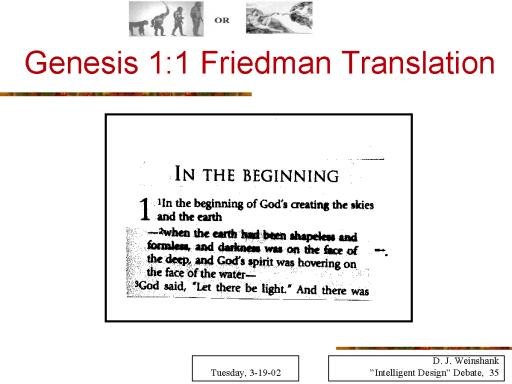
Note this translation is more accurate and does not indicate creatio ex nihilo.
My answer would be that uni means one, which describes a single thing existing as it always has, whether that has a starting point or has been eternal.
Dividing creation/ultimate origins into stages is problematic. -
What is essential to being a human being?Searching for the essence of anything, from what it is to be human to what it is to be a cup is a failed enterprise. The enterprise will also not at all be metaphysical, but will be linguistic, meaning we will be quibbling over best definitions regarding how we use words as opposed to what is intrinsic in the thing.
To avoid the language game, I find it more important to ask the moral question, as in how ought we treat people and what are the aspects we most highly value in people.
In the folks you work with, surely I would not claim myself more human than they because I'm smarter and more intellectually gifted, but I still find those traits specially (although not uniquely) human. That is, as much as we realize they'll never read and do math, we would provide them educational opportunities and instruction befitting their ability. To deny them intellectual development that they could achieve would be inhumane.
So, no, I don't think intellectualism makes us human, but to deny it, denies our living up to the height of our creation, and so it is a human thing to link our intellectual, emotional, and spiritual development to our humanity. -
Psychology - Public Relations: How Psychologists Have Betrayed DemocracyIf the tragedy of our time is that the masses have been manipulated by the expert manipulators, then why not clarify once and for all The Truth so I can know what to believe in and avoid this trickery.
This Forum in particular has been of no help so far. Every post offers a different opinion and every one peddles a different point of view. -
Creation as a Rube Goldberg Machineclaim Christianity says that eventually there will be only heaven and hell.
If that is not correct, please tell us 1) where it’s incorrect and 2) what is the correct view.
Prediction: you can’t. — Art48
"Good people go to heaven as a deserved reward for a virtuous life, and bad people go to hell as a just punishment for an immoral life; in that way, the scales of justice are sometimes thought to balance. But virtually all Christian theologians regard such a view, however common it may be in the popular culture, as overly simplistic and unsophisticated; the biblical perspective, as they see it, is far more subtly nuanced than that."
https://plato.stanford.edu/entries/heaven-hell/#:~:text=According%20to%20a%20relatively%20common,of%20earthly%20lives%20we%20live.
From the same article:
"So one way to organize our thinking here is against the backdrop of the following inconsistent set of three propositions:
All human sinners are equal objects of God’s redemptive love in the sense that God wills or aims to win over each one of them over time and thereby to prepare each one of them for the bliss of union with the divine nature.
God’s redemptive love will triumph in the end and successfully win over each and every object of that love, thereby preparing each one of them for the bliss of union with the divine nature.
Some human sinners will never be reconciled to God and will therefore remain separated from the divine nature forever.
If this set of propositions is logically inconsistent, as it surely is, then at least one proposition in the set is false. In no way does it follow, of course, that only one proposition in the set is false, and neither does it follow that at least two of them are true. But if someone does accept any two of these propositions, as virtually every mainline Christian theologian does, then such a person has no choice but to reject the third.[1] It is typically rather easy, moreover, to determine which proposition a given theologian ultimately rejects, and we can therefore classify theologians according to which of these propositions they do reject. So that leaves exactly three primary eschatological views. Because the Augustinians, named after St. Augustine of Hippo (354–430), believe both that God’s redemptive (or electing) love will triumph in the end (proposition (2)) and that some human sinners will never be reconciled to God (proposition (3)), they finally reject the idea that God’s redemptive love extends to all human sinners equally (proposition (1)); because the Arminians, named after Jacobus Arminius (1560–1609) for his opposition to the Augustinian understanding of limited election, believe both that God’s redemptive love extends to all human sinners equally (proposition (1)) and that some of these sinners will never be reconciled to God (proposition (3)), they finally reject the idea that God’s redemptive love will triumph in the end (proposition (2)); and finally, because the Christian universalists believe both that God’s redemptive love extends to all human sinners equally (proposition (1)) and that this love will triumph in the end (proposition (2)), they finally reject altogether the idea that some human sinners will never be reconciled to God (proposition (3))." -
Creation as a Rube Goldberg MachineSo you've shown the folly of a literalist caricature version of Christianity. Challenge yourself and arrive at a version that makes sense to you.
-
The purpose of educationAnd everything in between. But yes, the basic polarity is between instrumentalists, often politicians and business leaders, whose goals focus on efficiency, outcome, and concord, and who see students as little more than pegs to be fitted into socio-economic roles vs holists/liberal humanists/existentialists etc., who are more likely to be educational theorists or practitioners, and who are more interested in individual development, flourishing, and creativity. — Baden
I think both sides accuse the other of trying to fit students into a mold so that the next generation will be in their image. Everyone claims indoctrination from the other. -
Internal thought police - a very bad idea.The fact that people are afraid to discuss ideas is precisely the problem. — Tzeentch
Isn't a healthy state of affairs if people are afraid to be racist, for example, or do you envision the ideal state where you can go up to someone, spout your racism, and expect appreciation for your openness?
I initially read this OP in the abstract, as if the lament was that people weren't more open in airing their views to random passersbys, but now it seems people just wish they could offend in peace without repercussion.
Yeah, that's not how the world ever worked -
Internal thought police - a very bad idea.I think I already explained it above. In my country we had about 60% vaccination rate and every day I would read the news that about 10k people tested positive, 6k of them were vaccinated and 4k unvaccinated. So pretty much no effect here.
Yet about 10 died, roughly 8 of whom were unvaccinated, 2 vaccinated. So some effect here. — M777
The data is inconsistent with your recollections:
https://ourworldindata.org/grapher/united-states-rates-of-covid-19-deaths-by-vaccination-status?country=~All+ages -
Internal thought police - a very bad idea.There's no more confusing way to prove that one's free speech is being suppressed than by discussing all the things one is not permitted to discuss.
-
Internal thought police - a very bad idea.That's your approach. I usually find power in speaking truth, so it's hard for me to imagine a scenario where I would avoid a response. ) — M777
I do believe in speaking truth to power, but I see no value in speaking truth to every guy trying to make a TikTok video. If you think yourself heroic in defending your views to every passerby, have at it.
In any event, my views on "what is a woman" are probably close enough to the current politically correct position that I'm not worried about being bullied, yet I still wouldn't answer. When did the idea that people are obligated to discuss religion and politics to every troll become the rule. -
Internal thought police - a very bad idea.I'd say I am amazed by how easily seemingly grown up people would bend over backwards to cater to some hypothetical bullies. — M777
They're not bullies. They're just annoying, so they go ignored. If you stick a microphone in my face and ask me my views of abortion, I doubt I'd respond. If you made a comment trying to provoke a response, I'd probably give a "sure, whatever you say" sort of response. It's not a sign of courage to stand up to every petty battle. -
Internal thought police - a very bad idea.I'd say that is a rather cowardly approach - being afraid to speak your position just because some petty bully might not like it. — M777
My comment was that refraining from discussing one's position isn't equivalent to internally suppressing one's position. Whether that behavior is cowardly or prudent has no bearing on my comment. -
Internal thought police - a very bad idea.In my opinion such internal blocking of engaging with certain thoughts is a very bad idea, as it noticeably hinders one's ability to think clearly. — M777
They are not internally blocking or hindering their own thought. They are reacting in a socially appropriate way to a situation that that might lead to conflict and trying to decide the best way to handle it. They have been asked a question that is polarizing and divisive and they don't know who their audience is or how their answer might be used for or against them. Their views on "what is a woman" might be very well formed and thought out, but they refrain from responding simply because they don't care to have that debate or advertise their position. -
“Supernatural” as an empty, useless termThis preserves the old meaning of the term "nature" as excluding the man-made, because humans have 'a higher nature'. — unenlightened
In your nature/man/God division, the above distinguishes between nature and man, but not God. The God category though is the question of the OP, which refers to it as the "supernatural." It is clear what we mean by nature and by man, with a trip to nature being a trip to Yellowstone National Park and a trip to the man-made to Disneyland.
In common parlance, we mean nothing metaphysical by the nature/man distinction. We just note the two categories, even if ultimately humans are part of nature and Disneyland is as natural as a park.
Should I be stranded in the wild, unable to cross a river back to civilization, finding a fallen tree bridging the river would be a lucky event, with some debating whether it was a natural event and others supernatural divine intervention,, but whether it was man-made would be simply an empirical inquiry, looking for evidence of saw marks and the like.
The point here is that we do need to talk about elves and angels if we want to maintain the natural/supernatural distinction. Talk of the subjective and the moral only protects the supernatural for those who think it the result of something beyond humanity, not just a creation of humanity. The supernatural is beyond nature and humanity. That's just how we use the word. -
“Supernatural” as an empty, useless termfind this confusing if your X = 'natural' as X(a) and X(b) would then have to be subcategories of natural.
Surely the contest is between x=natural and y=supernatural.
If y doesn't exist, then sure you can still reference it as a nonexistent, just like winged horses, orcs and elves or the word nothing. — universeness
X = everything. X(b) world include the non-exustent, like elves, ghosts, and gods.
And so that's the point. The lack of a physical referent does not, as the OP argues, dissolve the term into uselessness. If it did, when you said "supernatural," I would look at you confused, as if you uttered gobblygook.
Don't read this as a suggestion that because the term supernatural is useful and non-empty that there must be elves. I'm not uttering objects into existence. -
“Supernatural” as an empty, useless termThis just seems like desperation to hold on to your own attraction to or need for the supernatural. — universeness
I didn't read it that way. The OP states the supernatural is an empty useless term, but the existence of the supernatural isn't necessary for the term to have meaning or use.
If the world consists entirely of X and only X and we speak of there being exactly two categories of X, X(a) and X(b), and we learn there are no X(b)s, we can cease referencing to X(a) and just say X. If howevee we continue to refer to X(b), even just to declare it doesn’t exist, it has usage and meaning. -
God as ur-parentI did not read his comment that way. The story of the Garden of Eden is based on the idea that God (the father; the authority) punished humans (children) for being disobedient. The lesson is we should obey God, regardless of how good our parents are. — Jackson
I don't see the Garden of Eden mentioned in the OP. Nowhere in the story of Eden does it talk about parents and the duties owed to them. The commandment related to parents (which occurs much later) states you should "honor" your parents, which does not mean to obey, and it actually doesn't even mean to love.
I'd also disagree with you that the Bible is written to mean you are not to challenge the authority of God (or, by extrapolation, one's parents). There are plenty of instances where the authority of God is challenged by humans and even instances where he relents after being challenged.
I'm just pointing out that your biblical analysis is highly interpretative and not bound by the text. -
God as ur-parentBut if it's the godlike elemental primacy of parents in early childhood, then it's true, I thought this was shared experience. — hypericin
To the extent God is portrayed in an anthropomorphic way, and especially in a paternalistic way (as in God the father), there is a parallel between parents and God. How far individual families extend that metaphor would vary by family, but it's not a universal experience to have parents that present themselves as absolute infallible entities. I never had the experience and I never thought of my parents as occupying a superhuman role.
Again, this isn't to deny your experience. You might have had parents that were placed upon a godly pedestal only to be disillusioned when you learned otherwise, but that says more about your upbringing than it does about fundamental human family structures. -
A brief discourse on Delusion.Delusions are restricted to opposition/denial of known facts. For instance to say the earth is flat is delusional. — Agent Smith
There is often dispute over "known facts," which makes it difficult to call someone delusional just because they might be proceeding under a very different worldview and might be accepting justifications that you would never hold acceptable.
For instance, that the world is only a few thousand years old, that it was created in 6 days, that there was a flood that wiped out all living creatures except those housed in a protective ark, that the earth is in the center of the universe are all beliefs very much contrary to what I take to be "known facts," but I don't think a believer in those are delusional. I think they're wrong, but I also don't think they are mentally ill.
If someone believes that God spoke directly to them and warned them to watch out for the demons masquerading as small children who are out to destroy them, then that person would have delusions of grandeur, delusions of persecution, and paranoia, all of which I would have no difficulty as declaring as delusions. That mentally ill person though is far different from the guy who holds to antiquated beliefs imposed by an insular and likely unsophisticated social group. -
To What Extent Can Metaphysics Be Eliminated From Philosophy?am a reasonably normal person and I think my understanding of reality is consistent with how most people in my culture see it. — Clarky
Why is your culturally relative evaluation of reality relevant here? Are you presenting an argument based on that? -
To What Extent Can Metaphysics Be Eliminated From Philosophy?That isn't what I wrote. — Clarky
We don't exclude how normal people see the world when attempting to determine the nature of reality anymore than we exclude how abnormal people see the world. We note only that the concept of normal perceptions have no bearing on reality.
My comment about you referenced how I suspected you had a notion of normal, which was in reference to your internal standard. What is the the normal response to hot peppers? Are they really hot or mild?
Hanover

Start FollowingSend a Message
- Other sites we like
- Social media
- Terms of Service
- Sign In
- Created with PlushForums
- © 2026 The Philosophy Forum