
Comments
-
Is space/vacuum a substance?In the world of pure mathematics, a vector field in the complex plane describing a function F(z) having an "indifferent" fixed point a=F(a) might show the enormous differences of displacement as z=a is "tipped" a tiny bit to one side or the other. — jgill
Yes. But what if this non-linear sensitivity is being regulated by a parameter that is a reciprocal relation such as y=1/x? And so yx = 1?
A tiny tip one way is yoked to a tiny tip that compensates. Unit 1 has been fixed as the identity element, the common departure point. The indifference lies in now giving it any particular value to denote some quantified scale. It is now always just a generalised quality - the way an identity element behaves as a symmetry awaiting its breaking.
Other examples of starting values that emerge as the balances of divergences.
The value of pi - understood as the ratio of a circumference to a diameter - can vary according to the geometry of a plane. Pi = 2 for the closed or negatively curved surface of a sphere. Pi heads for infinity in the opposite case of the positively curved hyperbolic plane.
It is only the special case - the Euclidean plane, where lines can remain parallel to infinity, never converging or diverging - that the ratio is a familiar fixed constant. 3.14159...
Euler’s number or e is perhaps a clearer case in being the constant that emerges from the "self-referential" reciprocal built into a pure model of continuous compounding growth.
That is, f(x) = e^x graphed as a curve which intersects at y = 1; x = 0.
The system is set to the most general initial value - 1 - before any growth has had the time to be added. And then the slope it generates by x = 1 is e - or 2.7182818... The unit 1 picture spits out a pi-like constant - a universal scale factor - for the dynamics of self-compounding growth.
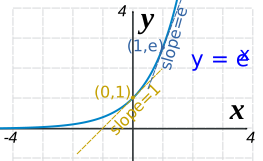
https://www.mathsisfun.com/numbers/e-eulers-number.html
With the Planck scale, the physics wants to run it backwards to recover the "unit 1" reciprocal equation that is the Universe's own universal scale factor. That is the thought motivating this particular game here.
Okun's cube says it must take all three fundamental Planck constants in a relationship to recover that unity. If all three constants - h, G and c - can fit into one theory, then that is the theory of everything.
General relativity unifies two of them - G and c. Quantum field theory unifies another pair - h and c. So unifying all three is about a combined theory of quantum gravity.
At which point everything collapses into confusion as it is a completely self-referential exercise. There is nothing "outside" as the yardstick of measurement. It is all reduced to some internal interplay.
Well, this is why efforts like Loop Quantum Gravity have tried to extract realistic solutions as emergent features from the kind of self-organising reciprocal thinking I describe.
If you frame the quest as getting back to where time and space are coordinates set to zero, then energy density has to be infinite. Neither extreme is a sensible answer to the question.
But if instead the general answer - from a dimensional analysis - is that everything starts from 1, that gives you a fundamental grain to grab hold of. You have a yo-yo balance to swing on. You can extract a log/log powerlaw slope that is the dynamics of an expanding~cooling Cosmos. The energy density thins as the spacetime spreads. The rate of both is yoked together, as scaled by the speed of light - the third side to this "unit 1" Planck story.
So how small and hot was the Universe at the Big Bang? The answer is 1. Or rather so hot and massive that it was as small and curled up as possible in terms of its scale factor. And vice versa. It was so hot and massive it was striving as hard as possible to blow itself apart in every direction. It's spatiotemporal curvature was just as much hyperbolic or positive as it was spherical or negative.
By the Heat Death, the end of time, the scale factor is still "1" but now in an inverse fashion. Everywhere is so cold and empty that the gravitational curvature - the stress tensor of GR - is at its weakest possible value. Almost zero, or 1/G, of what it had been. And the same for h as a measure of the quantum uncertainty or positive hyperbolic curvature wanting to blow things apart. Effectively it has fallen to 1/h or nearly no curvature in that direction either.
So the Universe stays "flat" and follows its unit 1 scale factor trajectory as a spreading~cooling bath of radiation. But that conceals the trauma that is the Big Bang as a state of unresolved tension - the maximum difference in terms of being the "largest" energy density packed into the "smallest" spacetime. And the Heat Death as the evolution towards the calmest expression of that driving tension - its dissipation into its own reciprocal state of being the smallest energy density packed into the largest spacetime.
I'm sure I'm only writing this out for my own amusement. But I just find it a fascinating story.
A different kind of "maths" results from setting your origin to 1,1 rather than 0,0. It constrains any path being traced to something nicely tamed by its own self-referential set-up. -
Does Size Matter?So comparatively, on the whole, an individual human is enormous, and our planet-spanning civilization even bigger still. — Pfhorrest
Interestingly, we - as complexity - arise bang in the middle of the spatiotemporal story of the Cosmos.
Looking down, it is 33 orders of magnitude to reach the Planckscale. Looking up, it is 28 orders of magnitude to reach the edge of the visible Universe - the event horizon which bounds our existence.
So - as brains - not exactly in the middle of space and time. But close. And closer still if we are a planet-spanning civilisation as you say. -
DefinitionsSo the dichotomy between determinism and chance or freedom is false only as long as one insists that nature must be one or the other. Nature shows us both; in varying blends or degrees, or in various contexts or perspectives, I suppose. — Janus
That's it. The trick then is to see how both sides of the dichotomy are equally "good" as each is the creator - the definer - of the other.
We don't want to eliminate indeterminism by speaking of determinism. We don't want to eliminate order by speaking of chance. We want to draw attention to these being the limits in terms of what could be. And how both are needed to then have anything actual at all - as the blended outcome.
That is why the maths of reciprocals captures the logic of the dichotomous relation. It makes the business explicitly dialectic or self-referential. It is all about the reciprocity that connects the apparent dyadic divide.
That is why it is a healing influence in our divided world - a semiotic bridge over all the Cartesian divides.
(Well, not. Everyone hates happy endings apparently. :smile: ) -
Definitionsbut your response was to oppose a correct dichotomy, the right kind, susceptible to triadic reconciliation. I — csalisbury
Yep. That's the trick.
You are against such totalising, even when it is a well proven success. You try to dismiss it as "pragmatic", as if being useful is a dirty word. You will blather on about poetry or feelings or other tribal artefacts of the anti-totalising brigade.
It's funny. Proper metaphysical strength Peircean pragmatism offends the objectivist and the subjectivist alike.
But that is because they are happiest trapped in that Cartesian dialectic. If its dichotomistic inconsistencies were resolved, they would no longer have anything to write poems about, or realist polemics about.
You are down that dark hole. I can hand you the ladder out but I can't make you climb. You have to want to leave the angry gloom that is the anti-totaliser's fate. [ Joking tone adopted ]
But I wasn't impugning your use of time during quarantine (???) though it appears you are impugning mind. To be clear, are you responding to my post by asking if I'm having a rough go of it? — csalisbury
I was responding to your Cliffnotes jest....
There was (a) the Enlightenment where the balance was at least close to correct, then (b) the split where there was set in opposition (i) a focus on the self vs (ii) a focus on the world... and we should then do (c) a harmonious reconciling of the two?
I just found it funny that I had paid some special attention to exactly that as a historical dynamic. Hegel is (in)famous for his dialectical claims about the German state representing an end to history to the degree that it had achieved a natural rational order - a state of Enlightened self-governing.
Neoliberalism felt it had achieved the same natural enlightened state of arriving at the end of history - at least according to Fukuyama.
So the question arises what is the true dichotomy that human history keeps trying to resolve in a synergistically valuable fashion? That was my research topic.
Clearly it is in some sense the balance between the forces of labour and capital - to follow the Marxist analysis. Or free competitive action within the cooperative space of a collective market - the neoliberal story perhaps.
My own answer is thermodynamic - the basic view of natural systems. Humanity stumbled on a fossil fuel bonanza that could be harnessed by industrial age machinery. If we learnt to think like machines - form a mathematical level of semiosis with "reality" - then we could burn through this bonanza at an exponential rate.
So the dichotomy is between extropy (energy available for work) and entropy. Or between a source and its sink. Humanity could be gas guzzling and ride that a rocket-fueled economic curve - escape the mundanity of a life wedded to all being farmers living within the limited means of the daily solar flux.
The unresolved part of that economic dichotomy is the balance is all source, no sink. Burning fossil fuel for useful work produces also all its entropic waste products - mainly heat. That is a problem when you need to dump that heat into deep space but it gets trapped by the atmosphere. You have no sink as part of the equation.
Anyway, you see the Hegelian trajectory I have in mind. The economic system of life was always thus. An entropy gradient from source to sink. An "enlightened" world needs to pay for its sinks as well as its sources to have an economy that can last.
Something like neoliberalism becomes objectively wrong to the degree it doesn't balance the equation in that fashion. We can measure how out of line it is as we have a definition of what could count as creating a system with a long-run future.
So no, its nothing about your "rough go's". I just think its funny that the worst things I could be doing in your eyes - well I will be doing them! -
DefinitionsI don't see dichotomies, I see continuums. — Janus
Dichotomies are the limits to continuums. So they are necessary as the division that provides then the mediating spectrum - the actual world of concrete possibilities that lie inbetween.
Its another intricacy of Peircean logic. Thirdness - as regularised order - enfolds also secondness and firstness. It is all aspects of the one whole.
So you need raw potential, you need a symmetry-breaking that reveals there could be a symmetry, you need then the symmetry that is the globally generalised state of habit - the continuum that is revealed by the emergence of asymmetric limits to the possibilities inherent in mere vague potential.
So dichotomies are the mediating step - secondness or the actualisation of asymmetry. And in revealing those complementary limits, a continuity of all the places inbetween is also revealed. Actuality is measureable in terms of its relative distance from the opposing poles of being.
Is everything a matter of mere chance? Is everything a matter or strict necessity? Nature tells us all actual being is relative to those two bounding extremes.
The false dichotomy lies in having to claim one state is primary. The true dichotomy is the dyad that is resolved triadically rather than monistically. It describes the matching limits on actual existence, and so neither limit itself actually "exists". They mark the end points of a continuum where existence lives. -
DefinitionsThis sounds like a cliffnotes summary of the introduction to 'History of Ideas' by Idea Historian. — csalisbury
That's exactly what I spent my three month lockdown sabbatical on - researching a defence of Hegelian history!
Instead of seeing the world as two cosmic forces in great battle, resolved triadically,... — csalisbury
Yada, yada. If you don't like the idea of synergistic resolutions then I'm sure that a lack of them is the view you build into your every encounter with life.
How's that working for you? -
Does Size Matter?An alternative to size is complexity. What counts as the most complex thing in a generally very simple Universe?
Pound for pound, centimetre for centimetre, even second for second, the human brain probably wins that cosmic contest. Trillions of synapses in precise microsecond coordination, packed into a 1200 cc volume.
So we rule! -
Is space/vacuum a substance?If the constraints are fixed constraints (what the laws of physics are generally believed to describe)... — Metaphysician Undercover
The current approach in cosmology and particle physics would be to see any global regularity in terms of emergent constraints. That is why symmetry and symmetry breaking are at the heart of modern physics. They describe the form of nature in terms of the complementary emergent limits on free actions. A probabilistic view where change is change until change can no longer make a difference. At that point, the system is "stable" and its equilibrium balance can be encode as "a universal law".
Potential is completely incompatible with with the bivalent system, and therefore needs to be represented in a completely different way — Metaphysician Undercover
Yes. That is the distinction I have made all along. Potential would be simply a vagueness. The PNC fails to apply. And possibility is the next step along. A possibility is a concrete option. The PNC applies in that to go in one direction is not to go in its "other" direction.
A possibility is an actuality in that regard. A generalised notion of potentiality in fact. There is now a world, an embedding context or backdrop, where every act is matched by a "reaction". To push is to encounter resistance. To move is to depart.
It is all made actual and concrete by the fact that every possibility is bivalent. A direction is asymmetric as it breaks - and hence reveals - an underlying symmetry.
Vagueness is where there just isn't any such general backdrop to local events or acts. If you are in a canoe in a thick fog on a still lake, do you move or are you still? The PNC can't apply unless there is some context to show that a change is happening, and even not happening.
But when the fog lifts, we have reference points. We are either moving or not moving as the clearly bivalently complementary options now. We have a choice between the two opposed possibilities. The PNC becomes a legitimate rule.
Possibility is something general. If it is reduced to a particular possibility such that we can represent its binary opposite, we are not representing the possibility properly, because possibility always relates to numerous things, not one thing. — Metaphysician Undercover
Yep. You dispute the distinction between vague potential and crisp possibility and then repeat the basic argument.
As Peirce says, the trajectory is from Firstness to Thirdness, from vagueness to generality. Actuality as a set of concrete local possibilities emerges via the contextual regularisaton of a vagueness, a unformed potential, by generalised habits. A prevailing state of global constraints.
The generality of a backdrop is needed as the symmetric reference frame that orientates local possibilities as the bivalent symmetry-breakings, or asymmetries. That is what I have said all along.
And hence you need the further category of vagueness to stand behind this evolutionary development. The generality of a backdrop or symmetry state has to arise out of "something" too.
If actualizing possibility X means not actualizing possibility Y, this does not mean that X is the opposite of Y. — Metaphysician Undercover
It is not X and Y that speaks to bivalence. It is X and not-X.
A possibility does not have the capacity to actualize itself. — Metaphysician Undercover
Sure. In your mechanical model of reality.
The Peircean model says vagueness is only regulated. So there is always chance or spontaneity to affect things. Regulation is asymptotic. It can approach the limit but never actually completely reach it. So infinitesimal chance always remains in the system to tip the balance.
That is why quantum mechanics can work. Or any other form of spontaneous symmetry breaking in physics.
You only need a system to be symmetrically poised between its two directions - the choice over a concrete action. Something is always going to tip the balance. Nature just fluctuates at a fine-grain level and chance will give the poised system its nudge that then actualises the possibility.
It is the old paradox of a ball balanced on the peak of a rounded dome or pencil balanced on its sharp tip.
Newtonian physics says a perfectly balanced ball or pencil could never topple. Nature says that - quantum mechanically - the world is just never that still. There will always be a slightest vibration. And the slightest vibration is all that is needed for the ball or pencil to spontaneously break its symmetry and so actualise a possibility. -
Evolution of LogicThe limitations of these apes seems to be related more with memory capacity and attention span, not necessarily logic. — Harry Hindu
It is partly that. But more generally there is a lack of the necessary “top-downness” in neural control from those highest cortical areas.
The brain is organised hierarchically. So the “logic unit” of the higher brain is Broca’s area, a premotor stage for planning actions and feeding into the rungs of the motor cortex that handle the habitual detail of those acts.
Apes have a smaller and less powerful version of this area. Hominids evolved a steadily larger one, most likely first for tool making and tool use. Then this became a pre-adaption for the ability to make complex structured vocalisations.
Making a flint axe is a process of sequences of precise steps towards a general intent that is much like articulating an idea. And early humans evolved a very un-apelike tongue and vocal tract that was tailor made for articulated noise making. The first reason for a grammar-like ability to make speech-like sound sequences could have been as a form of expressive “singing” - social communication via indexical vocal gestures.
So apes lack key aspects of the neural machinery. A large and evolved Broca’s area - a premotor area that would be involved in the focusing and remembering of complexly structured utterances - would be one.
Humans are good at incredibly complex music patterns. But apes don’t seem so hot with a violin either.
So their problems with forming long chains of reasoning and nested logical concepts is pretty easily explained,
I ought to say that this means of course that logic is not biologically innate. It Is a cultural adaptation.
This goes back to the old debate about whether language or thought comes first. It is believed human rationality had to evolve first to give early humans something that needed saying, But it is the other way around. The development of language as a new level of social-semiosis made it possible to use the brain in entirely new ways. The grammatical structure of speech was a cultural pre-adaptation to inventing a rational style of thinking that followed mathematical strength rules.
It seems to me that it is the opposite - that language piggy backs on the capacity for logic. The law of identity, excluded middle and non-contradictions are the most fundamental rules of logic and language simply couldn't be conceived of prior to these rules being inherent within the mind - like that some identifying mark identifies something else. Establishing correlations and relationships has to be an inherent mental skill if you are to correlate some sound or marking with something else. — Harry Hindu
There you go. Thought before language or language before thought? That is a bit of a chicken and egg question as the two are entangled. But the neurology and evolution of the vocal tract tells us that there must of been other good reasons to move the biology down the path towards the kind of recursive grammar that enables structured speech acts and hence structured thought acts.
The metaphysically extraordinary thing then - as Peirce would tell you - is that the world itself is organised rationally. Reality is itself semiotic. Or rather, the laws of thought as we have framed them, reflect the symmetry breaking structure of a self organising Cosmos.
In truth, the laws of thought only really encode a mechanical or reductionist model of nature’s causality. The laws are not a logic of holism. But that’s fine. Homo sapiens is mostly concerned about being able to mechanically regulate the natural world. So culturally, a reductionist mindset is all we need to teach the little ones. Nature can be treated as a technological problem to be solved.
But anyway, it is clear enough from social history what piggybacks on what. Rationality is a recent human invention.
Modern speech had been around for at least 40,000 years. The sudden emergence of art and decoration as fully symbolic expression speaks to that. And rationality got codified as a particular habit of thought among a small class of the educated In Ancient Greece.
Grammar already provided an analytical tool of sorts - that ability to break the holism of the world into discrete tales of who did what to whom - the enforced sentence structure of subject, verb, object.
But rationality as we understand it now Is next level semiosis in being proto-mathematical. Just pure mechanical syntactic operations. The semantic units are completely general in being notational symbols for operations on values.
So yes, because the ability to handle the laws of thought are so revered in modern western culture, there is this built in expectation that this was the great evolutionary step which separates man from the beasts. Or even white men from more primitive grades of men. That is why it becomes so important for those ape researchers, those researchers in comparative cognition, to settle the argument of whether animals are just as rational, or definitely not rational at all.
But my view focuses on the development of speech as a neurological pre-adaption for vocal “social gesturing” that took about a million years to evolve. That exploded into the far more powerful semiotic tool of full blown symbolic speech and thought about 50,000 years ago - a cultural invention of an actual language. A new kind of software or operating system for the neural hardware that really released its potential as a regulatory tool.
Then after that came the mathematical level of semiosis as semantics was generalised away to leave only the naked mechanical bones of a computational thought style - the ability to reduce the description of reality to a bare grammatical pattern. Logic as a universal abstract template that reveals reality itself as a machine.
Logic itself of course is still in fact under development. Aristotle codified the laws of thought. Peirce set the scene for a holistic reframing of them. But along came AP and the madness of its logical positivism. Then came the actual computer revolution and the madness of the cognitivists who wanted to believe that neurology was just a bad - wet, messy and leaky - implementation of a set of symbol processing logic gates.
The developmental trajectory got shunted sideways. You have to laugh or else you would weep. :grimace:
But anyway, logical thought is a learnt skill. And beyond the familiar mechanical conception of logic, there are still higher levels one can aspire to as ways of usefully encoding reality. It is all an unfolding work in progress. -
Is space/vacuum a substance?Must I don the cape of my favorite philosophical crusader in order to be “worthy” of this forum? — Dan Cage
Things are pretty relaxed on that score - at least as the price of entry. But philosophy is a dialectical contest. So if you say something easy to bash, then expect that gleeful bashing. That is the price of staying. :up:
I am open to anything, but I find very few human thought-inventions compelling. Is there a label for that? — Dan Cage
Depends how many philosophical positions you have actually encounter and whether you made a sufficiently compelling case against them really.
Skeptic would be a good thing to be labelled. It would mean you have mastered the basics of critical thought. -
Is space/vacuum a substance?But I do not recognize the Epistemology label so I have not knowingly subscribed to it. — Dan Cage
That's just what they called the introductory epistemology class back when I was little. Hume, Berkeley, Descartes, Kant. The usual crew. -
Is space/vacuum a substance?
-
Is space/vacuum a substance?True if limited to strictly human thinking — Dan Cage
Does nature offer counter-examples? What are they? -
Is space/vacuum a substance?There exists middle ground where one could be open to all possibilities, not just the binary ones. — Dan Cage
All possibilities are binaries if they are to be clear and not vague. To take a direction, you have to be moving away from whatever is its counterfactual.
Possibilities come in matched pairs. Or to the degree that they don't, then - as a possibility - they are vague. -
Is space/vacuum a substance?It would not be appropriate to refer the "application of constraints" unless there is something which is applying constraints. — Metaphysician Undercover
You are the one referring to the "application". And the obvious answer from my point of view is that the constraints are self-applied. The regularity of habits develops out of nature's own set of possibilities.
Then you proceed into nonsense about self-organizing systems, as if inanimate matter could organize itself to produce its own existence from nothing. — Metaphysician Undercover
Nonsense? Or science?
Cosmolology shows how everything is self-organising back to the Planck scale. I provided you with the hyperbolic curve as a model of how there need be "nothing" before this self-organising was already going.
A habit is the propensity of potential to be actualized in a particular way. What is fundamental to "potential" is that no particular actualization is necessary from any specific state of potential. — Metaphysician Undercover
That is why we are talking about habits developing. At first, everything would try to happen willy-nilly. Then later, things would self organise into an efficient flow.
If someone shouts fire in the cinema and everyone rushes for the same door, lots of bodies trying to do the same thing at once have the effect of cancelling each other out. There is a chaotic jam and nobody gets anywhere.
But if the crowd organise into a flow, then everyone can get out in the fastest way possible.
Rules emerge like this. Just think about how traffic laws emerged to avoid everyone driving like a panicked crowd. Efficient flows always beat inefficient chaos. It is nature's finality. The least action principle. -
DefinitionsIt was rather that distinction between the explicit and the ineffable, the said and the shown. — Banno
If your "saying" is based on metaphysical reductionism, then of course it can't speak to the holism that is the greater attainable view. You might be reduced to showing, rather than telling.
But let's not get bogged down by the usual point that the only way to learn tennis or drive a car is to be shown how to do it - grab a racquet, get behind the wheel, and start understanding the ineffable essence of being a tennis player or car driver.
There are grades of semiosis. Each is its own "linguistic community" in terms of the system of symbols that underpin it. Some of the major grades underpinning life and mind are genes, neurons, words and numbers. To learn the game of tennis, one must do that in the language understood by your neurons.
Social concepts like "that is the service line, this is how you score" need to be communicated too. Words are good. Mathematics is better.
Is the ball half on the line, in or out? Hawkeye can apply an algorithm to give the correct answer and remove any shred of human ineffability. If no-one umpiring is really sure and can't speak the truth, a calculating machine can ... to a millimetre or two. Differences agreed not to make a difference.
So humans are complex beasts that live a life that spans multiple levels of semiosis. Ideally, they are all aligned in some kind of holistic harmony.
But some folk never even develop a mathematical level of self. And some folk become so mathematical as to lose sight of life lived at those other integrative levels.
It all comes down to a productive balancing act again. Arguing about dichotomies like said and shown, explicit and ineffable, is only a useful exercise if the argument eventually reveals the way they are two halves of the same whole.
Have you yourself got there yet with this particular question?
Can you tell us what "word" means? — Banno
In the linguistic sense, I think that is one thing Pinker managed to get right in talking about the dichotomy of words and rules.
That was the answer I gave a few posts back - https://thephilosophyforum.com/discussion/comment/438849
So words and rules are how we fracture an attempt to express an idea into a set of semantic parts arranged into a syntactical whole.
A word is whatever constitutes a semantic part within such a structure.
It's all pretty plastic and flexible. The plasticity is the feature and not the bug. So "cat" could be the semantic component. And cattery, is two words - cat and -ery - combined via a rule.
The rule is that the general idea (a cat) is constrained by the general idea of a type of purposeful facility. Draw the Venn diagram and form the right logical conclusion. The intersection is now a new more specified or particularised semantic unit - a "cattery". And that can get slotted recursively back into some syntactical adventure. We can speak of this cattery and not that cattery. The cattery that occasionally houses dogs or occasionally is empty.
The ability to make further semantic distinctions via syntactical constraints is recursively infinite in principle.
And a word is thus defined as the semantic aspect of what goes on. The novelty or significance that gets meaningfully shaped into being upon coming into interaction with the structuring habits of a rational grammar.
Of course, "Colorless green ideas sleep furiously." That sounds as though it ought to be carrying some cargo of semantics. It is "perfectly" grammatical. And there are words. But we understand it to be nonsense. The words don't go together in a way that is rationally grammatical. No self~world state of intentionality that we can recognise is being expressed.
That is, words - as in the single items we might look up in a dictionary - are a very reduced notion of semantics. The idea of speech as a concatenation of individually meaningful signs is another reductionist exaggeration.
A speech act - whole phases, sentences, even diatribes - can be "words" in the sense of conveying the holism of a complete mind~world intentional stance. A point of view worth distinguishing from the many others that might have been available but are now neatly rendered "unspoken".
Syntax is the structure that pins down meaning to something that cannot be merely nonsense - some jumble of urgent noises or scribbles in the dust. Then individual words - like cat or cattery - are where this constraint on semantic interpretation hits the point where we become pragmatically indifferent to any remaining uncertainty.
The boundary of "a word" is defined not by the information it contains - the dictionary approach - but by the information its serves to exclude. The negative space its serves to signal. There is no need to penetrate further to find the word's meaning. It simply marks the moment where digging more would be redundant in terms of fulfilling some particular communicative intention.
Rabbit is whatever is not not-rabbit. Duck is whatever is not not-duck.
A duck-rabbit is whatever is not not-duck-rabbit. So an old lady-young damsel is not a duck-rabbit. But oh, they are both Gestalt illustrations of the constraints based approach that perception takes.
Seems it is semiotics all the way down then. -
DefinitionsThat's not what I had in mind. .... It's more like seeing the duck or the rabbit, and realising that the same drawing gives rise to both. — Banno
So the disproof of the Gestalt argument is ... a Gestalt argument?
There is no difference that makes a difference in the stimulus as such - from your "physicalist" point of view. But you can create a difference that makes a difference by shifting your state of interpretance - your "mental" point of view.
A bad example if you want to dispute my position. -
DefinitionsI was just reading Wittgenstein’s forgotten lesson. — Banno
So isn't this another false dichotomy we have to break through to discover the right dichotomy?
One can oppose science and the arts as both being forms of life and so set the stage for which counts the higher form, which the lower. Who is our champion, who is the horrid bastard.
Or you can play the other game of just shrugging your shoulders and saying it is just two different things. Higher or lower? It's all relative. There is no essential difference if everything is a form of life, some kind of internally coherent system of communication. The question of commensurability is irrelevant as the question of incommensurability is also irrelevant.
I of course take yet another route of saying well we need to discover the complementary kind of dichotomy that brings some proper synthesis to the whole debate.
With the opposition of the sciences and the humanities, what could this be?
Pretty obviously it maps to the usual opposed poles of metaphysical being - the realm of the world and the realm of the mind. Or more pragmatically - the semiotic view of the mind~world relation - the sciences are focused on depersonalising our point of view, the humanities have as their own natural counter-goal the object of socially constructing what it means to be "most human". An ideal self.
So in the "stepping right back from it" pragmatic view - the one that starts with the "form of life" metaphysics that Wittgenstein nicked unattributed - the sciences and the humanities should make a healthy opposition that can be more than the sum of its parts. We use them as inquiries to sharpen our notion of the world and of ourselves - as the two elements in semiotic interaction.
Now this does conflict with many peoples' notion of humanistic inquiry. The advice there is to find "yourself", or worse yet "express yourself". Really, the advice needs to be "construct yourself". And as we are all socially constructed as "selves" (with a good dash of genetics of course) then we need to be able to talk about the "technology" of that construction. And even the purposes that would guide any such effort.
That ought to be the fundamental business of the humanities. And what it finds in that direction ought to inform the sciences in their own matching voyage of "discovery" - or rather, its construction of the world as a useful image. A model of reality that has the anchoring point of view of a humanistic centre.
So I guess I take a rather industrious view of both the humanities and sciences as academic disciplines. :smile:
The difference isn't about science merely analysing reality while the arts are about properly living it, being in it, feeling it, discovering it as some deeper level or experiencing it on some higher plane. All the culture wars rhetoric of which stands above the other, or is the proper ground to the other - whatever it takes to be the primary, making the other secondary.
Instead, a pragmatic/semiotic view - a form of life view - would argue that both "the world" and "the self" are the two halves of a joint construction. And progress lies in constructing the better total model. They are not separate exercises. The problems of modern life lie in the way they got disconnected pretty fast after a moment of unity in the Enlightenment. Scientism and Romanticism began the business of "othering" each other in an unhelpful way.
Fetishising either the self or the world is the mistake. We need to be consciously engaged in a co-construction of these aspects of being alive and mindful. [Insert all the usual utopian visions of that here.] -
Is space/vacuum a substance?A graph of the reciprocal function might help give a better visual representation of my argument about the start of time.
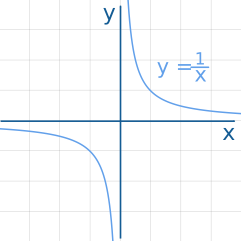
So note that the reciprocal function describes a hyperbola. And we can understand this as representing the complementary quantum axes that define uncertainty (indeterminism, vagueness). Let's call the x axis momentum, the y axis location. In the formalism, the two values are reciprocal. Greater certainty about one direction increases the uncertainty about the other. The two aspects of reality are tied by this reciprocal balancing act.
Now think of this parabola as representing the Universe in time - its evolution from a Planck scale beginning where its location and momentum values are "the same size". In an exact balance at their "smallest scale". The point on the graph where y = 1; x = 1.
Note that this is a value of unit 1. That is where things crisply start. It is not 0 - the origin point.
Now if you follow the evolution of the parabola along its two arms you can seen in the infinite future, the division between momentum and location becomes effectively complete. The curves are asymptotic so eventually kiss the x and y axes. They seem to become the x and y axes after infinite time.
And then the catch. If you are an observer seeing this world way down the line where you believe the x and y axis describe the situation, then retrospectively you will project the x and y axis back to the point where they meet at the origin.
Hey presto, you just invented the problem of how something came from nothing, how there must be a first moment, first cause, because everything has to have started counting its way up from that common origin point marked on the graph.
A backwards projection of two orthogonal lines fails to read that it is really tracing a single reciprocally connected curve and is thus bamboozled into seeing a point beyond as where things have to get going from. It becomes the perennial problem for the metaphysics of creation.
But if you instead take the alternative view - the reciprocal view that is as old as Anaximander - then the beginning is the beginning of a counterfactual definiteness. And that takes two to tango. Both the action and its context - as the primal, unit 1, fluctuation - are there together as the "smallest possible" start point.
Where y = 1; x = 1 is the spot that there is both no difference, and yet infinitesimally a difference, in a distinction between location and momentum, or spacetime extent and energy density content. It is the cusp of being. And a full division of being - a complete breaking of the symmety - is what follows.
Looking back from the infinite future, the starting point might now look like y = 0; x = 0. An impossible place to begin things. But there you go. It is just that you can't see the curve that is the real metaphysical story.
That kind of absolute space and time - the one where the x and y axes are believed to be represent the actual Cartesian reality in which the Universe is embedded - is just a projection of an assumption. An illusion - even if a usefully simple model if you want to do Euclidean geometry or Newtonian mechanics.
The Cosmos itself isn't embedded in any such grid. Instead it is the curve that - by the end of its development - has fully realised its potential for being asymptotically orthogonal. So close to expressing a state of Cartesian gridness, Euclidean flatness, Newtonian absoluteness, that the difference doesn't make a damn.
It gets classically divided at the end. But it starts as a perfect quantum yo-yo balance that is already in play from the point of view of that (mistaken) classical view of two axes which must meet at the big fat zero of an origin where there is just nothing. -
Definitions[Some] hold that there is such a thing as the meaning of a word; and that any worthwhile theory of language must set out, preferably in an algorithmic fashion, how that meaning is to be determined. — Banno
[Others] will go along with quine: Success in communication is judged by smoothness of conversation, by frequent predictability of verbal and nonverbal reactions, and by coherence and plausibility of native testimony. — Banno
These don't have to be two incompatible views. They could be two extremes of a continuum.
The general algorithm is a logical division of things into figure and ground, signal and noise, information and entropy.
Sometimes differences make a difference. Sometimes differences are a matter of indifference. So the general algorithm is the pragmatic one of how divided do we have to make the world so as to be able to talk about the world usefully?
Communication is smooth when two speakers are on the same page. They read the world the same way in terms of what is figure, what is ground, what is signal, what is noise.
Further difference-making is a wasted effort as that is pursuing differences that don't make a difference.
But equally, the communicative balance breaks down if the speakers discover some remaining vagueness in their language. A lack of bivalent precision - a failure to understand now about differences that do make a difference - becomes something that demands further work.
So a community of speech (or semiotic interactions) relies on hitting that Goldilocks balance of being neither too vague nor too crisp, neither too indeterminate or too determinate.
When communication goes smoothly, that only says a productive balance has been achieved. Some pragmatic division of reality into figure and ground - as a shared psychological model of that reality - has been reached and is serving its particular purpose.
But purposes change. A sharper view may be required. A stricter definition of terms becomes a useful exercise.
Or maybe the opposite applies. The discussion is too bogged by irrelevant details. Differences that don't make a difference. A greater degree of vagueness about the parts will allow a better focus on the whole.
Does a cat always have two ears, four legs and whiskers? Generally and yet not always. A smooth conversational balance relies on a remarkably well tuned ear for an appropriate degree of definitional precision.
So the algorithm involved is a triadic balancing act. It is a system framed by its black and white extremes, then all the shades of gray that emerge as the choices inbetween.
The world can't be a matter of "every difference making a difference", nor "no difference making any difference". It can't be all signal, or all noise. Not if it is ever going to include a "point of view" worth speaking about.
Instead speech relies on a world of contrast - that part which we find it worth speaking about, and that part we also speak about by not in fact referring to it. What we leave out of speech acts is just as important when having a conversation.
Hence the pragmatics of also resisting the idea of giving definitions. Stopping to do that interrupts the smooth flow. The interpretive context of every proposition should be taken as read. To speak about it would be redundant. Or worse yet, it would fail the test of being the part not being spoken about. The part of every speech act that is drawing the line at the pragmatically right place in terms of an appropriate ratio of figure and ground, event and context, signal and noise.
Speech acts have their negative space as well as their informational content. I somehow feel this isn't well understood in Philosophy of Language discussions. But it should be obvious from the practical psychological basics of cognition. -
Is space/vacuum a substance?Do you not apprehend the necessity of a "being" which applies these constraints? — Metaphysician Undercover
If I visited another planet and found all these ruins and artefacts, I would feel they could only be explained as machinery constructed by a race of intelligent beings. That would be a logical inference.
But If I visited another planet and found only mountains and rivers, plate tectonics and dissipative flows, then I would conclude something else. An absence of intelligent creators. Only the presence of self organising entropy-driven physical structure.
This demonstrates very clearly that you do not understand final cause, nor do you understand freewill. — Metaphysician Undercover
I simply don’t accept your own view on them. That’s different.
However, I think that Peirce had very little to say about either of these, and you are just projecting your misunderstanding of final cause and free will onto Peirce's metaphysics. — Metaphysician Undercover
He emphasised the role of habit instead. Constraints on action that explain both human psychology, hence “freewill”, and cosmology if the lawful regularity of nature is best understood as a habit that develops.
So it is usually said he was very Aristotelean on finality. But he also wanted to show that any “creating mind”, was part of the world it was making, not sitting on a throne outside it.
But the fact of the matter is that the existence of artificial things is much more accurately described by the philosophy of final cause and freewill, and naturalism can only attempt to make itself consistent with final cause by misrepresenting final cause. — Metaphysician Undercover
So we agree there for quite different reasons. :grin:
Furthermore, I never described any "collection of instants", nor did Newton rely on any such conception. — Metaphysician Undercover
OK I accept Newton’s arguments were more complex. He had the usual wrestle over whether reality was at base continuous or discrete. Were his infinitesimals/fluxions always still a duration of did they achieve the limit and become points on a line?
But his insistence on time as an external absolute was how he could also insist that all the Universe shared the same instant. Simultaneity.
And note that the argument I’m making seeks to resolve the continuous-discrete debate via the logic of vagueness. Neither is seen as basic. Instead both are opposing limits on possibility. And this is the relativistic view. Continuity and discreteness are never completely separated in nature. But a relative degree of separation is what can develop. You can arrive at a classical state that looks Newtonian. Time as (almost) a continuous duration while also being (almost) infinitely divisible into its instants.
That is the issue which modern physics faces, it does not respect the substantial difference between past and future. — Metaphysician Undercover
That is where incorporating a thermodynamic arrow of time into physics makes a difference. It breaks that symmetry which comes from treating time as a number line-like dimension - a series of points that you could equally read backwards or forwards.
Once time is understood in terms of a thermal slope, an entropic finality, then the past becomes different from the future.
What has happened is the past as it now constrains what is possible as the future. Once a ball rolls halfway down the slope, that is half of what it could do - or even had to do, given its finality. It’s further potential for action is limited by what is already done. -
Mind Has No Mass, Physicalism Is False
Success!Not trying to be funny — csalisbury
Fail!The above is my best imaginative attempt at understanding what it's like to have reached that point. — csalisbury
Troll!Not funny or mocking, but certainly intended to provoke. — csalisbury
Hyperbole!t's not funny to me; it's scary. It's like a spider in a hole. — csalisbury
It seems to me you have a loud and firm internal (inescapable?) voice that quickly stifles anything approaching surprise... — csalisbury
Alternatively I have put in the work and know what I'm talking about. And I am up for well-crafted counter-arguments. Are you up to providing them though?
Your parody only illustrates your own confusion about anything I have said. And I've said it all so extremely simply for your benefit too. :wink: -
Mind Has No Mass, Physicalism Is FalseIf you want to be funny, it has to achieve the kind of "surprisal" I was just speaking about.
You have to start the listener on one path and then reframe things in a way that shows it can be understood in quite another. The aha! of a rapid reorientation tickles the pleasure spot of the brain.
Of course if you want to mock, that's a different exercise. Similar, but you want to produce an aha! realisation that connects to fear and anxiety instead. Your desire is to enforce your social norm.
Ask Banno for tips. He has mocking down to an art. As evidenced a couple of posts back. -
Mind Has No Mass, Physicalism Is FalseSometimes the brain is online, and sometimes it is not. — darthbarracuda
The brain is always "online" if you are alive. All neurons are firing all the time even in your deepest sleep. They have to as otherwise all the biological structure would fall apart. Functioning holds it together.
What gets shut down is the integrative coherence of what is going on. An awake state depends on the precise modulation of neural firing rates. It all has to come together like an orchestra playing a tune. Deep sleep is then more like an orchestra disjointedly tuning up for a few hours.
The weight of the brain is always a wrong measure to discriminate anything useful. The right physical measure - the meaningful one - is entropy dissipation.
And even a sleeping brain runs pretty hot - just as an orchestra tuning up still makes an energetic racket.
So an awake brain has to be measured in even more subtle entropic terms - the Bayesian Brain approach that measures its global level of integrative coherence in terms of a free energy principle.
What gets measured here is the brain's ability to resist the world's surprises. While sleeping, we have limited awareness and thus a limited ability to predict the events of the world. While awake, that is what the brain is doing. Trying to out-predict reality. And then having to stop and learn - attend and think - when the predictions fail. -
Mind Has No Mass, Physicalism Is FalseBetween a dead me and an alive me there's something missing which doesn't have mass. — TheMadFool
Sure. What goes missing is entropy dissipation at the organismic level. You no longer turn any food shoved in your mouth into useful work.
But leave your dead body a few hours. It can become a feast for other hungry "minds".
Weigh a well-rotted corpse, along with its oozing and vapourous losses due to decomposition. The total biomass might well be more for a time before it leaches away into the ground. All that extra "mind" might actually add mass. -
Mind Has No Mass, Physicalism Is FalseThere would be a corresponding change in the mass between a living brain, which itself includes electrical current — Banno
Electrical current flowing in the brain? And the electrons are firing along at relativistic speed while we are still awake and alive?
:rofl: -
Is space/vacuum a substance?The problem here is that you do not account for the acting free will, final cause. It does not act according to these constraints, the determining context. It acts according to what is desired for the future. Yes it is constrained, but the primary objective is to bring about what is desired, regardless of constraints. — Metaphysician Undercover
That is only a problem from your theistic presumptions. It is the basic inconsistency in theism or idealism that my version of physicalism resolves.
Finality is not about "free will". It is about the inescapability of the emergence of natural law - global habits of regularity that arise directly from nature's efforts to instead attempt to head locally in every direction at once.
You don't understand Peirce's metaphysics yet. But this is the guts of it.
"Potential" is a human conception which is perspective dependent. An apple hanging in the tree has potential energy due to the force of gravity. — Metaphysician Undercover
Citing Newtonian mechanics here is odd given that it is indeed a highly technical and reductionist perspective on whatever "potential" might mean.
Well I guess you need to match your theism with its "other" of scientism to avoid talking about physics in the holistic way I am doing. But clearly I don't accept your attempt to limit the concept of "potential" so strictly.
Theories about entropy and heat death, only describe potential from the human perspective, the human capacity to harness energy. — Metaphysician Undercover
An engineer might have that human concern. A cosmologist is more interested in how that technical language speaks to thermal gradients. It is not about a potential to do work (serve human finality). It is about a potential to roll down a "second law" entropic slope (and thus serve cosmic finality).
But at the first moment in time there is necessarily no past. Can you apprehend this? — Metaphysician Undercover
It is you who think in atomistic moments to be strung like beads on a chain. So this is why you end up with the problem of either having to have a first moment, or an infinity of moments.
My view is about effective scale. So at the beginning everything is the same "size" and so indistinct or vague. By the end scale is as polarised as it can get. The small is as small as possible, and the large as large as possible.
In the Heat Death, the visible universe has reached its maximum extent due to the inherent limits of its holographic event horizons - technical jargon for the distance any light ray can reach before the ground under it is moving so fast that effectively it winds up standing still ... as is the case when you fall into a Black Hole.
And it has also reached its minimum average energy density as every location within that spread of spacetime now has a temperature of 0 degrees K and so the only material action is a faint quantum rustle of virtual particles.
So this is a very different conception of "time" than your Newtonian one. It is not a collection of instants - truncated or endless. It is instead a reality that is truncated at one end by symmetry - an absence of any concrete distinctions. And then truncated at the other by its opposite - a completely broken symmetry where energy density and spacetime are poles apart.
Everywhere is cold. Everywhere is large. And it is all one great "moment" - a continuity - in that it is a single story of symmetry breaking, a single thermal history of development. It begins and ends for reasons internal to its own structure-creation. There is no "outside" against which its existence can be measured.
Pragmaticism does not produce good metaphysics. — Metaphysician Undercover
It is the only test of bad metaphysical theories. -
DefinitionsWhat matters is both the proximity of what the cat likes and your expression of "dislike" and its force. Tell your cat tomorrow what it did wrong today and you won't accomplish anything. — tim wood
How did you manage to extract that as something I might assert as being otherwise? Do you not think that was an omission of the bleeding obvious? :grimace:
As it happens, I was having to deal with the whims of my cat - its insistence on sitting on my lap – as I tried to tap these words on the keyboard. So I am well aware of the pragmatics of these things.
Even forceful speech is no use. Physical propulsion is what is required. :grin: -
Neil Armstrong's Memory Of The Moon And PhysicalismOne could say that a memory of a place is not the same as physically being at that place... — TheMadFool
Case closed then surely?
....but the question is what's the difference between being physically at a place and a memory of that place? Do the two not fade into each other - there's a continuity there, right? — TheMadFool
Well obviously no. There is every kind of physically-relevant difference. For a start, for one you need to be wearing a space suit, the other you would want to be in your tourist clothes. And you wouldn't want to mix the two up. While in the comfort of his own home reliving the memory, Mr Armstrong could wear what the hell he liked without making a material difference.
As @Banno says, a picture of a thing does not "fade" into the actuality of that thing. It stands - for us - as a sign of some experience (or semiotic state of interpretance).
So yes, the "mind is not physical" in some general way. But calling it immaterial as opposed to material doesn't really work. Cartesians have been banging their heads against that wall for long enough now to show it is a failed approach.
I'm making my usual too-subtle point that the "mind" is about a modelling relationship that an organism has have with the world to be in that world. The mind thus has to have a physical basis - neural signals take time and energy. But also, by making the cost of that physical basis a constant tax on symbolic thought, the thinking becomes costless and free ... effectively.
The thinking just has to pay for itself by pragmatically producing the means that underwrite its existence. The organism must have food and water, plus all of the other things that make life possible and worth living.
So your OP highlights the fact that recalling different scenes looks to have zero physical cost. I am adding the key rider that this is only actually a zeroed common physical cost.
In the end, that makes a world of difference to this whole mind~matter debate. -
Refutation of a creatio ex nihiloNo-thing is no formed thing or no contingent thing or thing that can be defined. This is the void which is the source. — EnPassant
Matter is nothing in the sense that it is only form. — EnPassant
I agree with the trajectory of your argument. But I say it needs to go further.
Logical analysis does its usual useful trick here of finding the dialectical structure that is at the heart of any thing. Every individuated or actualised thing is a product of its material and formal causes (as hylomorphism tells us).
So the Universe - as something that is individuated and actualised, a state of substantial being - must itself be the product of the same combo. It must divide into its material and formal causes.
Creatio ex nihilo doesn't work as a true nothing would be an absence of material and formal cause too.
Theism or Platonism doesn't work as it might posit a formal cause, but is pretty mute about material cause. There is no workable complementary definition of the two aspects of causality as there would need to be if the Universe is going to be its own natural bootstrapping story - something that can be its own cause ultimately and so provide a model of causal closure.
Formal and material cause need to be seen dialectically as two aspects of the one world so that individuated substance becomes the emergent product of a closed causal process.
So how to recast Big Bang cosmology in this light?
We can think of the essential dialectic as constraints on degrees of freedom. In the beginning, there was a random everythingness. Fluctuation in every direction and so nothing happening in any direction in particular. You wouldn't even have 3D space and its collective thermal direction that is the entropic gradient we call time. There would be an infinity of directions and so no directionality worth speaking of in this ur-state. A perfect symmetry of indeterminism. A blank everythingness that is neither material, nor enformed. Just a pure vagueness or state of potential.
It doesn't even exist. It is "there" only as the limit of what it would mean to exist - to be substantial.
Individuated existence - as the Big Bang creation event - would then get going as this Apeiron, this ocean of fluctuations, first gained some degree of form, and hence a matching degree of materiality as that which is dialectical to that form. Or equally, we could put that the other way round as the first degree of materiality that thus was also the first degree of an enformed existence.
So in terms of standard physics, we are talking about some actualised constraint of an infinite potential towards some meaningful degree of dimensional limitation. If there is the matching thing of an ocean of fluctuations, they are now fenced into a common direction of some number of dimensions. A process of coherent or systematic evolution - a flow that now inexorably leads to its own most simple solution - is now in play.
In no time at all (as time is what emerges via this self-organisation) the Comos will flash through all lesser balances of material~formal causality - all the looser levels of breaking the fundamental symmetry of the Apeiron - to arrive at the maximally broken one. Our Universe which is the classical physical limit on the radical uncertainty represented by a theory of quantum gravity.
Krauss's "something from nothing" account is certainly clunky. It reflects the metaphysical prejudices of reductionists and positivists. They believe that only material causes are real. Formal causes are useful fictions that stand outside the physical world they describe.
But the mathematics of symmetries and symmetry breakings show that formal cause - as constraints on material differences - are fully real. Their structure is as physical as the fluctuations they regulate.
Quantum theorists are quite happy talking about virtual particles and other extravagances like multiple worlds. Entropy and information are two sides of the same coin. Materiality has pretty much disappeared from our raw account of nature - or at least has been softened to the right degree to allow formal cause to be just as physically real.
A suitable dialectical balance has been arrived at in the metaphysics of fundamental physics. Well, in fact things may have swung too far towards the formal aspect, if we are honest.
That is how Krauss does the confusing thing of talking about the Big Bang as a great big quantum fluctuation in a "field" - a field that has no place outside of the spacetime which then emerges from it in its material fashion. The formal aspect of the mechanics - the quantum formalism - is invoked. But it has to act on no-thing as its "field".
This would have to be corrected by an account that sees both the collapse mechanism, and the probability space being collapsed, as the two halves of the one action. Each has to develop into concrete form as a mutual or synergistic deal.
Krauss is employing a quantum formalism developed for application to an already 3+1D spatiotemporal world. It speaks to that end state accurately. But what is the quantum formalism that would apply to an infinite dimensional start point - an utterly unformed and unconstrained notion of "indeterminate everythingness"? That is the question to be asking.
Anyway, the void imagined as an Apeiron is not empty. It is just so full of unformed possibility as to be radically vague. It is as lacking in counterfactual definiteness or individuation as it is possible to be. And that applies equally to its material and formal aspects of being.
Each of those start at their least, which is why - dialectically - they can then, indeed must, develop towards there most. The "desire" of a perfect symmetry is its own breaking. And the least event will start that process "spontaneously". Once the ball starts to roll it can't stop until it arrives at its simplest position.
This is the metaphysics encoded in the physics of spontaneous symmetry breaking. It is how material physics accounts for materiality - states of matter that include plasmas and condensates - these days.
Krauss plays the old school reductionist as he is beating the cultural drum against the theists. Good for him. Preach in the language the masses understand. Be part of that conversation.
Meanwhile back in the lab, the theorists have learnt to think like dialectical holists when it comes to the issue of substantial being.
Formal cause is global constraint and material cause is local indeterminism. Each makes the other.
Constraint shapes indeterminism into determinstic degrees of freedom - actions with directions. And local indeterminism is that hot action awaiting some coherent direction so it can become an actualised flow of events. The flow then builds the constraints that are doing the determining as the system's "emergent" macroproperties.
Like the turbulence in a stream, vortexes are formed as collective phenomena. Water molecules get sucked into a direction that becomes a self-sustaining rotation because of its critical mass. All random action is being directed the same way.
In material science, this is why you can get collective states of matter like Bose-Einstein condensates or superconductors. The formal causes conjure up their material actions. And that works as the collective action is also producing those global states of constraint, or enforced coherence. The story is of a local~global, micro~macro, synergistic interaction.
It is a causally-closed and bootstrapping explanation of holistic interaction. Just the kind of physics we need to conjure a Universe out of a "nothing" - a void - that was also the vaguest "everything". An Apeiron. -
Neil Armstrong's Memory Of The Moon And PhysicalismWhat I'm looking at here is the immaterial side to the mind. — TheMadFool
You mean the symbolic aspect? The mind is an organism’s model of the world. To the degree it can symbolically model space and time situations, it is outside of those situations as a point of view. It can switch freely among different memory-based reconstructions.
There is a physical time and energy cost involved. The imagination has a standard refresh rate. But that cost is the same for any act of reality modelling. So there is no further physical limitation on the switching of views. The leaps from one point of view to another can be as small or large as one likes. The time and energy cost is there, but for the modelling, it is a built-in constant, not proportional to any actual real world physical effort. -
Neil Armstrong's Memory Of The Moon And PhysicalismIt takes about half a second to form one mental image and then start replacing it with the next. This is no surprise as neurons conduct their signals at earthbound rates of under 100mph and even way less where the axons are small and uninsulated.
So the materiality of the mind-brain shows up in the speed at which thoughts and images can be formed, or other things like that the brain uses as much energy as muscle. -
DefinitionsNot sure they do. I'm not particularly well versed in grammar, but "shh" or "ah" still has a correct place in sentence structure doesn't it? You couldn't put them just anywhere and expected to be understood? — Isaac
They are used outside of any grammatical structure. That was my point.
What is the future perfect of “shh”? “I will have shh-ed John before he could speak.” That would be using shh as a word to describe an action. So shh is both the action and - if used successfully in a grammatical structure - a symbol of the action. And quite a primitive symbol in being an icon of the action.
It actually sounds a bit wrong unless a poetic effect or some other pragmatics was intended in “shh-ed”. We would say shushed or some other word that removed the confusion of whether we were suddenly telling our listener to shut up in the middle of a sentence.
Would words used purely emotively or as behavioural triggers then cease to be words, would they be, by their use, ruled out of 'grammatical speech'? — Isaac
There is a neurological pathway difference when we utter emotion driven words like “fuck” or “bugger”. The limbic part of the cingulate cortex - the emotion processing part of the higher brain which is the social vocalisation area of the mammalian cerebrum, responsible for screeches and cries - produces these kinds of expressive, but stereotyped, noises.
Grammatical speech is handled by a different set of circuits. So - as we know when we are overtaken by inarticulate rage - the two actually feel like competing forces for control of out vocal cords. We may swear in colourful habitual phrases even. But something different is happening from formulating novel acts of speech.
This is one of the things about symbolic and grammatical speech acts. Every sentence can be a fresh surprise, even to us. We wait to hear what we say so as to judge the sense of what we now seem to think. It is a live attempt to solve a problem when we seek to put the world into words.
Swearing at someone is not a creative effort at that same abstracted level. It is using the cingulate’s rather more limited vocal repertoire of some well used vocalisations to bring about some result or other in a social setting. Or just to complain about life in general.
Is saying "no" in answer to a simple question using a word, but saying "no!" to banno's cat something else? — Isaac
Logical thought is a grammar that is designed to have a yes/no answer. Telling someone no as a social expression is giving them that answer before they even asked the question.
The cat will certainly understand your angry and warning tone even if you were to growl “yes” as your habit. And if you say “no” sweetly, the cat will struggle to read your intentions. -
Inherent subjectivity of perception.I see it as many people all feeling the same elephant. So they create different jargon, different metaphors. But they are trying to get at the same thing in the end.
Vygotsky was the one that really had an impact on me and made everything click into place.
Social constructionism also took off in the 1980s with Rom Harre’s group, working on the social construction of emotions, being important.
Is social psychology your thing? I confess I’m not up to date on who’s who these days. -
Definitions"Shhh", "Oi", "Hey", "Ah"... They're word's which just 'do something' on a very primitive level. — Isaac
Seems a bit grand to call them words. Is anything much lost by calling them social signs or expressive vocalisations?
I associate words with being parts of sentences. So they are really about the nested hierarchical nature of true speech acts. Components arranged by rules.
Your examples are certainly part of the pragmatics of social co-ordination. But they stand outside the grammatical system in which a word is a semantic unit being organised within the constraints of some syntactic rule.
“Hey” stands alone quite happily as the social context provides sufficient information to allow it interpretation as a sign. But we are doing something else when we are using a grammatical structure of words to convey the interpretative context via semantic symbolism.
The evidence of directly learnt responses to words opens up that possibility even with words whose meaning is also referential - ie just because a word refers to something, it doesn't mean that's always what it's doing in an expression. — Isaac
Sure. Words are always vocalisations. But vocalisations don’t always need to be words to be part of a social system of coordinating sign. That seems obvious enough from the grunts, hoots and hollers of any social species.
My claim is only about what makes grammatical speech so special - the power of symbols and rules. That doesn’t rule out every other step along the way to full fledged language. They don’t have to be eliminated from the repertoire. We are still social animals as much as grammatically structured thinkers. -
Is space/vacuum a substance?If we look at reality, as we know it, to find out what distinguishes or separates the determinate from the indeterminate, we see that the past is determinate, and the future indeterminate, with the present separating these two. — Metaphysician Undercover
Or rather that the past is the determining context. The future is created by what then becomes determinate due to the application of these constraints. The present is the "now" where global historical constraints are acting on residual indeterminacy to fix it as some new actualised event. So the present is defined by the actualisation of a local potential via the limitations of global historical context.
Or as quantum theory puts it, actuality is realised by the collapse of the wavefunction. A local potential and a global context are resolved to produce a result that is "determinate" and so now belonging to the generalised past, while pointing also towards a more specified future.
Events remove possibilities from the world. And so shape more clearly the possibilities that remain.
Time thus arises as the macroscale description of this directional flow. Potential becomes increasingly restricted or constrained over time as it realised in particular happenings. The business of change takes on an increasingly determinate character - even if there thus also has to be a residual indeterminancy to give this temporal trajectory something further to be determined by contextual acts of determination.
If I understand Peirce correctly, he wants to take one step further, and say that the present, which separates the determinate past from the indeterminate future (LEM not applicable), is itself a "vague" division. So at this time, the present, the LNC does not apply. So we have a determinate past, an indeterminate future which can only be predicted through generalizations (LEM not applicable), and a present which violates the LNC. — Metaphysician Undercover
As I point out, you call it a separation. I am talking about it as an interaction.
The present as an act of local actualisation has to emerge from the interaction of what is past (the development of some global contextual condition) and what is future (the indeterminancy still to be shaped - but not eliminated - by that process of actualisation).
I wouldn't get too hung up on mapping this directly to the laws of thought. We normally imagine them to be Platonic abstractions that exist outside of physical reality. So they are framed in language that is a-temporal from the get-go. Verbal confusion is only to be expected.
But vagueness would describe the state of things at the beginning of time because the indeterminism in the system is macro. There is no history of actualisation as yet, and so no determining context in play.
However by the time you get halfway through the life of the Comos - as we are in the present era - then it has grown so large and cold that it is most of the way to having only a microscale indeterminacy. The potential has been so squeezed that you can only really see it at the quantum level of physical events.
At the macroscale, the Cosmos is now getting close to the other end of its time - its classically fixed state of maximum possible global determinacy. It has arrived at what Peirce calls generality. (Or continuity, or synechism, etc).
Don't worry. It all makes sense.
Suppose we take a many worlds interpretation of quantum physics, does this say that the sea battle both will and will not occur? — Metaphysician Undercover
Yep. But who wants to go with the MWI?
This is the problem with wave theory. A wave needs a medium, and electromagnetism is understood by wave theory. Denying that there is a medium, and insisting that the activity is "wavelike" doesn't solve the problem. — Metaphysician Undercover
Alternatively, this is pragmatism. Accepting that we can only model reality. And so what matters is that the model works. It can solve our practical problems.
Appealing to God is not to brush things under the carpet, but to realize the true nature of time, and how the first act must necessarily be an intentional act, final cause. — Metaphysician Undercover
So can you lift the carpet and provide the detail of who is God and how He does these things? What first act did He perform with the Big Bang? What intent we can read into its unfolding symmetry breaking? How much choice did He have over the maths of the situation?
These would all be good starting points to tell us what is better about your model of existence. Let's see if you can say something that is not either too vague or too general. -
Inherent subjectivity of perception.Yes, this fits very closely with the social philosophers I have been reading, Mead and Parsons certainly. — Pantagruel
Hah, that takes me back. Symbolic interactionism!
After the standard indoctrination into the psych department cults of behaviourism and cognitivism, at last stuff that started to make sense. I stumbled on to Vygotskian psychology at the same time - his suppressed works only finally getting English publication.
And then after another decade, Peirce also was dug up from the grave. It became possible to see how he had got to the guts of it first. -
Inherent subjectivity of perception.There are innate mechanisms for processing sense data, which are acting even absent learning. — aporiap
In fact a huge amount of learning must take place for a new-born brain to be able to "process" the world in intelligible fashion.
This blog posts describes one of the classic experiments showing both that the brain does need to learn its robust perceptual habits, and that forming an embedded model of the self is a large part of what has to be learnt...
https://blogpsychology.wordpress.com/core-studies/cognitive-psychology/development-of-visually-guided-behaviour/
Sure there are also simple reflex pathways established by birth. But that isn't really what people mean by "perception". It's not going to produce qualitative states of experience - a running model of a self~world relationship.
And even these brainstem and midbrain level instinctual reactions involve a learning process. In the womb, a baby is still exposed to touch, taste, smell, sound and even a dim degree of light. There is adaptation going on.
But in human babies especially, we are born with the cortex - the higher brain - largely unconnected, just a mass of neurons that then grow a thicket of synaptic connections in speculative fashion. At birth, the cortex is still adding neurons at the rate of quarter a million a minute.
Then as the infant starts to interact with its world - when it gets the opportunity to be a self in opposition to a recalcitrant reality - things go the other way. A jungle of connections gets massively pruned to carve out the "sense data processing" habits of an organised brain. The pathways are created by cutting away the great excess of connectivity.
EEG recordings of infant brains show this in action. Even showing something as simple as a defraction grating - a grid of black on white lines - will cause many neurons to fire in the newborn visual cortex. Every cells reports it is seeing something, and so no cells are seeing anything in particular. The response is generaisedl no matter how fat or thin the grid of lines happens to be.
But rapidly, as connections are pared back, the brain response becomes sharply specific. Now only a few cells react to gratings of a certain spacing. The clamour has gone. The brain can discriminate gratings according to the relative thickness or thinness of the lines.
So a newborn has a basic start, for sure. But it has to then tune in to the world (and the body) in which it finds itself. It has to learn to makes sense of itself in an embodied fashion.
When you think about it, how could our genes dictate the exact positioning of every neuron let alone its every connection? Genes can only regulate bursts of growth, bursts of pruning. So learning is a part of neurodevelopment. What is innate is then the general propensity to be able to develop a model of the self in the world that underlies the process we call perception.
apokrisis

Start FollowingSend a Message
- Other sites we like
- Social media
- Terms of Service
- Sign In
- Created with PlushForums
- © 2026 The Philosophy Forum