
Comments
-
The Andromeda ParadoxI only talked about the Rietdijk–Putnam argument itself and how it didn't make much sense to me. — Alkis Piskas
The Rietdijk–Putnam preceded Penrose and is seen more as a philosophical argument in the literature. Frankly, reading wiki and the SEP articles on Time and Becoming and Temporal Parts very little of it makes sense to me either.
That's probably because I am more hung up on Plato's various suggestions of space, time and change.
The Ship of Theseus makes more sense to me in terms of temporal parts, identity and change. but the notion of same time or gaps in time between events still throws me for a loop.. -
The Andromeda ParadoxThe galaxies you are moving towards would have come into view regardless of your motion, only at a later time as measured by your clock. Similarly, the galaxies you are moving away from will also come into view, but at a later time — Pierre-Normand
the edge of the visible universe is receding from us faster than the speed of light. Although individual galaxies are much slower than light their apparent movement adds up radially away from us. Over billions of years we would see fewer galaxies spread further apart in ever darkening space.
The moving observer effect is special because it is in the observer's present, here and now. But that present, that 'origin' is not fixed in space-time. I'll throw another log in the fire.
The Hubble space telescope orbits Earth. Let's suppose that when flying at maximum approach speed in the direction of Andromeda it sees a quickly brightening supernova star. Mission control decides to keep the telescope pointed there to record continuously for 10 days. From Earth we will not discover that supernova for another 3 days, and on the other side of the orbit, now moving away from Andromeda, Hubble will not see it for another 3 days. This is not an illusion. NASA could set this up just to make Penrose's point, showing that the universe is a weird place. -
The Andromeda ParadoxHowever, getting back to the description of four-dimensionalism, there are things that throw me off or, at best, make me wonder:
1) "An object's persistence through time is like its extension through space". — Alkis Piskas
In addition to the problematic objects, there is also the question of what to do with the uniqueness of observers.
What the Andromeda Paradox implies is that the observed universe apparently shifts in its entirety towards a moving observer. Which means that in the forward moving direction many more of the most distant galaxies come into possible view and we lose some distant galaxies from possible view behind us. This is all pretty absurd, yet it is demonstrably true.
Then this becomes equivalent to an observer shifting its 'present' physically measurably in space toward the direction of motion. The effect is that we can see from some future present some event that can then be prevented from causing harm in the present present after we quickly got back to where we belong. -
The Andromeda Paradoxabsolute relativism, because it can be consistent with a sort of ontic structural realism where knowledge about the relations that generate observations is possible, at least in theory — Count Timothy von Icarus
Can the laws of physics about unknowable worlds be real, here meaning absolute, or must they be tentative as well? -
Space is a strange concept.Two different geometries can exist in the same ontological space. — EnPassant
But not at the same time and in the same respect. Physical universes are purely formal mathematical entities. Change the math and you change the world.
Ontological universes can similarly be many if we allow our implicit ontological presumptions not to be necessary. For example, psychological and social universes are also possible and can be shown to be more real than any philosophical ontological universe. -
The Indictment
He could pardon himself on day one, then the trumped up supreme court majority would rule on a challenge a year or two later. In the meanwhile, who knows what he would do with the country.if Trump is elected, he could make it go away — frank
Just like Trump, Hillary stupidly acted in spite of technical and legal advice. She was guilty as hell, and as a consequence, and directly due to Comey's last minute antics, lost the election."what about Hillary?" — GRWelsh
The question remains, though. In these sad times, no matter how clearly it is shown that the law has been violated, will it matter? What is or is not lawful doesn't seem to be a concern in our politics, nor does it seem to be a concern of many of our politicians. — Ciceronianus
Perhaps the legal battle only serves as a prelude to create even sharper lines of division between constitutional/democratic and tyrannical/self serving political forces. Smearing Trump with his own doodoo is fair and necessary politics, just as it was with Hillary. Should Trump be reelected he will surely militarize the country to raise himself above all laws meant for us ordinary folk. -
From nothing to something or someone and back.“Virtual particles” are called such because they are not real. They do not exist. They are pieces of mathematical fiction.~~ Victor Toth — universeness
Isn't that true of all mathematical physics?
The confusion is semantic. The philosophical technical terms 'real' and 'exist' as used here in a naive deliberately vague popular sense have nothing to do with physical fictional objects of convenience. -
Where Philosophy Went WrongAccording to Leiter's survey, these are the best general philosophy journals as of 2022.
browsing through just the recent titles, how many of these leading philosophical research articles would you be interested in reading even if you could understand their meaning? -
Donald Trump (All General Trump Conversations Here)Trump's punishment will probably be a small fine that he won't even notice. — frank
Which will come out of loyal donations for his defense that will exceed his costs many times over. If anything, this window dressing of prosecution for a relatively minor offense of an ex president will serve to support his claims of political persecution by the opposition party. His history of being a pig will bounce right off his teflon suit. -
Exploring the artificially intelligent mind of GPT4Unlike many philosophical discussion with fellow human beings, where we often end up having to agree to disagree, in this case, GPT4 and I regrettably had to agree to agree! — Pierre-Normand
Thank you for these enlightening and entertaining posts.
In maths, science, and engineering, just as in undergraduate philosophy, basic agreement to a consensus is taught, and is expected publicly from the professions. Disagreement in each enters mostly out of the sight of the general reader at the research level.
Looking at your conversations, it appears to me that poor GPT4 doesn't know initially where to place the query, so it conveniently starts at wiki level. Then it works its way up the ladder to more specialized knowledge bases depending on the stream of the conversation. Naively, it will also obligingly accept facts from you into its short-term buffer, to be forgotten whenever the buffer is scrapped.
From GPT4's point of view, it caters to your opinions to gain another happy 5-star exchange.
Unfortunately the user is cheated by its non-judgmental uncritical approach to the subject. Not being familiar with Rödl, I would really like to know where his work fits historically. I would also like to hear how he was able to make sense of nebulous jargon, and where he draws his distinctions and relations. But if GPT4 accepts my opinions based on my baseless assumptions and convinces me that I am correct then I have not gained.
In some cases it might be better if it challenged me first to at least clarify if not actually support my claims before giving in to me. For example, this may not apply to science, but all of Plato's work has to be re-read critically with the realization that he was a dedicated troll, even when he was most serious. We're not going to get this from an AI very soon, I imagine. But maybe I'm wrong. -
Opinions on Francis Macdonald Cornford's translation of The Republic.In agreement, just want to add a new complete set of translations from David Horan, available online directly from https://www.platonicfoundation.org/
-
The role of observers in MWIthe moon exists to the rock — noAxioms
Only if they interact. Otherwise neither exists to the other.
The point is to look at what it means to 'exist' objectively, publicly, subject independently and time&space independently, as against exist subjectively with reason.
Subjectively the rock is the center of its universe without denying the possibility of the subjective universe of others. Without interaction nothing can exist.
Solipsism is an extreme scenario that denies other universes. -
James Webb TelescopeIn other news, newly discovered asteroid 2023DW is on a collision course with Earth due to arrive on Feb 14, 2046.
It is about 50 meters across, roughly similar to the Tunguska (1908) and the Barringer Meteor Crater impactors.
However, people young enough to experience this in 2046 should not build up their expectations. NASA or some other agency will likely succeed in displacing the asteroid's orbit enough to delay or eliminate this event.
-
James Webb TelescopeIt's Hard to be Green

A green pea galaxy imaged by the Sloan Digital Sky Survey is shown alongside an infrared picture of an early pea [04590] captured by NASA’s James Webb Space Telescope. [...] Compensating for the cluster’s gravitational lensing effect and the galaxy’s greater distance to us, 04590 is even more compact, comparable to the smallest nearby green peas. — NASA
Green pea galaxies are small green and round.
But can our Milky Way be green? -
The role of observers in MWIDon't you see a problem with that? — magritte — Metaphysician Undercover
You're taking that out of its context. It was only meant to help unravel an attempt at a correct subjectivist philosophy. Not only psychology but also some physics can only be seen that way. But how? -
The role of observers in MWII’m using physics definitions. — noAxioms
Don't you see a problem with that?
Physical definitions don't have to have any meaning either in conversational or in a philosophical sentence. Even in physics meaning is convenient but superfluous as long as the formulas invented/derived describe to a point of prediction of possible phenomena. Physical definitions relate hypothetical mathematical objects of pure intellect. When explored philosophically, which is really unnecessary except to aid students in bridging to a physical mode of thinking, physical objects, such as energy and so on become Platonic conditional abstractions. -
Socrates and Platonic Forms
Plato himself made the 'man is the measure' doctrine sufficiently clear in the Theaetetus. “just as each thing appears to me, so too it is for me, and just as it appears to you, so too again for you” (Theaetetus 152a) The meaning of 'appears' was and still is ambiguous because the ancients couldn't have a clear distinction between sensation, psychological perception or insight, and logical judgment based on memories of personal experience. Plato suggested all of these for Protagoras (157d, 170a–171a). Mathematics and today's public scientific facts are not in the scope of subjective philosophy.What the claim that man is the measure means is still a matter of dispute. — Fooloso4
No he is not able to do any such thing. A refutation would need to show that Protagorean premises are inconsistent or absurd and Plato can't do that, nor can anyone else because it is logically impossible. It then comes down to looking for the flaws or fallacies in Plato's arguments as presented with an eye on the list of ancient sophistical refutations. Typically, Plato saddles his opponents with one or more absurd premises just for the purpose.Plato argues against the claim that the man, that is, each person is the measure, and thus is able to refute it. — Fooloso4
Fabulous, isn't it? Unfortunately this scientific method in search of forms, occupying an intermediate position between knowledge and ignorance, does not come up in the Theaetetus.Socrates describes his "second sailing" (Pheado 99d-100a). Rather than looking at things themselves:
~~So I thought I must take refuge in discussions and investigate the truth of beings by means of accounts [logoi] … On each occasion I put down as hypothesis whatever account I judge to be mightiest; and whatever seems to me to be consonant with this, I put down as being true, both about cause and about all the rest, while what isn’t, I put down as not true~~.” — Fooloso4 -
Socrates and Platonic Forms:up: Thank you for these posts.
Cornford's epochal work still had shadows of Kant, especially in being mindful of the unknowable noumenal universe and its original in Plato. What can be known is limited by our senses. rational resources, plus what humanity brought into the world. For Plato that is the objectively real Ideas that guide us. Without this guidance we are lost.The Forms are excluded in order that we may see how we can get on without them; and the negative conclusion of the whole discussion means that, as Plato had taught ever since the discovery of the Forms, without them there is no knowledge at all. — F.M. Cornford, Plato's Theory of Knowledge, page 28
As you say,
Theaetetus ... shows the need for an intelligible world not possible through the relativity of Protagoras or Heraclitus. It is done without recourse to Anamnesis and the separate realm of Forms — Paine
Therefore, Theaetetus, neither perception nor true opinion, nor even an articulation that’s become attached to a true opinion would be knowledge. — Plato. Theaetetus 129b, translated by Joe Sachs
That is, it would not be Platonic knowledge. If Protagoras had been allowed into the argument at this point he would have thanked Plato for properly developing Protagorian subjective knowledge. The difference is that subjectively I can always be certain of my knowledge of this moment and this moment alone.
The puzzle arises because modern Aristotelians and materialists take JTB for granted as the sound definition of knowledge and are shocked to discover that Plato demonstrated that this cannot be. What could be the difference? Cornford suggests that according to Plato, only the Forms can be known unconditionally. If we dismiss the Forms as abstract nonsense then which way should we look for an answer? -
How can metaphysics be considered philosophy?In ... epistemology we can't know if quarks exist. Fine. I would probably agree with you on that issue — Bylaw
The problem is not with the mathematical physics of quarks but with the licentious use of exist and know which should not be allowed to seep into physics. -
Evolution and the universeCan any animals be described as morally worse, or morally better? — Wayfarer
Yes, according to my personal decree of morality, subject to revision but absolute for each judgment of course. Like the baseball umpire's call of balls and strikes. Pigeons that roost on the head of the Teddy Roosevelt statue, and gulls and starlings that aim for pedestrians in a mall have low morals, but male sparrows that throw chicks out of the nest of a competing sparrow are despicable.
You think it's easy becoming top meerkat in a mob or alpha wolf in a pack? — Vera Mont
I suppose not. Can it be more hopeless than the millions of bank and insurance company clerks working years for a promotion to assistant supervisory manager? -
Evolution and the universeI don't see how human law can be compared favourably with natural law. — Vera Mont
Although I don't think you can demonstrate either a universal natural law of animal behavior nor that the laws in your country are the same as in mine, I agree with the gist of your point about people being morally worse than many other social animals when it comes to the treatment of their own kind. One major factor making for the difference is the shift from a fight for survival in animals to competition for higher social standing for people. We are competing for power, money, or prestige in the eyes of other people. -
Fibonacci's sequence and Emergence.in combining them, 1 + 1 = 2 (the sum) plus the addition of a new emergent conferred from the act of combination. — Benj96
Fitting regular hexagons together in a circle makes 6 hexagons plus 1 more emergent in the middle making 7 hexagons. But on the surface of a soccer ball 5 hexagons make 5 hexagons + 1 pentagon. It would appear that you are not entirely either right or wrong. Emergence seems to require at least one additional outside factor to guide a convergent or divergent process. -
Logical form and philosophical analysis?If philosophical analysis is not concerned with matters of empiricism, such as whether the morning star and the evening star are really just the same thing, then why is there so little attention paid to the analysis of logical form? — Shawn
Because analysis of propositions without content is empty and empirical content without formalism is blind? -
Probability Question
Mathematical probabilities are calculated. Empirical probabilities can at times be theoretically estimated based on looking at the actual world. Probabilities of fictional events are meaningless.
One issue with empirical theoretical estimates is that they require biased philosophical presuppositions prior to any personal experience or possible futuristic scientific observations. Another is that cosmological speculations require cosmological presuppositions, not fictional ones.
To my estimate, even if there ever was any extraterrestrial intelligence, their signals will never cross our timelines, therefore whether there are or ever were aliens out there we remain thankfully alone and free forever. -
ChatGPT and the future of writing codeWith AI the issue of creativity pokes a hole in the narrative of an extreme material-mind dichotomy. The intelligence of the machines improve gradually to eventually surpass human limitations.
Query ~ Please write a haiku about a walk in snowy woods
Snowy woods, so still
Silent footsteps crunch and crunch
Winter's peaceful thrill
~ ChatGPT
Query ~ What is creativity and how is ChatGPT creative?
Creativity is the ability to generate new and original ideas or things, often in the form of artistic or intellectual works. It involves using imagination, originality, and innovation to produce something that is novel and valuable.
ChatGPT is a machine learning model that is trained on a large dataset of human language and can generate human-like text. It is not inherently creative in the same way that a human is, but it can be used to produce text that appears creative to some extent. This is because ChatGPT has the ability to generate a wide range of responses to a given prompt and can produce novel combinations of words and ideas. However, it is important to note that ChatGPT's responses are based on patterns it has learned from the data it was trained on, rather than on its own original thoughts or ideas.
~ ChatGPT -
What is Creativity and How May it be Understood Philosophically?Statistically speaking,
All sheep are black (based on a sample of 1 of course)
All people have straight black hair
Shakespeare is alive and well in China (most people who ever lived are alive today) -
What is Creativity and How May it be Understood Philosophically?The process of bringing forth creative ideas may be like digging in the ground. But some seem to have got it down to a fine art. To some extent it may be possible to improve by practice but it does seem that some are so much better naturally — Jack Cummins
Creativity is just a word for a platonic abstraction of a mind process we share with all living animals of bringing to action or to words hidden meaning arising from deep forms of thought not directly available to conscious awareness. The creative process is autonomous until we choose to exercise it by force, digging directed with purpose and intent for extended periods. My wife fixed up a poetry closet for herself to shut out the world while she mulled over, wrote, revised and rewrote. A friend walks in the park in the mornings telling children's tales to a voice recorder. My best ideas pop into awareness out of the abyss when I lie in bed in the middle of the night seeking to get back to sleep. -
What is Creativity and How May it be Understood Philosophically?performance is measured according to standards and is also an act of communication — Jack Cummins
Creation is a struggle to bring to light ideas that might emerge from the formless depths of one's mind. Some ideas are merely new rearrangement of cultural memes and these can be judged according to some odd standards. Ideas that truly brake new ground will not be judged. -
Approaching light speed.For a photon, which has no mass and always travels at the speed of light, distance and time only exist from the perspective of the observer: to a photon there is no such thing as distance and time, once it's emitted, it reaches its destination instantly in zero time. — staticphoton
For the photon without distance and time how can there be speed of any kind? Is the photon everywhere at once? -
Ukraine Crisis↪jorndoe
Thanks for the maps.
Reuters give some more detail: they cannot supply Kherson well enough for its defence; they are afraid to lose too many men for nowt.
"Russia abandons Ukrainian city of Kherson in major retreat ~~ By Mark Trevelyan LONDON, Nov 9 (Reuters) — Olivier5
According to the maps, the Zaporizhzhia high dam which has a hydroelectric plant and supplies water to Crimea is now in the Ukrainian controlled area. Nevertheless, either side is capable of blowing up this dam at any time. The immediate result would be a wall of water carrying debris cascading down the Dnipro valley washing everything in its path into the Black Sea.
The Russian withdrawal to the South could be a recognition of a stalemate along the river caused by the presence of this threat, as neither side can occupy Kherson without incurring the possibility of great loss of men and equipment at any time. -
logic form of this argument?(2.) We know our action in an unfiltered way. — KantDane21
(2) equivocates "our" in meaning. Not all action can be known. My action may or may not be filtered to me but other actions are always filtered. -
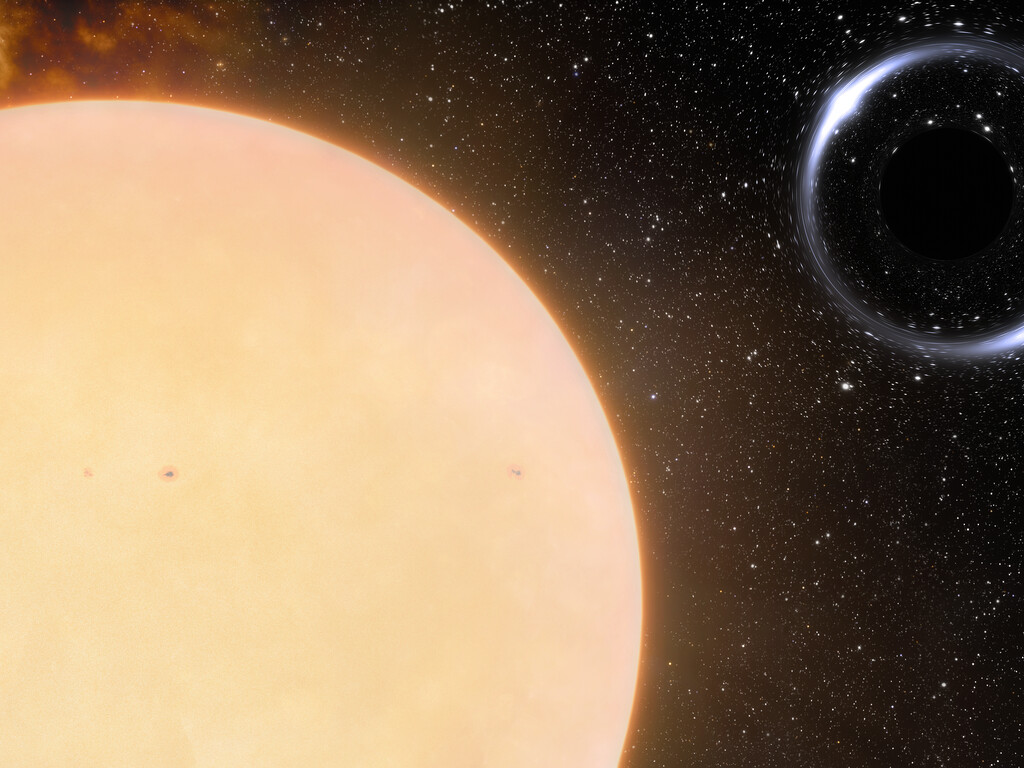
James Webb TelescopeIn other news, A surprisingly near black hole about 10 times more massive than our Sun has been found just 1,560 light-years from Earth, which is about as far as the Orion Nebula. Gaia BH1, is part of a binary star system whose other member is a Sun-sized star about as far from its companion black hole as Mars is from the Sun.
-
James Webb TelescopeThat's an interesting perspective you have there. — Agent Smith
It's the perspective of most scientists, if you ask them. -
James Webb TelescopeThe JWST hasn't made any startling new discoveries. :groan: I expected a paradigm shift event to occur. Looks like the JWST is nothing more than an upgraded HST. All that Sturm und Drang, for nothing! Maybe it's too early to comment ... astronomical data take time & money to process. Gotta be optimistic! Oui mes amies? — Agent Smith
theory ... is just a set of rules and equations ... [however] a mathematical model cannot answer the questions of why there should be a universe for the model to describe. ― Stephen Hawking — noAxioms
Scientists are sometimes quick to leap to hyperbole when singing the praises of their megabucks projects even if results can only be seen in comparative charts or new equations. But the JWST goes far to appease the astronomical amateur community by taking telescope time to give enthusiasts just what they've aimed to see in decades of stargazing on cold silent dark moonless mountain tops.
The universe was here first. We're just visiting for a short while seeing what we can see. Science is a tour guide pointing here and there. Most people are too busy with just staying alive or seeking daily comforts to notice. But then what's life for? -
Is the multiverse real science?that's one way to think about the multiverse I guess — ssu
The multiple universe models are driven by mathematical logic as extensions of cosmological theories. The parameters of those theories turn out to be just numbers that happen to work for us, but are they necessary or just lucky? Could they have been some other way? Of course, any other way we would not be here to ask, but the numbers and the implied universes (read logical realities) that might have been simply wouldn't care. Does our presence bias our views on the matter so that reality boils down only to that which makes it possible for me to type this sentence? -
Is the multiverse real science?If we can model our reality better with multiverse models than without, then why wouldn't it be science?
Everybody ought to understand that it's a model of reality, not reality itself. — ssu
There is a reality for each and every model, as implied and expressed by the models. Not the other way around. Choosing to call one of these realities 'reality itself' or 'really really real' is a personal choice no matter how many people are convinced otherwise. -
Ukraine Crisis
This BBC article pushes some of the same facts, but much of it is still speculative due to the paucity of legitimate military sources.
magritte
Start FollowingSend a Message
- Other sites we like
- Social media
- Terms of Service
- Sign In
- Created with PlushForums
- © 2026 The Philosophy Forum