
Comments
-
What Philosophical School of Thought do you fall in?I prefer not to identify myself with any "schools" or "movements". It smells too much of dogmatic traditionalism. The map is confused for the territory, the "way things are" is not identifiable or reducible to a single person's name. "Reality" is more mysterious and withdrawn. The names of metaphysical systems, the terminology and structures, all of this makes them works of art. Even if they are ultimately right, it would still be wrong to call reality by these names.
But this indeterminacy is apparently intolerable, so people divide themselves up into different groups, all with their special idols and "masters". It goes beyond the pragmatic use of terms for ease of communication and into a realm of competition, so it's no longer about what "reality" is like but more about who can outsmart everyone else. Belonging to a group of fellow idolizers makes you feel like you're a part of something bigger, a tradition, and that you have "superpowers" of sorts - you "see" the world "differently" than the "other" people.
So let's be clear here: "reality", the "way things are", is not identical to a person's name. The world is not "Aristotelian" or "Platonic", it's not "Deleuzian" or "Schopenhauerian", it's not "Hegelian" or "Kantian", it's none of these things. Aristotle might have been right about the four causes but that doesn't make the world "Aristotelian". Schopenhauer might have been right about the "Will" but it doesn't make the world "Schopenhauerian". Labeling reality like this seems to be an affront to reality itself. It means you believe that you, or your idol, is a master of reality, and that reality answers to this.
If someone comes along and tells me "your thought is very Aristotelian!" or "you sound like a Heideggerian!" I will tell them I have no need for these labels outside of basic communication. I don't need to be a "part" of any tradition, I don't want to be a part of any tradition, and it's a mistake to identify reality with these labels, so take your names and shove off. Stop trying to make reality something that has a determinate identity, as if someone has a monopoly on reality. How nauseating it would be if the way things are is intrinsically and timelessly linked to someone's name! It's absurd! -
How would you live if you were immortal?I'd wonder if I really was immortal. What if there was something that could kill me? How could I ever know I really was immortal unless I were God?
-
Achieving Stable Peace of MindMy hope is that the same 'over-evolved' brain that finds despair in lack of meaning can move past this dilemma in a positive way. — CasKev
You might be interested in the work of Colin Feltham. He's a psychologist and counselor who is working in the field of depressive realism, with an emphasis on integrating the thought of Peter Zapffe.
He's certainly not one of those positive psychology people, but he is trying to find ways of coping with the human condition that isn't disingenuous or fatal. I think one of the things he critiques Zapffe on is his underappreciation of love and intimacy. -
What are we trying to accomplish, really? Inauthentic decisions, and the likeI think you are correct that most of life is a repetition of boring events. We go through the motions of life out of habit and inertia. In my own experiences, what makes life vibrant and fulfilling is usually precisely what is not the case: possibilities. Anticipation gives life its color, the expectation of a future metamorphosis keeps us going, even if this future never actually materializes.
For example, I may program and code, with a cup of coffee next to me and earbuds in, listening to some sort of space ambient music or science-fiction music. It really pulls me out of "reality" and into a different one, the world of the what-if. What if I was on a space-faring vessel, exploring some distant star cluster, away from the political bullshit on Earth, the impending environmental disaster, the rampant suffering and decay? I think people live in this world of the what-if more than actual "reality". They spend more time dreaming than acting, because dreaming doesn't come with limitations. People take drugs to escape reality. They browse social media to escape their responsibilities.
I think, even if we can formulate a coherent philosophical pessimism that denounces "life", phenomenal existence, or whatever, we'll all have "good" days, where the world seems a bit more welcoming than usual. We get seduced into loving the world even if there's that little whisper in the back of our minds reminding us of the antelope being eaten alive in the savanna, the inevitable heat death of the universe or the fact that I didn't study for my exam this coming Wednesday. And I guess I would say that this is just who we are, it's in our nature to do this. It reminds me of Werner Herzog's brief bit about the harmony of the universe, and how he loves the forest even against his better judgment.
Probably a generic rule of thumb of the cosmos would be that it cannot satisfy everyone. For every state of affairs, there's always going to be someone for whom it doesn't quite live up to expectations or requirements. The affirmative attitude marginalizes these people, making it seem as though it is their fault that they find existence to be faulty.
Part of the Heideggerian care structure is the world, which is defined as the system of purposes and meanings that organizes our activities and our identities and within which things make sense to us. There are ready-at-hand entities (equipment), that have a reference towards-which (work), which is for-the-sake-of-which (a possibility of Dasein's Being), or for-Others, etc. The angst, the anxiety, comes from the moments when we ask for what sake do we ourselves exist and do all the things we do. It's a void of meaninglessness in which the nothing "nihilates" our contextual meaning, our world. Nothing matters anymore, it's all just very ephemeral and pointless. -
The problem with Brute FactsSo you can think the statement "The triangle is a circle", or you can speak it or write it down. The collection of qualia, sounds, or ink marks on paper is consistent and exists, but it does not refer to anything. — litewave
Are you sure that they don't refer to anything? How can we coherently talk about something without having a representation of it in our minds? How can something be absent in our minds and yet still we talk about "it"? -
Does "Science" refer to anything? Is it useful?Yes, I have read Haack and am in a lot of agreement with her. However I have found from my own reading that she calls science a loosely-organized federation of disciplines, and I can't help but wonder why, then, do we need the word "science" anyway and risk the sort of rampant scientism we have today?
-
Hedonism and crimeIf well-being and morally good are not connected, how can hedonism be a moral theory? — WISDOMfromPO-MO
It can be the axiological foundation of a consequentialist theory that would take the value of a population as more important than the value of an individual's experiences, as a population is merely a conglomeration of individual experiences, with all individuals being equal to each other.
Or you can focus more on negative experiences, and say that the pleasure that comes from killing people cannot be morally good because it causes negative feelings in others.
Like I said, rational self-interested hedonism =/= morality. -
Does "Science" refer to anything? Is it useful?There can't be scientism if there isn't any science! >:O
-
The problem with Brute FactsThe ultimate reason for why anything exists is logical consistency. What is existence anyway, if not logical consistency? — litewave
But how do you explain the fact that we can think about impossibilities? Do these acts of thinking not really exist? -
Hedonism and crimeSo if killing people is pleasurable to a serial killer then his well-being is increased by killing people, and, therefore, his killing people is morally good? — WISDOMfromPO-MO
No, at least not necessarily. There's a difference between saying taking pleasure in killing people is good for the person doing the killing, to saying the fact that the person kills people and takes pleasure in it is morally good.
What is good for someone may not always be what is morally good. -
The problem with Brute FactsThat there is some reason why God, the universe, mind, etc cannot not exist. — Marchesk
But why does this reason exist? And why does the reason that this reason exist also exist? If something is necessarily existent - why is it necessarily existent? "Brute" facts seem more like cowardice and obscuration than genuine, honest belief. -
The problem with Brute FactsI'm only speculating, but it seems to me that if we try to label, describe, or otherwise identify something as "brute", we have only pushed the explanation back even further. If, let's say, "mind" is "brute" - then what makes mind mind? If God is fundamentally the fundamentality of fundamentality, then what makes it the case that God is God? If the ultimate reality is, say, the Will, does it even make sense to say that the Will is "striving"? How would it be striving? How would be even come to conceptualize what this "striving" amounts to?
The only way out that I see is some form of infinite regress out of necessity (but what is necessity if not a brute fact?) We could say that the "brute fact" is ABCD, and if we try to analyze what "brute fact" amounts to, we'll end up with ABCD as well. A circular but infinite explanation. Sort of like saying everything can be divisible an infinite amount of times. -
God and the tidy roomIn other words, no one is reaching the conclusion that people were involved simply because the room, the furniture, etc. are there. We're reaching the conclusion because we know something about how rooms, furniture and so on are made.
With the Earth, trees, etc. there's zero evidence that anyone makes them. The evidence rather suggests that they're made entirely by natural/not-person-made phenomena. — Terrapin Station
Exactly. Just because some things are designed does not make all things designed. -
Why Is Hume So Hot Right Now?Does the Academic appreciation of Hume reflect honest philosophical consideration, or is it merely determined by the Academia's leftist/atheist bias? — Agustino
Or maybe the coherency of Hume's arguments is a reason for Academia's leftist/atheist "bias"? -
On What Philosophical Atheism IsPremise 2. There is no scientific explanation about God.
Conclusion. There is no reason to believe in God. — some logician
This does not follow. You must show that only a "scientific" explanation is a reason to believe in something. There are other reasons for believing in God that are not "strictly scientific", like personal experience, theological demonstrations, etc. God, by definition, is usually thought to be supernatural, or "transcendent" and cannot be studied "scientifically" - to demand that God be subjected to "scientific" inquiry is to sneak in a naturalism of sorts, a naturalism that may be defensible but certainly has not been defended here.
It's also not clear what "science" even is. It's a buzzword - everyone apparently "knows" what science is, but as soon as you actually ask them what the hell science is it's never quite straightforward or clear. Probably because there is no self-evidently obvious definition of science. -
Is rationality all there is?I was just wondering if rationality as a tool for philosophy has ''failed'' us. Should we not try out, for example, Taoist/Zen paradoxical thinking? Why not launch an all-out attack on our sensibilities and reason? Pressurize reason and expose the all-seeing, all-comprehending mind-eye, the true seat of all understanding. — TheMadFool
How would we know the answer to this except through reason? -
Is rationality all there is?Should we stubbornly continue to apply (or is it misapply) reason and logic to these problems? I think it's high time we looked at new avenues, new tools to apply to these problems. — TheMadFool
...said every great philosopher, ever. ;)
The trouble with the grandiose statements of the final demise of philosophy is that it's always in bad faith - philosophy just keeps coming back, one way or another. The Greek skeptics failed to prevent metaphysical theorizing. Hume and the Scottish empiricists ended metaphysics - until Kant unintentionally revived it. The logical positivists wanted only scientific and logical claims to be meaningful, but were ultimately unsuccessful. Nowadays there's the rising tide of naive scientism, that fails to account for all the previous attempts of ending philosophy. We've been struggling with these problems for centuries, and we probably will continue to struggle for as long as the human race exists.
Heidegger said it best - as soon as we have one single interpretation that never changes, we cease to be genuine inquirers and become dogmatists. And Wittgenstein would have added that the failure to "finish" philosophy has nothing to do with the inadequacy of philosophical investigation but with the sheer complexity of philosophical questions. It shouldn't be a fault, it should be an opportunity - the stuff we're struggling with was the same stuff Plato struggled with.
Philosophy is, in my opinion, largely a socializing activity. In the past, to be a philosopher would have been similar to being a wine connoisseur or an art collector. They put in their own theories and critiqued those of their peers. Nowadays people want progress and results and forget that philosophy does not work like that. Solving a problem isn't always the goal - truth is the "goal", but what we're really doing is just having some fun and exchanging ideas. We're in no hurry and have no deadlines. "Finishing" philosophy takes all the fun away. -
Discussion: Three Types of AtheismYeah, I recall seeing Proof here a long while but only briefly. Shame, I would have wanted to discuss some things with him.
-
Discussion: Three Types of AtheismA pity 180 Proof isn't here, he'd be great batting for the Absurdists :P . Feel free to discuss any of the ideas present in this OP. — Agustino
Speaking of which, where is 180 Proof anyway?
I think I can represent an absurdist agnosticism - the uncertainty of God's existence adds an additional absurdity into the equation. It is a recognition of the unlikelihood of God's existence but also that the answer to this is outside the boundaries of human understanding. -
Currently ReadingArthur Schopenhauer - Essays and Aphorisms
Søren Kierkegaard - Fear and Trembling
Richard Polt - Heidegger: An Introduction
Robin Le Poidevin - Arguing for Atheism
Emmanuel Levinas - Basic Philosophical Writings -
Philosophy is Stupid... How would you respond?Probably one of the things about philosophy that motivates some people to chastise it as stupid is how nothing seems to be set-in-stone. Now of course this is, in my opinion, one of the greatest assets of philosophy, and it's also just untrue that other disciplines are not the same. But people want facts - and a philosophy department does not provide "facts" all too often unless it's historical. In philosophy, there is almost universal disagreement on key issues and this can be interpreted as a failure of philosophy, when in fact it's simply evidence of the difficulty of these questions.
The next step people might take in their criticism is to not criticize philosophy, per se, but criticize those who practice it. They claim that they have some kind of deficient character or personality that allows them to study something as useless and boring as philosophy, not like those "other folk" who study the "important" stuff like science and maths. This is simply a personal attack and an affirmation of the status quo.
That being said, however, I do believe science should be more integrated into the philosophy departments (and not necessarily vice-versa). Philosophers need to be knowledgeable about science, but scientists do not necessarily need to be knowledgeable about philosophy (it's more like it's optional, or perhaps a one-semester class). Most importantly philosophers need to be influenced by the scientific culture, not to make philosophy "scientistic" but to make scientific philosophy. Both scientism and anti-science perspectives in philosophy come from an inadequate conception of science itself.
In general, though, I would really like to see a general culture in philosophy end, that of isolation. This comes in many forms. One form is the isolation from the sciences, where things are studying away from any empirical information that may actually be relevant to the topic at hand. Certain accounts of dualism in the philosophy of mind, for example, really only are self-coherent, they aren't really defensible in the big picture.
Then there's the almost clique-like nature of philosophical "schools", federations of thinkers with a common tongue and a common hero figure. You're either in the school or you're not, and if you're not then those part of it can walk all over you with their verbose terminology and esoteric vocabulary. It's a power game. And once again this leads to isolation. Part of the problem then is that it is hard to get people interested in this stuff. I still haven't read anything by Hegel and I don't know when I will or if I even will, I just don't have the motivation to because I don't really understand why Hegel is so important to begin with. From my own perspective, it is as if Hegelians (and other schools as well) don't want newcomers, but then they complain how Hegel could be used to solve many issues in contemporary analytic philosophy or science. Like if you think this is true, then it's up to you to spread the good news of Hegelianism, you can't just expect people to voluntarily spend several years studying something that they aren't sure is helpful or not.
There is also the self-imposed isolation of those who pair philosophy with religion. Historically speaking, philosophy was a very valuable tool for religions. It was philosophy in the service of religion, usually theological of sorts. Theology is just the philosophy that maintained its relation to religion during and after the chaotic splits of the Enlightenment. Religion gives philosophy a "big" purpose - to demonstrate the existence of God, to show the right way to live, to comprehend the sacrament or whatever. It's really important and to be a philosopher tied to religion, or just a theologian, makes you part of a tradition of sorts. But it's also very isolationist and therefore basically irrelevant to those who aren't "in" the school. And then those who are part of the group blame those who aren't for not reading their material. Which is entirely hypocritical as they probably don't read the material of other religious groups. It's really their fault for not communicating properly, but they make it seem like it's your fault and that you're guilty for not reading so-and-so's dissertation of the existence of the divine or whatever or misinterpreted what the esoteric circle was saying.
This leads into another isolationist tactic employed, that philosophy somehow has a "monopoly" on the "Big Questions". Philosophers study "the Big Questions" that pervade all existence. Wow.
One last issue related to this is one that I have seen here on the forums and elsewhere. It could be that philosophy attracts this sort of personality, but it seems to be a common-ish conception of philosophy as being life-changing and aristocratic. That by studying philosophy, you become a more "virtuous" person, or just straight up better than other people, is something I've found to be a common sentiment that is also found it other disciplines as well. I've found this sentiment in myself at times, chiefly characterized by a disdain towards newcomers and a preference for philosophy to continue to be "for the few". If philosophy is only studied by a small portion of the population, it automatically gives those who study it a sense of "special-ness" - they know (?) more than other people. They know (?) certain things that others don't, it's special knowledge that cannot be easily explained to others, assuming there is a desire to teach anything at all. Philosophy, then, becomes some kind of way to separate yourself from the "common rabble" and see yourself as superior to them. Heidegger at least tried to start from common experience and especially the countryside folk, but he still ended up using technical jargon and terminology which ultimately made his thinking isolationist.
A consequence of this sort of special snowflake attitude is that those who have it get super protective and anal retentive about their discipline. They want to be special, but if nobody cares about their discipline, they take this as an insult and go on to pine for the solidarity of the mountains or the woods or whatever. Which is just childish in my opinion.
You can see this general snobbish, isolationist attitude in the very language of those who have it. They'll often say "in philosophy..." or "in science" with the intention that this discipline is something you have to get into. It's a verbal "stop sign" - stop!, we don't want your kind here. Stay outside. This is a symptom of an inferiority complex. -
Philosophy is Stupid... How would you respond?The context of the discussion was effective altruism, where you calculate what does the most good for your contribution. If Singer had gotten a job on Wall Street, he would have had more money to give to charity, but he wouldn't have been in the same position to promote the idea behind being an effective altruist. — Marchesk
One of the things consistently brought up by the EA community is the importance of avoiding burn-out. Even if being a top-notch lawyer or engineer or banker would make you a ton of money, if you hate doing it you won't last very long. It's better to pursue a job that pays well enough that you can donate some to charity, that is also a job you enjoy so you can continue to donate to charity. -
Are there ghosts in the ante-room?I'm gonna be a bit polemical and harsh in this response, but only because I have some steam to blow off. Dawkins is one of those chaps that just pisses me off. The above quote in the OP from Dawkins strikes me as an example of him trying to show that a secular life is meaningful and worth living, but it comes across as some real im14andthisisdeep crap, aggressive crap at that.
A quote from River Out of Eden, which is an otherwise good description of the sentient condition, shows, when compared with his other claims, just how hypocritical and contradictory his views are:
"The total amount of suffering per year in the natural world is beyond all decent contemplation. During the minute that it takes me to compose this sentence, thousands of animals are being eaten alive, many others are running for their lives, whimpering with fear, others are slowly being devoured from within by rasping parasites, thousands of all kinds are dying of starvation, thirst, and disease. It must be so. If there ever is a time of plenty, this very fact will automatically lead to an increase in the population until the natural state of starvation and misery is restored. In a universe of electrons and selfish genes, blind physical forces and genetic replication, some people are going to get hurt, other people are going to get lucky, and you won't find any rhyme or reason in it, nor any justice. The universe that we observe has precisely the properties we should expect if there is, at bottom, no design, no purpose, no evil, no good, nothing but pitiless indifference."
There are good reasons to believe that the universe is indifferent to the injustices occurring, but there are also good reasons for believing the Mr. Dawkins is unable to come to terms with this himself:
We are going to die, and that makes us the lucky ones. Most people are never going to die because they are never going to be born. — Dawkins
Wait, what happened to the fact that some people aren't so well off as Mr. Dawkins? What was that about the suffering per capita being beyond decent comprehension, or how the universe has no value and is pitilessly indifferent?
Like come on, how can you get any more special-snowflakey?
We know this because the set of possible people allowed by our DNA so massively exceeds the set of actual people. In the teeth of these stupefying odds it is you and I, in our ordinariness, that are here. — Dawkins
Yeah, we certainly are ordinary aren't we? ...thanks, I guess? Here Mr. Dawkins seems to think that if we compare ourselves to people who would have been better than we are, but who do not exist, we can affirm our own existences. It's supposed to encourage and motivate us - but it's also kind of insulting. But more importantly, Mr. Dawkins tries to cover his bases by telling us how we aren't special and we aren't as good as those who could have been - but simultaneously tell us how that simply the fact that we are makes us special and important. It's humble-bragging, isn't it?
And had we never been, we wouldn't have been any worse. He can preach and shout about how fan-fucking-tastic it is that we're alive, but as soon as you put his words into practice, it ends up being nothing more than a bit of empty sophistry. A cheap pick-yourself-up-by-your-bootstraps that can't survive a basic intro to ethics course that is only taken seriously because he's a scientist and he knows stuff, he knows more than you or I. Say - if we are to cheer and high-five each other for being alive, are we to feel relieved that we were born? Does Mr. Dawkins honestly want us to pity those who never were - does he sincerely believe what he says?
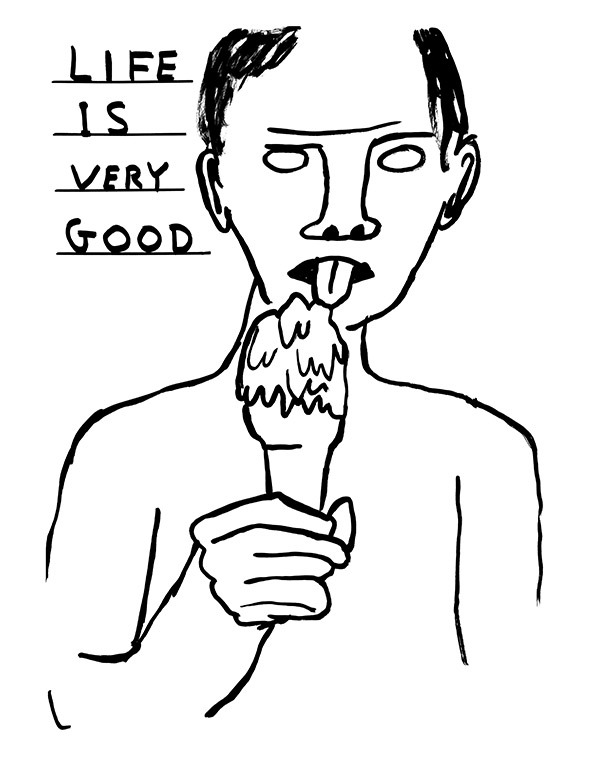
The fact that it was so unimaginably unlikely that any one of us would exist is evidence that our individual and collective existences are a fluke, and not some marvelous achievement that Mr. Dawkins wishes it to be. We didn't exactly do anything to get here, for better or for worse.
Mr. Dawkins seems to want us to tremble at the meaningless indifference the universe has to us, and our general unimportance in the grand scheme of things, but simultaneously also desire that we leap up and sing and parade around reminding ourselves how special we are, simply for being. Like, congratulations, you exist! What an amazing accomplishment! What an incredibly sublime and spiritual achievement! - ack, I can't stand that cheesy "scientific spirituality", the one that chastises those with religious spirituality but then recommends that we binge-watch Carl Sagan's Cosmos, read Mr. Dawkins' many evangelical books, worship our self-image (jack ourselves off to our reflection in the mirror) and constantly remind ourselves how we are special because we are "starstuff" (...just like everything else - tell me more about how "starstuff" is "scientific").
Consider the final sentence in the quotation above:
"The universe that we observe has precisely the properties we should expect if there is, at bottom, no design, no purpose, no evil, no good, nothing but pitiless indifference."
And then pair this with a quotation by Cioran:
"Objection to scientific knowledge: this world doesn't deserve to be known."
Riiiiiiight - so, once again, we have Dawkins (and co.) wanting us to submerge ourselves in the nihilism of the Enlightenment, only to pull us back out by a complete contradiction. The universe is indifferent and indecent - but it's also quite beautiful and spiritual! But remember it actually doesn't give two shits about you and could purge your existence at any time, really. But ya' gotta remember, life is pretty sweet, isn't it? Have you looked through a telescope recently? How privileged we must be to have the opportunity to see a representation of Saturn through our eyes that will later degenerate with cataracts! Remember when the dumb people before thought Saturn was a god? Ahahahahaha how silly of them, hehehe now we know stuff. Wanna know more? Suck my dick and buy my books!
We privileged few, who won the lottery of birth against all odds, how dare we whine at our inevitable return to that prior state from which the vast majority have never stirred? — Dawkins
How dare anyone think otherwise! How dare anyone not want to be here! How dare anyone wish they didn't have to die! How dare people complain about their suffering! How dare they, dammit! How dare they not agree with me! How dare they threaten my meaning! waaaaaaah!

(cartoons are by David Shrigley, for those interested). -
Do You Dare to Say the "I" Word?Thank you for sharing that story, I was not aware of it. It is powerful.
-
Life is a pain in the assLike I said, it was more of a suggestion than a criticism. I don't see these threads going anywhere and it seemed to me that you were getting frustrated with the lack of progress.
-
Life is a pain in the assRight, but the pessimistic point is that life is not worth living and that there are no reasons to continue it. It seems almost aggressive to demand people justify their existence, especially if you believe they won't be able to.
-
Life is a pain in the assYes, it was not meant as a criticism per se but more as a recommendation, that perhaps pessimistic threads should be abandoned because they are not productive in any substantial way.
-
Life is a pain in the assProcreation brings it into sharp focus. — schopenhauer1
I entirely agree - but what help is this to those who already exist? Might someone be better off not knowing their existential predicament, or at least exacerbating it through critical philosophical analysis? Why expose people to the pessimistic worldview?
The answer, from what I can tell, would be that the knowledge of the human condition, although difficult to bear, is a requirement in order to be a responsible human being. Understanding the predicament we are in can, hypothetically at least, lead to a change in character and expression. We become more compassionate and patient, appreciate the goods in life more and most of all refuse to procreate.
Without any ethical foundation, truth for the sake of truth is irresponsible. If our goal is to convince people to not procreate, then this provides a solid reason to shine light on the structural issues of life. Any other motivation, however, must be primarily self-serving, if only through catharsis or sublimation. I don't think we're doing anyone any benefit by pointing out these features of life for the sake of pointing them out. There needs to be some sort of positive reason or benefit to understanding the human condition that overrides the toll such an understanding has on a person. In the absence of such a reason, it is best that we just don't say anything. Nothing positive will have been accomplished and all we will have done is make the problem worse. -
Life is a pain in the ass
Truth for the sake of truth is said to be noble, but exposing people to pessimism without any additional advice or considerations seems to accomplish very little. Have you considered the ethics of promoting pessimism without prudential care or a substitute method of dealing with life for those who gain nothing and lose a lot from learning about the bleakness of existence?
I ask this because these posts, while certainly not excessive per se, seem to be repetitive cul-de-sacs that have no positive outcome: people leave without their beliefs being substantially changed, and/or now everyone is even more conscious of the collective suffering in the world than they were before. And for what?
I suppose I'm too pessimistic for pessimism. -
Philosophy of depression.Personally I believe that depression, so long as it is not a biological issue like a chemical imbalance or whatever, stems from an extreme disappointment or disillusionment with the world. Only optimists get depressed. But then again I think we all have a bit of optimism in our character that cannot be purged.
-
IdentityIf men want to dress like women or men want to dress like women, that's their prerogative, but you can't force me to use pronouns that don't match their biological sex. — Thorongil
"Men" and "women" are gender pronouns, not sexual pronouns.
At any rate, you seem to have ignored the question of the OP. The question was not "can people identify differently than their biological sex", it was "is biological sex even an appropriate label in the first place". -
IdentitySo anyway, the basic argument presented is that if we define natural kinds as a family resemblance of entities with similar features, then it is factually correct to label those with similar feature as belonging to a natural kind. If "being male" means "having a penis", then people with a penis are male. Being male is equivalent to having a penis. Natural kinds may not "exist" outside of our conceptual scheme, but "nature" does seem to act "as if" they do through patterns of constraint and inclusion/exclusion.
Ethics only enters the picture if this identity is extended from a factual description to a normative prescription. It is a normative claim to believe that if you are male, you must use your penis in a certain way, or embrace your male identity and identify as a male. The expectation that one identifies with their physical identity is a normative claim that can be criticized. -
Philosophy is Stupid... How would you respond?Because your identity and culture is historical and it's important to learn how this came about.
-
Philosophy is Stupid... How would you respond?By it actually making sense, at least somewhat, and being historically important.
-
Philosophy is Stupid... How would you respond?Most bad philosophy is tossed out sooner or later. Only the good stuff gets put in the textbooks.
_db

Start FollowingSend a Message
- Other sites we like
- Social media
- Terms of Service
- Sign In
- Created with PlushForums
- © 2026 The Philosophy Forum