
Comments
-
Nothing to do with Dennett's "Quining Qualia"Well actually it would be better to say the entire experience is qualia, in that’s how a keyboard appears, but certain properties such as shape or reflectivity are inferred from the experience. And those are taken to be primary, objective properties. But to answer directly, it would be the color, feel and even smell of the keyboard from which we construct an object in perception. Or the result of that construction, however the neural mechanisms work.
-
Nothing to do with Dennett's "Quining Qualia"You want me to remove all the properties of language and then report my experiences to you? They aren’t linguistic. The language is just a reference.
-
Nothing to do with Dennett's "Quining Qualia"SO what is the nature of this privacy? Can you make it clear? — Banno
Something that can’t be communicated, apparently. Insert Luke’s comment on showing here. -
Nothing to do with Dennett's "Quining Qualia"chesk
Thoughts that might be spoken, but haven't been; — Banno
Thoughts I hear in my head. Or see in my imagination. Or remember with whatever sensory modality.
But how to make sense of that? — Banno
Since we’re both human, we have similar enough experiences in which to build language upon. But do note the limits of communicating our experiences to one another. -
Nothing to do with Dennett's "Quining Qualia"SO were is this getting us? How are qualia distinct from chairs? — Banno
Qualia are the secondary qualities of perception. They’re not properties of chairs. -
Nothing to do with Dennett's "Quining Qualia"I do not think that Dennett is denying that some thoughts are private, in the sense of being unspoken — creativesoul
One wonders what Dennett means by unspoken thoughts. Surely not “inner dialog”? -
Nothing to do with Dennett's "Quining Qualia"As much as I do for the external world. And yes, you don’t know that I see the same thing without verification of some sort.
-
Nothing to do with Dennett's "Quining Qualia"I’m self-reporting to you. I don’t require a self-report of my own experiences. But I do need it for others. Thus the privacy of experience.
Now if you have no experiences of your own, I can understand why you would confuse self-reports and language with experience. But I suspect you do, and like Dennnett, have convinced yourself that it’s a trick of your brain. -
Nothing to do with Dennett's "Quining Qualia"Not to me it isn’t. Maybe you’re a p-zombie?
-
Nothing to do with Dennett's "Quining Qualia"The appearance or the seeming. It appears that I see color, feel pain, etc. it’s those sensations.
-
Nothing to do with Dennett's "Quining Qualia"It’s private in the sense that only I know I’m having the experience, in virtue of having the experience, without telling others or they inferring it from my behavior. I could be staring at the image while thinking of something else. Something I admit to occasionally doing on work Zoom calls, which I’m only found out when asked a question about what I was supposed to be paying attention to.
-
Nothing to do with Dennett's "Quining Qualia"Actually, you’re right. Dennett does deny all four properties in total.
My claim--which can only come into focus as we proceed--is that conscious experience has no properties that are special in any of the ways qualia have been supposed to be special. — Quining Qualia -
Nothing to do with Dennett's "Quining Qualia"Dennett's aim(I'm guessing) was to use a physicalist framework to effectively explain all that quale and qualia are claimed to be the only explanations for, and in doing so show that there is nothing ineffable, intrinsic, private, or directly apprehensible about the properties of conscious experience. — creativesoul
That's a bit strong. I believe Dennett's argument is that the concept is incoherent because it cannot support all four properties given his intuition pumps showing otherwise.
But saying that therefore nothing to all four about conscious experience is going too far in this paper. Take privacy, how can some conscious experiences not be private to the individual? We don't and can't always know what someone else is thinking or feeling, therefor some of their experience is private.
I do need to go back and reread the paper to respond to fdrake's questions. So I may follow up on this after doing so. -
Nothing to do with Dennett's "Quining Qualia"That's odd, I thought the ones you called out, including myself, were doing that.
-
Donald Trump (All General Trump Conversations Here)dunno. Perhaps they saw Trump accurately as a purely transactional actor, and concluded that he would deliver on his end of the bargain, which he did with the Supreme Court. They did a deal with the devil? — Hippyhead
Could be, for some anyway. Depends on what level you're playing the political game at. But I do know some conservatives who deeply believe in him to this day. -
Nothing to do with Dennett's "Quining Qualia"Are we supposed to just agree with Dennett, or are we supposed to limit our discussion to just this particular paper, and not the ongoing wider discussion, of which Dennett has contributed?
And if we're limiting our discussion to Quining Qulia, does that preclude any responses to it from professional philosophers? It's hard for me to just focus on one paper, given the richness of the wider discussion, and given that Dennnett has his share of unconvinced detractors. It's not like the consciousness debate ended with this paper. -
Donald Trump (All General Trump Conversations Here)Trump is something else altogether. Trump isn't really a Republican at all. He has no convictions other than his own personal self interest. Evidence.... — Hippyhead
That's the thing that gets me. What made conservatives so convinced Trump is one of them? Most of all, what made religious conservatives think that? They espouse having these political and religious conservative principles, unlike their left-leaning foes according to them, but what about Trump is principled, other than his self-interest?
He ran as a Republican because he saw an opportunity at the time given the lack of appeal for all the other Republican candidates as people were growing more disillusioned with establishment politicians. Thus all the rhetoric about "draining the swamp". But it was all doing what Donnie does best, grifting. He's a bullshit artist. -
The Road to 2020 - American ElectionsTroublesome to say the least. The people believe Trump. — creativesoul
Yes, I know a few people like that. They don't think Trump is a liar. It's the other side. A key to understanding this is that at least for the religious conservatives, they have an entirely different worldview which encompasses American politics. And then quite a few more also are heavily influenced by Fox News and AM radio, which is heavy on the propaganda. The Democrats are always cooking up some left-wing conspiracy according to those sources. Even though they'll admit Biden is moderate, he's being controlled by the progressive wing, or he's going to step down soon after winning. -
The Road to 2020 - American ElectionsThe take-home is that half of eligible voters wanted to put their trust in a liar. — Banno
You mean of those who actually voted. It's not like Australia where there's mandatory voting and very high turnout. Probably 1/3 of eligible voters or more still didn't turn out this election, even with he higher turnout. The projection I see is 66%.
So the question is did the 34% or so who likely didn't vote not care and were okay with the status quo, did they feel disenfranchised by the electoral college, did they feel the two parties don't represent their views, did they feel it was too difficult to vote, etc? -
Nothing to do with Dennett's "Quining Qualia"That’s a really good point. It’s not just arguing for a certain intuition.
-
Nothing to do with Dennett's "Quining Qualia"You see what seems to be colors making up images. That it seems there are colored images is the what it’s like for humans to see. Dennett may be right in quining the traditional property combination of qualia, but the seeming remains.
-
Nothing to do with Dennett's "Quining Qualia"That some seemings are readily apparent and others are pointed out just illustrates the dynamic nature of conscious awareness. The rabbit-duck can flip back and forth, which means it seems like there is a duck, and then it changes to a rabbit. It doesn’t mean there is no seeming.
-
Nothing to do with Dennett's "Quining Qualia"What two types do you think Dennett is equivocating between? And can you provide a link to some of his work that demonstrates the equivocation? — fdrake
Dennett states in Quining Qualia that he grants the existence of consciousness, but then in Illusionism as the Obvious Default Theory of Consciousness, he defends the argument that consciousness is an illusion as a good starting place for dissolving the hard problem in favor of explaining the magic trick.
Everything real has properties, and since I don't deny the reality of conscious experience, I grant that conscious experience has properties. I grant moreover that each person's states of consciousness have properties in virtue of which those states have the experiential content that they do. — Quining Qulaia
In other words, you can’t be a satisfied, successful illusionist until you have provided the details of how the brain manages to create the illusion of phenomenality, and that is a daunting task largely in the future. — Illusionism as the Obvious Default Theory of Consciousness
Which just sounds like he wants to say we're conscious, but not really. Kind of like an anti-realist about dinosaur fossils. He's also expressed the ideas that consciousness might be a trick of language, a trick of the reporting mechanism, or just introspection giving us the wrong idea. But whatever it is, consciousness isn't what we think it is. Which sounds like eliminativist talk.
Anything but phenomenal. And if there's no actual subjectivity, then there's no actual consciousness as the word is used in these debates. Which means we don't actually have color, sound, pain sensations. -
Nothing to do with Dennett's "Quining Qualia". In short, he equivocates. He does the same thing with free will. — frank
Yes he does. Because he wants to have his cake and eat it to. So he can't bite the bullet and just eliminate free will or consciousness outright, as he considers those to be concepts worth salvaging, as long as he can redefine them to remove any of the problematic implications.
So he wants to say of course we're conscious of colors and sipping tea, but it's only in a functional, dispositional sense, not a phenomenological one. And he has endorsed illusionism elsewhere, calling consciousness a magic show in support of the position Keith Frankish has argued for. -
How was Idealism Taken Seriously?I was looking through the points made by Berkeley and I fail to see how he arrives at my not having an idea of an object existing unconceived. — Darkneos
His argument is that all ideas of mind-independent objects smuggle in a perspective. You imagine a tree as if you were looking at the tree from some angle. What you can't do is imagine the tree from no perspective. He also rejects abstractions as real entities, so therefore abstract notions (like mathematical models) of material objects don't work either.
Keep in mind the above is an attack on indirect realism, where material objects are inferred from mental ideas/representations. He first has to go through arguments disproving direct realism, because obviously if we're directly aware of material objects, then Berkley's idealism doesn't get off the ground.
As for solipsism, it's a legitimate concern in my view, but I guess minds are given in Berkley's philosophy. Also, so is God, who is required to keep ideas persistent when we're not perceiving them.
Berkley's idealism is just one form of idealism. There are others with their own strengths and weaknesses. And he wasn't the first. Idealism can be found in ancient philosophy. The motivating factor was the problem of perception, and later on, the varying ways humans categorize and make sense of the world. -
Nothing to do with Dennett's "Quining Qualia"
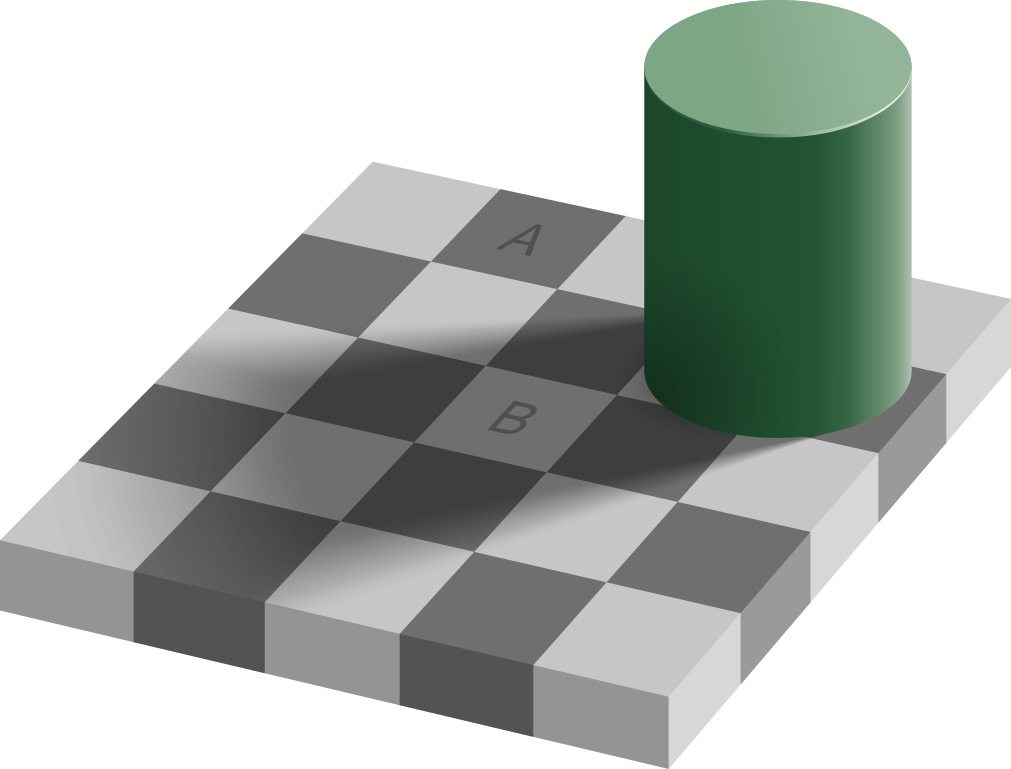
That we see the squares for A and B as different shades of gray is a visual illusion. Does this mean we only seem to see two shades of gray? That the illusion of color difference is itself an illusion?
Or is the seeming to have a conscious experience the what it’s like for any conscious activity? There is a what it’s like to see red because it seems we see red. You can’t have a seeming to be conscious without there being something it’s like to be seeming.
The seeming is consciousness. -
Nothing to do with Dennett's "Quining Qualia"it seems that I’m enjoying Klee’s work, but I remind myself that it’s just a bunch of mindless robots playing a trick on me.
-
Nothing to do with Dennett's "Quining Qualia"I'm stuck in Mary's room. What frequency is it? — frank
A fact you can’t know without being told the dress seems to be red. -
Nothing to do with Dennett's "Quining Qualia"Nice dress, isn't it? — Olivier5
It only seems that way. -
Nothing to do with Dennett's "Quining Qualia"It's more likely to be the case that visual imagery in dreams occurs without the usual perceptual stimuli for vision, but that visual imagery in dreams is part of the functionality of the person's sensorimotor and discriminatory systems regardless — fdrake
Probably so, but I don’t see how this makes the sensations extrinsic if it’s the brain circuitry that produces the sensations, not any other part of the perceptual process. So then we’re left debating whether the relevant functions or neurons are themselves conscious, as in some sort of identity. -
Nothing to do with Dennett's "Quining Qualia"You can have coloured features in dreams without the same flavour and intensity of sensorimotor feedbacks we have when conscious, that's not quite the same thing as perceptual feedbacks between agent and environment. — fdrake
Right, but the consciousness debate isn’t limited to perception, and the fact that other ways of stimulating the relevant brain circuits leads to conscious sensations locates those sensations in the brain. Also, I disagree that all non-perceptual states are less complex, It really depends on the brain and the experience. Some people are very good visualizers. Some can create music in their mind. Mental abilities and experiences range quite a bit. Take the right hallucinogenic and you can have very vivid color sensations. -
Nothing to do with Dennett's "Quining Qualia"The thing with colour etc being relational properties means they don't collapse down to either being subjective or objective. A subjective state of colour is "in" your mind. An objective state of colour is "in" the perceived object. Characterising colour as a relational property makes it neither wholly in the head nor wholly in the object, it's a property of the relationship between the two of them. — fdrake
The problem with this is that we can have color experiences independent of perception.m, such as in dreams or by directly stimulating the visual cortex. -
What is Dennett’s point against Strawson?Yes, adequate, with respect to empirical knowledge. Would you agree with me, that human reason is often not satisfied with the merely adequate? — Mww
Certainly in the case of consciousness. There may be a few other exceptions. I was just stating the implication of Dennett's arguments. -
Nothing to do with Dennett's "Quining Qualia"We never stand still long enough for any sort of input to become present to us in this revealed sort of way; we're already involved with whatever it is, expecting it, seeking it, avoiding it, using it, regretting it, whatever. We're really nothing at all like cameras, you know? — Srap Tasmaner
Well, one can meditate and focus on a particular sensation or object for a time.
I think maybe we don't really either, not in the way typically imagined. I want to say what has to be avoided to start with is an image of experience that is at all static. Empiricists have this model of experience as chopped into a long string of instants -- your visual field is like this, then this, then this, and you have to make these inductive leaps to tie it all together into any kind of coherence. But there's nothing like this really going on, is there? We are, while awake, in constant multifaceted contact with our environment and processing an unending stream of data which we constantly project into the future and take action on. All of these point-like experiences we seem to construct retrospectively, I'm not at all sure anything quite like that is ever actually happening. Feeling the sun and the wind is bound up with all the rest of the process of living, testing, responding, projecting. — Srap Tasmaner
Sure, it's dynamic. Perhaps some of the traditional intuitions of qualia are flawed because of not taking this into account? -
Nothing to do with Dennett's "Quining Qualia"I'm not entirely in agreement with Dennett, because I'm not a physicalist, and for good reason. However, he has successfully rendered the conventional notion of Qualia false at best, and devoid of content at worst. He showed that it is an accounting malpractice. — creativesoul
Even if Dennett does so for the ineffable, intrinsic, direct, private definition of qualia, it still leaves sensations to be explained. And not just for perception, but all conscious mental activity, only some of which is made public to others through language or behavioral inferences.
And that's why I think Dennett ultimately ends up espousing or implying some form of illusionism in other talks or papers he's written. It should be noted that He did use to defend skepticism about dreams, claiming that we only come-to-seem-to-remember upon awakening. Because dreams present a similar problem, perhaps an even more difficult one for physicalism, since dream content isn't based on perceiving an external world.
But dream research since then has supported dreaming as an activity that happens while you sleep, not something invented as you wake up (or at least not always). And lucid dreaming is a thing.
The consciousness debate seems to mostly revolve around perception for some reason, but consciousness isn't limited to that. If you can daydream while driving a car, what is going on in Dennett's account? -
What is Dennett’s point against Strawson?I'm not asking if you agree with that answer (I'm not even sure I do) I'm asking why it isn't even addressing the question, as schopenhauer1 claims. — Isaac
Because I just don't see how one gets color, sound, taste out of number, shape, extension. It's that simple. Dennett is wanting to say the world is just explainable in terms of Locke's primary qualities. Which in modern language is function and structure. But the secondary qualities, or the sensations of consciousness, aren't derived from the primary ones.
So we're left with explanations that explain the underlying mechanisms, as best we've figured out so far, but not the resulting sensations. The best people on Dennett's side can do is dismiss the senasations as an illusion, leaving nothing but the cognitive trick to be explained.
The implication of Dennett's arguments is that we are p-zombies, fooled into thinking we have conscious experiences which can't be explained by the physical mechanisms, or at least, we haven't figured out how to do so. But it's all just a magic show. There's no real mystery, no cognitive closure, no dualism. Physicalism is adequate. -
Nothing to do with Dennett's "Quining Qualia"It's no good re-telling us that we do indeed have intuitions that objects have sensory properties, that's where the whole inquiry begins, we move on from there to explore some of the problems with that intuition. — Isaac
There is a potential epistemic minefield in this approach. If we can't trust our sensations to be real, why trust that there is a material world at all? Empiricism is based on investigating phenomena, but those phenomena appear to us as having colors, making sounds, etc.

Marchesk

Start FollowingSend a Message
- Other sites we like
- Social media
- Terms of Service
- Sign In
- Created with PlushForums
- © 2026 The Philosophy Forum