
Comments
-
The Philosopher's Dilemma - Average People Being Disinterested In Philosophical Discussion.The revelation here is that working at a job that you enjoy is a luxury because several others have to work other jobs they don't exactly enjoy just to make that possible — Darkneos
"Don't exactly enjoy" leaves a lot of wiggle room. You probably have statistics to back up your statement. A couple of others on this forum have expressed a desire for society to support those who don't wish to work. How do you feel about that idea?
Life tends to become a net negative when you begin to question everything around you. — Darkneos
I agree with this. :up: -
The Philosopher's Dilemma - Average People Being Disinterested In Philosophical Discussion.You realize that the only way such a life is possible is because the majority doesn't follow that way of living? — Darkneos
For many I suspect working at a job you enjoy, or at least tolerate, provides an existential dimension to your life. I fail to see that your post provides any revelations about society. In my case I worked at a job I enjoyed and gave me time off for an important avocation.
But I admit, times have changed and it would be much more difficult to do what I did these days.
"At either end of the social spectrum there is a leisure class", E. Beck 1960s. -
Quantum Physics and PhilosophySo how would you visualize them being one (imaginary) thing? — jgill
Sorry. I don't understand the question. — Gnomon
Think of this as a secular counterpart to The Holy Trinity: Father, Son, and Holy Ghost - all are one and there may be Christian mystics who can envision the three as one imaginary entity. :chin: -
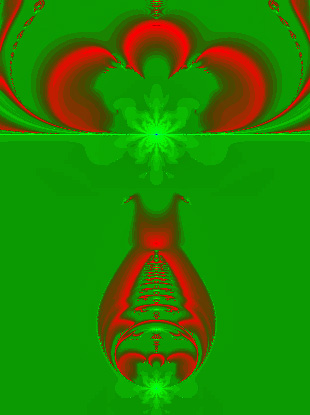
EmergenceAt each pixel a (complex number) value is computed, then the pixel is colored based on the modulus of that number. E.g., dark green=small, bright red=large. The actual functional computation is complicated. It's virtually impossible to ascertain beforehand what sort of image will emerge as the program runs. Hence, weak emergence.
Sometimes philosophical discussions can be dry and it helps to look at graphic examples in reality. :cool: -
EmergenceHere's a graphic example of weak emergence from a BASIC program I wrote that involved an infinite composition of complex functions. Unpredictable imagery. Magnified 2000X.
Quantum Bug (don't let this into your quantum computer!)
-
Quantum Physics and PhilosophyWaves, particles, fields - how they can be consolidated in the mind, now there's a challenge for metaphysics. — jgill
There's no metaphysical mystery to such immaterial notions : they are all imaginary. :wink: — Gnomon
So how would you visualize them being one (imaginary) thing? -
Preservation of information through time and universal memoryI think the best way to preserve information is write it in stone — Athena
It's astounding how well the ancient Egyptians did this, isn't it? Continues to fascinate me. :smile: -
The Philosopher's Dilemma - Average People Being Disinterested In Philosophical Discussion.What if one wants to work less and work for less money to be able to apply themselves in other areas of life more important to them? — The Questioning Bookworm
I did that with my life, very successfully. The system doesn't necessarily have to be changed; one has to use one's imagination to solve this problem. Don't ask the government to grant your wish. -
Quantum Physics and PhilosophyThis is just the physicist's way of saying we know there's some energy there but we don't know what form it has. — Metaphysician Undercover
I'm thinking in terms of pure mathematics. Excitation in the complex vector field. I'm wondering how that might be interpreted, devoid of physics. (I'm sure someone will tell me :roll: )
Waves, particles, fields - how they can be consolidated in the mind, now there's a challenge for metaphysics. — jgill
This is an error in the interpretation of the Copenhagen interpretation — Darkneos
I'm speaking of envisioning these three things as a single entity, not necessarily associated with QM. Probably beyond metaphysics. Like visualizing four dimensions. -
Quantum Physics and PhilosophyMetaphysicians might try to formulate and discuss ways of comprehending and envisioning the fields of physics. As a math person I easily perceive fields as vector fields - usually 2-D - with functions giving vector values at each point. But when a physicist talks of "excitations" of a field that's a different matter, and one that is highly intriguing. Physicists use the word "particle" differently than does the average person, as KK has mentioned. Waves, particles, fields - how they can be consolidated in the mind, now there's a challenge for metaphysics. Or is this in the same category as visualizing four dimensional space? (I once knew a topologist who claimed to be able to!) :cool:
-
The Philosopher's Dilemma - Average People Being Disinterested In Philosophical Discussion.There are conversations about life's problems that some would consider "philosophical". These are ubiquitous. But when one starts using terms like "ascriptivism" or "coherentism" mundane life goes by the wayside and a more academic environment must prevail. It would be the same as me bringing up something like "algebraic varieties" in a social setting. Those present would soon depart.
If you are a serious philosopher you might pursue some arcane topic to exhaustion and write about it, posting your thoughts on the web, and obtaining some small satisfaction in doing so - even if few others show interest. I've done that in a tiny sliver of mathematics, and one of my colleagues expressed it well by saying, Its like being a retired priest and always looking for inspiration in the scriptures, You do it because that's what you do. :cool: -
Physics: "An Inherently Flawed Mirror"?The quote is on page ten of QED: The Strange Theory of Light and Matter, R. Feynman, Princeton University Press, 1985. It's in the introduction by Feynman. The book is a redacted version of a series of lectures Feynman gave at UCLA as part of the Alix C. Mautner Memorial Lecture series. :cool:
-
The Impact of the Natural Afterlife on Religion and SocietyI don't think that's what Elhmann was arguing. He wasn't arguing a slowing of time but a full stop. — Krisaaaaeeeeeeee
Maybe so. I haven't looked at his article in a long time. Perhaps I extrapolated an infinitesimal time period from what he said since it makes a little more sense to me.
Time flies as you age . . . -
The Impact of the Natural Afterlife on Religion and SocietyDr Ehlmann seems to have left the room. I find it interesting that while there is some evidence here and there (and personal experience of Moi) of time "flying" the older you are - that is, if you, for instance, think five minutes have passed when fifteen minutes have gone by - Ehlmann contends the opposite: Near death (usually when old) stretches the passage of time out dramatically. You might think a day has passed when, in fact, only a microsecond has elapsed. Curious indeed. :chin:
-
Quantum Physics and PhilosophyWhy would quantum mysticism be better addressed by trained physicists than by trained mystics? — Metaphysician Undercover
By interacting with the Higgs Field, trained mystics would become weighty and pretentious. But I could be wrong. There's a lot of uncertainty here. :chin: -
Physics: "An Inherently Flawed Mirror"?↪jgill
You might be thinking of the well-known Heisenberg quote: 'We have to remember that what we observe is not nature herself, but nature exposed to our method of questioning.' — Wayfarer
"The next reason that you might think you do not understand what I am telling you is, while I am describing to you how nature works, you won't understand why nature works that way. But you see, nobody understands that."
R. Feynman, QED, page 10. :cool: -
Physics: "An Inherently Flawed Mirror"?Richard Feynman, one of the greatest physicists, I seem to recall stated that physics could never say why nature behaves as it does, only how.
-
Quantum Physics and PhilosophyI know very little about quantum physics, even as a mathematician. Philosophical speculation may easily drift into Quantum Mysticism. I prefer to leave the subject to trained physicists, but I realize it's such fun to discuss it it's hard to resist. :cool:
-
Determinism, Reversibility, Decoherence and TransactionI think it's more economical than parallel universes. — Kenosha Kid
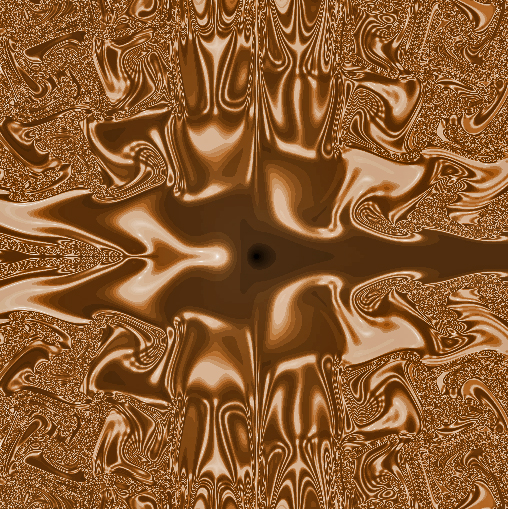
Here's a PU in case you haven't seen one before:
:cool: -
Thinking a (partial) function of age?But an old mathematician: if you're active, are you active in the same way on the same kinds of problems? Or different somehow? — tim wood
Getting your degree (a kind of union card) involves learning a little about various branches of mathematics as you begin to focus on a specific area of thought. It's a research degree, so you start along a particular path, forming relationships with others in your clique. I began this process a half century ago, and wrote and published a bit as I taught college math, until I retired in 2000. Then I moved into an unpopulated mathematical realm and started creating results for the pure enjoyment, posting notes on researchgate.
As I write this I have just solved another trivial problem I set for myself, concerning the convergence behavior of a path line in a time dependent vector space. I find I still am able to delve deep into a challenge, but when I was younger ideas came to me as I sat with pen and paper, while now I have to get up and move around to accomplish the same. And sometimes what I write must be corrected, since it doesn't correlate with what I am thinking! One has to accept this as a penalty for aging.
As for poetry, here's a line I wrote a while ago in response to the author of the thread on whether or not growing old is desirable - he said one gets "stupider": And so you pave your road ahead, a passage fraught with loathe and dread. :cool: -
Thinking a (partial) function of age?Do you notice any long-term trend or theme in your own life of thinking? — tim wood
At 83 I'm still able to engage in math research (of a sorts), but the aspect of thinking that I have noticed the most change in is an increasing inability to multi-task. I leave that to my wife who is ten years younger. :meh: -
Determinism, Reversibility, Decoherence and TransactionSo I opened an account at the bank with $100 at an imaginary 3.14% interest rate — Andrew M
With interest rates for savings where they are one might as well open an account with an imaginary rate. :worry: -
The tower of Babel of philosophyIt is a sad state of affairs if philosophy must remain in the hands of the academic professionals alone. — Jack Cummins
As a retired mathematician I was going to say that has happened in math, but then I did a Google search and found out that amateurs - depending on how you interpret that term - have made contributions to the subject in recent years. So, carry on amateur philosophers and good luck! :cool: -
Cosmology and DeterminismThis is the most sophisticated OP I've seen in the eleven months I've been here. It will be interesting to read the philosophical comments in reply. I'm curious about the images; where did they come from?
I see analogous phenomena in dynamical systems in : attracting fixed points and repelling fixed points, then there are indifferent fixed points that may combine the features of the two. I wonder if there are cosmological similarities of the latter? -
Determinism, Reversibility, Decoherence and TransactionIncidentally, what does QM have in common with a savings account? :cool: — jgill
This is not meant as a pun. Under stipulations that will make the Kid's eyes roll, there is a fundamental form or principle underlying the math of both. Start with a very simple version of Schrödinger's equation:
. Then get rid of that annoying Hamiltonian by stipulating . Now, writing this as a normal derivative, since x is held constant in the partial, .
Now, turn to a savings account with a yearly interest rate r (like r=.03) compounded n times per year. At the end of a year one has an amount under continuous compounding,
. Which is the solution to the differential equation, .
Underlying both DEs is the fundamental relationship: The instantaneous rate of change of something is proportional to the amount at that time. The first DE has the imaginary i in its "constant", and works its magic.
(I know, I've made a mess of the physics!) :gasp: -
Determinism, Reversibility, Decoherence and TransactionWhen I study elementary dynamical systems in C, I sometimes employ functions that "reverse iterate", and those systems show the time symmetry. Time dependent vector fields - like force fields that fluctuate - show symmetry occasionally. Here is an elementary and casual discussion of the subject.
Incidentally, what does QM have in common with a savings account? :cool: -
Thinking a (partial) function of age?Or alternatively, do we generally become wiser or more foolish - and is there anything instructive to be taken from the answer? — tim wood
There is no general answer. One can study a person over a long period of time and perhaps draw some sort of conclusion about that person, but there can be no inclusive reply. Your comment about seeing how the specific might be explained by the general sounds a little like math Category Theory, which has never been of value to me in the intellectual world of the nitty gritty. But I would guess a seasoned historian could perceive how small social struggles fit into a much larger picture.
Lots of room for rambling here. :smile: -
Determinism, Reversibility, Decoherence and TransactionCertain mathematical formulae or processes in physics show a symmetry in the time variable. How this relates to "going back in time" is a reasonable question.
-
Side Effects of The InternetIf somebody in PF is shown that his ideas in math are simply wrong, the typical response is that the member (usually a new one) simply insists that he or she is right. — ssu
:smile: :up: -
Determinism, Reversibility, Decoherence and TransactionIs making a measurement in QM and getting a specific result time reversible? How much of "time reversibility" might be artifacts of the mathematics that describe phenomena?
:chin: -
Determinism, Reversibility, Decoherence and TransactionIn how many different ways does the notion of "waves" appear in quantum theory?
-
Determinism, Reversibility, Decoherence and TransactionThe truth about reality is just too far removed . . . — Metaphysician Undercover
I suspect I will not understand the truth about reality when you reveal it, but I'll give it a try. :up: -
Determinism, Reversibility, Decoherence and TransactionA circle with an infinite radius is an incoherency. This is exactly the problem I am talking about, the faulty attempts by mathematicians to make circles compatible with straight lines. It necessarily results in incoherency. The logical thing to do when faced with this glaring incompatibility is to address the nature of reality, and attempt to determine the reason for that incompatibility, rather than to attempt to veil it, or cover it up with such incoherent principles. — Metaphysician Undercover
Go right ahead and spin your metaphysical web. Like the flock of sparrows now sitting on my fence, the peanut gallery awaits your penetrating views. :cool: -
Determinism, Reversibility, Decoherence and Transactionthe square and the circle, are fundamentally incompatible. — Metaphysician Undercover
Although topologically the same.
Straight lines can never be reconciled with curved lines — Metaphysician Undercover
I have done quite a few investigations into linear fractional transformations, and one feature that makes them important is they transform Circles into Circles, where the capital C is in recognition of the fact that a straight line is simply a circle with infinite radius. This has to do with the Riemann sphere.
It appears the rest of your post goes into the hyperreals, where others on TPF have greater competence. -
Determinism, Reversibility, Decoherence and TransactionAs intriguing as complex representations in physics, for me, is how linear operators are so effective. One would think nature to be complicated and non-linear; linearity is a very stringent condition, while simplifying the math. However, it is a seasoned trick in the profession to approximate the non-linear by linear constructs, and, of course, ordinary differentiation and integration are linear operators. The simplest of functions on C, such as f(z)=az+b, are - according to most definitions - non-linear, although f(x)=ax+b is a linear function on R since its graph is a line. The word linear has several interpretations depending on contexts. The elementary function f(z)=e^iz is non-linear.
-
Determinism, Reversibility, Decoherence and TransactionComplex numbers form a 2D vector space over the reals which is isomorphic to R2 (vectors take the form (Re(z), Im(z), adding real and imaginary parts works just the same as adding x and y components, it's why the plane representation of complex numbers works). — fdrake
This might trivialize C. Here's a quote from the web, from an educational perspective:
"Question.Is C isomorphic to R2? Answer.As a what? A field?Question (revised).Is the field C isomorphic to the fieldR2?Answer.NO! R2is not a field, it’s a vector space!Question (re-revised).Is the vector space C isomorphic to the vector space R2?Answer.That’s a good question! However, it is meaningless/misleading. A vector space isomorphism is only defined between two vector spaces over the same field. R2 is a two dimensional field over R and C is a one dimensional vector space over
I.2."
Elementary dynamical systems in C I have worked on would not have been possible in R2. -
Determinism, Reversibility, Decoherence and TransactionAs evident from the terminology which you use, (described in my reply to jgill above), your education was not in physics. Nor was mine, so we ought to be on par for any approach to this matter of physics — Metaphysician Undercover
It would help if this issue is clarified. -
Determinism, Reversibility, Decoherence and TransactionThat's nonsense, to say that a particle knows where it's going. Are you suggesting that the particle has a mind of its own? — Metaphysician Undercover
If a substantive thing, (massive object), is inclined toward temporal continuity (as inertia implies), yet "feels" a force which would impel that object to change, then there are two very distinct forces involved, the force to stay the same, and the force to change. If the object stays the same, despite feeling the force which would impel it to change, doesn't this appear to you like the object has made a choice, and exercised will power to prevent the force of change? — Metaphysician Undercover
jgill

Start FollowingSend a Message
- Other sites we like
- Social media
- Terms of Service
- Sign In
- Created with PlushForums
- © 2026 The Philosophy Forum