
Comments
-
Should A Men's Rights Movement Exist?As I said, men and women have issues that are particular to each sex, and developing a clear understanding of those issues is worthwhile. So a 'men's movement to understand men's issues' seems reasonable to me. But for most men and women, neither a feminist nor a masculinist movement is what is needed. What men and women need much more than several more identity-oriented rights movements is more clarity of what they need as working people.
Jobs, wages, working conditions, and job security are critical issues common to all working people. So is affordable and readily available medical care for both physical and psychological (including chemical dependency) illnesses. Adequate affordable housing, and quality education are basic needs. Permanent, stable, and healthy families are of equal importance to men and women. A healthy environment in which to work, live, and play is equally important to men and women.
These may seem like stale, old, irrelevant problems, but they are at the heart of life for both men and women. There aren't significantly different feminist or masculinist interests here: Both sexes have the same interests. -
Ecological Crisis; What Can Philosophy Do?Also, I appreciate you letting my generation off the hook. — Grre
You're welcome. It just isn't a generational issue. The Industrial Revolution started in the late 1700s. Everyone since then has either suffered and/or benefitted from industrialization. No one is guilty, everyone is responsible.
@Boethius is right about ecological theater. It's similar to the theater of safety performed at airports. Just because recycling one's cans and bottles isn't in itself going to save the world doesn't mean we should stop recycling. We can, we should, we must recycle. We should buy less stuff to start with. Of course, some cities have no recycling programs. Minneapolis has two recycling programs: combined stream recycling of plastic, paper, and metal (goes in one container) and kitchen and yard waste recycling (goes in a different container). These two recycling programs leave very little stuff to put into the garbage container.
Of course it will be impractical for many people to bicycle to work, because no provisions have been made to make bicycling safer, more convenient, and faster. It doesn't involve billions of dollars for cities to create bicycle lanes on streets, separate bicycle paths along disused railroads, and the like. With some adjustment, one can bicycle year round even in a city with cold weather like Minneapolis.
Look: IF we were serious about reducing our CO2 footprints, we would immediately sharply reduce the miles we drive. We would walk more, use bicycles, and take whatever public transit we could find. In the decades ahead, as oil becomes more expensive and the consequences of global warming start to bite deeper, we will have to abandon the private automobile, along with much else.
Had we taken global warming seriously in 1980, in the intervening 40 years we could have built a good deal of mass transit (rail, bus, trolley, bike ways, etc.). We didn't. So making these changes now is that much more urgent.
All that said, it is still necessary for major corporations and governments to make a 180º turn around.
How do you suggest The People hold corporate's feet to the fire? — Grre
Political campaigns are essential. "The People United are much more difficult to defeat." Who do you vote for? Are they or are they not committed to a human future? Boycott corporations who seem uninterested in change. Referenda and initiative campaigns. Support solar and wind power programs. Individuals have the responsibility of reducing their own consumption. That is and will continue to be true, no matter what else happens. Advocacy. Creating bad publicity for banks, politicians, and corporations who seem unresponsive to the threat of global warming.
Expect cooptation. Expect to see mass marketing of T-shirts with eco-slogans, buttons, all sorts of product tie-ins. Expect to see counter-campaigns by oil companies explaining how they are struggling to save the world. It's bullshit, and all that crap can be ignored.
PS. Thunberg's next planned global climate strike is planned for May 26. I'm mad that my schooling is done for the year and I'm no longer in high school, or I would have participated. — Grre
You mean, there is no way for you to plug into this action? Help is always needed to get these things off the ground, and wherever you live, there is a need for people to start organizing. Grow where you are planted.
By the way, expect to feel a sense of futility at times. Changing the direction the world is going is harder than making an aircraft carrier turn quickly. If saving the world were easy, it would have been done already.
How will it all work out? Gee, I don't know. I simultaneously harbor hope and doubt that you will be successful. (I use the plural "you" because I won't be around that much longer, given my age.) Your #1 enemy is inertia and contrary interests. A lot of wealth is tied up in coal, nuclear, and petroleum, and people (being what we are) are not just going to let their investments evaporate if they can help it.
James Howard Kunstler The Long Emergency: Surviving the End of Oil, Climate Change, and Other Converging Catastrophes of the Twenty-First Century Kunstler doesn't offer some magic solution that will enable clever people to escape the problem. As he says in another book: "Too Much Magic: Wishful Thinking, Technology, and the Fate of the Nation".
Kunstler offers good, solid, and punchy information about peak oil, CO2, methane, etc. -
Should A Men's Rights Movement Exist?Men have interests unique to their sex, just as women do. Men and women have a lot of interests in common, which should at least sometimes override sex-difference-interests. If not a men's "rights' movement, a lot of men would, I think, benefit from a men's movement directed toward sex-role excellence--that is, finding better models among men to emulate.
-
Ecological Crisis; What Can Philosophy Do?Yes. Like, if you have two feet, use them whenever possible. I realize that many people live in pedestrian no-man lands, where travel on foot is just not safe, and biking is probably even unsafer. Then too, a lot of people do not live near a bus or rapid transit line of any sort. But, many people do. A lot of people dislike riding on buses. I don't drive, I have to use buses, and I find them to be loathsome some times. So I get that. But if we want mass transit, we have to use it when feasible (else demand won't exist).
There are days when an isolated yurt sounds like just the thing.
When I am out biking around the city on weekends, I find that there are few people on the street. Few people walking, except for dog walkers, a few runners, a few other bicyclists. No adults, no children. It's just not the sign of a healthy society -- people should be more active, be able to walk a mile to the store and back. Like, actually walk 3 blocks to the drug store. Instead, they drive.
One of the consequences of past-the-peak-oil and the need to reduce CO2 emissions, is that people in cities will have to use their own internal bio-drives to do stuff. Then they won't have to drive to the gym to exercise. -
Ecological Crisis; What Can Philosophy Do?Some analysts have said that the opportunity to avoid the present crisis of global warming passed sometime around 1990--30 years ago. How so?
Evidence that accumulating greenhouse gases could lead to global warming began to converge in the 1970s. Various streams of data, from satellites to cores extracted from the ocean floors and glaciers formed the basis of more specific predictions and the development of better climate models. The decade of the 1980s was THE TIME when climate change should have been taken seriously and should have been acted upon.
THEY missed the boat. By 2006 when Al Gore's An Inconvenient Truth was published, 26 years had passed. Since 2006, another 13 years have passed. Had THEY acted on the basis of early creditable information, we would have had 40 years in which to reduce dependence on fossil fuels.
So, who are THEY? Energy corporations like Exxon, Shell, BP, etc.; auto makers; elected officials; oil and coal producers, et cetera. THEY are the people who own, manufacture, process, and sell energy, transportation, plastics, chemicals, and so forth. They, and governments, were the critical institutions that acted to continue business as usual, or failed to act to prevent ecological damage.
We the people are relevant as part of the solution, but in times of crisis (such as World War II or climate change) it is the major industrial giants that have to be mobilized first. This wasn't done; it isn't being done.
Some US states are undertaking some of the policy changes now that should have been undertaken 40 years ago. An example is "30% of electricity from renewable sources by 2030". "30% in 2030" projects are good (if they are achieved or exceeded), but they don't address transportation and heating exhaust which are huge sources of CO2 emissions.
The best role for The People is to keep the political and corporate feet to the fire -- as the expression goes. In the meantime, The People should start walking, bicycling, and using mass transit. -
Climate Change vs Population GrowthEducate women — frank
Yes. That has been demonstrated many times that educated women bear fewer children. -
Climate Change vs Population GrowthYes; affluent people reproduce less than poor people. Why, exactly, isn't clear. Maybe affluent people are too busy earning affluent incomes to raise children. Maybe affluent people would rather be affluent than spending hundreds of thousands of euros on children. Maybe child survival rates are so high that 1 child is enough. Maybe sophisticated European metrosexuals just can't be bothered. Europe's population rate is below replacement levels which is a good thing in terms of ZPG, but is very bad for the economy. After all, somebody has to work in the factories, distribution centers, transportation, hospitals, nursing homes, farms, etc. Therefore, immigrant labor is necessary. Fortunately for affluent people in Europe, North America and parts of Asia there are plenty of inexpensive laborers available.
I'm not knocking immigration here (I do that elsewhere). I'm just pointing out that the virtue of low birth rates here and there is limited, because the population of laborers is still needed by affluent people to maintain affluence. -
Climate Change vs Population GrowthProjections of population growth may not be realized. Global warming is likely to have significant effects on food production, disease rates, available water for drinking and agriculture (and industry), reproduction, and so on. Worse for everyone concerned, 2070 will be another 50 years past peak oil. The whole world will be very hungry for that dense energy source. The greening of the Sahara, never mind stopping the progression of desertification on the southern edge of the Sahara, is not something we will be able to engineer.
Are you familiar with the "wet bulb" measurement? It references how fast moisture evaporates at given temperatures and humidity. Human beings can not survive outside when the wet bulb temperature is above 98. [>98º + high humidity] Why? Because our sweat doesn't evaporate, we can't cool off, and our internal temperature starts to rise, and we go into heat shock and die. A high wet bulb temperature means that much less time outdoors is available for agricultural work, hence less food production. Who will be affected? Everyone in tropical and sub-tropical areas, including the southern US. -
Climate Change vs Population GrowthDon't worry about population. Mother Nature has the requisite ways and means to lower the population to sustainable levels. Just hope you're not around when she does it.
-
The right to dieWhere the question of a "right to die" comes to the fore is when someone wishes to end their own life, but is not physically able to do so independently. Is it permissible to help someone die?
If one is ambulatory and isn't overly fussy about how one might die, it would seem like the "right to die" is inherent--not relying on the action of a state. If I decide to jump off a bridge, or wade into deep water, or fill the garage with carbon monoxide, or blow my brains to smithereens, what does the state have to do with it?
That said, I am in favor of discouraging people from committing suicide, rather than enthusiastically encouraging the suicidal. -
Is the writer an artist?I read a lot, and I can fairly report that there are many fine examples of pure, unadulterated slop out there. Awful stuff. Just wretched. And some of it sells well and receives appreciative reviews. There is also a lot of excellent work, too.
I pay little attention to literary prizes, whether it's from the Nobel, Pulitzer, Booker, or What Have You Committee. When one goes back and reads prize-winning novels from 60 or 80 years ago, many of them do not seem very interesting. Music doesn't seem to suffer from this problem.
The best bet for identifying what kind of writing is really good is to take a look at what people are actually reading, looking at, watching, and listening to.
400 years later, people still read or watch Shakespeare, and still listen to Monteverdi. There are a lot of people still reading Jane Austen and George Elliot 140 years later.
How many of these best selling authors from 1933 do you recognize?
Hervey Allen, Hasty Carroll, Sinclair Lewis, Lloyd C. Douglas, John Galsworthy, Lloyd C. Douglas, Mazo e la Roche, Bess Streeter Aldrich, Louis Bromfield, Hans Fallada? Zero? One? Two?
How about these 21st Century Nobel winners?
Kazuo Ishiguro Remains of the Day was clearly recognizable as a novel.
Bob Dylan Dylan's poetry (at least from his early years) deserves some sort of prize; Nobel? Well, it's their money; they can give it to whoever they want, I suppose. They didn't give him a prize for singing, you'll notice.
Svetlana Alexievich
Patrick Modiano Started a recent novel by Modiano and dropped it. Tedious.
Alice Munro I've liked some of her writing,
Mo Yan
Tomas Tranströmer
Mario Vargas Llosa
Herta Müller
Jean-Marie Gustave Le Clézio
Doris Lessing
Orhan Pamuk
Harold Pinter
Elfriede Jelinek
John Maxwell Coetzee
Imre Kertész -
.Its impact on intellectual pursuits and on innovation is especially hindering. — whollyrolling
I don't know whether adhesive elites sticking together has hindered intellectual pursuit or not. I don't know how one could tell. It seems more likely that elites have not hindered practical innovation because the nuts and bolts of agriculture, manufacturing, transportation, distribution, etc. have never been of much interest to the elites.
"Engineering" wasn't respectable until relatively recently. The savants in the universities were not aware of Marx's insight that changes in the means of production (in its broadest sense) determines what is possible intellectually. That's related to Plato's concern that the wrong kind of music would disturb society's peace and progress.
War and finance, and sometimes art, have at least been dependent on "common people". — whollyrolling
Quite a lot has been dependent on us proles, when you get right down to it. The pampered elites wouldn't have been pampered if they hadn't been able to hire cheap help to make their lives comfortable.
Workers of the world, UNITE! You have nothing to lose but your chains, and a world to gain. Karl Marx
Marx was hardly a member of the elite. -
.I propose that all "philosophy" has hitherto been an evolution of specialized language predicated on fortifying a master-slave relationship between the educated and the uneducated. — whollyrolling
Dear me! Whollyrolling. Sweeping up all "philosophy" into one master/slave pile calls for an extended defense. Your OP should have been much, much longer, because extraordinary claims require extraordinary evidence.
Try putting this into a broader context. Don't all power elites (academic, financial, military, artistic, etc.) all tend to separate themselves out from the lumpen mass, associate among themselves, and promote their particular interests?
They were all born into affluent families and received "higher education" that was expensive and unavailable to a vast majority of people at the time. — whollyrolling
You are right -- the education which famous philosophers received was a luxury service. It still is. Roughly a third of the US population has a college degree, but these are not elite degrees by any stretch of the imagination, and two thirds of the US population lacks even a pedestrian degree.
Elite fields -- literature and philosophy are similar -- are the domain of small coteries of people. Being a member of a 'coterie' usually involves being at least financially comfortable. It involves traveling in rather small circles of specialists. Some elite thinkers have managed to remain comfortable. Marx was a downward-mobility disgrace to his bourgeois forebears. He ended up on private welfare sponsored by Fred Engels. But even that is usually the luck of elites. Most people, however bright and needy they are, don't get underwriting.
Like me, for instance. Had I been underwritten by some rich fan, I might have been somewhat more intellectually productive. Or, maybe I would have spent more time drinking, screwing, and other forms of decadence. Marx seems to have done a fair amount of that sort of thing. Of course, he also managed to turn out Das Kapital and a few other items. -
There Are No Facts. Only Opinions. .Few, however, would seriously maintain that the universe actually revolves around them in the way that the earth revolves around the sun. — NKBJ
My guess (and hope) is that people mean "the universe seems to revolve around them", from their slightly skewed perspective. -
There Are No Facts. Only Opinions. .That humans are self-centred has been demonstrated for thousands of years and i we have yet to demonstrate otherwise. — whollyrolling
It seems to me to be the case that human are self-centered. Of course, that isn't all we are all the time. But creatures with egos like their reflections. In a way, most creatures are self-centered. Their various lives are composed of efforts to survive and propagate. Survival and propagation require a narrow focus. -
There Are No Facts. Only Opinions. .Philosophy, as I see it, is a bunch of brains thinking about their brains. — YuZhonglu
Maybe a bunch of brains thinking about other brains?
That is one of the basic questions: What can I know? Like... Am I real? Are you real? Are our perceptions of what we call 'reality' consistent with what 'reality' actually is? (It often is, but sometimes it is not.) How would we know, one way or the other? -
The poor and Capitalism?Socialism requires a high degree of micromanaging of the people by a government system. Usually, this results in starvation, corruption, and brutal violence as seen throughout the world in nations that embraced actual socialism. Removing the property from the "rich" essentially takes away from the working class. — Waya
And what do you think corporations are doing if not micromanaging people in a corporate system?
Believe me, I know this. I have a jerk for a boss who is sexist against women and pays me well below the living wage for my area. — Waya
So your boss is a jerk, he doesn't pay you enough, and this is the government's fault?
Why don't you keep the blame where you laid it: on your boss's doorstep? He's the one deciding to underpay you and maybe harass you to boot.
For some odd reason unknown to me you would prefer to blame non-existent socialism for your problems instead of a harsh, capitalist system which doesn't give a shit about you. -
The poor and Capitalism?Hey, I'm dirt poor almost to the point where I wonder if I will get another meal and still dead set against socialism and Karl Marx. He speaks for an elite class that takes from the poor and manipulates them into slaves for such a class. — Waya
You accidentally confused capitalism with socialism. It's the capitalists who are the elite class that takes from the poor.
Socialist position: No need for slaves; no room for masters. -
There Are No Facts. Only Opinions. ."Everyone is entitled to their own opinions. They are not entitled to their own facts."
Is "There Are No Facts. Only Opinions." a fact or an opinion?
A "fact" is information that is verified by experience; not just one person's informed experience, but everyone's informed experience. Opinions are judgements about facts.
The opinion that there are no facts, only opinions, is an invitation to chase rabbits (Alice In Wonderland) where there are no facts. -
Philosopher Roger Scruton Has Been Sacked for Islamophobia and AntisemitismI'm glad to see this forum's owner is more balanced than that. — Judaka
The TPF owner is on a lithium drip, so he's very balanced. -
Philosopher Roger Scruton Has Been Sacked for Islamophobia and AntisemitismSo what part of
many of the Budapest intelligentsia are Jewish, and form part of the extensive networks around the Soros Empire — Maw
is antisemitic? That Jews are part of the intelligentsia, or that they form a network? That they are in Budapest? That they are associated with the "Soros Empire"? Can't Soros have an empire?
Would we say that "many of the Budapest intelligentsia are [GAY], [ENGLISH], [CHINESE], and form part of the extensive networks around the Soros Empire" is homophobic, anglophobic, or sinophobic? -
Philosopher Roger Scruton Has Been Sacked for Islamophobia and AntisemitismI've done nothing different than most here habitually do — sunknight
Sunknight: Best Practice is to proceed forward cautiously until you have established what you can get away with and what the moderators will stomp on. Like all members here, the moderators have uniquely sensitive corns on their toes which, when stepped on just so, send them into tizzies. As far as I know, the idiosyncrasies of the moderators' sensitive toes have not been mapped.
Generally 'slash and burn' approaches will get bad feedback. Try to avoid.
It is the case that if you want to disparage Islam, transgenders, gays, (anybody, basically, to whom the suffix "phobia" is regularly attached) you should do so in an unusually elegant fashion. -
Ethical conundrum: is obesity a form of self-harm?Calories in the form of sugars and fats have never been cheaper, and as a result obesity is a global problem. Welcome toThe Fat Earth Society.
The solution is simple. Stop eating, fast until the weight is normal. — Jonmel
Sorry, that is simply not true.
Some people get fat as an act of self harm, but this is a small minority. Most people get fat, and become obese because their calorie intake exceeds their calories expended. Age, lifestyle changes, living situations, and various other factors can affect this.
I was slim and fit till I was about 45. Then I changed from a fairly active job to a sedentary one, and started gaining weight--slowly. By the time I was 60 I was beginning to approach obesity, and since then I haven't been able to lower my weight by more than 3% to 6%. At 72, the chances of losing a significant amount of weight are about nil. What I can do, and do work towards, is a reasonable level of activity to stay reasonably flexible and strong.
Much worse than fat 50 year olds are fat 10 or 15 year olds who are clinically obese. I wouldn't blame them for being obese; I'd blame low quality food and a repellent outdoor physical and social environments. -
Religious Commitment: Decline of ReligionsReligious activity is strong and growing in some places, and shrinking in others. Christianity, for instance, is quite strong in China, Africa, and South America. In Europe it is quite diminished. North America is somewhere between active and shrinking; here it depends on whether one is counting mainline protestants, catholics, or evangelicals.
I would guess some kind of similar pattern prevails for Islam.
It is waaaay too early to announce the death of religion. 6 billion out of 7 billion people participate in some kind of religious activity/organization. 1 billion, at least, do not.
I am of a mixed mind as to whether or not we would be better off with a good deal less religion. If strong, positive, secular and civil values replaced religion, that would be fine. If religion is going to be replaced by fascism, or blind faith, or aggressive dehumanizing conversions, then no. -
Is Modern Entertainment Too Distracting?Yes, but it was people in the past like Duchamp in 1917 who made it possible for people in the internet age to call their crap "art". As William Faulkner said (in a novel I never read, and almost certainly never will) "The past is never dead. It's not even past."
-
Is Modern Entertainment Too Distracting?
Now this is something that I call the critical reviewer's disease. — ssu
Yes, there are definitely people who spend a lot of time consuming voluminous quantities of cultural product, and in so doing they enter a twilight zone of hypersensitivity to stuff that actually doesn't matter much--this first novel, that rap group's greatest hit, this book of poetry, that journaling project, the latest recording of Beethoven's 9th, blah blah blah. I flee when they begin pontificating about this or that art form, art group, art event, artistic clusterfuck, etc.
Nothing new here, of course. Coteries of sophisticates have been doing this for a long time -- probably there were cultural critics who had tedious opinions about the latest cave art before the paint had dried.
Culture hasn't gotten better, I don't think -- just more of it, more specialized, more diverse, shorter shelf life -- all that -- but the media of radio, television, internet, recording devices, etc have enlarged the hose, and one can drown in the flood instead of just getting a drink (see "drinking from a fire hose").
Print isn't immune. There is more and more print available too -- not just new print, but old print served up by archival projects. I read too much which leads to too much information that other people do not want to hear about. Sigh.
People have not changed. They like to be entertained. There are more people now (three times as many in the world as when rock and roll began (1950s), and there is much more cultural activity now than 70 years ago. There is also more economic activity: more mining and manufacturing, more sex being had, more crooked deals getting done, and more rubbish -- much more. -
Is Modern Entertainment Too Distracting?Today ANYONE can produce art and put it into the public sphere whereas merely decades ago this wasn’t the case — I like sushi
1917 - Too far back?
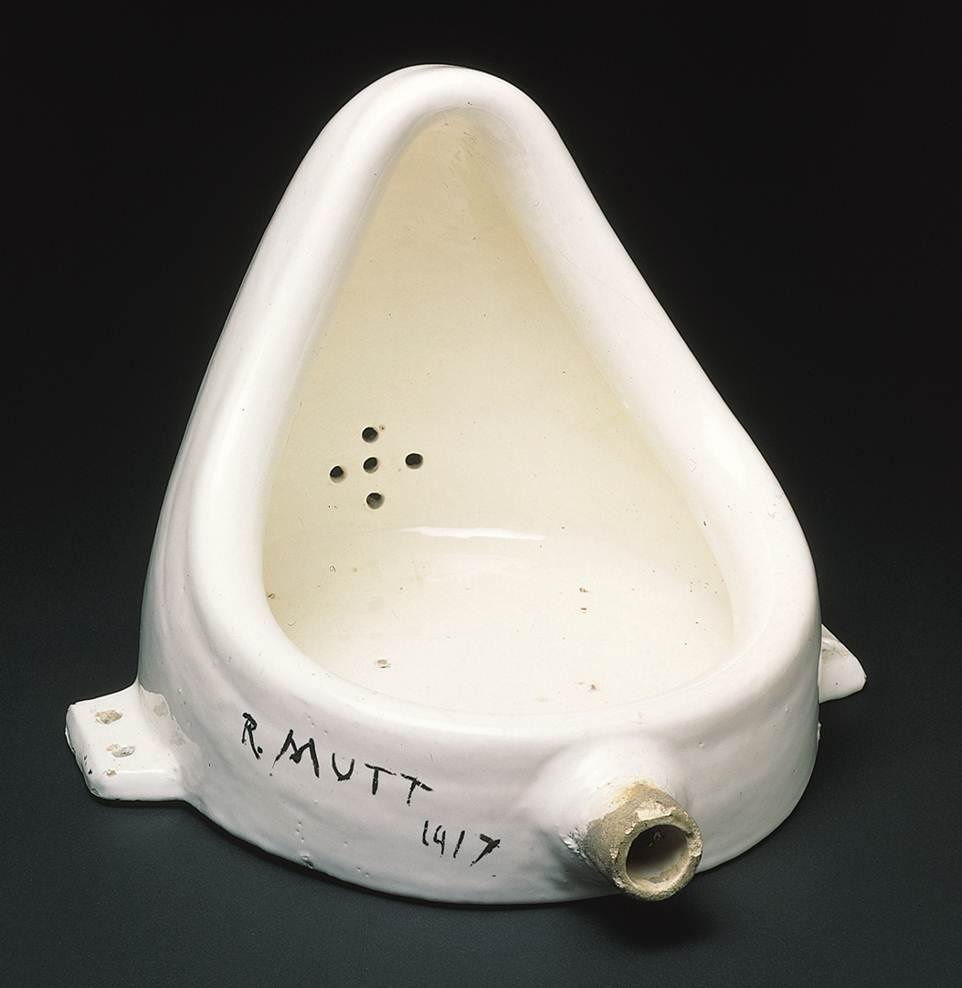
Duchamp announced that if you say it is art, then it is art. -
On intentionality and moreI suppose buckets of "warm slop" could be construed as sexual innuendo, though -- just personally -- it wouldn't do much to turn me on. But tastes vary. The intentionality would matter a great deal.
Mostly though, I associate "slop" with hogs wallowing. Nothing sexual, just wallowing, snorting, grunting. What hogs do in wallowing holes.
Have you observed hogs doing their wallowing thing? They take it very seriously. Usually in the summer.
"Slop" is also a verb. "To slop the hogs" is to feed them their daily ration of ground corn mixed with other feeds and water or milk and dumped into troughs, where the hogs act like the pigs swine are. -
Grammar or creativity?They can't be standards.
In my opinion, there are no standards for poetry. — Tarun
There are, of course, standards. One standard is how well the construction of the poem fits the topic. Another would be originality of expression. A third is how well the techniques of using language are deployed. and so on.
Another standard, the toughest one, is whether anybody remembers and re-reads or recites the poem. Most of the poetry that has been written has been buried because nobody found it particularly memorable. That has been the case for millennia.
If you don't believe there are standards, you probably need a large dose of Onomatopoeia. -
Grammar or creativity?To use the technical term for it, thinking that poetry can't be measured, guiding the creativity, gives a shape to creativity, etc. is bullshit.
Look, poetry isn't mystic mastication. It's a form of composition which requires sticking to rules and regulations--even in free verse.
Haiku, for instance, involves 3 lines of five syllables, 7syllables, and 5 again. They could rhyme or not. What haiku is like in Japanese, I don't know. But those are the simple rules in English haiku. If you don't follow those rules, then it isn't haiku.
If you are writing a poem in heroic couplets, it must be in iambic pentamer, and the couplets have to rhyme. Those are the rules for that style.
Of course you don't have to write that way. You could write like Bob Dylan -- I certainly would if I were very, very talented.
Subterranean Homesick Blues
Bob Dylan
Johnny's in the basement
Mixing up the medicine
I'm on the pavement
Thinking about the government
The man in the trench coat
Badge out, laid off
Says he's got a bad cough
Wants to get it paid off
and so on. There is a meter and a rhyme scheme. The grammar is pretty straightforward.
My guess is that Dylan didn't just dash those lines off, stand up, and sing them. The stuff of his that I am familiar with look polished--meaning, worked on a lot.
If you want to write poetry, start with straightforward grammar. Learn how to maintain a beat of emphasized syllables, and how to rhyme. Try, at least. Go on from there. Learn something about the basic forms.
I don't know whether you have a creative bone in your body or not. There is nothing about poetry (or anything else) that makes one creative. Creativity is mostly the result of striving to achieve beauty, and is mostly hard work.
Here's a sample of heroic couplet verse by Alexander Pope:
Together let us beat this ample field,
Try what the open, what the covert yield;
The latent tracts, the giddy heights explore
Of all who blindly creep, or sightless soar;
Eye Nature's walks, shoot folly as it flies,
And catch the manners living as they rise;
Laugh where we must, be candid where we can;
But vindicate the ways of God to man.

-
Who is the owner of this forum...The impression I had of Sapientia (AKA "S") was that he was a prodigious producer of proper and prudent prose. So... what happened?
-
Violent Criminals And Australian ManhoodI don't know, Ilya; do you some screws loose?
Look: About those criminals who founded Australia: "Between 1788 and 1868, about 162,000 convicts were transported from Britain to various penal colonies in Australia. The British Government began transporting convicts overseas to American colonies in the early 17th century."
The 17th-19th century British were not averse to using capitol punishment for crimes (like stealing) which they thought deserved death. If one could get hanged for stealing bread, then there probably weren't a lot of violent felons left to deport to Australia. So, who were they deporting to America and Australia?
They were mostly deporting poor people, whom they classified as white trash, deplorables (term from Hilary Clinton's campaign), riff raff, useless, and so forth. The ruling-class Brits hated the poor. Poverty was criminalized. Criminals were deported.
Why is this so? Most likely because the first white people in Australia were violent criminals, and violent criminals aren't known for being gentlemen. And what Australian men need to be told is this: — Ilya B Shambat
Most likely you are out in left field on the topic. Are you supposing that in the intervening centuries, the poor people who were used to stock the future working class of Australia did not change at all from their uncouth ancestors? Or maybe you don't like the Working Class either?
there are any number of Australian men howling for my blood and that of the Australian woman who married me. — Ilya B Shambat
This sounds more like an exaggerated self-aggrandizing persecution complex than anything else. How close on your trail is the mob that wants to lynch you?
In Australia, where I presently live, the biggest problem is how men treat women. There are many good things about Australia, but this is a national disgrace. The Australian men have an international reputation for abusive treatment of women; and that makes Australian men look like creeps. — Ilya B Shambat
I always thought Australian guys looked hot, rather than looking like creeps, but that was probably a small sample I was looking at. Is it really the case that male-female interaction is the worst problem Australia faces?
Are Australian men worse really worse than African men, North American men, European men, South American men, Asian men, Arab men, Pakistani men, etc.?
When my former wife left me to be with another man, I did not threaten to kill her — Ilya B Shambat
That's good. It's a positive sign.
which country, in other respects, is one of the best places in the world — Ilya B Shambat
If it is one of the best places in the world, in other respects, then I would have to assume that women are receiving less than than the usual and customary level of abuse. -
On intentionality and moreDisclaimer: The following is written with the intent of making vague, positive-sounding non-inferential remarks about a topic of which 9/10ths is floating on the surface as foam. I wish to figuratively dump a couple bucketloads of warm slop on you, in the event that your wallowing hole is cooling off. I don't want you to get a chill.
Communication between people (don't know about other species) has always been difficult because...
Sometimes people have mixed motives. Sometimes people are not clear about their own intent. Other people can be difficult to interpret. The signs and signals of language are not always clear -- even face to face. Sometimes we are not clear receivers of messages. We sometimes harbor suspicions, hopes, fears, doubts, erroneous thinking, and so on, which can make it difficult for us to gauge the intent of an innocuous "Good morning."
Certainly, some people in internet chat or lengthier discussion formats intend to irritate others, write abusive, dismissive, crude comments, and so forth. Stupid people are able to use the internet, their stupidity notwithstanding. Some people are short-fused and explode with little provocation.
Despite all that, most of the time people in a Internet format like TPF manage to communicate in two directions successfully, with a minimum of friction. [The minimum of friction still involves at least some friction.] One of the ways we achieve this smooth, low-friction mode of interaction is through the good offices of our own little gestapito which liquidates offenders swiftly, if sometimes arbitrarily. We have to assume that our gain is other fora's loss. Those expelled from Paradise no doubt migrate to other sites of philosophical interaction where they spray their hot bile all over unsuspecting (but perhaps deserving) subjects. -
The military industrial complex and the economyMy question is this: Should such a large part of the economy really rely on military technology production and maintenance. — christian2017
No.
The military doesn't submit bids for products from reluctant manufacturers. Companies are anxious to participate in military production because it has traditionally been quite profitable. And the manufacturers are not silent partners. Building the technological capacity for modern war is a very cooperative effort between the military and industry.
The logic of having weapons, and getting paid to make more weapons, is a strong inducement to eventually use those weapons on an old or new enemy. Vietnam, Iraq, and Afghanistan were / are our new-enemy wars. Other countries have done the same thing elsewhere. A tremendous amount of product was used in these three wars, to no particular good effect. In a way, results don't matter. The important thing is to drop the bombs, launch the missiles, fire the bullets, etc.
There is a revolving door relationship among corporations, the military, and lobbyists. The result is more spending on arms.
I'm not claiming that our military is useless or harmful to the US (that's another argument altogether). What are harmful are the vested interests of arms manufacturing corporations steering national policy. This is largely (but not entirely) a post WW-II phenomena. -
On Psychologizingeveryone else should be taken out back and shot — S
As the saying goes, "spare the bullet and then you have to put up with dipshits that much longer."

BC

Start FollowingSend a Message
- Other sites we like
- Social media
- Terms of Service
- Sign In
- Created with PlushForums
- © 2026 The Philosophy Forum