
-
Thoughts on EpistemologySO add a time and place, if you like — Banno
Yes. You can keep adding displacement. As much as you want. But that doesn't absolve you of the need to account for that machinery of displacement. Your anti-Cartesianism still misses the point. -
Thoughts on EpistemologySaying that the cat is on the chair and saying that "the cat is on the chair" is true amount to much the same thing. — Banno
Except that one is a spatiotemporal occurrence and the other is a timeless assertion. Janus tried to point that out.
There is a gap - or epistemic cut - that epistemology still needs to account for. The fact of a displacement in terms of our ontic commitments is the epistemic feature and not the metaphysical bug.
So trying to collapse that - as in attacking the Kantian dualism of scheme and content - is philosophically obtuse. -
Thoughts on EpistemologyAs Wittgenstein responded to his own question of whether he was really just a "behaviourist in disguise" and whether, for him, "everything except human behaviour is a fiction", he said, "If I do speak of a fiction, then it is of a grammatical fiction." — Luke
Again, the complaint I have here is that it fails to distinguish grades of semiosis or "grammatical" structure.
So yes, you can look to behaviour as speaking to what is truly believed. That is the turn from Kantian cognitivism to a Pragmatic enactivism or embodied cognition - a Peircean sign relation with the world. We betray our beliefs in our actions.
However the human mind has a double structure. It is structured both at a basic animal/neural level, and then that is elaborated on by a social/linguistic level of semiosis. So there is a neural code and speech code in play.
Semiosis is then about how codes in general are about constructing useful "fictions". Both our neurology and our sociology want to reduce reality - the noumenal - to the phenomenal, an umwelt. We want a reality that is a play of interpreted signs. We want a view of the world that is not of the world in itself, but a view of our selves in a world that has an intelligible structure.
So there is a general semiotic logic at work which founds any notion of what counts as truth. And the component that is generally neglected is indeed - where Wittgenstein is correct - that the truth is the truth that is this view of a world within which we exist.
The rub is that this "we" is a construct. And not just a social/verbal construct, but also a biological/neural construct. And so there is a double "grammatical fiction", a layered "grammatical fiction", at the centre of any theory of truth debate.
That is what I have consistently argued. But most folk seem attracted to Wittgenstein because he seems to promise an end to exactly that kind of complex analysis.
Peirce is "too difficult", "too tricksy". Give us quietism and an end to metaphysics. Let us just slay Descartes and Kant and not worry about what more sophisticated epistemology has to replace them. Let us just return to our dogmatic slumbers and dreams of naive realism. -
Follow up to Beautiful ThingsWell, I think the answer is "sort of." Probably no particular thing is universally beautiful. The things I consider beautiful are personal. — T Clark
You can see something physical at the heart of aesthetic judgements - natural properties like symmetry, balance, and economy of effort. So there are objective properties that appeal.
I would guess that is because our brains evolved to be pattern recognisers. We need to zero in on what is the most general condition of our world so as to appreciate what is then the particular or often, the wrong, the blemished, the marred, the imperfect.
I would add straight away that the brain also evolved to make good mate choices, to find good food, etc. So that would also play into our aesthetic responses.
But we can see a circle or square as beautiful in being highly symmetric. Or more naturally, our eye is drawn to geometries that speak to perfectly balanced growth and elaboration.
So why is the golden rectangle perhaps more appealing than the ultra-simplicity of a square. Is it because the eye can see the universal growth ratio inherent in it?
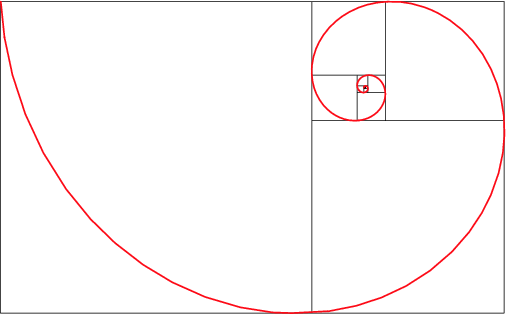
And why the appeal of mountains, surf, trees? Again what we likely appreciate is the perfect balance represented by fractal self-similiarity - a scale symmetry.
That's not the whole story of aesthetic judgements, but it seems the most objective part of our evolved responses. We have an eye for natural perfection as that then is what allows us to see its imperfections. The imperfect perceptually pops-out once we have a baseline ability to recognise the perfectly freely growing or elaborating complexity that defines a natural balance.
Then there is a more subjective slant on the same general neurocognitive imperative - to make the world easy to read at a glance.
We like compositions that are balanced in their familiarity and surprise. Again, it is about the Gestalt need to balance figure with ground, event with context, so that the world is felt to be intelligible and yet not dull. We want a work of art to reward us both in being deeply familiar and deeply unfamiliar. And the ratio might be that of the golden rectangle or logarithmic growth. So a spicy dash of surprise at every level while also a healthy base of confirmation of what we reasonably expect.
It is not hard to see how this applies in all aesthetic ventures from an oil painting, to music, to great cooking or a nicely furnished room. There is some ratio of the familiar to the surprising that meets the subjective preferences of a mind that wants to be able to safely predict its world and yet still be always learning, or steadily growing and expanding its range of experience itself.
So aesthetics could be explained ecologically by the needs of our brain to see through to the essential baseline structure of the world. The world is objectively what it is due to the nature of growth as a "mathematical" process itself. And then subjectively - to be good at building a model of the world - we need a psychological architecture that is also based on open-ended growth. That is how we can develop a good fit. We seek to find a good balance between habit and attention, between familiarity and surprise, in every moment.
So every aesthetic object or image should "test" our responses in that fashion. They should contain a brain-suitable balance of predictability and surprisal. There will be a ratio of the two that feels the most informational or meaningful.
Phi, or the golden ratio - 1.618... - could be the right number. Here is someone who suggests that: https://plus.maths.org/content/golden-ratio-and-aesthetics
There's a ton of psychological studies on preferences for complex stimuli, but I can't recall there being some magic number being identified. You tend to get general comments about a U curve, but not some special value.
The relationship between the complexity of a stimulus and its perceived beauty has been a topic of great interest with influential studies since the earlier experimental investigations of aesthetics. For instance, Berlyne showed that complexity is a dominant determinant of interestingness and pleasingness of a stimulus (Berlyne, 1963; Berlyne et al., 1968). Berlyne (1971) suggested that the relationship between complexity and pleasingness could be explained by an inverted U-curve, where the stimuli with intermediate levels of complexity are the most preferable ones. This concept of an optimal amount of stimulus complexity has been supported by numerous studies that found an inverted U-curve when characterizing aesthetic preference as a function of complexity (Vitz, 1966; Berlyne, 1971; Saklofske, 1975; Farley and Weinstock, 1980; Imamoglu, 2000).
https://www.ncbi.nlm.nih.gov/pmc/articles/PMC4796011/
This is probably because it is hard to get people exactly matched in their life experiences. We all might have a similar brain design, but also would all find somewhat different things surprising or familiar.
Plus the world itself is varied as an environment. All of nature might be fractal in its growth, but the slope of that line can be very different. A flat sea and a mountainous sea are both fractal, yet also at opposite ends of the spectrum in terms of beautiful monotony and spectacular excitement. -
Science is just a re-branding of logicWhen you go to the seaside, do your encounter a beach as well as the grains of sand?
Think about how you would naturally reply if a friend asked where you went at the weekend. -
Science is just a re-branding of logicWhat, the world isn’t structured by categorical relations? The notion of generals and particulars fails the test of naturalness? We are merely imagining that reality is organised hierarchically?
I find that hard to believe. -
Thoughts on EpistemologyInterpretation is moving from one language to another, yes? — Banno
Huh? That would be interpreting two different languages. And that could well involve the construction of a different sense of being a speaker to speak like a native.
How does interpretation work when we are both speaking English? — Banno
We would both share some point of view - enough of one so that the personal differences or personal quirks did not feel like they make an important difference. We would share the cultural identity involved. We would be the kinds of selves that entails.
And now can you address the questions I've asked of you repeatedly. It is boring dealing with these trivialities you post as replies. -
Thoughts on EpistemologyI've got no idea what an absolutely public language might be. — Banno
One where everyone shares the exact same interpretations with no personal nuance.
But even if you shout "fire", there's always going to be a few wondering what that could mean. -
Thoughts on EpistemologyDo as your professors advise then. Read the paper, put it into your own words, then I will grade you.
Or this search gives you 130 hits to explore.
https://thephilosophyforum.com/search?Search=epistemic+cut&expand=yes&child=&forums=&or=Relevance&mem=&tag=&date=All&Checkboxes%5B0%5D=titles&Checkboxes%5B1%5D=WithReplies&Checkboxes%5B2%5D=child&user=apokrisis&pg=p2 -
Thoughts on EpistemologyI use it like Pattee. I learnt if from him directly. But if I see you making an effort, of course I would help explain anything you might not understand or disagree with.
-
Thoughts on EpistemologyOnce more. Please answer the direct question.
The corollary was that public language is equally a matter of degree. Are you wanting to say there can be no absolutely public language? -
Thoughts on EpistemologyYou do not have to be here. — Banno
Still hoping to be in control of the discursive boundaries? Make this a safe space for that guy Banno? Remove the possibility of his authority being challenged?
But you enjoy this. — Banno
Of course. I love the immense variety of life. And without the irritation, it is easy to get lazy. -
Thoughts on EpistemologyAs I said, we would use the resources of the communal language, but would be free to create private words.
And what is more germane to my original argument - which was about the advantage of a pragmatic theory of truth - is that I am focused on the issue of the speaker doing the speaking. Who is this person really? Is s/he a social construct or is s/he a neurobiological individual?
There is both a division and a division that is not clearcut - relative and dichotomous rather than dualistic and absolute.
So I am focused on what it could even mean to be private - in any sense. Or public, in any sense. I am highlighting the fact that language - as semiosis or a triadic sign relation - has to make the I-ness that both speaks and appears to understand the speaking in right fashion. The production of actual language speaks to the successful production of the I-ness that we associate with "being a speaker expressing meanings".
Banno wants to talk about Davidson and that whole edifice of flanneling built on the possibility/impossibility of translation. This is somehow vitally important to put Cartesian dualism to the sword, not to mention Kantian representationalism.
Well good luck to all that AP still playing its philosophy of language long past its intellectual sell-by date.
Meanwhile over here - particularly at the intersection of science and metaphysics - Peircean semiotics is going strong. The essential issues have been framed in far more fruitful fashion.
Rather than trying to kill metaphysics, science is cashing it out as irreducibly complex triadic relations. Systems science, cybernetics, hierarchy theory, complex adaptive systems, and all the other ways of speaking about a holistic or organic understanding of existence.
So the issue is not "in what language", but "for what reason".
A systems perspective recognises the reality of final cause. And for there to be "a purpose" there has to be "a self" in some proper sense.
Hence the private does make no sense. That is the mistake of Cartesian dualism and Kantian representationalism.
But the public also makes no sense as that is a reification of the collective.
You need an actual theory of wholes which makes sense of the forming of the parts. Which is the issue I am focused on. -
Thoughts on EpistemologyThe time wasting is apparently mutual. IF it is all a matter of degree, then there can be no absolutely private language...
I think we agree, but you do not realise it. Odd. — Banno
Tiresome bullshit. The corollary was that public language is equally a matter of degree.
Are you wanting to say there can be no absolutely public language?
So still the same old games from you, Banno. The less you say, the safer you feel. It's a life I guess. -
Thoughts on EpistemologyCould you answer the question that was asked, please. What were you agreeing on?
Musing a bit, that is part of the problem I have with apokrisis's epistemic "cut"; the cut could not be a private thing. — Banno
The cut is another relative thing, never absolute. And it creates the "private" realm from which either communities or individuals would construct meaning in terms of a sign relation.
So the entirety of you problem is that you haven't understood the concept. That tends to happen when you are lazy about reading the literature.
What would sharing it with yourself look like? — Banno
As I've said, speaking creates the speaker. A linguistic identity, a psychological construct of self, develops by mastering the habits of language use.
Being a self is a particular kind of language game. One that is baked into the general communal game. It is right there in the grammar - me, you and them - as Mead pointed out.
So if I have a beetle in my box, I can talk about it to myself. I can construct the view which says there is this "me" and there is this "other".
But this is not of course a whole private language. It is some private vocab. It refers to the world that only I see because only "I" could have such a point of view. It is that tightly tied to any claims to identity that "I" might have. Hence why qualia are treated as the height of the private and ineffable.
In general, our "I" is socially and culturally constructed. It encodes the communal "I" as the point of view from which a generalised and linguistically sharable selfhood arises. So most of our speaking remains speech from a collective cultural identity. As I said about wine-tasters, this becomes true even of talk about ineffable qualia.
Thus again, this is about degrees of the private or public. In the end, the speaking "I" is still largely a cultural self. But every person lives in a different body. We all have some unique point of view as well. So there is scope for private language to construct that as the private experience of some solipsistic notion of "myself". -
Thoughts on EpistemologyA private language would be one that cannot be shared with anyone even to begin with. — celebritydiscodave
But you could share it with yourself? -
Thoughts on EpistemologyFoolish me. I expected that for once you might be trying to engage. We are so quickly back into time-wasting attempts to extract any clarity.
So when you said you agreed with this statement - "So the private vs public dichotomy speaks to two opposed ideal limits." - what did you mean by saying you agreed?
I said your absolutism was unwarranted. Language could be only relatively private or relatively public. So it is all a matter of degree.
Now you say you agree with that and yet disagree with that. And then you have the gaul (sic) to complain about my testy response.
If your sole intent is to waste my time, let me know. -
Thoughts on EpistemologyThe difference is that a private language is one that cannot be made public even in principle. — Banno
Well, I would not say it like that, but yes, I agree. — Banno
So you now disagree with yourself?
As usual, you chose to be gnomic in your response, leaving others to guess at what you could really mean.
The only time you get more fulsome in your replies is when you complain about my "bad attitude". You can see why I might regard that as hypocritical given that I find your "terseness" rude and unhelpful. It doesn't fit the usual definition of a discussion - a free give and take of ideas - does it? -
Science is just a re-branding of logicFor the sake of completeness, I should remind that Peirce was famously working on a logic of vagueness. So that was about the unbreaking of broken symmetries.
He could have gone beyond his musing about abduction if he had crystallised that logic. But we can see its outlines in the way he opposes vagueness to generality in terms of the three laws of thought.
Vagueness is that to which the PNC does not apply - to be vague is to be such that saying something of it is neither true nor false. (While generality is that to which the LEM fails to apply - a generality excludes neither one nor the other.)
And then Peirce also sought to move beyond regular logical methods by founding logic in diagrammatic argument. So rather than an algebra of symbols, he felt that a geometry of constraints or relations drilled down to the deepest level. It is in diagrams that reasonableness of logical truths becomes the most self-evident and undeniable.
Again, this was a move to strengthen the connection between human constructed principles of thought and the way the world physically exists.
Spencer-Brown famously picked up this move in his laws of form.
So formal predicate logic - the focus of your typical philosophy course - is a rather restrictive view of logical relations and their possible models. There is a heck of a lot that seems "outside" of that, as Peirce was so good at showing. -
Thoughts on EpistemologyThe difference is that a private language is one that cannot be made public even in principle. — Banno
Absolutism is always the wrong move. Relativism is the way to go.
If you stick to relativism, then you can actually have limits that behave as limits - absolute in being the "place" that reality can approach with arbitrary closeness, but never actually arrive.
So all language use exists in the space between the limits of the absolutely private and the absolutely public.
Some kinds of experience - like the smell of a rose - seem ineffably private. Yet wine and coffee tasting professionals have a vast vocabulary by which they can analyse what they experience and share it in reasonably reliable fashion with a community.
Indeed, making the "umwelt" point about semiotics again, once you can think of hints of cat piss or whatever, then you become equipped with the language that allows you to look for these particular analytic signs. Your raw experience becomes linguistically structured so that you experience the wine as a collection of particular references. You can measure how close the wine gets to some ideal in terms of a type.
Anyway, there is no experience so private that we can't create a language that shares it. Indeed, the very idea that there could be a "private language" is already saying that is so.
And likewise, there is no language so public that we can be sure every member of a linguistic community will experience the words the same way.
If you say "cat", then I could have some very different mental image spring to mind. Yours might be a brindle tom. Mine might be a white persian.
So the private vs public dichotomy speaks to two opposed ideal limits. And the reality is then all that takes place within the bounds of these limits. All speech acts are relatively private or relatively public to the degree that either the speech acts translates freely or awkwardly.
Translation can never be ruled out even if achieving commensurability in points of view is always going to be a work in progress. -
Science is just a re-branding of logicIt's main categorizations are informal and formal logic. Informal including inductive reasoning, and abductive reasoning. Formal mainly being deductive. — MonfortS26
I agree if what you are saying is that reasoning has this natural psychological structure that Peirce describes. The same method applies across the board in critical thinking as an epistemic necessity. So the three stages are really fundamental.
But as you say, abduction and inductive confirmation are informal. So you will come up against resistance from those who want to refer only to the formal part as "logic". At this point, it becomes a meaningless argument over terminology.
No such intervention is required by logic, which can freely float above world in perpetuity without in the least encountering any worldy resistence. — StreetlightX
Sure, rules are just rules. Generalised syntactical structures are by design separate from the semantics that particular grammatically-correct statements may claim. So floating freely above the world is central to the semiotic deal. It provides a general means to structure propositions.
But then to interpret a sentence does reconnect the whole business to the world. The act of measurement or inductive confirmation is where logic meets resistance from potential falsification.
So the world is present in the grammar of predication, or whatever. It is present in its most generalised possible form. It is a view of how the world works boiled down to a most abstract view about the necessity of certain relations.
It floats above the world as pure form - or as pure and immaterial as we can imagine it. (A Turing machine still needs the physics of a gate and tape, a Boolean circuit still needs connections and switches. So the divorce is never absolute.)
But then the grammar gets particularised as some material claim. It becomes some actual structure of constraints that "say something meaningful" - or not, as the case may prove to be.
My main question, is there an application of logic that falls outside this cycle? — MonfortS26
I can't think of any. Although again, the question might be better phrased as to whether there is any other reasonable method of reasoning. :)
The live issue is probably that we don't have a good handle on abduction. Even Peirce was notoriously mystical sounding about the psychological details.
So somehow we seem to be unreasonably good at jumping towards the most productive guesses when it comes to finding the right foundational generalisations, whether it be hypotheses, axioms or principles.
It happens too often just to be luck - a random search algorithm. And we can't really go along with supernatural inspiration.
But there are semi-formalisable processes for taking abductive leaps, nevertheless.
What we are usually trying to do is guess the general causal mechanism - the wider rule - behind some particular state of affairs. So we are trying to unbreak a broken symmetry. We are trying to de-individuate some individuated state of being. And this is where logical methods - like dialectics - come into play. We can think retroductively, looking backwards from the variety of the particulars to the generality of some dichotomy which had to be the initial breaking of a symmetry.
So retroduction seems a semi-formal logic to me. There is a method behind the apparent freely inspired guessing. You know what you are seeking to get things started. Generality is a symmetry. And you want to see through the variety, the detail, to recover the dichotomy that must be at root of that variety. The simple break represented by that which was "mutually exclusive and jointly exhaustive".
That is, abduction already knows where it wants to land. It must leap backwards from the particular to the general. It must leap from the fractured variety back towards the first fracture. It is looking for a complementarity of opposed possibility that is always the starting point for any process of development or evolution.
So - as Peirce was sort of saying in citing Galileo's il lume naturale - the psychological architecture of human reasoning works because it mirrors the actual evolutionary logic of the Cosmos.
It all starts with a symmetry or a vague and undifferentiated potential. Then the symmetry gets broke in some dialectical fashion and unleashes a flood of direct consequences. Constraints or regularities emerge from this confusion to create some persisting order. The broken symmetry achieves an equilibrium, a global rule of habit or law.
So nature itself expresses this reasoning method. It starts with a symmetry breaking - the primal leap that is the retroductive target of abductive thought. It follows with a direct mechanical unfolding of consequences - the deterministic interactions that are "deductively" played out. Then finally some global rule of law emerges as the symmetry breaking finds its steady equilibrium. The world is now in a position to inductively confirm its own existence. It has habits that measure its state of being and check that local individuated actions are "in line" with its "beliefs". -
Thoughts on EpistemologyYou always have to make it personal Banno. Just stick to responding to the arguments and you'll be fine.
-
Thoughts on EpistemologyHere we go. Now the self-pitying soliloquy for the imagined onlooker.
You forget I've seen every play in your book many times now. So just get on with your reply. Stop pretending to worry - while turning your head and throwing mournful looks to the cheap seats - about what attitude I will adopt. -
Thoughts on EpistemologyUluru isn't what Ib]I[/b] say it is; it is what we say it is. — Banno
Same general semiotic principle. Language embeds the notion of the self that speaks with meaning. So cultures do form vocabularies to serve their pragmatic interests. And we become socially constructed as selves by participating correctly in that language game.
You could check out GH Mead of symbolic interactionism fame here. He applied Peirce to early sociology. Or Lev Vygotsky for the Russian version.
You seem to have built your view as a series of deductions from inside your self, or something like that; — Banno
I haven't built anything. It just pragmatist philosophy and social psychology as far as I'm concerned.
So it is a position built from scientific observation of human society, human development and human psycholinguistics. So induction not deduction.
but Wittgenstein is suggesting that one stop and look first, at what happens when language is used. — Banno
Strewth. How revolutionary. You mean like social psychology? Like symbolic interactionism or social constructionism?
The self doing the speaking is as much a social construct as the language that self is using. — Banno
Did you say that or are you quoting me there? Honestly, I can't tell.
Removing the Self from where Descartes had placed it in the middle of philosophy is one of the net things about Philosophical Investigations. — Banno
Well we've already been though how Ramsey whispered the secrets of pragmatism in Wittgenstein's lughole.
As I say, Peirce was fixing Kant who was fixing Descartes. Wittgenstein is pretty irrelevant.
There's this really nice old paper of how Kant's cognitivism was fixed by Peirce's semiotics - http://ecommons.luc.edu/cgi/viewcontent.cgi?article=1905&context=luc_theses
From what you have said it would seem that the speaker can decide in one way or the other if the stone is part of Uluru or not. But that's not what I would say. It's not the speaker who makes such decisions, but the community being addressed. And what is being asked is not about the ontology of Uluru so much as the way we use parts of that sacred rock. — Banno
The speaker could take a view. The community could take a view. All that matters so far as a pragmatic view of truth goes is that each party would be forming some general theory about "sacred Uluru" and would see the stone in evidential terms. Either the stone will be ruled by identity-justified constraints, or the party in question would feel a justified indifference.
So the threshold might be determined by something physical - like the size or the degree of attachment. Or the criteria could be anything. The person wanting to souvenir the stone might be a tribal magic man or a state authorised geologist with a permit in his pocket. All that matters is that there is a theory that covers the issue and there is a way to "tell the truth of the matter" as some act of measurement. Some attribute of the stone has to become a sign of whether it is imbued with this quality of sacredness or not.
The key here is that there is a habit of interpretance in play. There is a belief. And then the world is understood in terms of the belief. The belief knows what kind of signs or acts of measurement fall within its scope.
The stone is stony enough, or sacred enough, or whatever enough, to count as such. Or not, as the case may be.
The radical psychological claim is then that all experience is like this. Semiosis doesn't just apply to language use, it applies to the basic neurobiology of experience, and even of course to biology in general.
But then I don't have a clear idea of what this "cut" is - apparently between me and it, as if an individual could have a private language. — Banno
You could look it up. Just google Pattee and epistemic cut. Or von Neuman and self reproducing automata. Or Rosen and modelling relation. Or....
You get the picture. Stop being such a lazy sod and make an effort. You might finally learn something. Imagine poor fated Ramsey whispering in your lughole too.
I know this is misrepresenting you, Apo, — Banno
Well why not pull your finger out and do your research.
How will you reply? What attitude will you adopt? — Banno
Always the psychodrama, Banno. You want to play the game of "pretend to respect me and I'll pretend to respect you." And worried you won't get that, you try to play the authority figure. You set yourself up as the judge of whether someone's behaviour conforms to some proper standard.
Well bollocks to that as you know. If you want respect, make an argument that works. Stop pretending that you are somehow in control of how this goes. -
Thoughts on EpistemologyWhat your opinion of the height of Everest is, perhaps? — Banno
But I already sketched the argument in this very thread and have just elaborated it in terms of your latest mountain obsession, Uluru,
Others have been rifling through the archives for you.
Take the height of Mt Everest. As a mountain climber, it doesn't really matter if it is X metres high, give or take another minute or two of climbing. At some level of truth-telling, our interest fuzzes out. The pull of the moon might have some measurable effect on Mt Everest so its "true height" changes by nanometres constantly all day. But this becomes noise - unless we establish some purpose that makes a more exact measurement seem reasonable.
So it is BAU. You asking a question and ignoring the answer.
I realise that your preferred tactic is to frame questions which it might sound silly to deny. Are these my hands I see before me? This may dazzle the epistemologically unworldly. But it ain’t going to wash here. -
Thoughts on EpistemologyIndeed I don’t think we differ by much from apokrisis’a actual position, were he able to present it rather than simply atack his own straw construct. — Banno
Is this what you mean by passive-aggressive?
Time and again I give a full account of my position. And then you pretend I'm "refusing to explain".
I'm calling you out Banno! (Heh, heh, remember those fun old days?) -
Thoughts on EpistemologyBut it does mean that When we talk about Uluru, we are talking about that very thing, and not about some concept-of-Uluru that is distinct from the rock.
This view will be mischaracterised as a defunct version of realism. It will be asserted that I am somehow talking about a mystical Uluru-in-itself. That critique fails to recognise that the the thing-in-itself can only persist as a reasonable idea if one maintains the distinction between thing and scheme. — Banno
So what this summary misses is that our talk about Uluru is also talk that defines "the person speaking".
This is obvious just in that the correct term was Ayers Rock when I was a kid. That spoke to the identity of a particular linguistic culture. Just as saying "Uluru" is identity-defining for Aussies today.
So that is why you need a larger semiotic framework. The self doing the speaking has to be included as part of what the act of speaking must produce. An attitude of mind has to take responsibility for the words which construct "its" world.
This "idealist" correction to the naive realist story applies all the way down. If I pick up a stone while climbing Uluru, is that part of Uluru or not? The fact of the matter becomes a social construct. Sure, the legal view will attempt to cash out in the physical facts. But essentially the view will be based on cultural identity values.
Am I going to be penalised for picking up a souvenir grain of sand, or get fined for the Uluru dust that gathers on my clothes? Chipping of a chunk is an obvious no-no. But where is the proper borderline? It can't be in the material facts as rock is rock whether it is rock dust or rock grain or rock lump or rock mountain. So it has to be in the cultural facts - how much rock is enough for people to want to care?
The principle of indifference applies. A semiotic relation with the world is based in interpretance. And interpretation takes acts of measurement as its appropriate signs. Uluru as a qualitative concept in our minds must be pragmatically quantified in terms of some perceptual judgement. We care about tourists chipping away. We don't care about the dust on their clothes - even though we could care if there was a reason, a value, for doing so in our minds.
So yeah. Banno's theory of truth is lacking the distinctions needed to be an actual theory.
A triadic semiotic theory says we do construct our understanding of the thing-in-itself as a "scheme". But this scheme has its own two parts - the interpretant and the sign. There is the "self" - the individuated habit of interpretation that we call "us" - and then the system of signs that are the "evidence" of the kind of world this self could have in mind.
It is the same structure as science itself - the whole point. There is a theory of the world, and the acts of measurement what confirm that theory. The world is still out there beyond.
And this disconnect - this epistemic cut - is the necessary basis of knowledge. It allows the model to be separate from the world so that it can continue to learn from the world, continue to adapt.
And needless to say, the "I" at the apparent centre of knowing things, is also able to develop and become individuated as part of that virtuous cycle of adaptation.
So a theory of truth that justifies the scientific method and is psychologically realistic in a way that Kantian cognitivism never was. Who could want better? ;) -
Thoughts on Epistemologyand now when asked to explain yourself you take the role of a fanatic. — Banno
How so? If you want to say something Banno, you should learn to just spit it out.
What have I been asked to explain?
In what way is situating my position in a relevant context of academic research being a fanatic? -
Thoughts on EpistemologyWhy do you think I don't know what I'm talking about? I had a ring-side seat on the whole neural synchrony saga.
-
Thoughts on EpistemologyI explained over and over what I mean by brain states, — Sam26
Well, it seems that it is in fact a specific supervenient/identity theory story about neural synchrony and not some generalised notion of "brain activity". So I was spot on correct in my understanding from the first.
But yes, plough on. You have shown that you don't want to engage with informed criticism of a brain states approach. -
Thoughts on EpistemologyLOL.
I remember reading this far...
It's my contention that brain states "are synchronized neuronal activity in a specific frequency," — Sam26
...and switching off.
But thanks. The paper nicely places the metaphysics in the space of identity theories as I suggested. And it fetishes neural synchrony in exactly the way that was in vogue in philosophy of mind in the early 1990s.
So it is precisely the kind of supervenience-based reductive nonsense I was criticising back then, and still doing today. -
Thoughts on EpistemologyThe value of what I think, for me, consists primarily in how it influences what I do. — Janus
Well Peircean semiosis is about placing value there at the heart of things. Of course Pragmatism has been misunderstood as being simply about the value of "usefulness" - some kind of reductive utility. But really, it is broader than that. Certainly Peirce himself got rather mystic and carried away when he started to talk about evolutionary love or agapism. However a triadic sign relation does say we see the view of the world that is useful to us ... the view that indeed defines "us".
So semiosis says belief or truth-telling is rightfully self-centred. It has to be as a sign relation is how a self - an interpretant - can arise at the centre of its world, or unwelt.
And that fact - that any proposition rightfully also speaks to an interest - is clearly what is missing from the usual reductive AP or philosophy of language approach.
AP tries to make true the reductive ontology that got science off to its flying start. Reality could be reduced to logical atoms. Formal and final cause could be neglected as what counts as foundational is material and efficient cause.
And so questions of the self, or value, etc, just fell out of the AP picture. Of course, that way of thinking never produced the great final rationalist theory that folk like Russell and Whitehead were expecting. But the aspiration still leaves its clear mark.
It is the reason Banno goes stum whenever pressed to account for the knower along with the knowledge. To even admit that such a question hangs over the business of truth or belief is to confess that AP simply doesn't have a story on formal and final cause. It has built its house on nominalism, atomism, materialism, mechanicalism and the rest. So Banno's tactic is to fight the strawman of Kantian representationalism and pretend the solution is some kind of monism - we just are at one with the world in some mystical, yet apparently metaphysics-eschewing, fashion. :)
I of course argue that Peirce set things right before AP even really got going. Though circumstances meant Peirce was not widely understood in his own time. Ironically, the second acclaimed phase of Wittgenstein can now be traced to a mumbled, unattributed acceptance of what Peirce was saying, as heard via Ramsey in particular.
I can see that it makes no sense to think of the scheme on one side and the world on the other. This would create an unbridgeable gulf. On the other hand we cannot sensibly say that the scheme just is the world, surely...? — Janus
You got it. Kantian representationalism was a step towards working it out. But it is too dualistic. We need to take the next Peircean step that is triadic. We need to speak about the holistic interaction in which both world and self emerge via a sign relation.
What would be silly is to then collapse any distinction by pretending there just is no epistemic issue to discuss. To reduce knowledge to "meaning is use" is a trite slogan. Even if Peircean semiotics was also saying that meaning is about embodied usage - the interaction that is the "self" in "its world". -
Thoughts on EpistemologyYou're taking this too far into neuroscience — Sam26
What, you don't think that identity theory and functionalism are positions in philosophy of mind?
You accused me of misinterpretation. I am replying that I understood you in terms of a mainstream community understanding of your jargon.
All that's needed, is to understand that there is brain activity that precedes or coincides with our actions, and that some actions are expressions of beliefs, quite apart from statements or propositions. — Sam26
And I've explained why I think that is inadequate. Any theory of truth needs to distinguish between the different levels of "thought" or "belief" involved. As I said earlier, discussions such as these trip up on the difference between linguistic semiosis and neural semiosis.
It is not easy to disentangle the two in humans, as we are soaked in a linguistic enculturing from birth. Even the physical world we grow up in is structured with paths, walls, doors and other linguistically-derived constraints.
Yet to make a correct connection between our propositional-style rational thinking and our bare sensory experience of the world requires taking account of this complex layering of semiotics.
That is why I object to the ontic commitment implicit in talk about "states of affairs" - physical or mental. It is a dualistic and representational framing of the situation. It is not an embodied, semiotic and triadic framing of the situation.
So it is a philosophy of mind that remains mired in Kantian cognitivism and has yet to move on to Peircean pragmatism, the modern semiotic view. -
Thoughts on EpistemologyOK then. I am familiar with what that would mean to both neuroscientists and in philosophy of mind. My comment stands. Talk of the brain having states is quite a strong commitment to a particular ontology compared to some vaguer phrasing such as talk about activity.
The distinction might be critical for distinguishing between an identity theorist and a functionalist, for example. -
Thoughts on EpistemologyI never meant for the term brain states to be defined in a very precise manner (not that you're necessarily doing this). It's simply a term that refers to mental activity that precedes our actions, and I don't think that when philosophers and others use the term, that they had in mind some one-to-one correspondence between one's belief and a particular brain state. — Sam26
Sorry but I’m more familiar with the language games of neuroscientists than your private language. So “brain states” is a phrase expressing a commitment to a particular physicalist ontology - one where a particular state of conscious experience would be uniquely specified by a particular state of neural affairs.
If you had said “brain activity” or “neural goings on”, then the hand waving generality would have been clear. But you chose the words you chose.
Furthermore, a hand waving notion of “whatever activity was the case to stand as a belief” simply says that however a belief was caused, then that was how it was caused. You have not grounded anything really, just said effects must have a cause. A “state” can be presumed, whatever the heck a state is.
And unless you said something further to make it clear, the very framing of this - as a correlation between a state of physical activity and a state of mind - is dangerously representational. It sounds like you are committing to a general ontology that treats the mind as some kind of passive display rather than a meaningful semiotic interaction with a world. -
Thoughts on EpistemologyAgain, if you want a discussion, say something interesting. There’s a post what I wrote not a page back, yet you just want reruns of your dullest one liners. Show you can actually engage with other people in an actual conversation for once.
apokrisis

Start FollowingSend a Message
- Other sites we like
- Social media
- Terms of Service
- Sign In
- Created with PlushForums
- © 2026 The Philosophy Forum