
-
Predicates, SmehdicatesThe species casts us off in different directions, and some of us do what we can to assimilate as many fragments of this splintered god as we can. But even this goal is a 'fragmentary.' — syntax
Yes, society is now large enough that we must all become some kind of specialist. We must all inhabit niches.
This is in fact another direct prediction of the hierarchy theory approach I take - my earlier posts on Stan Salthe's work.
Simultaneously we become both more general and more particular as culturally individuated beings. Everyone knows far more about the Kardashian clan than makes social sense. And every one of us also has narrower interests than can be shared with our immediate social group.
So increasingly, exponentially, we all diverge in these opposing directions as individuals. We have more in common with the world and less in common with each other. We go hard out in both ways - leaving us wondering about the "me" who has to be found in the middle, still holding the extremes of selfhood together in some coherent, integrative, fashion.
Well, again this speaks to the essential differences in viewpoint being expressed here.
Personally, I want to be integrated and whole. I don't want to become a pluralistic bricolage of conceptual fragments and varied impulse.
And that sets me against the kind of PoMo celebration of foundational diversity which doesn't, in turn, recognise its own roots in a totalising notion of humanity - the highly questionable foundation provided by a "one world" Romanticism.
As a psychological model, it just doesn't fly. Instead, my holist approach takes you to places like positive psychology that understand the socially constructed nature of "the self".
The only way to be integrated as a self is to understand the disintegrative forces at work.
Thousands of years ago, poetry and improv were at the heart of personal identity within a tribal social setting. They were the right technology for an oral tradition.
But thousands of years on and we are not in Kansas anymore. That is why I find them inauthentic if taken out of that tribal context and advanced as a viable modern mode of analysis.
Marxism had its analytic moment. Post-modernism had its analytical moment. So lets keep moving right along swiftly.
Sociology now roots itself in biology, and biology in thermodynamics. It is the new ontic structural realism - the theology of dissipative structures. :)
It may be too sciencey for many. But science has only really cracked the back of complexity in the past 30 years or so. So it will be another generation of philosophy perhaps before there is that general catch-up. -
Predicates, SmehdicatesI know. An acute sense of ridiculousness and softness and disgust seems like it underlies your whole approach. You systematically bleed things of those features, to find the skeleton, again and again and again. — csalisbury
Wrong analogy. I did biology and found the dissecting of dead things a chore. I stopped going down the psychology/neuroscience path once I found what was expected in an animal lab. My natural interest was in understanding the living and dynamic - the ecological and anthropological story.
So yes, that is about seeing through to the hidden structure. But - to draw attention to your cheap rhetorical devices - the opposite of thinking the structure that matters is the dead and lifeless anatomy of the bled corpse. The structure I am interested in - the semiotic/systems one - is the "mathematical-strength" one that animates even physical existence itself.
It gets tiring that you keep trying for these cheap oppositions - you fun-loving artistic type, me sterile reductionist - no matter how many times I explain how that is not it.
But as I say, you need me to be that other here to justify your own contrasting "metaphysics of value". I have to be as simplistic as you to make your simplicism admissible.
"raw sensual impressionistic' pleasure is a construct born out of an opposition of theory and experience. — csalisbury
Hence the self-conscious quotes. That was the point I was making about authenticity.
To the realist, the pragmatist points out that all scientific belief rests on the reading of dials. Numbers replace the thing-in-itself.
And to the idealist, the pragmatist points out that science does read dials. It is materialist only in that semiotic sense of fully cashing out the phenomenality involved in being in a knowing relation with the world.
So here, the pragmatist does say that all phenomenology is simply a play of signs of this kind. It is all an umwelt. And that then becomes the new triadic relation (of interpretant, sign and world) that becomes the generic departure point for our pluralistic metaphysical excursions.
What I'm saying is that the 'lived level' is hyper-varied and composed of all sorts of things, including Big Concepts. — csalisbury
So it is still "composed"? We are thus still in the land of the reductionist, the atomist.
My argument has been the systems' one of constraints matched by degrees of freedom - so constraints and constructions.
Our lived level is not hyper-varied, as that is just going back to the pluralism that is the direct consequence of atomistic contingency - the world constructed by degrees of freedom. Our lived whole is triadically structured. It divides dialectially into the globally generic constraints and the locally particular accidents.
If you just want to talk about concepts, they would still have this triadic structure - coming in various shades of the three basic dimensions, the general, the particular, and the vague. So there are our most general organising ideas (like reductionism, or holism). There are our vast variety of particular impressions - our concept of what is significantly different or indifferent about some passing conscious moment. And then there is also the vagueness where the lived experience is ambiguous, confused, or otherwise ill-developed and ill-defined. Neither general nor particular, as yet.
Yes buttttt. Didn't I address exactly this in my earlier post? — csalisbury
I'm really not sure if you just can't see how your writing keeps trying to manifest a standard issue reductionist account.
Maybe you are thinking it is enough to accept the logic of the dialectic as a qualification to the simple basic approach of atomism/compositionalism, whereas I am arguing for its upfront replacement by a causal holism?
Exactly the opposite! I'm trying to indicate that I have problem with 'foundations' in general, not trying to usurp the throne of the-one-who-has-the-right-foundations. — csalisbury
Again, I don't see how this can be your position if you are arguing so hard against the kind of holistic foundationalism I am advancing.
So there are foundationalists. Then there are anti-foundationalists. But where is your own next move to the synthesis - the one that puts the totalisers and the pluralists accurately on complementary ends of the larger thing of a connected spectrum?
The Peircean point is that this can only be done triadically - as in the form of a hierarchical relation.
So if you reject triadicism, then you still haven't transcended the simple opposition of totalisers and pluralisers. You don't have an actual metaphysical model that speaks to this situation in a manner that is a mathematical theory that could make specific predictions.
The only way I can make sense of someone who approaches art (or other stuff) as something involving 'mindless immersion' is someone who can't think out of triadicism. — csalisbury
So are you taking proper note of the quote marks here? Remember this is a meta-theoretic account now.
Whatever "mindless immersion" could mean would of course be culturally and historically conditioned. And so of course the analysis - at the meta-social level of the anthropologist - would be triadic.
Fer fucks sakes, who else first embraced structuralism as a mode of analysis? Although I agree that the sad history is folk went for the dyadic semiotics of Saussure over the triadic semiotics of Peirce. Or alternatively, the half-baked material dialectics of Marxism.
But my argument is that a holistic view of sign relations has to be triadic - for all the reasons Peirce pointed out.
So it is not that I can't escape the pit of my own triadic presumptions. I can think like a reductionist as good as anyone else. It is that I chose this triadicism as the best explanation following a pretty exhaustive search.
And if you mention any human cultural activity - poetry, coin-collecting, tennis - then I would consciously apply this particular theory of semiosis to the analysis.
It is not because I don't have other choices. It is not because I am trapped in an unthinking habit. It is because a triadic structuralism is the best way to be a holist. It is as simple as possible, without being too simple. -
Intelligence, Abstraction, and MonkeysI don't see how you can 'predict' something that you hold to be necessary for the existence of the prediction itself. — csalisbury
Jeez. It's basic pragmatism. There is no choice but to have a belief that you can then test. So you induce from the particular to the general, and then discover how successful that generality is at predicting new particulars.
Can nothing shake the hold that foundationalism has on your habits of thought?
(Of course not. You need the failure of foundationalism as your justification for a totalising pluralism!) -
Intelligence, Abstraction, and MonkeysLook up, not down. — Wayfarer
Or move up to discover that there was the down, and vice versa. -
Predicates, SmehdicatesThe metaphysician may lay down his metaphysics from time to time in order to engage in life. Yet, when he takes it up again, he'll nevertheless claim that his metaphysics are the ground for all the things in which he was, temporarily, unreflectively engaging. — csalisbury
As usual, I would point out that you are treating as a bug the exact thing I would call the feature.
So for you, there is an obvious problem if one or the other is not defended as the foundational (making the other epiphenomenal or otherwise "illusory").
But I am saying that ideally, the two activities would be complementary extremes. The "doing well" would be doing both well in a reciprocally-defining fashion. So one doesn't ever have to lose sight of the other. Indeed, both knows what it is by keeping its "other" squarely in its sights.
Practically speaking, this might mean being conscious of how a learnt habit of analysis or critique can interfere with "just living life". So when one goes on holiday or to an art gallery, does one document everything with a camera, try to relate it to some wider metaphysical theme. Or instead, is there a fruitfully contrary mode of simply becoming as mindlessly immersed in the sensual experience as possible?
Can becoming more analytic foster its corollary? Or must it simply replace it?
A balanced life would be where you can live the contrasting extremes of being both on the inside and the outside in a fully expressed fashion. The best choice is always both ... to their extremes ... in an overall resulting balance.
The easy trick is to make the irreducible stuff the 'other' which is always-already included as other. However this stroke already misses the varied texture which is experienced as that textured variety. — csalisbury
Again, you have this fixation for either/or and missing my point - it is the dialectic of "possibly either/or" that leads you to the resolution, the synthesis, that is "definitely both".
So if the metaphysical pole speaks of the generality, the necessity, then its opposite pole is that of the particular and the contingent. And that is not an invalid pole of being. It is the "other" pole which gives the metaphysical pole any meaning.
What I am pointing out to you is your fixed habits of thoughts. If you hear someone totalising, then out you dash with your counter of pluralism.
And that is fine. There is always that corollary. But my argument is that my brand of systems metaphysics incorporates the reaction to every action. I am already including the pluralism that makes my totality the complete one. In Peircean fashion, I am saying contingency and particularity are basic ... and that makes no difference. Even the contingent and the particular - the individuated - makes no sense except in the context of necessary and the general.
Pluralism depends on unity and couldn't just exist on its own. (Or the other way around.)
I can express these in poems and literature, through playing with friends etc etc. I *can't* do that with the other-oriented third of a triadic metaphysics. All I can do is apply that metaphysics to this or that thing where all I find is repetitions of the same pattern. — csalisbury
Poems and literature can be a way to distance yourself from lived reality. They can be bad metaphysics.
Even at school I told my teacher I wasn't going to analyse the set texts as it would spoil any enjoyment they might have. I rejected the idea of creating a critical distance.
Of course, I just wanted to avoid any homework. But still, I really do believe if that an author has an important point to make, poetry is the least efficient way to make it.
I love Tarkovsky's films. However I won't waste time trying to extract a concrete message from them.
But what it will lose, if it pretends to be a Literary Theory of Everything, is the poem itself. — csalisbury
As I say, I tend to agree that poetry or art doesn't really need any overarching theory if the issue is finding "raw sensual impressionistic" pleasure in it.
However, what you frame as either/or, I say has triadic unity. If you have a reason for stepping back from the local level of folk enjoying their culture, then you can start to see the production of meaning in terms of some theory. And that theory will be useful - meaningful at its own meta-level. It will reveal the patterns underlying the mechanics of the human response, the methods used to create.
Yes, if you are operating at the level of an art critic or social anthropologist, you might "lose something" by working at the level of generalised necessity - you will lose precisely the contingent particulars. But why would you lose the complete ability to move between the two levels of experiencing the world?
The Romantic misstep you may be making is thinking that the lived level is foundational, the metaphysical level is somehow fake and inauthentic. My semiotic argument is that both are naturalistic and authentic. Or to put it the other way, the lived level is just as socially constructed.
The Romantics qua Romantics were thoroughly infected and inflected by the dialectical. — csalisbury
Why would that surprise me, given my particular totaliser scheme here?
Romanticism set itself up as the other of the reductionist/materialist Enlightenment. And so it tried to express that otherness in every possible way.
If the Enlightenment said humans are naturally socially constructed creatures, then the Romantics wanted to get outside of that with both more extreme views of nature (the innocent savage) and of spirit (the sublime self).
So the dialectical manoeuvres of Romanticism are exactly what my systems logic would predict. Everything semiotic always works like that - creating itself by find its otherness to the other.
But Now if I ask you to write a poem in response, or if I ask you do some improv with me etc. — csalisbury
I would gag. I couldn't fake that "encounter group" level of earnestness. :) -
Intelligence, Abstraction, and MonkeysWhat do you mean by prediction? — csalisbury
It is a general prediction of a dichotomistic or dialectical view. Things that start with the initial thing of a symmetry-breaking then proceed towards their completely broken state ... which is a state of extreme asymmetry or hierarchical organisation.
So think of this as a story of mutual repulsion that drives two things towards their opposing limits. And it is the story of all metaphysical-strength dichotomies. That is why I say it is a prediction.
My interest here is that the problem of the evolution of language was about the first big question I worked on. And it was a huge chicken and egg dilemma to say which could have evolved first - semantics or syntax, the thoughts or the speech machinery with which to express them.
You had an academic divide as it seemed either one or the other had to be foundational, the other a consequence.
Eventually I came to understand a systems science way of looking at these kinds of things (long even before I got to Peirce). And so what became obvious was how words and rules were reciprocally related. If you started to get a little bit of one, you also started to get a little bit of its other. So a little bit of tipping and the system would bifurcate towards its latent extremes.
So a system science/hierarchy theory approach in general predicts that system organisation emerges in this kind of dialectical or symmetry-breaking fashion. And that then made sense of how language and thought, as syntax and semantics, could co-emerge as a rapid evolutionary shift in humans.
If you shift from a reductionist to a holist view of causality, the whole world looks different in this fashion. -
Intelligence, Abstraction, and MonkeysThere are all kinds of Hegelian games to be played here, but the key is in recognising that (1) token and type are reversible roles/promiscuous, and (2) that every token implies a type. If you take (1) and (2) together, the only conclusion to draw is that even a single item, if it is understood to be a token ('of an apple', say), already brings with it considerations of 'type'. — StreetlightX
I would draw attention to the deeper structural aspect of a dialectical or dichotomistic symmetry-breaking here.
The animal mind is smart, but stuck in the moment. To break out of that involves not simply a displaced play of tokens - the emergence of symbolic reference - but the complementary division of words and rules.
The usual way of thinking about these evolutionary issues is chicken and egg. It always seems to be a question of what came first - the first referential words or the first grammatical rules. And that becomes a hard one to answer as language appears to require both if it is to work.
However a symmetry breaking approach predicts that words and rules will co-emerge as each other's other. The division itself is the thing which is the seed that grows by the feedback of its own synergistic success.
So what tokens imply is the possibility of syntactical organisation. The less the meaning of a word is bound up in the rich contextuality of some embodied state of mind, the more it consequently encourages the rise of syntactical habits that replace that lived, in-the-moment, contextuality with an abstract one produced by grammatical rules.
It is a shift from analogue to digital. The rise of tokens - words which concentrate meaning by contracting it into a habit of association - then also creates an empty space which rules are naturally going to fill.
So yes. The rise of words leads to a natural abstraction of semantics. This is a hierarchical thing. The great variability of everyday experience becomes itself divided - dialectically/dichotomously - between the contingent and the necessary, the particular and the general. Words anchor a symmetry-breaking contrast between what is semantically general about "an apple" and what is by instead "the differences that don't make an essential difference" when it comes to apples.
But the even larger division is between words and rules - semantics and syntax. The more wordy we become, the more rule using we can also become.
And that semiotic symmetry-breaking is still unfolding as we evolve from everyday language through to the most abstract mathematical and logical languages. We can see the complete divorce that is the final conclusion. -
Predicates, SmehdicatesThe "abstract" triangle is still a particular, the one you imagine, the one printed in the book or drawn on the blackboard. The difference is in how you handle it. If you ignore none of its particularity, that might be taking it, say, as a work of art. But if you ignore many of its particular features -- its particular materiality, the thickness of its lines, etc. -- then you can treat it as an abstract triangle. — Srap Tasmaner
If you step back from things, you can see that much of this comes down to maths targeting form - structure, constraints, etc - and energy, or material cause, being left out of the picture.
So that is why a pragmatist/semiotic approach wants to tie conception to action, to behaviour, to embodiment. It is a way to get energy back into the picture. Rational structures have to be re-connected to material actions to be fully real.
This is why we need a triadic metaphysics like hylomorphism. We need a division or dichotomy - such as matter understood as opposite to form - which can then explain the emergent substantial actuality that then becomes our world of individuated objects.
So when it comes to Platonism, structuralism, universals, etc, the surprise is that a pure energy-less account can even be given. Every substantial triangle is messed up in its imperfect materiality. Yet we can discern the perfect geometric triangle that stands as the ontic limit to all actual triangles. The goal of an ideal triangle exists - in a spacetime beyond energy.
But puzzles are created because folk don't analyse the material or energetic half of the story the same way - as the complementary ideal limit. Instead, energy is treated as actuality. Matter is taken for granted as having enduring fixed existence. It is the brute stuff that doesn't get metaphysically questioned.
However if we do analyse the material half of the story like we do the formal half, it does dissolve into a primal notion of fluctuation or potency. We wind up with nothing solid at all, just whatever unformed action would seem like at the limit of being. Pure contingency. Directionless impulse.
It is only when you have the third thing of material cause and formal cause combining in interaction - as constraints organising degrees of freedom - that actual substantial being arises. You get the kind of individuation that is a triangle - that someone expended energy to construct. And so a triangle with all its material imperfections - all the fluctuations or historical contingencies that represent both the imposed necessities of a form, and also some pragmatic fact of indifference, a point at which the suppression of any material raggedness in shape ceased to matter in practice. The triangle was triangular enough to fit its contextual purpose.
So this pragmatic/hylomorphic view of the actual world is inherently dichotomistic. The paradoxes are removed by accepting that forms are imposed on material possibility, and also in matching fashion, energetic exceptions or fluctuations are only ever suppressed towards some practical limit. Substantial reality then becomes the third thing of the resulting equilibrium balance - the point where individuation survives and persists as any fluctuations have been reduced to the point they are differences that no longer make an overall difference.
The imperfections are a noise. But the form and purpose of the whole is clearly apparent to be seen. A triangle is easy to recognise.
And so this is the triadic reality that our language and logic would want to target in turn if we are going to carve nature at its joints.
Meaning holism would get this. Language use is about formal constraints on energetic (ie: behavioural) fluctuations.
When we talk - even logically - it sounds like we are referring to Platonic objects. We are pointing towards the ideal triangles, horses, bald heads and Socrates that our words name. But pragmatically, the words are meant to act as constraints on behavioural variability. They should narrow our scope of action - our substantial and individuated expressions - to some point where any remaining uncertainty or contingency is simply a tolerable noise. Differences that make no difference.
So nominalism is deeply flawed. It points at universals and say they can't be real as clearly they are only transcendental limits. Nominalism can see the pragmatic trick that is going on there.
But nominalism is then bad at turning around to see that it does the same thing in presuming that it is the foundationally real - that the world is a sum of substantial particular, a merological state of affairs.
The material, the concrete, does dissolve if you turn the spotlight on it. It does proved to be simply energy, potential, fluctuation corralled by a context of imposed structure. Matter is as insubstantial as form.
Then the third thing of substantial actuality - the actual ground of being - is itself merely emergent. It is energy or fluctuation corralled by imposed constraints to the degree something or other had reason to care. Close enough was good enough.
Language and logic want to gets its teeth into something firm and definite. It targets this notion of the real, the foundational, the monadically essential.
And it always comes up disappointed. And that is because the reality is the whole of a triadic or hylomorphic relation.
Substantial being is what you get emergently once the opposed tensions of energetic fluctuation and structural organisation have played themselves out to some stable persisting balance. A language of objects with properties can sum it all up - especially in a Universe grown so large and cold, near the end of its own history. But that can't be the foundational view, the true view, of what has gone on. -
Predicates, SmehdicatesBut just, like, hanging out a cocktail party (or looking at a good painting, or reading a good novel) if you bring it back....you lose something. — csalisbury
Aren’t you confusing life and metaphysics? I don’t lose one by doing the other. They get to take turns.
All literature is three part: It's the struggle against the father (the canonical author who precedes you), the refusal to struggle with the father (a rejection of the struggle), and the underlying thing (where the struggle comes from, what causes us to either struggle or refuse to struggle. ) (this isn't just metaphoric, this is Bloomian criticism, a real school) — csalisbury
Surely Bloom is working at the dialectical level - the production of individuation - rather than seeking the final triadic or hierarchical state of stable resolution?
So he is in the ballpark in being dialectical. But it is different in a key fashion. The assumption is that individuation - the young poet managing to be seen as original and distinct from what has gone before - is the terminal goal. And Bloom lists six dialectical manoeuvres to achieve such individuation.
But my hierarchy story is about the final overall resolution of a dialectic. It is about the further thing of a dichotomy going to equilibrium in being expressed evenly, homogenously, fractally, over all possible scales of being.
Hence in this case, it is the view of the whole poetic system as it develops in time. Thus if the point of individuation is to disturb - actually disrupt the old order - then equilibrium becomes the state of development where new poets no longer really disturb much by their presence.
One way of doing that is if all potential poets - that is every person in a population - is trying to be a poet. And modern civilisation, with its universal literary education and self publishing, goes along way towards that. There are so many individuals trying to individuate in Bloomian fashion that you wind up with the scalefree statistics of a hierarchically organised statistical equilibrium.
They call it the fat tail effect in publishing. Tons of individual authors with tiny readerships and a few with truly outsized success.
So a hierarchy theory/dissipative structure theory analysis makes specific statistical predictions of the world. Literature output looks to conform. Once you have a crowd trying to individuate, you get a world where success has the characteristics that the maths of a triadic metaphysics predicts.
So Bloom was on to something. But like Hegel needed to be completed by Peirce - oh how Bloomian! - Bloom is only talking about the first step of individuation. The second part of the story is how disruption itself gets homogenised and normed.
We all end up thinking we could be young gun poets, or instagram stars, or scriptwriters, or whatever. But unlike the first Romantic poets, any actual disruption these days has a truly vast legacy of influence to overturn. Individuation has become both more equal opportunity, and also way more challenging due to the weight of all that has already been achieved.
My triadic approach predicts this. It’s maths has arise out of observation of the way the entirety of nature must work. -
Why has change in society slowed?Self driving cars were science fiction a decade ago. Now they are killing people.
Check out Rifkin’s the third industrial revolution documentary for an overview of the comprehensive change, based on an internet of things and a sharing economy, that is possibly happening. -
Predicates, SmehdicatesSo I got salty, apo, and I hope you'll forgive me that. — csalisbury
Never a problem.
But stilll. I mean if i see your name pop on on any thread, despite the subject, I'll have a hunch about what you'll say, — csalisbury
Of course. I have a TOE - a holistic one. And it stands in opposition to other TOEs - like standard issue reductionism and standard issue pluralism (which are essentially the same thing anyway).
So yes, the same basic battle repeats. Why not?
You never come out and play - you always bring it back to peirce. — csalisbury
That is ridiculous. I will always come out and play if people can muster their own moves.
And Peirce just happens to have done a surprisingly thorough job of tying it all up in a bow. There are hundreds of others I can cite on a systems approach to metaphysics, and indeed do cite. But why shouldn't I choose a pivotal modern philosopher as the anchor for discussions? Be reasonable.
The scope is limited, I mean. If the whole world is an x-partite thing, why are you always leaving out the non-peirce part. — csalisbury
What is this non-Peirce part then? What is being left out exactly?
Remember that the triadicism incorporates dualism (as the dialectical or the dichotomous) and the monadic (as the vagueness which is the pure potential, the ground of being).
So it is holistic in that it incorporates all the standard arities of metaphysics. If you can show that reality is quadratic, or polyadic, or whatever, then go for it. But there are good arguments for why three dimensions are both the irreducible minimum for analysing reality, and also thus the most you need.
The simplest possible world has to be triadic or hierarchical - that is complex enough to be contextual, relational, or constraints-based. But then also, those three dimensions are enough. Four or five would be unstable.
Its a mathematical fact. You can tie a knot in three dimensions, but it will unravel in four.
Whereas its more like - come out here and tussle man! — csalisbury
I'm baffled. Having worked so long and hard to achieve some clarity, you think I should abandon it? You are saying perhaps I would make more friends that way. But what if I'm actually really lazy and I need that hostility to motivate me to keep working on the arguments long after I am already satisfied with them? :) -
Philosophy in Science - ParadoxMy general position is the dichotomy between Philosophy and Science has been exaggerated. — Kym
That is true. But if that is your main point, the problem would be that your OP didn't advance some particular argument.
P1: I mean... the escape velocity of a black hole exceeds the escape velocity of light, so even light can't escape. (Wow)
P2: Gravity propagates via gravitational waves which have been shown to travel at light speed
C1: Even gravity can't move fast enough to escape a black hole!
C2: Black holes do not suck — Kym
It is easy to google the answer and see that you have set up the science wrong and so not established a paradox.
The mass doing all the gravitating and spacetime bending takes forever falling into the hole. So yes, the in-falling light or electromagnetic radiation is trapped in the hole, but the historical gravitational effect of that matter - or rather that distortion it all makes in the general spacetime metric surrounding the hole - is not. So if the hole bobs about, it would make gravitational ripples in the surrounding spacetime that propagate outwards at c. And just standing still, the hole would radiate a steady gravitational attraction which propagates at c due to the general warpage it creates in the larger fabric of the surrounding spacetime.
So you have confused in-falling light (a source of gravitating matter) with the gravitational effect of all the matter being concentrated at a point on the surrounding universe.
Now philosophically, or metaphysically, we can then start to question the presumptions of this successful scientific account.
For instance, we might note how there are two actual competing paradigms in play here. Is gravity "actually" general relativity's curvature in spacetime, or is it "actually" itself a radiating force -a quantum flux of gravitons?
And that could get us back to the issue of whether the divide between science and philosophy is much exaggerated.
Science would say its all just models, so the paradigms only need to work. One view can only be better than another view in that pragmatic sense. Philosophy might then say it cares about what is actually the case. Which is where the two would be very strongly divided as practices.
But then a further argument is that philosophy also is just reality modelling. As critical thinking, it is about questioning paradigms so that better paradigms can be imagined. Then science would be a principle way of exploring the rational consequences of alternative paradigms, (although there might be others, perhaps).
Anyway, that is the direction my own thoughts would go on the "exaggerated divide" issue, starting with what is actually a little bit paradoxical or self-contradictory about our contrasting general relativity and quantum mechanical models of gravity. -
Predicates, SmehdicatesThere's a difference, though, between works-because-it-establishes-some-relation-with-the-outside and works-because-it-totally-captures-the-outside. — csalisbury
Well doesn't regular logic depend on the commitments of an object-oriented ontology? Don't the laws of thought seem to work because they get something unarguably right - if you believe in the counterfactual definiteness of individuated objects that possess sets of properties?
Reductionism believes it describes a reductionist reality.
And remember that Pragmatism accepts upfront that it is only telling stories about the world. That is why I said it can only then minimise our uncertainty about our models of reality. It is totalising only in Pragmatism's usual falsification-seeking fashion. We are setting things up so that we could know that we were wrong.
Does he or does he not edge the fragments of the world he experiences toward this or that aspect of his solitude-won system? — csalisbury
Yes. But experimentally verified.
After all, Peirce said reality is propensity-based, for instance. Chance is fundamental. And then shortly after, along came quantum mechanics.
He also proposed experiments to see if space was curved before general relativity came along. He wasn't just some armchair metaphysician. He had a day job with the US Coast and Geodetic Survey working on the actual basics of scientific measurement, like defining the standard metre.
It was more like: its sad to drink alone, at the end of the world. — csalisbury
It's true of Peirce that he was very much drinking alone. Most of his writings were never published. Although CI Lewis sat in a pile of them and Peirce's influence seeped through Ramsey to Wittgenstein and others in ways only recently reconstructed.
I don't want to drag you into tawdry battles you'd normally avoid, but these kinds of metaphors....How do we fold peirce upon himself, in order to talk about unlocking everything or expressing everything through reference to one thing? — csalisbury
My point was that metaphors do nothing here. I am happy just to stick to actual arguments.
And yes, my argument is that a triadic relational logic is a universal mechanism. It unfolds every complexity into its greatest possible simplicity ... which is still always complex in being relational and hence triadic.
You seem to think we can get somewhere discussing the sadness or brilliance of Peirce rather than the validity of semiotic structuralism. I am always happy to discuss his character. But also, it is irrelevant to the argument. I wasn't arguing from authority, just citing my sources. -
Predicates, SmehdicatesThe full version is: "If you don't know that's red, either you don't speak English or there's something wrong with you." — Srap Tasmaner
Being pedantic, is that the fullest version? It could be the case that you both don't speak English and you are also not neurotypical.
So I prefer my: "If you know that's red, you both speak English and there's nothing wrong with you in the neurotypical sense."
That better reflects the holism of what I mean - the fact that this is semiosis doubled up. -
Predicates, Smehdicatestldr: if you have a peircian hammer, everything looks like a perician nail — csalisbury
Your view. My view was formed by encountering the fundamental problems of neurocognition and philosophy of mind, then finding Peirce sorted out the epistemology/ontology for life and mind in general. And for 20 years, biosemiosis has been roaring away.
So if we must do battle by cheap metaphor, why not say Peirce is the key that unlocks every door, or the language that expresses every thought? Who said rhetoric was dead. -
Predicates, SmehdicatesSo my reasonable sentence above ("This is red to speakers of English") turns out to be an explanation of how the word "red" is used, not an explanation of how perception works. — Srap Tasmaner
But you added here the constraint of a particular language. And there is no warrant for it's addition - given you agree about the evidence from anthropology.
So if we say speakers of a shared language with a shared neurology, that would cover off both the cultural and biological factors involved here. We wouldn't get hung up on either distinction by becoming overly specific and thus nonsensical.
But Whorfianism does still apply. Redecorating our house, I discovered the infinite number of shades of white. I learnt a language that did anchor the memories that allows me to make more reliable hue discriminations.
So that was a controversy presented as a black and white story (by Whorf, not Sapir). Either social constructionism was the case, or biological determinism. And the actual story is that both levels of semiosis are constraints on our habits of interpretance. Quite a different psychological model - like a Vygotskian sociocultural one - is needed to capture the connection between nature and nurture. -
Predicates, SmehdicatesThe thing I really wanted to focus on was the "has to explain" part. As in "An atom already has to explain why it endures in "uncuttable" forever fashion." — csalisbury
Well, the argument is that metaphysical reasoning says it is one thing or the other. Either the stability the material parts is fundamental, or instead it is their dynamism that is fundamental. So we have two competing hypotheses. And we would ask which delivers the more complete ontology we are seeking?
So both views have something they must explain. A foundational assumption of stasis has to then account for the possibility of flux. An assumption of foundational dynamism has to then account for the emergence of stability.
I was saying no more than that.
Except that atomism also has to explain how the void could arise, how its localised form would endure, etc. It is already a complex ontology. And as I say, in particular, folk take the unwarranted view that to endure forever unchanged is something natural and not in need of explanation.
So we can easily trip up the atomists by saying that their search for an explanation failed by their own lights - they stopped too soon, and without realizing that they were being false to their own, implicit, ontological/methodological directives. — csalisbury
But I also say that the world - at the very cold and expanded scale that supports our own being in the Cosmos - is fairly accurately described by atomism. As an ontology, it really works for us.
It is only because we can no go deeper in terms of the observable that we might want to reconsider - get back to the kind of holistic ontologies we have been ignoring since Anaximander.
When you talk about Peirce, it seems like you're talking about the terminal state of a certain way of looking at things. It seems quite refined, and finished. But why should I think this represents a core metaphysical truth rather than a completed way of thinking about the world? The final formalization of 'explanation' maybe. — csalisbury
Isn't terminal the new foundational here? And the reason I see Peirce as metaphysically complete is the ontology is the epistemology. He started with the logic, the reasoning method, that makes the world intelligible to us. And then realised that the same logic was what made the Cosmos intelligible to itself - the way it developed its own rational state of being.
So it is an epistemology that works as that is how the ontology itself works. And we "know" that because modelling the reality that way is what works.
Neither our minds, nor the Universe itself, could escape the essential simplicity of the symmetries of a sphere. Neither epistemology, nor ontology, gets a choice about what we discover to be the mathematical or rational strength essentials of existence.
Now many folk don't like that kind of totalising talk. But let's see their counter-argument against the structural facts.
That's a sad achievement though, isn't it? Why would that minimisation be an 'achievement'? What's left, after that achievement? But to trumpet the achievement? louder at first, then softer. But trumpeting nonetheless. because there's nothing left anymore, but to.... — csalisbury
Huh? So now you want to play the unsatisfied totaliser?
If I say - as part of my univocal metaphysics - that certainty only asymptotically approaches its limits - then you say, well, that ain't good enough for you. The glass that is 99.999...% full is, gulp, sad.
Maybe you prefer complete mystery or radical uncertainty to my story of things only ever being "almost sure". Takes all sorts. -
Predicates, SmehdicatesHmmm. You seem to me working your way up to "The apple is red to speakers of English,"... — Srap Tasmaner
Not if you just assert that the apple is red to speakers with a shared neurology. No need to take things to the Whorfian extreme on colour perception. -
Predicates, SmehdicatesMy feeling is that when people naively resort to atomism, the whole maximally-located, maximally-durable thing is exactly what they mean by 'simple'. — csalisbury
Yep, commonsense would tell you that the world is composed of substantial parts. It is a very natural starting supposition - especially for humans who specialised in constructing things.
And atomism is an especially convincing idea once you have the mathematics to show that there are such things as the simplest forms - little spheres. Or the Platonic solids.
So matter is already ultimately simple in being located generalised "stuff". And mathematical form tells you the simplest possible shapes of that stuff.
It is all so superficially attractive as an understanding of basic simplicity. And I am emphasising how logic has simply echoed that metaphysics - even to the point of winding up calling itself atomistic. A calculus of objects with properties, rather than a matrix of relations with emergent regularities.
I mean any term, right, has to include its opposite and differentiate itself from it. — csalisbury
Yes, we should expect dichotomies as soon as we start asking fundamental questions.
Matter vs form already reveals itself in atomism. It was the way to unite the two aspects of reality in some kind of ultimate simplicity. Atomism is convincing as you had the simplest matter in its simplest forms. And then the causation was divided so that atoms owned all the change, the void was an a-causal backdrop.
The spirit driving the search for the simple, I think, is one that sees anything less-than-maximally located or less-than-maximally-enduring as relying on things that are maximally-located, maximally-enduring. It says this (everything) comes from that. — csalisbury
Again yes. But is this really the simplest ontology of development?
I am contrasting the atomist conception - where for no reason, the world starts with a bunch of balls in motion in a void - with a Peircean-style ontology where there is less than nothing at the beginning. Beginnings are vague - just unbound fluctuation without a relational organisation. There are no meaningful elements to get a game going. These meaningful elements have to evolve out of the murk via bootstrapping self-organisation.
And this is the new physical view of reality. Atoms only exist because the Cosmos expanded and cooled. Protons last forever (or near enough) because the Universe eventually got too cold to melt them.
So the fact that localised matter can endure is an emergent property, not an inherent one. Physics has proved that. Even a point particle like an electron only endures until it meets its anti-particle, a positron, and the two disappear back into the radiative void in a puff of energetic symmetry-restoration.
Metaphysically, physics is showing that the localised does not endure except due to a global thermal accident. Everything would be merely an event, a fluctuation, if it weren't for the way that some of the cosmic radiative crud didn't get trapped for a while as localised atomistic matter. Wait a while and it is all going to get fizzled back the Heat Death end of the Universe. The true simplicity of smeared-out events will be restored to Nature.
So, for instance, the whole Pierce triadic thing. Does it have to explain itself or not? and, if not, why not? It just is? — csalisbury
Of course it must explain itself. And the point is that it does. It is as near to a bootstrap ontology as human metaphysics has imagined.
So pragmatically, it is the metaphysics that works. And it is a metaphysics that arose out of Peirce's foundational contributions to logic. That is what I am drawing attention to. The bootstrap Cosmos expresses a bootstrap logic.
This is not arbitrary. This is delivering on the Platonic promise that logical atomism couldn't fulfil. This is about the form or relational structure that was always inevitable and so foundational to existence.
Instead of taking the commonsense approach - believing in uncuttable matter and wondering what would be the simplest form it could take - this is instead going direct to the principles of symmetry and symmetry-breaking themselves.
A sphere is as simple as it gets as a form. But why is that exactly? What context, what unbounded set of possible relations, makes that so?
From there, it is a simple flip to see the endurance of spherical atoms as instead the universal confinement of excitations by thermal symmetry-breaking. Electrons persist as local features because they can no longer self-annihilate back to a vaguer radiative state.
And they are not spheres but point particles. Or rather, they are no longer any kind of located material being at all but simply chiral twists in the vacuum fabric of reality. They are trapped knots of broken symmetry that can't untwist any more.
So physics has gone right through the mirror and reflected through to the other side. It has gone from hard material spheres, through point particles with no external material presence at all, all the way to purely formal strings or loops which are representations of mathematical symmetries, not material things at all.
Analytic metaphysics is catching up on this shift with its Ontic Structural Realism. It is what has happened. Reality is being explained by the inevitability of mathematical structure, not by the mystery of material substance. Symmetry-breaking principles tell us why the primal state of things - an unbounded sea of fluctuations - would evolve a stabilising structure of final habits.
But what stops me from saying this procedure is as infected, at heart, as the atomist thing? — csalisbury
Well, it works better. So at worst, it is the least infected metaphysics.
I mean atomism works - for us at our very cold and large classical state of being. We are only a couple of degrees above absolute zero and so near enough to a Heat Death.
But physics is about seeing the bigger picture. And atomism melts away as you return towards the initial conditions of the Big Bang. It will even radiate away when the Cosmos does finally reach its Heat Death, with even protons and electrons being fizzled to cosmic background radiation by dying super-massive blackholes. So atomism is, at best, a passing phase of complexity in the great journey from one form of maximum simplicity to - reciprocally! - its other form of maximum simplicity.
(You can't say that physics ain't completely precise about these things. :) )
It wants to find the base of everything - then it thought a while and said, well, not the base, but the engine. — csalisbury
It is a fair point that this cosmology/logic needs still some kind of base of initial conditions. The argument on that is the Peircean view - which is built on a Vagueness, a Firstness, an Apeiron, as the least imaginable kind of starting point. A Vagueness is literally less than nothing - nothingness simply being a void, and a void being ... a hole, a concrete absence, in some thing.
So yes, the focus is on the engine of structure creation - a triadic relation. But the problem of a starting condition is not denied. The claim is that it becomes the least concrete kind of starting point that could be imagined. The achievement of a Peircean approach is to do the most to minimise this aspect of the Cosmic mystery ... while also managing to shed the most light on the engine of structure creation that explains everything the Cosmos has then become. -
Predicates, SmehdicatesI've been thinking about the difference between 'atomic' properties versus 'complex' ones. — csalisbury
The 'internal structure' isn't really 'internal' - it's laid out in patterns of usage and webs of explication. — csalisbury
The funny thing about the "atomic" is that it is not the ultimately simple. It in fact represents the complexity of a dichotomy. The atomic is both maximally located - point-like in space - and also of maximal duration - unchanging until the end of time.
So the invocation of atomism is often a metaphysical sleight of hand. We ought to be talking about events, instances, accidents or fluctuations if we want to drill down to the simplest localised spatiotemporal existents. An atom already has to explain why it endures in "uncuttable" forever fashion.
If reality is indeed a web of relations, then what preserves the individual identity of some located entity? It has to be something else that is going on.
So the very idea of the atom is irreducibly complex. It binds together two extremes of being in being both spatially local yet temporally unbounded.
Hence a good reason why logical atomism came unstuck. A logical holism - a logic of relations - is needed because the story is irreducibly complex. As I've already argued, following Peirce, a logic of relations is indeed irreducibly triadic or hierarchical.
To stabilise real atoms, they must be in causal relation with a void. Old school atomism of course treated the void as a second a-causal backdrop - not really a relational thing. But modern physics has found that it actually does require causal relations between its local excitations and its global spatiotemporal frameworks.
Again, where reality goes, logic ought to try to follow. :) -
Whole is greater than the sum of its partsCan we identify a case where the " The whole is LESS than the sum of the parts?" — malcolm
What about chaos? All those parts flying about in determinate and lawful fashion, yet amounting to nothing strongly orderly on the whole.
If "the sum is greater" is about the power of global coherence, then chaos is about the other thing of increasing the global incoherence. -
Representational theories of mind...don't we end up in a circle, since "representation" is not a two-way relation between a representer and a representee, but a three-way relation: one thing represents another thing to or for some third thing, and that third thing is always something concsious — jkg20
Representationalism has fallen out of favour in cognitive psychology, and replaced by an ecological or embodied view, for that reason.
If the mind is understood dualistically as a data display, a computational transformation of physical inputs into perceptual output, then there is always the issue of the homuncular self that is then needed to see the display.
So the only proper way to set things up is to take the step up from a dualistic to a triadic framework. The "self" has to be brought into the process as merely a part of it. And this is achieved in a similar fashion by a number of triadic approaches, such as enactive psychology, Peircean semiotics, and generative neural networks.
In short, the "self" becomes the stability of a point of view, the regularity of some set of conceptual habits that constrain the particular acts of perception. There is a dualism between stability and the plasticity of the "conscious experience". The "I-ness" stems from there being an anchoring consistency in terms of the long-run existence of a point of view. Then the "data display" is the fact that this point of view expresses itself across a whole dynamical variety of short-run occasions.
And then the whole of this duality between a stable self with plastic experience is situated within the larger thing of a modelling relation with the world. There is only a mind to the degree that something is being done. If you lie in a sensory deprivation chamber with nothing to do or experience, then your mind, your sense of self, dissolves away as it does in sleep. If you are not in action, you aren't creating the relation that sustains yourself as a self ... in contrast to a world.
So representationalism is out in a general way. We have to understand consciousness in terms of a triadic modelling relation where "we" are habits of interpretance forming the fleeting signs - the states of impression - which co-ordinate a state of active engagement in a world.
Consciousness, as a thing, doesn't exist without all three parts in play. Take away any one and the wholeness ceases to apply.
What about the unfocussed anxiety I often experience when I'm hungover? — jkg20
This again treats consciousness as something "I" have. And this "I" should be conscious of actual perceptual objects ... because the world is, of course, "composed of objects".
So the chain of reasoning depends on each of the three parts of the modelling relation having separate existence. There is the consciousness, there is the representational display, and then there is the physical reality.
But really, the brain has evolved to do a job of evaluating the world. And anxiety and vigilance are states of interpretance that take, as their signs, that something is not quite right about the world. The "perceptual object" which the mind is responding to, what it is attending, is a perceived absence, a perceived lack, a perceived context which is significant in terms of its possibilities, not its actualities.
Again, a computational or representational model of cognitive function makes this difficult to reconcile. If the brain relies on data coming in from the outside world, then it doesn't seem straightforward that the mind would see things that are not actually there.
But an embodied modelling relations view of the computational process says the mind works the other way around. We are constantly projecting an expectation about what we should be seeing in the world. The "output" starts the ball rolling by us guessing the likely perceptual state of what is imminently taking place. And that in turn means that our own intentions and interpretations are already in play.
It is only following that that the world actually does something - or doesn't - and we get its "input" as feedback on the value or stability of our anticipations. We learn the degree to which we were right or wrong, and so must update our habits of interpretation.
That is why it is so natural to feel anxiously vigilant and expectant - aware something could be about to happen in a generalised way, even before any such object appears to justify our mental state.
And a lack of anxiety or vigilance is also a state of prediction - the natural kind of expectation we would be in if we interpret our current context as safe and unsurprising. We just tend not to notice that contrasting state as any kind of state at all. When all seems stable, it lacks the dynamism that we use to distinguish between the uncertainty of the world and the certainty of our own selves. -
Does doing physics entail metaphysical commitments?Probably just simpler to say science believes there is ontically one world, but epistemically any number of models of it.
So instrumentalism and pluralism would be the same thing I would suggest.
You may have been making the point that every model advances its own ontic commitments. They talk of “real” entities like temperature or charge. But that wasn’t clear, and would still be pragmatism anyway. -
Does doing physics entail metaphysical commitments?3. Pluralism: Ontologies are dependent on theories that posit them, and they are all real just to the extent to which their respective theories are taken seriously. — SophistiCat
That seems question begging about how you would define "real" here. How does it not wind up sounding idealist or subjective - that is, anti-realist?
And an even greater difficulty. The least action principle is an example of how science does appear to discover a unity, rather than a pluralism, at the deepest ontic level.
You can try any theory you like ... but the historical evidence is that it needs to be based on the least action principle with its focus on closure and symmetry. -
Bernardo Kastrup?though I'm still a bit bemused that apparent 'cranks' get consideration in Scientific American, and seemingly reputable academic journals — snowleopard
All the SciAm stuff looks like blog posts that talk around the subject. The papers are minor journal efforts again talking around the subject rather than advancing a thesis with clear consequences.
I admit I’ve only glanced at the abstracts so given him the most superficial of considerations. But crank academics are so numerous that the patterns are very easy to recognise.
You call him a hardcore CERN material scientist, but he is a computer engineer. That is another red flag.
The sociology of computer science permits a loose speculative approach to the questions of mind and reality. It won’t harm your career much to publish what is essentially crank science. A neuroscientist or physicist knows they will be judged far more harshly by their peers.
I personally don’t object to crank science in a strong way. But that is because I find it’s pathologies informative from a philosophy of science point of view. It reveals the paradigmatic nature of science. It really does have to rely on a socially constructed sense of what “smells right”.
So this guy - and how he is constructing an apparent publication record that includes SciAm and a track record at CERN - is another data point on that score. -
Bernardo Kastrup?So just wondering if anyone here is familiar with his ideas, and if so, what might one make of them as a viable alternative to physicalism or panpsychism? — snowleopard
I agree this is crank as science. Or can you point to the observable consequences that could falsify his story? If it adds nothing as a metaphysics, then it explains nothing either.
The weak bit for me is his reliance on a division between perceptions and thoughts. I’ve only skimmed a couple of his writings. But so far I get the feeling he only accepts this rather general distinction, where he would have to really justify it in terms of psychology theories and their evidence if he wants to claim it as a grounding metaphysics for a science-level idealism.
Where is the mathematical model of thoughts and perceptions that would give his idealism hard deductible consequences? A hand waving folk psychology just isn’t enough.
So in what sense would he offer an alternative to physicalism if he cannot point to any observables that would be different under his framework, and his framework in turn would seem to predict none of the observables of the physicalist framework it would claim to transcend? -
Predicates, SmehdicatesWhy is the square a square? Eventually it comes down to how we've set it up and nothing more. It's a sufficiently stable and well demarcated bunch of roles to be a general thing - stuff hangs together. It's so stable that a square is formally a model of the symmetry group of a square, so the object doesn't have to come first once it's sufficiently well described - it becomes a satisfier of various patterns and roles. — fdrake
Nice. The square is a manifestation of a symmetry-breaking. It is an abstract object in the sense of existing as a limit state. If we are going to tile a flat plane with regular (maximally symmetric) polygons, then - Platonically - there are only triangles, squares and hexagons that will satisfy that constraint.
So now I would draw attention to the difference between abstract objects - or emergent limit states - that we might deem natural and fundamental, vs those that are contingent or complex.
The Platonic puzzle is that both squares and horses could be considered as ideals or perfect forms - abstracta in Platonia. Yet clearly there is also some critical difference between mathematically general patterns or forms, and the kind of biological or cultural forms that seem perhaps archetypal, yet not in a fundamental way.
This is where pan-semiosis or an information theoretic perspective comes in.
The kind of abstracta that have fundamental force - that have true universal existence as limit states - would be the patterns of nature that involve the least structural information. Or in your terms, the rules of their games are simply the most general and inescapable that could be imagined.
So simpler than tiling a plane (which is a little bit special really) would be a universal object like a vortex. The universe at its most naked is a desire to entropify. And nature arranges itself so as to always maximise that outcome. The second law is the rule, and least action is the object of the game. A vortex emerges rather universally as the simplest form that can achieve that result. Among an infinity of possible flow patterns, the vortex is the limit state abstract object that does the job of satisfying this constraint the best.
Well, it gets more complex as nature is hierarchical in spatiotemporal scale. As when hexagonal convection currents first erupt to speed the cooling of a thin oil film - a Benard cell - the vortex is simply turbulence seen on a confined single scale of being. A bath drains with a spiral because as a physical system, there is already other fixed constraints impinging on its free dynamism. There is just the one little plughole a large body of water has to gurgle through.
But a system with minimal information, minimal fixed context, will express turbulent flow over all its possible scales of being. The system will become chaotic. Fractal. Scalefree. Its fluctuations will so lack constraint that those fluctuations no longer have any typical scale.
So when we get down to it, a square is still a fairly high level abstract object in having fixed constraints concerning its scale. A least constrained state - the state where an abstract object stands for some emergent Platonic limit on form - would be more like this kind of fractal notion of "cubic space tiling" ...
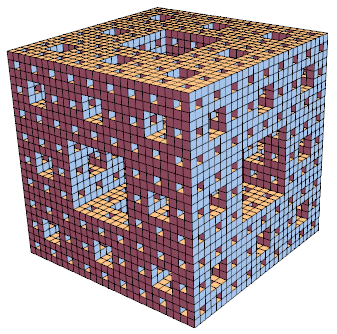
So if we want to talk about abstracta as being real, then symmetry maths is our best "game". It is the way we drill down through a story of contextual constraints, stripping away all the superficial or contingent ones - like the kind that might produce a horse - to arrive at the bare minimum of information needed to generate stable order.
Platonism works because there really is some fundamental basis to the very playing of "games of constraint". If objects are the inverse of their contexts - the emergent order that puts a concrete limit to the scope for disorder - then vortexes, fractal branching, and other dissipative patterns are the actual bedrock of physical existence. They are as near as it gets to "bare materiality" in terms of there being "necessary order".
So we have a baseline for abstracta. The patterns generated with Platonic inevitablity in dynamic situations with the least imaginable constraints. The games with the fewest given rules.
And from there - pan-semiotically - we build our way back up to contingent objects like horses and castles.
Horses and castles are also still - at the deepest physical level - just dissipative structures. Horses are nature's way of turning oats into shit, producing at least 80% waste heat along the way. Even castles require great effort and thus great friction and dissipation. As a focus for battles, they become a real magnet for entropic action - a man-made vortex for energy and materials.
But horses and castles are abstract objects - ideal limit state forms - in terms of what is now a complex environment. They are the inverse reflections of a world with the kind of history that has accumulated much information - like grassy, oaty, ecosystems; or feudal human cultures regularly in local conflict.
So what we have is an ontology that is dualistic in information theoretic fashion. The world is its material flows. But also its informational constraints. Reality emerges pan-semiotically because both information and entropy are completely, equally, real. One is not imaginary, the other the proper deal. And physics now makes that pan-semiotic fact centre stage.
Take a tornado - a vortex ripping across the prarie. The information part of the equation is the context that fixes its particular set of constraints in place. Or to put it more simply, everything that is a fact about the recent history of the weather.
Conventionally speaking, the tornado exists in the present. The critical instability that roars away right now is the "material object", the thing that we grant substantial ontic reality. Again conventionally, the past is no longer real as it is dead and gone. And even the future isn't real as it hasn't happened.
But the larger information theoretic view sees past and future as part of the triadic whole, and so also just as real. The past is real in that it actually shapes the current context in its every detail ... and the tornado is simply the limit state object that expresses the violent weatherbomb game which has been set up.
Likewise the future is real in the sense that it contains the entropic goal. Overall, the future is going to be the past left now in a more degraded or entropic state. In informational terms, a store of information is going to get dissipated. A world that was momentarily more complex - having built up some informational density in terms of a weatherbomb temperature gradient - will be left more simple, having got rid of the information of those very constraints.
If there was a town standing in the way of the tornado, that simplication will be evident in its materials winding up being more fractally distributed across the landscape. The man-made returned to a more natural symmetry.
So abstract objects are a story about contextual constraints. Constraints are information that produce material patterns. They produce the regularities of form that are stable material being - instabilty reduced to its dynamical limits.
And as such, there is a sliding scale from the universally necessary to the locally contingent.
Some forms - like vortexes and fractals - are so simple that they will appear everywhere. The most minimal information, or material history, is needed for them to be the manifest case.
While others like horses and castles still reflect these kinds of global symmetry-breaking games - principally the mandate of the second law. However they also are the product of far more elaborated histories - the contexts represented by ecosystems or cultures. They become real abstracta - optimal limit state answers - only in that more highly evolved or highly specified sense.
(All this, by the way, is why Stan Salthe had a dualistic stories on hierarchies. I earlier described the semiotics of hierarchies of entities. This is now the more sophisticated model that is a specification or subsumptive hierarchy in Salthe's jargon. This is now the infodynamic view.) -
Predicates, SmehdicatesLOL. I'm sitting here thinking that I've just wasted most of my morning when I really do have real work to finish today.
-
Predicates, SmehdicatesIt's as if most reasoning proceeded on the basis of a bait and switch between learned stuff summarised and internalised and really existent abstractions. But it looks like a real relation between these two is denied? Dunno. I imagine this is similar to apokrisis's perspective in some ways. — fdrake
I am a meaning holist. So on the face of it, Sellars' move seems objectionably nominalist. It treats even wholes as always particular. But then it also look to says that wholes are not composed of general parts. So it may be a tactic for revealing the essential inversion that is at the heart of true holism.
Look at the parts and you discover the wholeness. Look at the whole and you discover the partness. Relations need relata, and conversely, relata need relations. Nominalist and Platonists both get it wrong to the degree that they can't give us a clear view of this reciprocal dynamic that maps the particular to the general, the general to the particular.
So what do I think about the reality of abstracta? I take the hierarchy theory view - as set out by Stan Salthe in particular. The abstract now becomes the regularities that persist, that become fixed, due to the semiotic effects of spatiotemporal scale.
So rather than abstracta being transcendent - either actually transcendent forms, as in Platonism, or transcendent constructs, as in nominalism - they are an immanent fact about a material world that has spatiotemporal scale, a world that is organised as a hierarchy of "cogent moments".
Salthe gives a simple model of how it works. Imagine a world of entities of similar size. Now imagine the same motifs or integrative processes being repeated freely at both smaller and larger sizes. We have our regular size blobs - the entities that are about the same size as us, and so they they look like other distinct things. But as these blobs grow larger and larger in relation to us, they begin to fill our field of view.
Eventually, a single blob is so large that it exceeds our vision and becomes the complete unchanging backdrop. It is everywhere at all times, so far as we are concerned. It is no longer particular, but completely general - simply due to spatiotemporal scale and the fact we are confined to a point of view concerning entities.
This creates the upper bound of a hierarchical world. Individuated particulars - even ones that are processes unfolding in space and time - eventually must turn into global generalities simply due to an unbounded growth that makes them too big to continue to be related to as individuated particulars.
So this is a model of how the abstract can, indeed must, arise in a world where entification is a thing, but also not an artificially bounded thing. If there is entification, it should freely be the case over all scales. As why not? And in that fact lies the corollary that scales of entification will eventually completely fill a point of view, crossing a relational event horizon so as to become a universalised property. A fact about the whole.
Then conversely, the same story applies when we look in the other direction - down towards the fractally shrinking scales of entification. Now the generic units that are composing existence are getting both smaller and more frantic. Their spatiotemporal integrative scale, or cogent moment, is becoming microscopic - from our point of view. Eventually it gets so small as to turn into a continuous blur, so far as we are concerned. It all gets too small for us to have a relation to it as a set of discrete elements.
So now we have a complementary realm of abstracta bounding our entified existence. Purely for immanent and natural reasons - the fact that we are observing things from a characteristic scale of entification - both largeness and smallness become the congealed bounds, the event horizons, which come to fix our existence.
We live within the holism of whatever is the spatiotemporal scale that is so large it completely fills our point of view. And also, we are supported by the solidity of the spatiotemporal scale that is so fast and busy that we can't slip between its cracks.
So the abstract is both emergent and real. And it lies in two complementary directions to the particularity or individuation we find all around us - at a similar enough scale of entification.
And of course this hierarchy theory story is Peircean.
The lower bound of reality is the fast/small scale of chance events or Tychism. The realm of the differences that no longer make a difference. The realm of the quantum indeed - when viewed from the distanced safety of the classical middlescale.
The upper bound of reality is the slow/large scale of inveterate habit, or the continuity of Synechism. Now difference is eliminated not by indifference or contingency, but by the growth of universal necessity. All other possibilities have been eliminated. We live within the one unbroken totality - as now general relativity aims to describe.
So to get back to meaning holism, my point is that nominalism vs Platonism is a very familiar dualistic battle. It seems one or other side needs to win.
Yet a pragmatist view - and Sellars is meant to be very close to Peirce, even if it seems to have come via Dewey - really ought to be able to home in on the reciprocality of parts and wholes. The point about local vs global, particular vs general, is that they are just the same thing - divided by an asymmetry of scale.
So ordinary language and predicate thinking wants to work from the bottom up, constructing holistic complexity from substantial parts. However we know that zoom in on the parts and they themselves will keep dissolving into further parts. It is only by keeping our proper distance - preserving the larger thing of the semiotic relation we have with them - that they will remain that solid blur protected by indifference. The predicate approach will function so long as we don't actually look down.
But equally, holism is suspect in its claims of being able to form its world from the top-down, just by the imposition of Platonic constraints of form and purpose. Zoom in on the wholeness and it will be revealed as in fact just another particular. We get the usual story of a totalising physical theory that instead explodes into an unbounded multiverse. Again, it is the semiotic relation that is the only thing holding everything together.
An accurate description of reality, a language that captures its structure in terms of particulars vs generals, has to learn how not to treat the global as a Platonic reality, but just an event horizon that - like a mirage - exists because we are maintaining a suitable distance from it.
So holism - of this kind - is irreducibly triadic. (Salthe did dub his model the basic triadic structure. His book on this - Evolving Hierarchical Systems - is essential reading.) We exist in world of stable objects - the medium-sized dry goods of a classical realm - because any instability is being regulated from both possible directions.
From below, the instability might grow more violent as the scale shrinks, but it also becomes so microscopic as to be indifferent - to us. The "partness" both increases and also ceases to matter.
And conversely, looking up, any instability disappears. Scale makes change too slow have an effect. For us, universal law becomes the rule - even though now this "wholeness" starts to look rather particular. It has become "everything that is the case". A singular totality that we can no longer rightfully decompose into predicate parts.
So when it comes to speech and its efforts to logically frame our experience of reality, we can see how it actually wants to target the critical instabilities of the world at our scales of interest. What gives us the most practical information is the distinctions that give names to the points where this instability~stability dynamic is poised right on its cusp.
Are we talking about a part or a whole? Well, what is most useful is to talk about entification which is right on the brink of going either way. As that is the kind of talk which gets at the actual deep structure of the world.
The relata are the stable elements, says reductionism. The relation is the instability, the potential transformation. But then conversely, all relata, all elements, are themselves not entities but processes, says holism. What is solid and eternal are the relations, the structure, the organisation.
Hmm. A contradiction or instead just complementary views? The same critical instability seen from opposite directions?
Sure we can dispense with predicates to emphasise one of the views. And then - which seems to be Sellars' intent - we discover the nominalism that can be found inside holism. Just as holism finds nominalism within itself when it does its own naming of abstracta, its own naming of absolute generalities.
Again, the art of language would be to be able to put a finger on the hinge points - the place where the interesting flips happen.
This horse is white. Whiteness is generic. Here we have put our finger on an instability that orientates us to the way the world really is in its game between what is necessary, what contingent, or what is general, what particular.
Entities both hang together and fall apart. Language - with a predicate syntax, yet also a sentential holism of interpretation - gets that.
Chomsky was at least right about the recursive hierarchical organisation of speech. The unit of comprehension is not the syntactic particle. It is already the irreducible thing of a semantic entity framed syntactically by an above and a below. It is a word phrase that is indifferent to finer distinction, and stabilised by the constraint of the larger meaning intended. The words are detailed or particular enough for ambiguity to be grammatically ignored, while the words are also bounded enough by the habits of whole sentence-making to count stably as a compositional semantic unit.
Zoom in or zoom out, and all this stability falls apart. But keep everything the right distance and it hangs together for long enough to achieve a pragmatic goal.
And that is meaning holism. The emergent stability which underpins entification. -
A particle without a top or a bottom?Wouldn't the forces have to act within some kind of substance, like the so-called aether? — Metaphysician Undercover
I see no reason to postulate an aether, nor any reason to postulate something to 'constitute spatial extension'. — andrewk
Yep MU. That is why physics now talks of excitations in condensates.
You have proposed forces, and points of interaction, along with "space", but if there is no substance to space, then all the things we observe are just imaginary, products of our own minds, like forces and points are generally considered to be. So you've just inverted everything, saying that the substance is not the object, it is the space. In other words you describe objects as a property of the substance, space, instead of describing space (via measurements) as a property of objects. — Metaphysician Undercover
It is more tricky. We can't escaped the necessity of some kind of duality - the usual form vs matter, or whole vs part distinction.
And it doesn't work to try to reduce this duality to a monadic stuff. Atomism tried to do that by imagining causal particles in an a-causal void. That sort of works because it accepts the necessity of a duality of part and whole, but reduces the whole to an inert container or backdrop. It gives us a classical picture of causality. However we know that the classical picture actually breaks down as we approach either the global relativistic bound, or the local quantum bound, of scale. Suddenly the context, the vacuum, the spatiotemporal backdrop, becomes powerfully causal again.
So physics has to instead accept an irreducibly triadic view of things. The parts and the wholes must be involved in the third thing of a mutual relation. They must be fundamentally entangled. The reality must be both particle-like and field-like within the one coherent physical description.
You are arguing that it is a defect that physics can't seem to decide - which rules, the particle or the field conception of reality? But the very fact that we have arrived at an invertible relation (one that is formally a reciprocal, complementary or dichotomous relation) shows we are in the right place. If it is actually a contrast of two mathematically inverse models, then we have a larger model that is in fact relating two opposed limits on being.
Our work is done! We have a reciprocal formula that can flip the parts into wholes and the wholes into parts.
This is why there is all the current fuss over holography and the dualities of string theory. Mathematically, we can demonstrate that our best theories of the small scale can be reflected on to our best theories of the large scale, and vice versa. Like particle vs field, they are two views of the same thing essentially.
As ever, only the details need to be worked out. ;) -
Commonsense versus physicsIsn't that precisely the kind of view that the author of the article is saying involves a contradiction? — jkg20
It would be a contradiction if both are treated as direct realist claims - the reality is either that the world has to be coloured entities, or that it is really just is only "electromagnetic radiation".
But if both of these are simply understood to be pragmatic models - ie: indirect realism - then why can't we have many models of the same reality?
So physicists (and neuropsychologists even more so) will argue that the scientific model is more realistic than our "commonsense" biological experience. But it is these guys who would be making the point that perception only models reality - commonsense wouldn't say that. And these guys who - if they respect pragmatism as the basis of science - would say their scientific models of reality are still at the end of the day only models.
Once the indirectness of experience is recognised, that is what sets it up for constant improvement. We start finding ways to step outside our own experiential limitations with an "objective" approach to modelling reality.
Is it? The last time I looked at a physics text book (admittedly only at undergraduate level) fermions and bosons were very much still in the picture. Do you have a reference to research that is trying to do away with them? — jkg20
Again, if it is all just reality modelling, then older cruder models can live alongside the newer, more exiciting ones, without being a big deal. It is standard practice in science to use Newtonian models and forget about the relativistic or quantum corrections when they would be "contradictions" that don't make a practical difference.
So what I mean is that an example of a big shift in the mental picture would be the move from thinking of reality as being composed of substantial particles - of the fermionic or bosonic type - to instead classes of excitations of fields which exhibit either fermionic or bosonic behaviour.
Condensed matter physics tells us that this is the "reality" now. Collectively, as in superconductors, fermions can combine so as to become condensates with bosonic character. To put it crudely, rather than a bunch of individual fermionic particles, you have instead a bosonic fluid.
And back at the Big Bang, when there was only a hot relativistic soup of particles/excitations, a world ruled by a vanilla GUT force, the fermion/boson distinction would be moot - a chiral symmetry yet to be broken. The half-spin that characterises a fermion would not be seeable if all fermions were still effectively moving at light speed.
At the Big Bang temperature, bosons become fermions, and fermions become bosons, freely. There is no effective distinction, only a latent one.
And in current theory, the dissolving keeps on going. The original Dirac picture of a fermion has given way to Weyl and Majorana fermions - two different ways of conjuring up the same effective excitatory mode of behaviour.
As we drill down to the bleeding edge of science, it explodes into thousands of models of the underlying reality. Enough for every researcher to build a career.
So your cited article concludes...
Despite what some French philosophers might say, it is a rule of reason as basic as they come that contradictions cannot be true, so the story being fed us by those who want to interpret modern physics realistically, is contaminated not only by muddle-headedness, but more importantly by falsehood.
...but my reply is that first, science generally accepts it just pragmatically models reality. But second, neuropsychology tells us that is what brains only do as well - indirect realism is the case.
Then third, "commonsense experientialism" is epistemically inferior because it lacks the kind of open-ended evolvability of the scientific method. All we can ever do is look and see a colour as a colour. We are trapped subjectively in our evolutionary biology. But scientific modelling - a method targeting "objectivity" - can escape those confines to give a more direct model of reality. It is more direct to the degree it is less "subjective". It is a game we can set up and control.
Your article claims....
Consequently “out there in the real world are just fermions and bosons” means at least “out there in the perceptible world are just fermions and bosons”. However, according to the second phrase I highlighted, the perceptible world is supposed to be a mind-dependent construction brought into being by the effects of light on sentient beings. So, on the one hand fermions and bosons must exist independently of the perceptible world, in order to participate in causing that world’s coming into existence, yet on the other hand they are supposed also to be things that exist in that perceptible world, and so cannot be independent of it.
...but note that physics actually turns the perceptual part of all this into the business of reading numbers off dials. What we experience is not the "qualia" of consciousness - colours and features - but symbols that stand for mathematical or rational concepts.
So science is saying, "in here" I register the click of a geiger counter or a needle pointing to some number representing a velocity. And science can accept that in the end, that is all there is. This is the default instrumental position represented by the Copenhagen Interpretation of quantum mechanics. All we end up being able to say is that we seem to be able record sets of measurements when we pose questions of reality in certain prescribed ways.
So your article is targeted at physicists who say that physics sees reality more clearly. And that sounds like a claim that neuropsychology shows human mentality to be indirect modelling, while physics has direct access to the underlying reality. And that can't be true, for the reasons the article outlines.
But physics could also be starting from a position of far greater epistemic humility - accepting it really is only modelling, and that in the end, even its observations are just experience reduced to dial readings - and then using that sound epistemic base to launch itself into the boldest kind of objectivising project.
That wouldn't be believing a contradiction. It would be dealing with a contradiction already implicit in "commonsense" realism by placing it squarely on the table and wrapping a rational method around it. -
BeliefIt seems to me that if we need to redefine the terms "language" and "syntax" in order to make sense of our viewpoints, then we are much better off coining new terms. — creativesoul
Redefine? When did you bother to define them? -
BeliefOn my view, with my very limited understanding, there is no syntax of any kind without language. — creativesoul
But now the definition of language comes into play. If neural signals are syntactic, then do neurons speak a language to each other? And if computers also operate in languages - as we say they do - then where does the semantics enter into the picture as they whir and click in a programmed blizzard of transistor gate switches?
So yes, to get anywhere, we have to get down to a deeper level of discussion. Everyday notions about language, grammar, meaning, belief, truth, etc, won't yield the answers being sought.
What is syntax and what is semantics?
I am identifying syntax with constraints - habitual structure that serves purposes. Semantics is then a material state of constraint - an actual state of interpretance where a set of signs could have a positive meaning.
For human language, the new level of constraint that made all the difference was the simple one - the evolution of an articulate vocal tract that then imposed itself on the hierarchical organisation of an intentional brain.
Once noise-making became restricted in a particular fashion - a serial concatenation of distinct phonemes, the sing-song expressive sounds that only we have the right lips, tongue, palate, throat and vocal chords to make - then already there was a syntactical choice implicit. At the level of a motor act chain, we had to decide what sound was followed by what next sound.
The attention of others was already captured by the fact we did make these chattering expressive noises to each other as the most highly social and big brained apes. We only had to stumble into the value of grammatical form. We just had to discover the trick of breaking up the holism of our thoughts into a regular subject/object/verb patterning that could be used to tell logical causal tales.
The vocal tract placed a general serial constraint on the motor holism of the brain. And then grammatical form added a further telling constraint on its conceptual holism. A limitation on the brain's freedoms became a telling improvement. We found ourselves being forced to speak of the lived complexities of our world in terms of displaced social simplicities.
"Buffalo in the next valley." "The wind gods are angry." "The camp needs firewood." The most rudimentary division of an animal level of conception into words and rules, semantic reference and syntactic order, was the breaking of a huge intellectual barrier.
Articulate speech gives you infinite possibility from finite means. And it is the very limitedness of the syntax which is crucial to the open, unbounded, nature of the semantics. Computation is what you arrive at when you get down to bare binary distinctions - a 1 and 0 - and create as complete as possible a divorce between the two sides of the equation.
The more general or universally functional the habit of structure imposed on expression, the more numerous become the specific states of intentionality or meaning that can be expressed.
So tighter constraints = more countable degrees of freedom. A sharper division between syntax and semantics = an exponentially greater space of possible expressions.
Syntax and semantics, rules and words, are both separated and connected by their being in this reciprocal, inverse or dichotomous relation.
And again, it is this essential connectedness - the fact they are two faces of the one symmetry breaking - that makes it silly to argue for hard distinctions in terms of "what came first?" - which is chicken, which egg.
If you say an animal can have semantic states - language-less beliefs - then it goes without saying that syntax has to be present as well. You just need to learn to recognise it.
And that is what psychology does. Ecological or gestalt approaches to perception are seeking out the syntax that structures thought at an animal degree of development.
Language is a big deal as it gives humans displaced thinking ability. We can think thoughts where the thought is of us in the world. Animals can't do that. They have in place thinking where they just are acting in relation to the world as it presents itself.
So there is a syntactical structure in play - just the rather embodied and unmediated one of the way the world currently imposes its own syntactic structure on the animal's store of behavioural possibilities.
What does the animal think about next? Whatever its environment, its dynamic context, might suggest.
This picture puts the semiosis, the modelling relation, at the centre of things. If the division of syntax and semantics is a thing, then we should be able to see that in the essential continuity of the semiosis that powers life and mind at its every level.
I guess this is the sticking point. It might be a surprise to think that nothing essential has in fact changed from the first bacterium. A language-like relation was at the heart of abiogenisis - the moment an organic molecule first became a message or signal.
Even propositional language is simply the same trick amplified through a series of continual displacements. Sentences seem as displaced and un-embodied as could be imagined. Universal Turing computation made the notion of information truly Platonic. But really, it is just the same semiotic breakthrough unfolding towards its ultimate limits. Nothing new under the sun.
So again, to identify syntax as strictly a property of human speech leaves you short when it comes to telling the deeper story of semiotic continuity. It sets up an explanatory hurdle where one need not be. -
BeliefWhat does syntactic structure consist of? I'm being reminded of mentalese here... — creativesoul
Cute.
But you are right. We would have to wade through the thickets of Chomskyian universal grammar to get to a proper answer on that.
It definitely ain't mentalese. But some of that structure also has to be innate genetics - the bit that isn't neural network induction, cultural idioscyncracies, or mathematico-logical education.
So yes, I would spread the syntactic load across all four levels of semiotic mechanism I just identified. And even for me, that would be some book chapter length posts.
It is not mentalese as that is a claim about a language of thought which creates a semantic content that then only needs a syntactical translation into grammatical speech. So it suggest there is some wordless flow of ideas and images that then get turned into speakable words - with reasonably content-preserving accuracy.
Again, my neurocognitive account would see something right about that. It is not absolutely wrong. But that is because all action generated by the brain is hierarchical - and constraints-based. All voluntary and attentional action starts off with a vague general idea that has to be made concrete by a cascade of firming up steps - the prefrontal cortex connects to the supplementary motor cortex, which connects to the premotor cortex, which connects to the primary cortex. As more specific constraints get added one on top of the other, a final articulated act emerges.
So the difference again is the basic one of causal expectations. The computationalists see mentalese as a way to explain how inputs become outputs. For content to be created, it already had to be there. Hence the paradoxes. Where did the input get into the story? Mentalese just claims the creation process is hidden behind a convenient firewall. And don't ask difficult questions.
My approach - the one that neural networkers take - treats output as a matter of constraints-satisfaction. The mind is alive with free possibilities. All you have to do is to become focused enough on the fact of a problem for the connecting path to pop out - given the right multi-level feedback or cybernetic structure.
Anyway, rather than write that book chapter, again I simply say that there are these two choices - a bottom-up constructive view of things vs the top-down constraints-based view. How brains think was where the switch from the one to the other first happened for me when I got into the neuroscience some 30 years ago. -
BeliefSome... belief is prior to language. All belief is meaningful. Some meaning is prior to language. — creativesoul
But is belief prior to syntactic structure? Is meaning prior to syntactic structure?
Forget language for the moment. I already accept that semiosis - a modelling relation - takes place at multiple levels in complex minds. We humans are modelling the world at an evolutionary/genetic level, a developmental/neural level, a social/linguistic level, and even now a rational/numeric level.
You can argue for a continuity of belief/meaning across all those levels. They are all examples of information regulating dynamics, syntax regulating semantics. The same essential semiotic mechanism or modelling relation. The genes believe something meaningful about the world. The genes propose a body organisation and learn the truth of that particular guess. Our brains form neural habits - meaningful beliefs about how to get stuff done with reliable results.
So you are showing concern about temporal priorities. Belief exists, then linguistically-structured beliefs. Meaning exists, then syntactically-structured meanings.
But this is just a faulty reductionist analysis driven by a felt need for concrete foundations to explain anything more complex.
I am arguing the holistic or systems view. There is something foundational, but it is semiosis or the modelling relation itself. So you have the same thing happening from the start. But also it undergoes such radical phase transitions as it shifts from genes, to neurons, to words, to numbers, that the disjuncts come to matter just as much.
The telling of the tale has to do equal justice to the continuity of semiosis and the discontinuities of new grades of semiotic mechanism.
You can't go back and fix all the tired old epistemic terms - belief, truth, justification, proposition - by pursuing a reductionist foundationalism.
That was the "too simplistic" mental image of how things should happen that got you into all the confusion in the first place. -
BeliefWhere would you place the temporal genesis of this foundation of indifference? — frank
Again, you are back to a search for a "concrete foundation" as a matter of inveterate mental habit. It's getting comical now. :wink:
Why would it matter when the epistemic indifference first starts? Why wouldn't it instead be a question of when the development of a state of indifference reaches its final terminating limit?
Again, remember the Peircean answer. Truth is what a community of rationalising inquirers would converge on by the end.
So you just expect the answer to be bottom-up. Everything true would have to be anchored in something deep, basic and hard.
But instead, the alternative is that everything is only held together by a structure of habits sufficient to suppress the innate irregularities of chance and uncertainty. Reality - epistemic and ontic - has to arise in bootstrap fashion via the steadily emergent suppression of ambiguity and chaos.
It all works top-down ... by the end. -
BeliefFloating in a sea of doubt, are you? — frank
Not exactly the right metaphor.
I think belief is the filling in of blank created by the Cosmic First Question: Que Pasa? — frank
Well that is precisely the ontology I've just criticised.
You imagine a void, a blank, a generalised nothingness, and ask how could that kind of a-causal container suddenly gain a manifest content. How could the meaningful appear as creatio ex nihilo? Why anything?
That is the dominant mental image in metaphysics - the classic reductionist way of thinking about situations. And it creates all the confusion when we get down to fundamental issues.
I instead argue for a boundless potential - an everythingness that is a nothingness - which then becomes something, some structured set of things, by the emergence of constraints. Structure organises the confusion and leaves you with something substantial.
So belief is not filling in the blank of the unknown - finding what answer pre-exists the questions. It is about systematically reducing the possibility of our notions being wrong. An answer emerges as that which proves itself to eliminate the most uncertainty.
That is why you would have me floating on a sea of doubt. Instinctively, you want to find a concrete foundation on which all the other turtles can rest. And it is funny that this foundation would be "unbounded doubts". What kind of concrete foundation is that, you ask merrily?
So try imagining it the other way round. It is constraints on doubts all the way down to the point where we no longer find a reason to care. And that then is our epistemic foundation. Our own indifference.
We don't float on a sea of doubt in helpless fashion. We begin to believe where we ourselves have rendered doubt impotent and insignificant - in terms of "us" and our desires, our intentions, our purposes.
Every poster here pretty much is stuck in the bind of wanting foundations for beliefs or truths that might be given to them by reality. But even reality - according to our best quantum models of it - doesn't have that kind of foundational realism.
And yet still, despite the Universe itself floating on a sea of quantum doubt or indeterminacy, it seems to exist. Or persist. It is stabilised by emergent structural limits. It is "collapsed" or decohered so that it enjoys classical strength certainty, given a sufficiently generous spatiotemporal scale.
So the pragmatic/constraints-based view works as ontology as well as epistemology. You just need to switch up your mental metaphors for something more holistic and relational. -
BeliefThe content of belief matters. It must be gotten right if we are to report upon belief correctly.
It's all about the content. — creativesoul
I think so much wrongness flows from this view that meaning pre-exists as "content". You have the image in mind of a semantic load that has a definite existence in its own right and simply has to be shovelled into a convenient syntactic container.
The container is an a-causal structure. It simply holds the meaning for you and so becomes an arbitrary or contingent part of the equation. It doesn't affect the meaning it transports from one place, or one mind, to another.
The container might have its inadequacies. It might be leaky, too small, inconvenient in shape to handle. A word like "cat" would seem to spill over in messy fashion if we tried to shovel every possible sense of what we could mean by cat into its little box shape. But still, "catness" would be treated as something quite definite and pre-existence.
So it wouldn't be the semantics that is in question as a putative content, just whether we had a big enough syntactic box to hold enough of what we could intend to mean in some speech act or propositional statement.
But I argue for a very different (yes, Peircean) conception of the relation between semantics and syntax.
Syntax acts as a constraint on semantics. So there is no definite pre-existing content. Semantically, there is just unlimited potential meanings. Beliefs start with unbounded ambiguity, vagueness or indeterminacy. It is all just undefined possibility. The laws of thought do not yet apply.
And then syntax is what shapes up this semantic potential into something more rationally structured and definite. The box is there to stamp an organisation on whatever gets poured into it. Or rather, what gets poured into it is our radical uncertainty, and we have to decide how well it seems to fit the structure suggested. There is a further part of the story where we have to decide whether the fit is good enough to serve our purposes - and so any fine grain ill-fit becomes a difference that doesn't make a difference ... to us.
So these are two different mental pictures of what goes on. You are pushing the semantic content story, the mental object story. Words describe ideas. There is this semantic stuff floating about in the shadows of our mind in a definite pre-existent fashion. We just need to shove it in the right boxes so we make it syntactically expressible.
Alternatively, you can fail to solve the same problem with Banno's behaviourism. Our behaviour becomes the physical substitute for the mental objects. Behaviour seems nicely public and definite. That makes it suitable for treatment as a pre-existent semantic content to shovel into syntactic boxes.
But a constraints-based view of things starts with unbounded semantics. Anything could mean anything. There is just noise, no signal.
And then habits of interpretance or organisation can develop to produce a robust system of a mind in a pragmatic semiotic relation with a world. The blooming, buzzing confusion can become structured so that it a useful and regularised view.
Propositional strength statements then become an end of the line type deal.
Taking this relation to its extreme, you get the kind of universal syntax that would reduce the blooming, buzzing confusion to its theoretical minimum. The words would force the possible meanings into the most logically water-tight, or computationally constrained, formulas. They would wind up having the simplest kinds of properties - the counterfactual possibilities like being true or false, right or wrong.
So beliefs are all about a sharpening up - the imposition of syntactic limits on semantic possibility. A belief is an active reduction on our potential uncertainty. It draws the line on where - for now - we have decided to cease to doubt.
And to make that work, you have to include the pragmatist's principle of indifference. Truth becomes not something ontic of the world but ontic of our relation with the world. It is us who get to be indifferent about the truths or semantic contents being good enough to serve our purposes. And so now it becomes critical to define this "us".
Pragmatism does that in terms of the notion of the limit that would be reached by a community of like-minded rational inquirers. If the world actually does exist in any recalcitrant and mind-independent fashion, then inquiry should be able to arrive at a view of the constraints that make reality itself that way. -
Commonsense versus physicsThe article argues for a hard binary choice. Which isn't really pragmatism.
In fact, what Russell’s argument actually shows is that we face a choice: either we can be realists about modern physics, and ditch commonsense or we can regard the deliverances of modern physics merely instrumentally.
So yes, in some sense instrumentalism has to be the position of last resort. Given that any construction of reality might be faulty, we have to accept we are trapped within our own cognitive states of belief. The noumenal, or thing-in-itself, lies forever beyond out phenomenal grasp.
But then, pragmatically, we can also discover that our phenomenology contains invariances. We can arrive at concepts that don't seem budgable - as Kant also recognised with his synthetic a priori. Both empiricism and rationalism do seem to lead to general invariances of experience when inquiry is taken to its reasonable limits. Both experimental facts and mathematical facts emerge as basic looking.
So now we must contrast commonsense realism with the kind of realism we arrive at following exhaustive rational/empirical inquiry. Does one paint a more real picture of reality than the other - even given both are pragmatic exercises (one largely conducted by biological evolution, the other largely by human cultural advance)?
It seems pretty clear - looking back at commonsense from the larger science-informed perspective - that when it sees the world as a clutter of coloured objects, it must be the less real view. Colour is a mental property ... somehow explained by electromagnetic radiation being a universal material state and brains doing some kind of information processing to extract a useful signal from the world.
So as I argued, the mental does become increasingly mysterious to us as we depart commonsense and describe reality in terms of its mathematically structured observables. We seem to be seeing through to the brute material world - at the expense of manufacturing a matching amount of uncertainty about whatever it is this thing called mind could be.
On that score, what we gain on the one hand in terms of our pragmatic realism, we seem to lose on the other. If we have to wind up calling colour experience an epiphenomenal illusion, then our realism - in regard to our own subjective reality, which we epistemically agree is all we have got at the end of the day - hasn't been done justice.
However, psychological science - and the sciences of information or semiotics generally - can be turned on precisely that problem. We can treat the modelling relation itself as a universal reality to be accounted for by a model or theory.
And modern physics itself has moved on to start to take that step. So the idea of fermions and bosons - as the new names for bits of matter - is dissolving as physics shifts to a holistic and information theoretic point of view on "reality".
Commonsense can't really move on like this. You can't unsee colours even if you learn colours "aren't real".
And that is what makes physics, or rational inquiry in general, a step up in terms of pragmatism. It separates out the two necessary parts of the whole business - the theories and the measurements, the concepts and the impressions.
Commonsense is a biologically hardwired view. Rational inquiry is an open-endedly provisional view. So commonsense has hit its limit of inquiry - for us, as a species at this point in time. But rational inquiry can keep going, perfecting its view in terms of theories and measurements. And it can also show that it is increasingly approaching a limit as it does so.
The mathematical options for accounting for the structure of reality keep becoming less. The empirical evidence that might shake our beliefs keeps becoming ever more well explored. Every century, we get exponentially closer to the limit of the knowable.
So yes, we can ditch commonsense for something better. But also, physics is itself just a pragmatic construction - a modelling relation. So physics ain't completely different in principle. Just very different in regard to it being the view we are actually free to construct and not merely the view we had to inherit as a consequence of our being evolved and ecologically embodied observers of reality. -
Predicates, SmehdicatesA diagrammic approach to predicate logic would seem to explode this, demonstrating the essential contextuality or holism of such relations as x is larger than y, or A is one of a class of red objects.

Peirce thought his existential graphs were his ultimate and unambiguous clarification of a logic of relations. Speech - being a linear code - does suffer from being less constrained than the geometric reality it describes.
You can believe in nominalism if you can reduce reality beyond its irreducible spatiotemporal structure. But existential graphs show up that illusion quite neatly I would suggest.
apokrisis

Start FollowingSend a Message
- Other sites we like
- Social media
- Terms of Service
- Sign In
- Created with PlushForums
- © 2026 The Philosophy Forum