
-
Eternalism vs the Moving Spotlight TheoryIs this different for Presentism? — Luke
Yes, it holds whether the past and future are real or not.
However, if what you mean by "exist in more than one position" is to have a part of the mountain existing at one spatial position and another part of the mountain existing at another spatial position, then I agree that different parts of the mountain "exist in more than one position". — Luke
:up: Then you understand perfectly well what is meant by "existing at more than one point in time". In 4D, it is the same thing. Time is not special in this respect.
Proceeding hierarchically, stop me when I presume incorrectly:
If you are happy that a 4D object exists at more than one time to the extent that it exists in more than one position (i.e. has length), you are presumably happy with the concept of duration in 4D, which is a length of time between two points in time.
And if you're happy with time intervals in 4D, and you are happy that the spatial position at one end of the interval may be different to that over the othet end, the you are presumably happy that a 4D object's position changes with with respect to time, i.e. it's position at one time (x, y, z, t) maybe different at another.
There is the kinematic definition of motion. Nothing needs to be bolted on or derived further if you stick to that definition of motion, other than the assumption of continuity. There is no version of the above that can be held and motion not pop out gratis. -
Sending People Through Double SlitsOn a relational view, since an interaction occurs at the slit, collapse occurs in both the electron and apparatus reference frames.
— Andrew M
No, the electron is in a fixed state in its frame, that's the point of the paper I linked to — Kenosha Kid
Sorry, yes, just got what you meant. We are more or less on the same page. -
Sending People Through Double SlitsOn a relational view, since an interaction occurs at the slit, collapse occurs in both the electron and apparatus reference frames. — Andrew M
No, the electron is in a fixed state in its frame, that's the point of the paper I linked to. The transformation takes us from a frame in which the lab is in a well-defined position and the electron in superposition to one in which the lab is in superposition and the electron has a well-defined position. It is the lab that undergoes collapse.
However, no reason not to consider an intermediate frame in which both are in superposition. But the wording of the OP, an electron-sized person's point of view, suggested specifically the frame in which the electron's position is defined.
So collapse is reference frame-dependent. — Andrew M
:up:
This is analogous to a Wigner's Friend experiment where a definite measurement event occurs in the friend's reference frame but remains in superposition in Wigner's reference frame. — Andrew M
In the Wigner's friend experiment, collapse is observer-dependent even with a given frame, e.g. the lab frame, and there's some evidence that this is correct (it is experimentally verifiable). However there's a nice symmetry here, you're right, insofar as both Wigner and his friend are well-defined wrt themselves and superposed wrt each other. It might not be a coincidence that the experimental verification of Wigner and the paper on frame transformation roughly coincided... perhaps QM is coming of age. :) -
Eternalism vs the Moving Spotlight TheoryWhat comes before and after the "i.e" is not equivalent. Motion is not defined as merely having a spatiotemporal position. — Luke
The passage you quoted did not state that motion is defined merely as having a spatiotemporal position, making yours an overtly fallacious argument. It states that the spatial part of the spatiotemporal position depends on the temporal part, that is: for each time, the object has a position. Assuming continuity.
Did you have questions? I thought you were just telling me what's what. — Luke
I have asked you lots of questions, yes. Here's one I'd really like an answer to if you're sure of your position:
What is it then that changes spatial position?
— Kenosha Kid
In Eternalism? Nothing. That's what I'm arguing. Nothing moves; nothing changes.
— Luke
No. What is it that changes position at all? Forget eternalism. Just a mountain at a given moment in time, an aerial photograph if you will. The summit is in one place. The foot is far away from it. It exists in more than one position. By your argument, radius is impossible because what changes spatial position? — Kenosha Kid
You will recall that your response was yet again evasive:
I'm not going to argue with you by analogy. There is no long-standing debate about whether altitude of a mountain can change with position. This is about time and motion. — Luke
Given that, in eternalism, time is laid out like space, I would like an answer. -
Eternalism vs the Moving Spotlight TheoryWhat does "depends on time" mean? — Luke
It means:
Motion is change in spatial position over change in temporal position. — Luke
i.e. that where something is depends on when.
I've taken great pains to explain myself and present my argument, which you continue to ignore. — Luke
I have answered every question you have asked. You have not done the same. -
Eternalism vs the Moving Spotlight TheoryWhat does "the time-dependence of an object's position" have to do with either of the definitions that we previously agreed to? — Luke
Because if a 4D object's position depends on time, it has a gradient with respect to time (equivalent statements). By definition that is motion.
[EDIT: Assuming continuity, i.e. that the 4D object is a continuous body in 4D]
^ This is an example of taking the time to explain oneself. My approach has been thus from the start. Stating otherwise is just openly being an arse. If your counterargument depends on that, fine. It'll be dismissed on those grounds. If you have an actual counterargument that makes sense, don't cheapen it with personal invective. -
Eternalism vs the Moving Spotlight TheoryMy argument is based on these definitions. — Luke
Then motion is possible by definition, since the time-dependence of an object's position is retained in the eternalist picture. Again, refer to the image for illustration.
I've actually presented an argument. Where's yours? — Luke
I've attempted to explain it in multiple different ways with a great deal of patience, occasionally stretched. Your responses have amounted to circular arguments, contradicting yourself, and refusing to ever consider any point that would resolve the argument when offered. I am sure this is top-notch by your standard, but it is woeful by mine. -
Eternalism vs the Moving Spotlight TheoryShow me where I've used a different definition of motion. — Luke
You agree that motion, as I have defined it, falls out eternalism by definition, or, in your own words:
Your argument is little more than motion is possible in Eternalism by definition. — Luke
And yet "motion is impossible" in eternalism according to whatever definition you use.
It follows logically that you must have a different definition, otherwise motion would also appear possible to you "by definition". -
Eternalism vs the Moving Spotlight TheoryOh my god. Your argument is little more than motion is possible in Eternalism by definition. The least you could do is address my argument if I'm so obviously wrong. — Luke
Yes. By the kinematic definition of motion, motion is possible in eternalism. As I said ages ago and multiple times, if you have a different definition of motion, different rules and outcomes will fall out.
Your definition is seemingly presentist-specific, though you deny it: the only reason "motion is impossible" in eternalism is because motion is defined in presentist terms. Therefore your argument is nothing more than: "motion is impossible in Eternalism by definition". In other words, you're just reiterating Zeno's paradox.
This was all covered several pages ago. -
Materialism and consciousness(To say nothing of the most embarrassing graph in modern physics....) — Wayfarer
Yes, it is embarrassing. But this is what I keep telling people who think physics is intellectually difficult: any idiot can do it, you just have to be interested! (And accept 30 timetabled hours a week at college.)
EINSTEIN: I cannot prove scientifically that Truth must be conceived as a Truth that is valid independent of humanity; but I believe it firmly. I believe, for instance, that the Pythagorean theorem in geometry states something that is approximately true, independent of the existence of man. — Wayfarer
What this says is that ideal Pythagorean theorem is a belief, not a fact, that is: the idea itself exists in Einstein's head, not out there somewhere. -
Eternalism vs the Moving Spotlight TheoryI'm not going to argue with you by analogy. There is no long-standing debate about whether altitude of a mountain can change with position. This is about time and motion. — Luke
This seems to be par for the course: every opportunity I've suggested to consider how motion is possible in eternalism, you have given some excuse to look away. It all comes down to dx/dt being well-defined in eternalism as d(altitude)/d(radius) is defined for a mountain at any given time, and that the geometry of a 4D object is not dependent on how we calculate it, just as the geometry of a mountain is not dependent on how we calculate it.
I don't think you really dispute this. But I don't think you're apt to follow that to its logical conclusion, which is that motion is therefore well-defined in 4D (a truism, given the kinematic definition of motion). I can't make you see where you refuse to look. -
Eternalism vs the Moving Spotlight TheoryAre you trying to "change" the subject? I thought the subject of our disagreement was whether there is motion in Eternalism. I've given my argument for why there isn't. You may need to clarify how this response addresses that argument. — Luke
No, but I feel you are, whenever you sense impending progress, drawing back. If you agree that motion depends only on time-dependent spatial positions, the crux now seems to be: what needs to change temporal position such that spatial positions may change? The question is perfectly analogous to: what needs to change spatial position such that spatial position may change? If you can understand how the altitude of a mountain can change with position, without some other thing having to change in order for that position to change, then understanding how a 4D body can have movement is in principle trivial.
In short, your counter-argument is equivalent to saying that, at a given moment, a mountain must be flat because there is nothing "changing" position to allow its altitude to vary with position. I am sure you do not think this, but the extent to which you think 3D mountains aren't flat but 4D motion is impossible is the extent to which you're switching definitions when you go from space to time. They are both gradients of geometric objects in some space. If you can account for this difference, we have progress. -
Eternalism vs the Moving Spotlight TheoryWhat object has changed its spatial location? Please tell me. — Luke
None. You do not need to "change" spatial location to have a length, or properties depending on space, unless, as I've repeatedly asked, you're using "change" with some unobvious meaning:
Nor does that gradient depend on me measuring it. — Kenosha Kid -
Eternalism vs the Moving Spotlight TheoryThe gradient of the mountainside is not a change in the spatial position of the mountain, as you implied earlier. The mountain hasn't moved. — Luke
Precisely, and yet it has spatially-dependent altitude (a gradient). So why can you not admit that in 4D a body has time-dependent positions (another gradient) and therefore motion? -
Materialism and consciousnessBut those truths, such as the law of the excluded middle, are not, on those grounds, the product of that evolutionary process. The law of the excluded middle, and such like, are by definition ‘true in all possible worlds’. So, we’re dependent on the (physical) brain to be able to cognise such ideas, but the ideas themselves are not the product of a material process, rather, they are what must exist prior for any material process to occur (hence ‘a priori’). — Wayfarer
Surely that's trivial to discount. First, it assumes the answer to the question by asserting that "the ideas themselves are not the product of a material process". Second, I can point to quantum mechanics where the law of the excluded middle does not hold (e.g. either the radioactive atom decayed or it did not), and the people dealing with it are fine. The law of the excluded middle worked as long as our experience of the material world fitted in with it. Then it was abandoned by some people for something more general when experience begged to differ.
Did the a priori fact of excluded middles suddenly change? Is it's truth dependent on circumstance? Or did its seeming truth derive from experience and pedagogy? -
Eternalism vs the Moving Spotlight TheoryIrrelevant. For which object are you measuring the motion? The mountain. So you need to measure the change in its temporal position. This will require that the same mountain (edit: object) is "defined for more than one time". And then see my argument. — Luke
I'm not asking about motion, I'm asking about length. It is relevant because duration in 4D is a length. I can calculate the gradient of the mountain at any point by measuring the "change" in altitude with "change" in radius. These are not changes over time, these are merely lengths. Nor does that gradient depend on me measuring it.
The same goes in 4D, where I can measure motion as "change" in spatial position with "change" in temporal position: these are lengths. And the motion is there whether I measure it or not. -
Eternalism vs the Moving Spotlight TheoryWhat is it then that changes spatial position?
— Kenosha Kid
In Eternalism? Nothing. That's what I'm arguing. Nothing moves; nothing changes. — Luke
No. What is it that changes position at all? Forget eternalism. Just a mountain at a given moment in time, an aerial photograph if you will. The summit is in one place. The foot is far away from it. It exists in more than one position. By your argument, radius is impossible because what changes spatial position? The extent to which that is a meaningless question is the extent to which "what changes temporal position?" is a meaningless argument. In 4D, space and time are exactly analogous. If you are satisfied that a mountain in 4D has spatial length, you are satisfied that it has temporal duration. -
Sending People Through Double SlitsOK, but the puzzle is to account for what happens when the two apparatus slits go past the electron in the electron's rest frame. — Andrew M
This isn't really in the picture, though. The probability of being beyond the slits grows. That is the closest you can get to "the two apparatus slits go past the electron". You can say, e.g., the probability of the slits being behind the electron is now > 50% for thr first time. That's doable.
That is, no definite measurement event would ever occur in the electron's reference frame. — Andrew M
There's no reason why, if a superposed electron can spontaneously and probabilistically collapse, a superposed laboratory cannot. In fact, I'd suggest the opposite: in the electron's rest frame, the collapse is almost immediate. It seems longer to us due to time dilation.
If a definite measurement event does occur at the back screen in the electron's reference frame then a definite measurement event should also have occurred at the slit. — Andrew M
This is not an argument from quantum theory, I gather, more a philosophical argument as to how quantum mechanics ought to be. The double slit experiment suggests that electron collapse at the slit only occurs if we attempt to observe it at the slit, e.g. if we put something in the way of the slit that causes earlier collapse, such as an electron detector. -
Simple Argument for the Soul from Free WillTypically, the free will chooses between two conflicting values, where one value is driven by the "appetite" (ie our desire for pleasure and undesire for pain) on one hand, and another value is driven by reason on the other hand (such as health, moral duty, etc). This image comes to mind, where the dark angel is the appetite, and the white angel is the reason. — Samuel Lacrampe
That was part of my caveat. But this too may be deterministic. There are people who would starve to deatg before stealing a loaf of bread. There are criminals who would steal for the least reason. The rest of us would steal a loaf of bread if we were sufficiently hungry. How we choose depends on the circumstances (what are my values, am I starving, is there bread, will anyone know, etc), i.e. is deterministic. -
Eternalism vs the Moving Spotlight TheoryIt is quite clear that, in Eternalism, the 3D part existing at t1 is not the same as the 3D part existing at t2. You wouldn't say that the 3D part at t1 moves to t2; clearly not: a different part exists at t2. — Luke
Yes, iirc I did ask for clarity on "3D part", I wasn't sure if you meant the body or its spatial coordinates. Continuity is what makes it the same object. Although, the ship Theseus and all that. -
Why are materialism and total determinism so popular today?My father won the 1st place in physics in my country several times and I believe he was also no1 in Balkans at a time. — Eugen
Are you thinking of tennis? In what sense did your father win physics?
Well, I don't know much about physics, but I know how the things work there at the human level, and trust me when I am saying there's pure personal interest. Quantum mechanics gets in contradiction with relativity? No problem, we'll invent the quantum gravity. — Eugen
But you understand there's no quantum gravity theory accepted by the scientific community, yes? It's reasonable to make hypotheses. They're not saying it's true.
I have worked in academic physics and the quality control is brutal. You say you don't know much about it, but you act like you can dismiss theory on grounds of taste. There is an abundance of scientists who give up huge amounts of their free time to dismiss theory on grounds that it's bullshit. While I can see you think there'd be benefit to science in getting your input early doors, trust me: we have actual experts trying to destroy our work continuously.
The other problem you raise is quite common: that science changes its mind when nature calls out its errors. You're not alone in characterizing that as a lack of integrity, and I doubt I can convince you otherwise other than to say we see no integrity in sticking to a stupid idea. Self-correction is precisely why science has succeeded as much as it has. -
Eternalism vs the Moving Spotlight TheoryIt has to be considered the same object to meet the definition "is defined for more than one time". You can't determine the change of temporal location of an object if it's not the same object that changes temporal location. — Luke
Oh, I think I understand. But that is satisfied by continuity. The mountain at the summit is the same mountain as the one at the foot. What is it then that changes spatial position? A presentist-esque answer might be a hiker moving from the foot to the summit. But this is not necessary for the mountain to occupy the space at the summit and the space at the foot. What's required is continuity: the geometry of the mountain.
Same goes for 4D objects. The Moon at some future event is the same as the Moon at some past event: both events are points on the Moon. What makes it the same Moon is continuity. It has length along the temporal axis. No temporal hiker, or spotlight, or objectively passing 'now' is required for it to have that length.
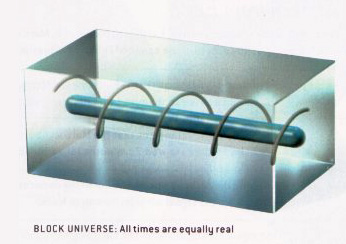
The length in time is evident in both the Earth (the cylinder) and the Moon (the helix). Both have spatial lengths (the thicknesses of the paths), but only the Moon has motion (wiggles). -
Why are materialism and total determinism so popular today?I really think Pfhorrest was pretty right saying you have a similar vision to Chomsky's — Eugen
It's possible. I once heard Chomsky speak on moral relativism and I dismissed him as an idiot, so I never gave much care for his views after that. Probably a bit harsh.
I guess you were fooled by my harsh statements regarding materialism, therefore you thought I was automatically a mad christian mad at this view. You probably hate mad christians, therefore you started to defend materialism. But I am not a mad christian and another aspect of today's people is that they use science to prove or disprove God, and you arguments, even if they are intended to defend materialism, many of them do not. — Eugen
I wasn't assuming you were a mad Christian, I just needed an example of an immaterial world for sake of illustration and analogy. I did assume you were a dualist, since materialism rather defined itself in opposition to dualism, but it wasn't terminal.
Anyway, it was an enlightening conversation. It can be difficult sometimes getting your head around other points of view. You are the second person today to attest to an experience of the world I hadn't ever considered before. I'm not sure I'll ever quite get it, less sure I could ever quite communicate mine to you, but something to chew over is always good. -
Why are materialism and total determinism so popular today?Than just try to laugh yourself at today's science. Seriously, future scientists will laugh their abstract asses at how we "curve" space and time by running faster. — Eugen
On the contrary, I can appreciate the successes of scientific achievement to date while recognising that current paradigms will almost certainly be overthrown. It is an iterative process, but a win-win one. If our current models accord with new observation, we learn something. If they do not, we learn something better.
The meaning of what you say made me write this, not the photons. That transcends matter. — Eugen
So seeing my message was not a cause of you responding to it? The photons are an incidental material fact of a transmission of meaning?
If hunger (immaterial) contribute to the chain of causes, than materialism is kind of f***ed. — Eugen
But again that's begging the question.
By the way, I am starting to think that you're more a rational person than a materialist. — Eugen
I am both, I hope. And a modern physicist to boot (doctorate in quantum mechanics). -
Why are materialism and total determinism so popular today?More like a Schrodinger's cat is either dead or alive makes more sense than to say it's a combination of the two just because you, as an observer, no not have this information. — Eugen
I actually agree with that. There is little evidence that macroscopic bodies can be in superposition. Most physicists would agree with the above.
You are totally right: loys of information (maybe all of it) is inside matter. Wait, what? Did I say information? Damn it, that's not material, therefore it does not exist. — Eugen
As you just demonstrated yourself, it quite clearly is material, so problem there.
You've totally convinced me that hunger has nothing to do with going to kitchen. — Eugen
It certainly doesn't have "nothing to do with going to kitchen". Can I characterise your position as this: there is either nothing causally relating two things, or the relation must be direct and unmediated? I'm not even sure this is an existing philosophy. -
Why are materialism and total determinism so popular today?They just validate their own theories and it's really not that hard to do that. — Eugen
More like a conspiracy theory?
I am sure future scientists will laugh at today's science. — Eugen
Inevitably. It is, I suspect unlike your belief system, a self-correcting system.
Why don't extrapolate and say from pure matter to information — Eugen
Because no transition is necessary. Materialism has accounted for information well. If you can send me a video link that is not encoded materially, please do.
Hunger does not directly cause me to walk to the kitchen. There are a great number of steps in between
— Kenosha Kid
Just enlighten my mind with that one please. Give me more details. And please be free to spot all my other errors. — Eugen
This genuinely surprised me. I get that you seek immaterial mediators everywhere, but I struggle to get my head around how you can believe that "I feel hungry" -> "I am walking into the kitchen" has no intermediate stages. Even, "I push down on the sofa and my torso rises" is an intermediate stage. It seems that you not only believe in immaterial forces, you believe that even physical human actions are atomistic, i.e. cannot be broken down into a series of smaller actions. -
Why are materialism and total determinism so popular today?Intelligence and consciousness - atoms aren't conscious and they have no purpose nor intelligence. 0 all the way. If you combine 0 with 0 you get 0. Not on this one, because a certain combination of atoms brings self-awareness, purpose and intelligence, not to mention perception, thoughts or the sensation of happiness. — Eugen
Apologies, you mentioned this before and I meant to respond but didn't. Your 0 + 0 + 0 + ... = 0 representation is that of yay many independent, non-interacting atoms. You're right: that will not yield a conscious system. In fact, it will not yield a system at all.
For the purposes of finishing this in a finite amount of time, let's just ask whether it is possible for a system of two atoms to exhibit behaviour that two independent atoms cannot. The answer is yes. Some examples, you ask! Sure! Rigidity: two independent atoms of carbon are easy to separate; two interacting (via the action of photons) atoms of carbon are not. Carbon is a rigid material (ask diamonds), but there is no carbon rigidity in a single carbon atom. Thus rigidity is a quality of a system of atoms not present in each atom.
This does not explain every single emergent phenomenon (I could go on just about C2), but it does not rely on modern physics (good old fashioned chemistry is fine) and it does do away with the idea that emergent properties cannot occur. A better, perhaps more specific argument is required for consciousness.
Btw, you don't need to go down to the atomic level to find the mystery of consciousness. For the most part, one would expect the phenomena to emerge, if it could emerge (and it does) at biochemical levels. The answer to consciousness is not going to take an atomistic form, though some parts of that answer might rely on atomic theory. It is not necessary to give a complete bottom-up depiction starting from fundamental particles. It is sufficient to understand how chemistry is a good approximation to quantum mechanics for chemical substances, how biology is a good approximation for chemistry in biological substances, etc. If one can derive the laws of biology from chemistry, and of chemistry from quantum mechanics, and demonstrate a biochemical explanation for consciousness, an atomic explanation is redundant. -
Why are materialism and total determinism so popular today?You've mentioned space matter curvature, which I believe to be utterly dementia — Eugen
Empirically and independently verified dementia... probably isn't dementia. Or do you think science is some kind of mass hallucination? :rofl:
I do not believe in modern physics — Eugen
That's fair enough. As Neil deGrasse Tyson said, the great thing about facts is that their true whether you believe them or not.
Now, irrespective of your personal dementia (I mean your mad beliefs :joke: ), you have surely noticed that modern physics is widely accepted by other people. You're asking the question: why is materialism so popular. As we've both noted, modern philosophical materialism and science have a mutual understanding. The most successfully tested models of our reality are controversial to you; they are not controversial to the mainstream. Is is therefore really a surprise materialism and determinism are so popular, even if you think they are wrong? And let me remind you of your stated scope for this discussion:
I don't want this to be a topic about denying or defending materialism, but rather the reasons behind its popularity. — Eugen -
Let’s chat about the atheist religion.Atheists tend not to be loose enough with their definitions. — Gnostic Christian Bishop
Atheists would say anyone who says that is too loose with their definitions. Every human who ever lived or ever will live is definitively a believer or an atheist. If atheists too are believers of sorts because they believe something, then theism is defined so broadly as to be utterly meaningless.
Atheism is simply a lack of belief in deities. It isn't a question of being too strict with definitions of those deities: that is what the word means if it is to mean anything. That I can conceive of a sixty-foot flying pig says nothing about what I believe in. -
Why are materialism and total determinism so popular today?4. There is an immaterial abstract part of the world that actually governs the material world — Eugen
That's (2) by definition.
Gravity (not material) governs matter. — Eugen
Gravity is the mediator between the mass of one material body and the action on another. That is also (2). The curvature of space-time is typically considered to fall into the material world, which is precisely what I meant by (2): anything discovered that mediates cause and effect in the material world is co-opted into the material world. In short, over time, the notion of "matter" has evolved from hard, massive stuff to anything in the physical description of nature.
A justification, post hoc:
All such mediating force fields are consistent with a particulate description of them. An electric field, for instance, is a medium both composed of photons and in which photons are excitations. The same is true of the strong force, and is supposed to be true of gravity, a current gap in which the immaterialist gods may still reside.
There does seem to be a dualism here: we have, on the one hand, massive particles like electrons, protons, skyscrapers; we have, on the other hand, these mediating fields like gravity, electromagnetism, the strong nuclear field, the Higgs field. Surely this is a duality at least: material massive things and energetic fields.
But the elements of these massive things are also fields comprised of, and hosting excitations in the form of, massive, particulate matter. Really, the differences between them are whether they interact with the Higgs field or not, itself comprised of and hosting excitations in the form of, massive, particulate matter which rather ruins the massive/massless symmetry.
There are other differences, but those other differences don't split down the massive-body/massless-body divide either. Spin, for instance, or charge. The differences between fields are too numerous to select one arbitrarily and say, "Everything like this is one thing; everything not like it is another."
These are, of course, just models, albeit models with unparalleled predictive success. Whether there is a real distinction between {whatever mediates light, whatever mediates gravity, whatever mediates mass, etc.} and {massive thing, charged thing, etc.} or some other arbitrary-seeming dichotomy is (1) again: the immateriality of the supposed immaterial world does not enter into anything.
Hunger (non-material) makes your physical body to move in order to eat food (purpose - abstract) — Eugen
But that is also mediated. Hunger does not directly cause me to walk to the kitchen. There are a great number of steps in between. This isn't qualitatively different from saying that Oppenheimer's parents having sex causes cancer in Japan. Causal chains are not inconsistent with materialism.
I could go on for hours. — Eugen
No need, I have spotted the error already. -
Is Yahweh breaking an objective moral tenet?Noble? Noble would have been Yahweh stepping up. — Gnostic Christian Bishop
*Comparatively* noble. If we're going absolutist, morality derives from God, right? So it is noble by virtue of him doing or sanctioning it. I think that's the standard answer. -
Why are materialism and total determinism so popular today?0 evidence for it, tons against. — Eugen
None that I've heard, but go for it!
- this is why it is so unscientific to say science can explain everything. — Eugen
That's not what I said. It is unnecessary for science to explain everything. Either:
1. the immaterial world does not interact with the material world
2. the immaterial world does interact with the material world as a statistically predictable mediator of material causes;
3. the immaterial world does interact with the material world, but not as a statistically precitable mediator of material causes.
Those are complete and mutually exclusive.
If (1), belief in the world is unjustified -> materialism.
If (2), the "immaterial" world is in fact of the same nature as the material -> materialism.
If (3), there can be no science. God-of-the-gaps--type arguments aside, science breaks down if unpredictable effects can appear in the material world.
I'm not sure you took the vital point of this, which is (2): if one posits an immaterial substance -- the Piggs field -- and that substance interacts with our material world in such a way that it can mediate material cause and effect, it would be material. Materialism could rightly plant its flag in it and say: the Piggs field is amenable to physical enquiry, therefore is physical. By definition.
So an immaterial world that wants to keep its spots will need to define itself by the limits of expanding physical understanding (God of the gaps) or else give rise to uncaused material effects (killing science), or else do nothing at all. Not very compelling. -
Eternalism vs the Moving Spotlight Theory...so cannot change temporal position. — Luke
Of course. That is true of spatial positions too. If a spatial coordinate is fixed, it by definition cannot be changed. That does not mean that an object cannot have length, for instance. Other spatial coordinates exist too.
As I've repeatedly asked: what is it that changes temporal location? — Luke
I think you need to reword the question then. I can't make sense of something "changing temporal location" beyond "existing at multiple times". They means the same thing to me. Can you differentiate them for us? -
Why are materialism and total determinism so popular today?- yes, but when you suggest that thoughts are material and actually everything is matter, you should come up with some really good arguments. — Eugen
A good argument to me is the absence of any posited immaterial realm that makes any difference. A more thorough argument might go like this:
If an immaterial component of the universe exists, it must either interact with the material component or not.
If it interacts, then there exists some coupling between the material and immaterial worlds, and the material world must have some property such that this coupling is possible.
The success of science depends on the material world behaving in a predictable, deterministic or probabilistic way such that any effect in the material world can be understood to have a material cause, irrespective of whether it has a material or immaterial mediator.
Whether that mediator is material or immaterial, we can construct a theoretical model of it and give it a name, such as the "Piggs field", and use this model to make predictions of mediated material effects from material causes. If the model is good, then belief in something in nature, whether material or immaterial, corresponding to that model is justified.
If the Pigg's field, or whatever we called it, helps to explain the nature of the material world, it is by definition a physical thing, that is, it falls under the definition of the physical or material universe.
If the immaterial world does not mediate cause and effect within the material world then, whether it exists or not, belief in it is unjustified.
Materialism, as in belief in no immaterial worlds, is then justified. -
Eternalism vs the Moving Spotlight TheoryIt's not the spatial position which is at issue but the object itself. — Luke
This difference in the spatial position at different temporal positions is movement though. It has to be at issue!
The same temporal part of a 4d object cannot be "defined for more than one time", so cannot change temporal position. — Luke
I see. Yes. The temporal coordinate at one time is fixed. That is a truism. So what? -
Eternalism vs the Moving Spotlight TheoryThat's the problem with your kinematic definition, kinematics deals with the effects of motion, not motion itself. — Metaphysician Undercover
It's not my definition, blame Galileo! :rofl: But there is no problem. It does not describe effects of motion, it describes motion. An effect of the motion of the teacup is that it is now on the floor. The motion of the teacup was the variation of its position with time.
When I see a thing moving, such as a car going past me on the road, I see it as moving. I do not see it as having been in one position, and now in another position. — Metaphysician Undercover
That's quite the strangest thing I've heard in a while. I will refer you to yourself:
But I don't believe that you really experience motion in this way. So I think you are either lying about how you experience motion, for the sake of supporting some metaphysical position, or you haven't ever really thought about how you experience motion, and so you are just fabricating this claim. — Metaphysician Undercover
If that's your level of argumentation, we cannot trust that each other are trying their best to explain what seems true to them. Further discussion would be pointless. I'm not having a go; you've described exactly how I feel about everything you have said. I just would have persevered and tried to reconcile our different experiences of motion, or perhaps got a consensus on another thread. -
Eternalism vs the Moving Spotlight TheoryThat's not quite right. I like it, but it's not really what I'm getting at. — Luke
Okay, sorry.
If a 3D part cannot be defined for more than one time (per Eternalism), then change in temporal position cannot be calculated and neither can motion. — Luke
Ignoring the parenthetical, sure, yes. I assume by "3D" part you mean spatial coordinates. This is the same as saying "All positions of all objects are fixed". I would agree that, assuming that, motion is impossible. But eternalism does not say this. It says that all of positions of all objects, past, present, and future, exist. It does not follow that the position of an object at a point in the future must equal the position of the object at a point in the past. Any difference is motion, even just judicious choice of reference frame. -
Why are materialism and total determinism so popular today?- I don't know much about dualism and I do not think that if dualism is wrong. therefore materialism has to be right. — Eugen
Sure, there could be an immaterial monism, a tri-ism, a quadism... Whether materialism is likely right must be assessed on its own terms.the problem is that it hasn't proven its own base statements and it is not capable to do so — Eugen
You will find that with anything. Proof is never forthcoming. One cannot disprove a fictitious, undetectable thing and therefore one cannot prove the absence of such a thing. When nature appears inconsistent with materialism, reasonable people will have to look to other than matter to explain it. Reasonable people have no problem with this. They do have a problem with insisting that one must believe in vague, malleable, or undefined things that cannot be proven or disproven.
science will only highlight the material translation of thoughts, perceptions, experiences, pain, happiness, etc. but it will never go at the core of these things — Eugen
Yes it will, if the core of these things is found to be a material system (which it almost certainly will be). You are making the argument based on ignorance I described above: an anti-materialism of the gaps. You are seeking refuge for anti-materialism not in the materialist interpretation of explained things, but in the lack of materialist explanation for as-yet-unexplained things. It's kind of ironic, really, since it recognises materialism as the explainer. A more compelling argument might be for why a materialist interpretation of an explained thing must be wrong, which typically takes us into taste. If you can see why these sorts of arguments might be unattractive to people, you can deduce the answer to your question "Why is materialism so popular?"
I'd like to hear a genuine argument that only what we can see and physically measure exists — Eugen
Because the universe behaves as if it were so, and because, until it behaves otherwise, the assumption of additional degrees of freedom in the universe is unjustified, unfalsifiable, arbitrary, and meaningless. This is not a proof that only matter exists, but rather a reason why the assumption is valid. The popularity of materialism does not depend on its being proven. -
Eternalism vs the Moving Spotlight TheoryI've argued that no 3D part is defined for more than one time. — Luke
Right, I think I see what you're saying. If the path of the 4D object could be written as something like P(x,y,z,t), i.e. whether the object is present at a given spatial+temporal 4D position, you're saying that essentially P(x,y,z,t)=P(x,y,z), i.e. time is irrelevant in 4D. This would be like the Earth in Huw Price's picture. If every object were like this, this would be a 3D universe with a pointless fourth dimension added with no purpose. It would not correspond to motion as we perceive it or mean it in a Galilean sense.
You've replied that what is defined for more than one time is the 4D whole. — Luke
Yes, exactly. And if it is also defined for more than one position, it is moving, i.e. "it is at some times moving".
You can't measure just a part of that whole to derive a value for motion, because the part is neither defined for more than one time nor what changes temporal position. — Luke
You're right to say I can't measure motion in a 4D object at a time without considering times before and/or after. In fact, to fully and accurately assess the motion of an object at a given point of time, I have to consider the object at all times, i.e. it is a field property of the 4D object, not a point on the object. I have been part of disagreement as to whether this means that something like velocity at some time t is a property of the 4D object at time t (local), the vicinity of t (semilocal), or the entire object (ultra-nonlocal).
The way I measure it in 4D is semilocal, but nature is thankfully not confined to human approximations of it. The way I experience it subjectively is also semilocal, that is: in determining which direction a bird is flying in, I need only consider the recent positions of the bird, not the bird's entire history.
Irrespective of how we calculate it, and irrespective of whether we can say that, at a given time, the velocity of an object is a property of that object at that point in time, we can say that, at that point in time, the object has velocity, and therefore is in motion at that time, i.e. velocity, however we get to it, is a time-dependent as well as spatially-dependent concept.
That was our agreed definition of motion. — Luke
If I agreed that velocity is undefined at a particular time, I did so in hideous error. I believe the definition of motion I stuck to that of kinematics, for which motion at a given time is well-definable.
Kenosha Kid

Start FollowingSend a Message
- Other sites we like
- Social media
- Terms of Service
- Sign In
- Created with PlushForums
- © 2026 The Philosophy Forum