
-
Factor Analysis and RealismLatent variables are inferred, a mental construct, part of a mental model. Thus, consistent with an anti-realist metaphysics. — Brainglitch
Yes, in the model of doing factor analysis. But the fact that it works suggest something more. You can't use the mental construct, as I mentioned above, to explain why the model works on real data.
IOW, this isn't just a mathematical concept. It's use to get at unobserved factors in real data. That's the reason statisticians came up with it. The theory being that there really are such things explaining the data. -
Factor Analysis and RealismMy understanding of the role of unobservables is that they are well-understood concepts that cannot be directly quantified, and for which proxies are used. For example IQ test results are used as a proxy for intelligence, or life expectancy may be used as a proxy for quality of life. — andrewk
Perhaps often this is the case, but there is exploratory factor analysis, where you might not know which concepts play the role of the factors. You can take any data set with related variables and do an exploratory factor analysis on it. -
Factor Analysis and RealismWell, assuming that there are such things, I'd assume they'd be called "unobserved and unconceived phenomena". — Michael
Why add "unconceived" to the mix? If it's not observed, then it's an unobservable, period. We might conceive of it, but for one reason or another, we don't observe it. They are two entirely different things. -
How do we know the subjective world isn't just objective?I prefer this one (making Earth great again):
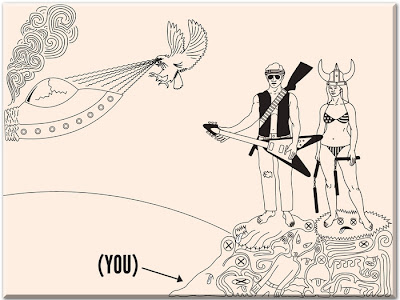
-
How do we know the subjective world isn't just objective?I think that epistemology leads to and structures ontology, not the other way around. What we believe we know, determines what is, not what is determines what we think we know. — Cavacava
So our reason imposes structure on the world?
I wonder what happens if we do make contact with Aliens at some point. Who is the measure of what is, us or them? What mediates between the two? -
How do we know the subjective world isn't just objective?The objective as you have described it has no meaning, it may exist and have existed but that existence is meaningless without us. It was all meaningless until we came along and gave it meaning. It more a question of how we play into the schema of things, since there is no schema without us. — Cavacava
Meaning is a loaded word. Ontological structure is better. Does the world have an ontological structure independent of us? Is it differentiated somehow? If so, can we know this? Do any of our current schemas approximate it? -
How do we know the subjective world isn't just objective?When you say 'objective' what do you mean? Are geometry, physics, and the other sciences all strictly objective, or are they also subjective. Or when you say objective do you mean 'real' as existing in the world outside of us, separate from us as things? — Cavacava
Mind-independent. The objective world doesn't depend on us perceiving, knowing, or talking about it. It's objective precisely because it doesn't vary based on individual perception, cognition, etc. It's also objective in that it doesn't depend on us being human. Man is not the measure, if anything is truly objective.
Didn't Kant connect the subjective with the objective, uniting or mediating them with reason which is objective universally necessary, reason which is the paradigm example of objectivity, yet is also a subjective ability, — Cavacava
Sure, if you accept Kant's account of reason. Then we can't know the noumena. Evolution is only true as it's correlated to us, not independent of us, even though evolution claims a time and process long proceeding humans, leading to human reason. -
What features could an non-human sapient being have (you can post non-sapient too)?Side Note:
The Solaris alien is compared to an infantile God at some point in the book. I think it would have served as a decent explanation for the Cyreneacs of our experiences. -
What features could an non-human sapient being have (you can post non-sapient too)?Stanislaw Lem's sentient ocean in the book Solaris which has been made into two movies. He was critical of popular science fiction depicting aliens as either humanoid or something that comes from our nightmares. In either case, meeting aliens is about us. In the most recent adaptation of Solaris to film, a recording of a scientist studying Solaris claims that our enthusiasm for space exploration is a sham. We're looking for mirrors, not the truly other (aliens).
The book and movie Contact get around this problem by having the aliens take the shape of a human known by the characters (Jodi Foster's in the movie). This is to make communication more comfortable (and possible for us).
Which is interesting, because in Solaris, a deceased loved one appears to the main character, possibly as an attempt at communication, but unlike with Contact, it's painful and incomprehensible. -
Religious experience has rendered atheism null and void to meIf science fiction is believed as correct, then a lot of absurd consequences follow — Metaphysician Undercover
Frozen block-time comes from the physicist Brian Greene. I don't know whether he came up with the interpretation, or just wrote about it in one of his books. -
Factor Analysis and RealismThis isn't about what might happen. Your already have your data set. The theory is that there are hidden factors explaining your data. You might be measuring one hundred different things, but they can be reduced to a dozen factors that explain those hundred measurements.
So if we want to explain why kids succeed or fail in school, and we measure a bunch of things, then we want to be able to reduce our data to what explains success in school. And then we can act on that (assuming an ideal world absent politics).
Now, on a possible anti-realist view of things, if there are no hidden factors, then some kids succeed and some fail, and there are a bunch of observations we can make. But there is nothing beyond that explaining the success and failure. Nothing beyond what we measure. This is in direct contradiction to what factor analysis assumes to be the case. There are things we cannot measure, so we have to resort to a statistical analysis to tease them out. -
Religious experience has rendered atheism null and void to meLet's use a hypothetical example. Human civilization lasts for a billion years, and it continues to advance over that time, until our descendants are virtually god-like compared to us. But they fail to create an FTL drive. They also fail to colonize the galaxy using generational ships.
If a Humean is asked why the galaxy isn't colonized, they will say that our future civilization just didn't do it. A necessitarian (pro causality) will say they didn't do it because FTL proved to be impossible, and the generation ships were just too slow to be worth it. The second explanation is more plausible, because if FTL is doable, then it would have been invented over a billion years. They just didn't do it isn't an explanation. But it works for the generation ships, which would be doable, but perhaps not worth it.
On the Humean view, neither is strictly impossible, as there are no laws ruling out galactic colonization. It just doesn't happen. On the necessitarian side, one is impossible and the other is not, but the second is a poor means of galactic travel, so it's not done, whereas FTL would be a great means of travel, but it can't be done, and thus the galaxy isn't colonized.
And maybe that's why we haven't received any alien visitors yet, or didn't find ourselves already part of a galactic civilization (this is basically Frank Drake's answer to the Fermi Paradox).
A Humean would just say that any aliens out there haven't bothered. A necessitarian would say they can't go fast enough to make it worth the effort. -
Factor Analysis and RealismRegardless, why does it work is the question. FA assumes there are such possibilities to be discovered. The math is based on that assumption.
-
Religious experience has rendered atheism null and void to meThe current theory of Thermodynamics says it is impossible. But one thing we mostly believe is that all of our current theories are wrong, and will be replaced by newer, better theories over time. — andrewk
Wrong or incomplete? Newtonian gravity is incomplete, not wrong in the sense that Relativity invalidates everything laid down by Newton. I guess it's a question of whether science is mostly building on and refining an edifice of knowledge, or completing restarting every big discovery (or paradigm shift, to use an abused term).
On the first view, we're not mostly wrong, we're just somewhat ignorant. We have a lot of the fundamentals in place, and now we're slowly learning how they fit together. We don't expect radical changes to the fundamentals in a thousand years, we just expect a far more complete structure of knowledge.
On the second view, science in a thousand years is radically different. We're not much different than medieval scholars in that regard. Our entire scientific understanding of the cosmos is way off, waiting to be eliminated in favor of better models. -
Factor Analysis and RealismI believe possibility is an epistemic situation when we don't know for sure what the factors are. It's possible that working memory is a factor in explaining the assessment results. But whether it actually is requires further confirmation.
The question is why there would be an actuality. Why would working memory or any latent variable exist, if the anti-realist view is the correct one? -
Religious experience has rendered atheism null and void to meThis Humean can't see any problem, because we don't know that we can't do those things. All we know is that nobody has managed to do them so far - from which we can infer nothing about what might happen in the future. — andrewk
Does physics admit to the possibility of making a perpetual motion machine at some point in the future, or is it ruled out as impossible? There are different categories of things that haven't been done yet. Some we know can be done, like setting foot on Mars. Some we think can be done, such as terraforming Mars to be self-sustainable for Earth life. Some we don't know, like cold fusion. Some we think impossible, such as FTL. And some are known to be impossible, like knowing the exact position and momentum of a particle.
How does a Humean explain the differences? It's one thing to say that I will never walk from the northernmost tip of North America to the southernmost tip of South America, and another that it's impossible for me to walk from here to the Moon. Why the difference? -
Religious experience has rendered atheism null and void to meAs opposed to Humans, yes. There's other weird creatures walking amongst us, like the Kantians and the Witty folk.
-
Religious experience has rendered atheism null and void to mePossibility is not actuality. There is no problem for the Humeans. They never claimed radical difference has occurred or must occur, only that it might. We can't do those things becasue, so far as we've encountered, they are only a possibility. To do them, they would have to be actual. And indeed, this means we might never do them at all. — TheWillowOfDarkness
The problem is the lack of explanation for why they might never be actual. Or more fundamentally, all the patterns we observe are brute. There's no reason the universe appears ordered. It just so happens to be that way, at least in our region of space, for the past few billion years. That's an awful lot of contingency. -
Religious experience has rendered atheism null and void to meI have. Up until last Tuesday, the USA had operated as a reasonably well-intentioned, albeit heavily flawed, democracy and world citizen. Then it suddenly elected a fascist as president. — andrewk
Non-zero probability of multiverse interference? Human free will violating laws of nature? Trump campaign got hold of Man in the High Castle video reels? -
Religious experience has rendered atheism null and void to meWhen we talk about possibility, we are discussing what's beyond the empirical, what the world cannot and cannot do based on logical reasoning, as a way of discounting the incoherent states which cannot (as opposed to "do not" ) exist. — TheWillowOfDarkness
Yeah, and our imaginations are not constrained by what nature can or can't do. We can imagine a perpetual motion machine (and people try to claim they've invented one), but nature allows for no such thing. Just like we can imagine FTL or time travel to the past, but we might never be able to accomplish either.
In fact, that's a problem for the Humeans. Why can't we do those things? -
Factor Analysis and RealismA short way of putting this is from the realist POV is that factor analysis should not work for actual data, unless there are real unobservables explaining that data. It can't simply be a useful statistical model, although the theory of what factors are doing the work is a human model. The anti-realist would need to explain why the factor analysis appears to work with real world data without resorting to unobservables as the explanation (they're useful fictions in the model for anti-realists, not the reason factor analysis works).
-
Religious experience has rendered atheism null and void to meThe point is that, at any time, it is possible, that the world may be radically different. But that doesn't mean that it it is. — TheWillowOfDarkness
But we have never observed this to be the case, so it could be just our imagination at work. Hume did point out a real problem with induction, but that doesn't mean nature has that problem. It could just be our epistemic limitations, and not something ontologically fundamental about the world. It's easy to imagine the sun ceasing to shine tomorrow, but what would that actually mean for nature? -
Religious experience has rendered atheism null and void to meMy opinion is that when and if we fully understand the laws, we will see that it could not have been otherwise. I think entropy is that way, although it's statistical and not absolute (no idea why nature has an apparent statistical quality to it, but apparently has something to do with the wave-like nature of things in QM).
-
Religious experience has rendered atheism null and void to meHave you not seen the science fiction movie out in the theaters right now called Arrival, or read the novella it's based on?
Anyway, the future having not occurred is just an epistemic situation for us. It's not because the future is radically different. It's because we haven't perceived it yet. Today isn't radically different than yesterday or five years ago. Those were all future days at one point.
If the frozen block interpretation of relativity is correct, then the future, past and present all exist the same, ontologically speaking. We just experience the illusion of time flowing. -
Religious experience has rendered atheism null and void to meIf I believe nature is governed by laws then I believe that the existence of anything at all, otters, thimbles or whatever you like, and the possible relations between, would cease the moment the laws that enable their existence ceased to govern. — John
What if it's the relationship between things, events, patterns which are the laws, and not something making anything behave or exist? If things are related in a certain way, then things can't help but be that way. The sun will shine tomorrow because of the relationship between matter, gravity and energy in the nucleus of hydrogen and helium atoms. It can't cease to shine until that relationship changes (conversion to heavier elements). -
Religious experience has rendered atheism null and void to meBut I cannot logically ground that belief in anything, and I accept that everything may change tomorrow - the sun not rise, people start floating in the air, pencils spontaneously combusting, enormous otters dancing the can-can inside a thimble, etc. — andrewk
Seems like a really large bullet to bite just to avoid supposing there is some sort of unobservable causality we infer from the patterns we do perceive. Also, I kind of wonder what's special about the future such that we could suppose it to be radically different than the past. Is it just because we haven't experienced it yet? -
How would you describe consciousness?Brain" is a term we use to describe a very broad class of information-processing structures build up with a network of neurons, sometimes we also speak of "electronic brains" and we also have artificial "neural networks" (which are non-biological) but we don't have a precise definition of what should be considered brain and what should not. — Babbeus
If you wish to apply computer science terms to a biological organ that shares some similarities with computing devices, then okay, I guess. Lots of people seem to want to do that. I don't think the brain is a computer, network or information processor, those are just the best technological metaphors we can come up with. -
How do we know the subjective world isn't just objective?nce you claim that some thing can exist without it's dependent, it is no longer the same thing. — Harry Hindu
Which is the dependent, mind or matter? Which can be reduced or explained in terms of the other? -
How do we know the subjective world isn't just objective?The problems arise, I think, when either that ordinary distinction is disputed (e.g., radical skepticism, subjectivism), or when it is applied to something other than judgements (e.g., dualistic phenomena, worlds, viewpoints). — Andrew M
Even under the ordinary distinction, we note the difference between dream experience and waking, but you do point out an interesting problem, which is that people can vary a great deal in their interpretation of things. I recall a thread (on the former site) where everyone agreed on the material being debated, but disagreed on what the philosopher had been arguing. It was to the point that one poster mentioned it as a vindication of idealism. And the material wasn't some dense postmodern text, it was Dennett, who is pretty clear on what he means. -
Who here believes in the Many World Interpretation? Why or why not?Of course, I have pretty much a logical positivist bent on such things. — Terrapin Station
There needs to be empirical evidence backing it up at some point, or else it will always remain an interpretation. If no empirical evidence can ever be given, then it's not scientific, but it's rather metaphysics, akin to saying we're living inside a simulation. -
Who here believes in the Many World Interpretation? Why or why not?Of all the gin joints in all the worlds, every equation and constant necessary for life is present in this one gin joint world we're in, while there are zillions in which the math doesn't add up. I'm thinking about it — mcdoodle
So this isn't a violation of Occam's razor? -
Who here believes in the Many World Interpretation? Why or why not?Well, the idea that the universe is spatially infinite was commonplace throughout the history of thought, and among today's cosmologists this is probably much closer to a consensus. — SophistiCat
So they believe in a real, physical infinity, as opposed to a mathematical infinity? I thought infinities in physics meant there was a problem with the theory requiring revision. Maybe it's just a personal preference, but infinity seems like zero or imaginary numbers to me. A useful concept that has no real embodiment. For example, there is such a thing as one rock (as in a single, countable, physical object), but there isn't actually zero rocks, anymore than there are physically zero unicorns, that's just a useful conceptual tool. -
How do we know the subjective world isn't just objective?don't think idealism does say that. What I think a Kantian idealism says, — Wayfarer
You mean a particular form of Idealism. If you had gone with subjective idealism instead, then there is no world independent of mind.
So it has an unavoidably subjective element; the illusion of materialism is that you can see the world, as if there were nobody in it, as if the subject has been bracketed out altogether (cf Nagel's 'view from nowhere'). But that conception is still a human conception, albeit one in which the quantifiable elements are fixed according to theory, and so which is inter-subjective, not merely or simply subjective. — Wayfarer
Which would mean that materialism is false, and there is no truly objective viewpoint human beings can access, although there may be a noumenal reality. -
So Trump May Get Enough Votes to be President of the US...It's interesting how Trump's election has ended up with a discussion on being gay in a Muslim country. Kind of funny.
-
So Trump May Get Enough Votes to be President of the US...What's the point of your reply? Any society consisting of more than one individual is going to entail limitations on absolute freedom. If one wants to be absolutely free, they can opt to live in the deep wilderness. Of course you lose the advantages of being in society, and thus the ability to do a great many things you can't on your own.
-
How do we know the subjective world isn't just objective?They way you know is to define these terms (subjective and objective) clearly. What is subjective without the objective? — Harry Hindu
What are dreams without waking? What is inner dialog without dialog others can partake in? What is consciousness without lack of consciousness? What is mind without mind-independent?
You mean like that? I suppose you can turn that around. What is mind-independent without mind (something idealists love to ask realists)? -
Brains do not cause conscious experience.You can also be shot in your sleep, and experience nothing.
-
So Trump May Get Enough Votes to be President of the US...I don't feel particularly oppressed despite all the diffusions of power. I can go wherever I want (money permitting), buy whatever I want, say what I want, organize protests, start a business, associate with whom I want, report my own news, run for office, move where I want, etc.
Is there a little too much surveillance and commercialism? Yeah, but it seems mostly aimed at creating more effective ads than denying me any rights. Would I feel more free in an Amish community? I doubt it. Have there been plenty of other societies which were less free? Absolutely. Could the political situation be reformed to make our votes count more? Most likely. But is it better than most political situations in the history of the world? Most likely. -
Brains do not cause conscious experience.Do they die from that or the resulting physical ailment?
Marchesk

Start FollowingSend a Message
- Other sites we like
- Social media
- Terms of Service
- Sign In
- Created with PlushForums
- © 2026 The Philosophy Forum