
-
The snow is white on MarsTherefore we have two options:
a. Extend the pre-existing word-concept to cover all versions of the manifest image and restrict the use of differential vocabulary to distinguishing between the two scientific images which underlie the manifest image.
b. Use different word-concepts to distinguish between variations in the scientific images which underlie the two more subtle distinctions in the manifest image. — John Doe
There is the manifest difference in temperature ranges often found on Earth where C02 ice sublimates into a gas, while H20 turns into a liquid.
Why do you use the word "image" for the scientific understanding? I get the manifest image, because it captures the notion of appearance for humans, given how visually dominant most of us are. But science is more abstract. Is "image" another word for description or model? -
An Outline Of Existential DependencyMaybe I could word this a bit better. All propositional claims that something is or is not the case, i.e., that someone asserts as either being true or false, are beliefs. — Sam26
That's an interesting way to define propositions. I would have thought propositions were stating either the truth or a falsehood, and it was up to us to find reasons to believe, disbelieve or suspend judgement about any proposition.
So why make the content of propositions belief? -
An Outline Of Existential DependencyBy the way all propositions are beliefs. — Sam26
There is intelligent life out there in the universe.
I neither believe nor disbelieve this as the evidence and arguments presented so far are equally good on both sides. Pyhrro and Sextus made this into a philosophy to live by where all belief was allegedly suspended
Carneides famously went to Rome to argue eloquently one day on behalf of Roman justice, just to turn around the next day and and refute everything he said.
I don't know about suspending judgment in everyday matters, but you certainly can in philosophy, or with statements that are unknown, such as the existence of life beyond Earth. -
Stating the TruthI just know that I dont get any enjoyment from philosophy anymore. It feels more like a very tense and nervous imperative to organize thought into some arrangement of leakproof compartments. — csalisbury
Well, there is the ancient skeptical approach. To paraphrase, the awareness of leaky compartments leads to ataraxia, in which one suspends work on leakproof compartments. After which, the leaks are no longer bothersome. -
A Wittgenstein CommentaryDo not confuse the idea of whether it is possible to doubt in some context, with what is sensible or rational to doubt, that is, because something is possible, this gives us no reason to believe it, or, it gives us no reason to doubt it. — Sam26
However, I just listened to a podcast on Parmenides, who provided a rational argument for disbelieving the empirical world in favor of the real world of the unchanging sphere.
It sounds silly, but what Parmenides did was build an argument based on the idea that all differentiation implies not-being, which doesn't exist. Red is not blue, cold is not hot, and so on. And since only being exists, there can be no actual differences, and as such, the world we experience is an illusion.
This in turn had a big influence on various ancient philosophers, including the Atomists, who said that it was atoms and not-being (the void) which are what really existed, and Plato, who said it was the eternal forms. And in Indian philosophy, you had the notion that only consciousness exists. So again, the idea that the empirical world is somehow an illusion.
Now we might very well take issue with those positions, but it does show how you can go about disputing the empirical, and thus the hinge propositions.
The reason for mentioning the above is that although Wittgenstein is pragmatically right in that the hinge propositions form the background for our understanding, they don't necessarily refute skeptical arguments, to the extent one is inclined to listen to skeptical reasoning.
In everyday life, they dissolve our skeptical worries, but that wouldn't sway someone like Parmenides. You would have to attack his argument directly, instead of pointing out that he's writing his poem with one of his hands. -
A Wittgenstein CommentaryOne does not play the language-game of resolution (that is, resolving knowledge claims and doubts) with oneself. — Sam26
Does this mean that a human being raised by wolves couldn't come up with the game, or does it mean that the last survivor of an apocalypse couldn't play the game?
Because it seems like I can certainly play the game when I'm alone. I hear footsteps late at night in an old house by myself. I go investigate and realize it's just the house creaking along with my imagination. -
An Outline Of Existential DependencyMy take is all thought and belief consists of drawing correlations between different things, visual memory could be one of those things... — creativesoul
Probably olfactory as well for many animals. Reading a little bit on how dog's experience the world of smell was rather mind blowing. -
An Outline Of Existential DependencyTo be honest, I really don't know what's going on in the mind of a prelinguistic person or animal. My intuition and my metaphysics says there is much more going on than we realize. What that is, again, I don't know. You're going beyond my claims, and my claims are going beyond what Wittgenstein would say. — Sam26
Temple Grandin was of the opinion that animals thought in pictures instead of words, and that a lot of people have a hard time with this because they're thinking is so dominated by language. But she calls herself a visual thinker who has to translate pictures to words in order to communicate with others, being that she's a high functioning autist. -
A Wittgenstein Commentary\We don't learn to use the word pain based on our private sensations, but we learn to use the word in association with others — Sam26
I'm saying it's necessarily both. Consider that humans wouldn't have developed pain talk if we didn't feel pain, just like we wouldn't have a color vocabulary without eyes.
I'm saying that how we talk about pain is necessarily social and not private. — Sam26
When I say I feel pain, I'm referring to my private sensation of pain. You might infer that I'm in pain because I'm jumping up and down and screaming. Or not, because I've mastered stoicism. -
A Wittgenstein CommentaryFor example, getting back to religious examples, if I say in ordinary speech, "I know that God speaks to me," is this a correct use of what it means to know? — Sam26
The thing here is that people have often used subjective criteria for knowledge. The Christian will probably say they know because their experience of God gives them evidence just like perceiving seeing the sun lets us know the sun exists.
They will probably reject the idea that knowledge is limited to the empirical or the deductive. The gnostics explicitly advocated for a kind of subjective relavatory knowledge. -
A Wittgenstein CommentaryOrdinary use I believe refers to the ordinary way in which a word was developed. — Sam26
That makes sense. So going back to your previous posts on Moore's demonstration that he has hands as proof of a physical world, ordinary language supports naive realism. This was fine until people starting reflecting on all the ways our perception can either fool us or is relative. And also how perception is based on the kind of creatures we are.
That leads itself to the possibility of skepticism. So if I can have a hallucination of a tree, then questions rise about the nature of perception. On a totally naive view of vision, we're just looking out at the world as it is. The tree I see is the external world tree. But humans came to realize perception is a lot more complicated than just looking out at the world.
So then we see a potential problem with ordinary language. It can be based on naive intuitions. The sun rises and sets. The earth is stationary with four corners. I feel in my heart and courage arises in the intestines. Living things have an animating life force, which could be the blood or the breath. And so on.
Claiming that philosophy goes wrong by abusing the ordinary use of words is ignoring how the ordinary usage of words often enough starts out wrong. -
A Wittgenstein CommentaryWe see others in pain and we learn to use the word in connection with the rules of the language-game. — Sam26
This leaves out the part where we also feel the pain and learn to associate our sensation with how other people are talking and behaving. Our ability to do this probably has something to do with being able to empathize with others and infer their mental states. Thus psychopaths exhibit a kind of deficit in not being able to understand why people feel certain ways, only that they can be fooled by faking the emotion.
There are some rare cases where individuals do lack an ability to feel pain. If you snuck up and pricked one of them with a pin, they wouldn't yell "Ouch, that hurt!". Nor would they go to a doctor to complain about some bodily pain.
Now imagine a world where we evolved without pain sensation. Harm would still exist as a word, but not pain. Similarly, if we were intelligent cave bats, visual concepts would not form part of our language.
How do I know when I'm in pain? Because I feel it. Not because I can speak it, but because it hurts. -
Stating the TruthAnd science is also about utility. It's about predictability, not truth. Any decent scientist will say that he is only trying to come up with models that can predict things, not models of how things really are — ChatteringMonkey
According to whom? Prediction is only one part of science. Understanding the way things are is another. -
Stating the TruthYeah the thing in itself… nevermind that there is no way of going beyond our senses, of going beyond appearences. — ChatteringMonkey
But that isn't true. We have the ability to infer what we can't sense by how it interacts with what we can perceive. We can also figure out which properties are perceiver-independent, because they don't vary and are not contingent upon being perceived.
Science, math and technology take us way beyond the senses. -
Stating the TruthThe problem is you're trying to get beyond perspective, and the utility truth has for us. Truth for truth sake... — ChatteringMonkey
What does truth have to do with utility or perspective?
I understand truth to be the way things are, regardless of whether it appears that way to us, we know it, or we care about it.
And that's how we typically use the word. He's not ready to face the truth, the other party is in denial about the environment, you're wrong about the distance Andromeda is from Earth.
Even if we did primarily mean utility or perspective for truth, we would need another word for the way things are. -
Stating the TruthI'm not entirely happy with my response.
It's true that pure snow looks white to humans. But is it true that snow is white in the same way that snow is made up of water crystals?
Some people might naively say "The sky is blue on a clear sunny day" is an unassailable truth, but upon thinking about it for a moment, we realize the sky looks blue to us because we only see visible light and not all the other radiation in the atmosphere.
So when we say it's true that snow is white or the sky is blue, do we mean it's true that's how it appears to us, or it's true that both are colored that way regardless of whether anyone is looking? -
Ontology and Experience704
Just what is an "ontological experience" — Ciceronianus the White
Would having an experience of "thinking, therefore I am" count? Or feeling existential dread? -
Stating the TruthCan you actually go any deeper, — Sapientia
We can and do go deeper with science, which is a combination of reason, observation and testing. We can't see subatomic particles or radio waves. But we can infer them from instruments that detect them, or theories which form the best explanations we have for explaining the world.
And as far as perceptual illusions go, we have our other senses to help us. If the stick looks bent, we can feel that it's straight. We can then figure out that light is being refracted by the water.
We can also make tools that aid our senses, like microscopes and radios.
With your colour picker results, you're also looking at something, except this time you're trusting your perception instead of subjecting it to the same level of doubt. — Sapientia
I trust the computer to give me accurate color information about what's displayed on the monitor as it's not subject to color illusions.
or is what seems to be a deeper layer actually just another illusion? How could you tell? — Sapientia
That's a possibility that's hard to entirely eliminate. Could we ever tell if we were inside a simulation? Maybe if we discovered some discrepancies, or the nature of simulations is structured in a way that physics tells us the universe is, or something.
But it doesn't even need to be simulation. If our best scientific theories tell us that time doesn't flow, and the universe is a hologram, then the world we perceive is to some extent an illusion. But we already knew that. A solid table isn't solid the way it looks or feels to us. This was a surprise, and there have been plenty of them.
The table is solid.
Is false under the old concept of solidness, in which tables weren't mostly empty space. It's false on the everyday notion of solidness the way "sunset" and "sunrise" are based on appearances and not the Earth's rotation.
And that's why saying that the truth is just a matter of looking when it comes to empirical claims is a bit suspect. -
Stating the TruthThat is just a question of unwrapping the event and attributing truth to the proper parts of the statement. There is nothing false about it, simply misleading to an average perceiver with average expectations. — Akanthinos
Simply misleading could be simply deadly if one sees a mirage in the desert, mistaking it for an oasis. Anyway, my point is that there is a difference (at least sometimes) between how things appear and how they are. If the world looks colored, that doesn't mean it actually is colored, that's just how it appears to us.
If the white snow is actually something else made to look like snow in order to fool me, then "The snow is white" is a false statement. -
Stating the TruthUltimately, it seems, that's a self-defeating position. If you can use illusions to doubt appearance, then why can't you use it to doubt your attempt at verification by colour picker. You've opened the floodgates, have you not? — Sapientia
My point was that we have a distinction between appearance and reality because sometimes they differer. Which means that just looking to see that the snow is white isn't always good enough to determine the truth of the matter.
Otherwise, "The sun rises and sets" would be true just because it appears like the sun is moving through the sky, when we now know it is the Earth turning. As such, sometimes investigation has to go a bit deeper than just looking and seeing that something is the case. -
Stating the TruthThis relation is symmetrical. The world is also the world that appears coloured to such creatures as us. — Akanthinos
True, but we could also apply this to various illusions.
The stick is bent in water is false even though the light being refracted by the water makes it appear bent. And thus begins the appearance/reality distinction.
Is the following statement about the picture below true or false?
The surface of A is a darker shade of gray than the surface of B.
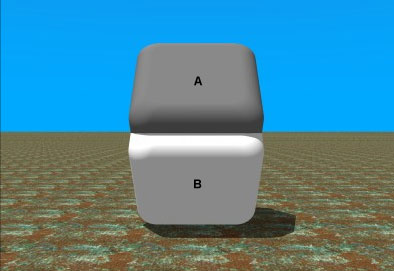
False, they're the same shade, which I verified with my color picker: RGB( 126,126,126 ).
The truth in this case is different than what it appears to be to us. -
A puzzle concerning identity - the incoherence of GenderJust as up until recently you couldn't have ADHD. — Baden
But you could still have the symptoms of ADHD. You would just be called something else like "scatter brained" or a free spirt, or lacking in the character needed to see tasks through.
Conditions still exist regardless of what label society wants to use for them, or whether they're even recognized. -
Stating the TruthAs usual, the missing words are being white “to us”. Truths are always ultimately psychological facts, not ontic ones, as they require that reality has the further thing of a point of view. — apokrisis
I don't agree with the always part, but your overall point does raise a problem I still have with deflationary notions of truth.
We can all agree that snow looks white when we see white snow. We can also agree that science tells us pure snow reflects all visible light into our eyes, which is why we see white.
But in a philosophy discussion, the question we typically want answered is whether the snow is actually white.
As such:
Ontologically speaking, the snow is white is true if and only if there is real, mind-independent snow that has a property of being white in a way that snow appears white to us.
It's not good enough to go look and see that the snow is white, because appearances can be false. And on a scientific understanding of how vision works, the snow only appears to be white to us. The colored in world we see around us isn't how the world is, it's how it looks for conscious creatures with visual systems like ours. -
Stating the TruthCan we get by without it? I think we can. — Banno
If so, then this would be a case where Wittgenstein was right about philosophers abusing language. -
Could time be finite, infinite, or cyclic?I pointed out that "every effect has a cause" cannot be either proved, nor disproved. How does what you have said relate to this? — Banno
Which means we can't know whether it's true. But it's also possible there is no truth to be had in this matter, depending on what one thinks about statements which are unprovable. -
Could time be finite, infinite, or cyclic?So we are agree that there are things we do not know. — Banno
Right, but that's different from whether there are things we cannot know, because of some limitation to our ability to know. We don't know whether there is life on Mars, but humans are capable of finding that out in time. We also don't know whether there is life in a galaxy 5 billion light years away, but we might not ever be able to know that given it's distance. -
Stating the TruthBut what is a "state of affairs"? And why bother to introduce it? — Banno
Because statements about things like the color of snow or the location of cats is about things which aren't statements. And if those things are what the statements say they are, then the statements are true. So you have a condition in the world referenced correctly by the statement.
It's a general form of what constitutes a true empirical statement. -
Could time be finite, infinite, or cyclic?
-
Could time be finite, infinite, or cyclic?How could you know that this is true?
How could you show it to be false?
So where does it stand? — Banno
Depends on whether truth can be something which is unknowable to us. -
Stating the TruthWhat makes "The snow is white" true is the snow being white. That's not a justification. — Banno
But this seems odd. You have a statement and then you have a state of affairs. The statement is true if the state of affairs is what the statement says it is.
State of affairs might be controversial, so substitute in actual, non-linquistic, intersubjective, empirical snow. That cold stuff that falls out of the sky on winter days that we ball up and throw at people which is usually white. -
Stating the TruthWhat has justification to do with truth? — Banno
Well, it's how you determine whether a statement is true or not. Or, it's what makes a statement true.
The snow is white. Okay, so something makes that true or false. -
If the dinosaurs had not gone extinctBirds [evolved reptiles] and reptiles, have two different brains in a line, running in series. — 3rdClassCitizen
And octopuses have nine brains - a central one with and one for each arm. -
Stating the TruthBut which, if any, of these are the Truth, as opposed to true? — Banno
Because the criteria would be different for each one? There is no one standard of justification that applies to all statements. -
Stating the TruthPerhaps truth is much simpler than philosophers tend to claim. Perhaps there is nothing to say about Truth. — Banno
Even if this is so, we might still want to ask whether a particular philosopher got it right. For example, Was Meillassoux correct that post-Kantian philosophy left philosophy (at least the continental side) in a state of correlationism where the world appears to us as if there were dinosaurs living millions of years before humans evolved?
Was Kant right that what gives rise to our sensations is unknowable? Is it true that what we perceive is not what is the case?
At which point we're asking for a metaphysical truth about the world. If it's not the world, then it could be a truth about our condition or language use. Is it true that meaning is use? Is existentialism true? Is morality objective? Is consciousness subjective? We want to know the truths about these things, even if philosophers fail to convince us they got it entirely right. -
Death: the beginning of philosophyWhat would that difference be? — Bitter Crank
How fast 13.7 billion years flies by? -
Death: the beginning of philosophy"Life goes by so fast when you're alive." my mother said. — Bitter Crank
So it slows down after your dead? I'm not sure about that. Seems like the first 13.7 billion years flew by. But maybe not existing is different than being dead. -
The language of thought.Consider this dream anecdote from Oliver Sacks regarding one patient:
Patient is a user of cocaine, and PCP to get high. Vivid dream one night, dreamt he was a dog, in a world unimaginably rich and significant in smell. Waking, he found himself in just such a world. "As if I had been totally colour-blind before, and suddenly found myself in a world full of colour." He did, in fact, have an enhancement of colour vision (" I could distinguish dozens of brown where I'd just seen brown before. my leatherbound books, which looked similar before, now all had quite distinct and distinguishable hues") and a dramatic enhancement of eidetic visual perception and memory (" I could never draw before, I couldn't "see" things in my mind, but now it was like having a camera lucida in my mind - I "saw" everything as if projected on paper, and just drew the uotlines I "saw". Suddenly I could do the most accurate anatomical drawings.") But it was the exaltation of smell which really transformed his world: "I had dreamt I was a dog - it was an olfactory dream - and now I awoke to an infinitely redolent world - aworld in which all other sensations, enhanced as they were, paled before smell." And with all this there went a sort of trembling, eager emotion, and a strange nostalgia, as of a lost world, half-forgotten, half recalled.
"I went into a scent shop", he continued "I had never had much of a nose for smells before, but now I distinguished each one instantly - and I found each one unique, evocative, a whole world." He found he could distinguish all his friends - and patients - by smell: "I went into the clinic, I sniffed like a dog, and in that sniff recognised, before seeing them, the twenty patients who were there. Each had his own olfactory physiognomy, a smell-face, far more vivid and evocative, more redolent, of any sight face". He could smell their emotions - fear, contentment, sexuality - like a dog. He could recognise every street, every shop, by smell - he could find his way around New York, infallibly, by smell. — Oliver Sacks from The Man who Mistook His Wife for a Hat
Now I don't know what it's like to experience the world in such a sensory state, but I can understand the story. So again, there's something wrong with saying that we can't talk about the beetle in our own box. -
The language of thought.That was funny!
An obvious rejoinder to the beetle-in-the-box is that we talk about our dreams, whose content is inherently private, since nobody else can experience what we're dreaming. The content of our dreams is epistemically closed off from others unless we talk about them.
If that doesn't count as private, then I don't know what does. -
If the dinosaurs had not gone extinctOr, more seriously, perhaps it is the Second Law of Thermodynamics that pushes the universe at this point of its evolution to form more and more complex structures, up to and perhaps beyond intelligent life (all to hasten its eventual heat death...) — SophistiCat
That's a really interesting thought.
Or perhaps dinosaurs could eventually produce a highly intelligent species. If they could produce something as un-dinosaur-like as birds (and some birds are pretty intelligent!), why not? — SophistiCat
Maybe so. There was a Star Trek Voyager episode where they came across advanced aliens who were descendants from Earth's dinosaurs, and left the planet for some reason before the big extinction event. I guess they just didn't leave any evidence behind for humans to find millions of years later, unlike fossilized bones and tracks. But it's just a fictional story.
Marchesk

Start FollowingSend a Message
- Other sites we like
- Social media
- Terms of Service
- Sign In
- Created with PlushForums
- © 2026 The Philosophy Forum