
-
There is No Secular Basis for MoralityA developed expression of this idea is found in the parable of the Good Samaritan, where moral concern or empathy is not confined to one’s own community but is extended even to detestable outsiders. — Tom Storm
So, you are saying that goodness comes from God and we know this because the Bible tells us it's so?
I think the more likely explanation is that we evolved something called biological altruism.
Altruistic behaviour is common throughout the animal kingdom, particularly in species with complex social structures –
For example, vampire bats regularly regurgitate blood and donate it to other members of their group who have failed to feed that night, ensuring they do not starve. In numerous bird species, a breeding pair receives help in raising its young from other ‘helper’ birds, who protect the nest from predators and help to feed the fledglings. Vervet monkeys give alarm calls to warn fellow monkeys of the presence of predators, even though in doing so they attract attention to themselves, increasing their personal chance of being attacked. In social insect colonies (ants, wasps, bees and termites), sterile workers devote their whole lives to caring for the queen, constructing and protecting the nest, foraging for food, and tending the larvae. Such behaviour is maximally altruistic: sterile workers obviously do not leave any offspring of their own—so have personal fitness of zero—but their actions greatly assist the reproductive efforts of the queen.
https://plato.stanford.edu/entries/altruism-biological/
Intuition seems to suggest that to behave altruistically is to reduce one’s own fitness, but with social animals, it increases the fitness of the group, and therefore is a behavior selected for.
This idea led to the development of the theory of Kin Selection and Inclusive Fitness
No doubt, we are much more likely to help someone we are related to, but if we see a stranger drowning, the instinct apparently kicks in, in some of us. We can get into other explanations, too, like how we mirror the behavior and emotions of others. Mirror neurons – which help us to understand the emotions of others - indeed do play a role in empathy.
https://positivepsychology.com/mirror-neurons/
It's likely borrowed from Paul writing in Romans where he says even of ignorant gentiles that morality is "written on their hearts". — Tom Storm
No, as a people of oral traditions, their history and moral codes, ideas of justice, etc. were engraved on their hearts long before the Europeans came along. They did not need to "borrow" the phrase from the Europeans.
In fact, we can look at different cultures, too, and find that the Christians are not the sole possessors of morality. The following passage from The Tao, written around 2500 years ago, hints at the Golden Rule.
Did the Christians "borrow" these ideas from Lao-Tse?
Heaven is long-enduring and earth continues long. The reason why heaven and earth are able to endure and continue thus long is because they do not live of, or for, themselves. This is how they are able to continue and endure.
Therefore the sage puts his own person last, and yet it is found in the foremost place; he treats his person as if it were foreign to him, and yet that person is preserved. Is it not because he has no personal and private ends, that therefore such ends are realised?
The highest excellence is like (that of) water. The excellence of water appears in its benefiting all things, and in its occupying, without striving (to the contrary), the low place which all men dislike. Hence (its way) is near to (that of) the Tao.
The excellence of a residence is in (the suitability of) the place; that of the mind is in abysmal stillness; that of associations is in their being with the virtuous; that of government is in its securing good order; that of (the conduct of) affairs is in its ability; and that of (the initiation of) any movement is in its timeliness…
When gold and jade fill the hall, their possessor cannot keep them safe. When wealth and honours lead to arrogancy, this brings its evil on itself. When the work is done, and one's name is becoming distinguished, to withdraw into obscurity is the way of Heaven.
When the intelligent and animal souls are held together in one embrace, they can be kept from separating. When one gives undivided attention to the (vital) breath, and brings it to the utmost degree of pliancy, he can become as a (tender) babe. When he has cleansed away the most mysterious sights (of his imagination), he can become without a flaw.
In loving the people and ruling the state, cannot he proceed without any (purpose of) action? In the opening and shutting of his gates of heaven, cannot he do so as a female bird? While his intelligence reaches in every direction, cannot he (appear to) be without knowledge?
(The Tao) produces (all things) and nourishes them; it produces them and does not claim them as its own; it does all, and yet does not boast of it; it presides over all, and yet does not control them. This is what is called 'The mysterious Quality' (of the Tao).
You can read The Tao online for free at this link -
https://www.gutenberg.org/files/216/216-h/216-h.htm -
There is No Secular Basis for MoralityWhat indigenous group/person? I am extremely skeptical of a quote like that from a category of people known to be amenable to superstitions and creator myths. — AmadeusD
Ten years ago I wrote a novel that took place in pre-revolutionary 18th century New York (then a province, and not yet a state) and did extensive reading about the Haudenosaunee as well as the Lenape of Pennsylvania. I can’t remember the exact source, but the quote is clear in my memory.
Despite popular opinion, the Indigenous people had a sophisticated code of moral conduct – but it was not a written code – “imprinted upon their hearts” – that they followed with constancy.
And their interactions with the colonials showed that even though they had a “Big Book” they often did not practice what they preached.
For some fascinating insights into the Native character of over 200 years ago, I recommend reading History, Manners, and Customs of the Indian Nations, Who Once Inhabited Pennsylvania and the Neighbouring States (first published 1819).
At 346 pages, it is a detailed look. It was written by Rev. John Heckewelder, a Christian missionary who learned their language and lived among them for many years.
You can read the book for free at Gutenberg at this link –
https://www.gutenberg.org/files/50350/50350-h/50350-h.htm -
There is No Secular Basis for MoralityYes, although some religious folk will say that since goodness emanates directly from God’s nature, we are good because it reflects God’s nature, with empathy being a part of the divine character. This would predate religion. — Tom Storm
But still depends on an external source for empathy - a god - and empathy is not that but something we developed as we evolved as a social species.
God doesn’t solve any problems when it comes to making moral decisions. — Tom Storm
I recall a quote from an 18th century Indigenous person - who said to a colonizer - "You white folk need a Big Book to tell you what is right, but what is right is engraved upon my heart." -
There is No Secular Basis for MoralityIt's absurd to think that humanity was a group of brutish, evil monsters without empathy before religion was "invented." Many aspects of religion were outgrowths of capacities well advanced by evolution in the human species before they ever decided to link these capacities with supernatural beings.
Empathy came first, religion followed.
But religion got itself all tied up with all kinds of hypocrisies. And, humans just got smarter, and reject fairy tales as fact.
But empathy remains, since we are hard-wired for it. -
Transwomen are women. Transmen are men. True or false?calling a woman an adult human female is not dogma. Its a description. — AmadeusD
One word is not a description. We need the fullness of language to describe any one person's experience. We need the fullness of intricate meaning and understanding.
As Henry Miller wrote -
“I do not believe in words, no matter if strung together by the most skillful man: I believe in language, which is something beyond words, something which words give only an adequate illusion of.” -
Transwomen are women. Transmen are men. True or false?And I'm noting this is not an argument about 'want', but what 'is'. — Philosophim
What is a woman? — BenMcLean
You are both asking for dogma which runs the risk of invalidating and erasing transgender persons.
Dogma is authoritative – as if only it is the truth – as if identification by others should supersede self-identification.
The experiences of transgender persons tell us that the definition of “woman” or “man” cannot be based solely on the physical body at birth.
I am more a skeptic than a dogmatist, encouraging open-mindedness and questioning rather than stifling them. -
Transwomen are women. Transmen are men. True or false?This is a language argument. — Philosophim
I was arguing your use of the word "want" -
Transwomen are women. Transmen are men. True or false?than getting something you want. — Philosophim
Let's first focus on this - reducing the need for authenticity to a "want." You seem to imply that transgender persons are somehow selfish should their claim to their true identity be their goal. Do you apply this judgement only to transgender persons, or to all persons?
Global warming. — Philosophim
Invalidating and erasing a scientific theory is not the same as invalidating and erasing a state of being.
Although, ignorance applies in both cases.
Are you arguing against clear language to get something beyond that language that you want? Or a — Philosophim
If the phrase 'Trans men are men" isn't proper language, shouldn't it be clarified? Once its clarified, you both have an area of agreement on a basic premise, then you can argue what trans men should be able to do in society. — Philosophim
Trans men are men. Trans women are women.
"What they should be able to do in society?" - I believe you are talking about using public rest rooms and playing in sports. Well, I have to tell you, only the people who pretend to be the gender that they are not are the danger in rest rooms, and barring trans persons from the rest rooms will not solve that problem. They are not the problem.
In sports - a transgender woman would still have the strength of a man, so should not be allowed to enter as a woman in sports. But - I will mention - - trans people make up less than less than 0.002% (10/500,000) of US college athletes, and even fewer of recent Olympians (0.001%) identify as trans.
A total red herring.
Here's the thing - the current war against transgender persons in the US is not about using the language properly, it is a campaign based on disgust - and disgust should never be the basis for policy.
You made no comment about Bree Fram, that I introduced to you? -
Transwomen are women. Transmen are men. True or false?There is zero emotional considerations here. This is not about politeness, social standings, or how we ought to treat trans individuals. This is about language. — Philosophim
This is disingenuous.
How the language is used will decide if it is a weapon or not used against transgender persons. -
Why is the world not self-contradictory?You is an absolute global unique fact. It's coordinate zero so to speak. There are no multiple coordinate zeros, unless there are multiple disjoint worlds, at which point one of the worlds would become the true coordinate zero again. — bizso09
Hmm ... interesting. The thought that comes to my mind is that none of us live in absolute isolation. My brain operates in a loop intimately connected to the environment.
Stimulus detected > analyzed > response -
Why is the world not self-contradictory?Does that mean that the world is fundamentally self-contradictory? — bizso09
This immediately made me think of the balance of opposites we find in this world. I'm not sure if this is what you are looking for, but various selves do not necessarily contradict, but exist upon a spectrum with opposites at each end. Individuals vs. the whole.
And this reminded me of some of the opening lines in The Tao -
... All in the world know the beauty of the beautiful, and in doing this they have (the idea of) what ugliness is; they all know the skill of the skilful, and in doing this they have (the idea of) what the want of skill is.
... So it is that existence and non-existence give birth the one to (the idea of) the other; that difficulty and ease produce the one (the idea of) the other; that length and shortness fashion out the one the figure of the other; that (the ideas of) height and lowness arise from the contrast of the one with the other; that the musical notes and tones become harmonious through the relation of one with another; and that being before and behind give the idea of one following another. -
Gender Identity is not an ideologytransgenderism (is that a word?) — Ecurb
I'm not sure. It doesn't sound right, does it?
Acceptance of trans people (and that includes using their new names and pronouns) is a matter of decency and good manners. — Ecurb
Agreed.
If some transgender individuals are "born that way" and others are not, would it be reasonable to discriminate against the latter group, but not the former? — Ecurb
I would say that discrimination is never reasonable?
Although I am not quite sure what you mean. Could you help me understand with an example? -
Gender Identity is not an ideologywe can accurate determine whether there is a direct correlation between being trans and being autistic. — AmadeusD
then the independent variable would be "autism/non-autism" and the dependent variable would be the incidence of transgenderism
If it were not a self-image problem, we would not be hearing about it. — AmadeusD
Let's look at this again. I had some difficulty with the word "image" because it tended to ignore the deeply embedded self-identity created in one's mind. But maybe that's where self-image is created, too. So, with transgender persons, I would imagine that the image they have of themselves does not align with the image portrayed by their outside body. -
Gender Identity is not an ideologyBut this is not scientific certainty. — Philosophim
And your theory is?
We're still not quite certain what causes people to be gay, much less transgender. — Philosophim
here's the thing - why is a scientific theory need to believe people when they tell us who they are? Yes, science marches on, but if I talk face-to-face with a person who shares their experience, I am going to try to understand, not judge them.
Actually, people do decide to become trans gender, if you're talking about 'transitioning'. — Philosophim
Transitioning is care for a state of being recognized long before that.
As for 'trans gender' like a boy liking dolls, I just view that as sexist language. And I think you can decide to be, or not be sexist. — Philosophim
You are still not getting the concept of gender identity being imprinted in the brain.
No, transgenderism is absolutely an ideology. — Philosophim
Not to the transgender person.
Gender, the term in itself, is not an ideology. Its simply an assertion that people have a belief about how men and women should act in society. — Philosophim
No, no, no, no, no. Please re-read all of my previous posts.
its just noting that when transgender groups start to ask for language and laws to change, that is by definition a sociopolitical aim. — Philosophim
All they ask is that basic rights not be denied
Tell me - do you approve of the Trump administration barring all transgender persons from military duty?
Meet Bree Fram -
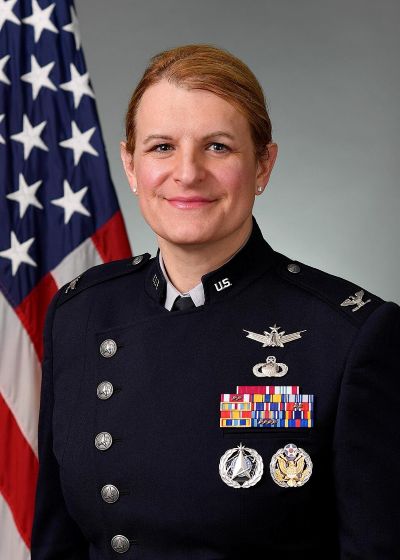
As a kid, Bree Fram dreamed of becoming an astronaut. After 9/11, she joined the Air Force and deployed to the Persian Gulf, where she tested new technologies to protect convoys from improvised explosive devices. That assignment led to her specialty: managing teams that built novel systems. (One came up with tools that could be used to take over an attacking drone, forcing it to fall from the sky.) The military kept sending Fram back to school, and her advanced degrees piled up. When the Space Force was created, she drafted its blueprint for acquiring the technologies of the future and ensured that new initiatives didn’t get smothered by bureaucracy. Her mission was cut short by a biographical fact: Fram is transgender. Upon arriving in office, Trump barred from service anyone who did not identify with their birth gender.
The Purged
It is attitudes like yours that make it so difficult for people like Bree
But until then, its a lie or embellishment from an ideological group that wants control and power. — Philosophim
Oh dear. So you are operating from fear, rather than reasoned thinking?
We might also say its selfish, narcissistic, deluded, and/or sexist. — Philosophim
I feel sorry for your transgender friend you have mentioned in the past. I don't think you can be a very good friend.
Ideologies can gain power because they assert 'their truth'. — Philosophim
You fail to grasp the argument. Transgender persons only want to live their own truth.
So ask away. — Philosophim
Why can't you just accept them as they are? -
Gender Identity is not an ideologyI just cannot understand what it says about my point there - emotions arise in the mind. They are mindstates. — AmadeusD
I suppose, but like all neurological responses, they begin with sensory input
So yeah, standard method would be to introduce a control group for each aspect you're studying. That wouldn't be hard, but you'd have the data to compare between all four groups. — AmadeusD
But why would you want to see this:
I would want to see a comparison with autistic non-trans people and non-autistic trans people. — AmadeusD
Seems to me this is hte case for most self-image problems. — AmadeusD
Herein lies your misunderstanding. Being transgender is not a "self-image problem." -
Transwomen are women. Transmen are men. True or false?I could never understand the obsession with the need to have a rigid definition of "man" and "woman." As if the fate of humanity rested upon it. Can't we just accept that we all humans, riddled with variation?
It seems there are a lot of people out there taking the absurd position that, "You cannot be what you are, because I do not know what you are."
Well, then, learn.
Learn.
Paradigm shifts are difficult. We have to let go of old beliefs that no longer fit the new reality, and our instinct is to be resistant to that. But you risk nothing when you try to understand where someone else is coming from.
Approach the issue as a fellow human, not some pedant. -
Trump's war in Venezuela? Or something?was Trump so petty that he had to through Machado under the bus because she got a Nobel prize? When is Trump we are talking about it, it might be really the reason. — ssu
Yes, he is that petty, and egocentric. According to reporting from the Washington Post, Trump is not installing the legally-elected Machado because she accepted the Nobel Peace Prize instead of giving it to him -
The day before, Trump had effectively dismissed the prospects of Venezuela’s democratic opposition, including Nobel Peace Prize winner María Corina Machado, whose stand-in candidate, Edmundo González, won more than two-thirds of the vote in an election last year that saw Maduro refuse to leave office.
“It’d be very tough for her to be the leader,” Trump said when asked about Machado on Saturday, adding that she “doesn’t have the support or the respect within the country.”
[…]
Two people close to the White House said the president’s lack of interest in boosting Machado, despite her recent efforts to flatter Trump, stemmed from her decision to accept the Nobel Peace Prize, an award the president has openly coveted.
Although Machado ultimately said she was dedicating the award to Trump, her acceptance of the prize was an “ultimate sin,” said one of the people.
“If she had turned it down and said, ‘I can’t accept it because it’s Donald Trump’s,’ she’d be the president of Venezuela today,” this person said.
This act of his alone demonstrates he does not have the interests of the Venezuelan people in mind. -
Trump's war in Venezuela? Or something?Why would it shock you if it wouldn't surprise you? — frank
It would be a shock to the system but not unexpected from Trump -
Trump's war in Venezuela? Or something?
I'm not a fraidy-cat person, but I fear for the precarious position the world is currently in.
Gangsters are in charge.
I'm Canadian, and though it would shock me it would not surprise me if Trump moves on Canada. -
Trump's war in Venezuela? Or something?I doubt there was such forethought... and the recent news indicates otherwise. Hitting someone generally results in their getting their back up, rather than their becoming more cooperative. — Banno
From an article linked to the one you linked -
"But the assumption that forcefully overthrowing the current government will lead to a smooth transition to democracy is dangerous," he said.
"Venezuela is full of armed groups that would resist the regime's collapse and undermine any effort to restore the rule of law. Generals currently loyal to Maduro might install an even more repressive leader.
"Without a viable strategy for what comes after the government falls, ousting Maduro could lead to even greater repression and hardship for Venezuelans." -
Trump's war in Venezuela? Or something?No oil company will invest in infrastructure in the circumstances Trump has created. — Banno
My guess is that he has them lined up already, since he has stated an agreement publicly.
But your point is taken - it will be quite the unstable set of circumstances. -
Trump's war in Venezuela? Or something?
Governance and policy are inconveniences, minor details, (as are people affected) that Trump is not interested in. At home, he leaves that stuff to Vought, Miller and Hegseth. (And they, in their self-serving ways, feed Trump's delusions that he is indeed the god of it all.) The only thing that concerns Trump is how he is going to get his cut of the pie. -
Trump's war in Venezuela? Or something?Whose power play is this? — ssu
Putin, Xi Jinping, Trump
The day after USA took Venezuela, this is what Trump said to Fox news -
"We have to do it again. We can do it again, too. Nobody can stop us. There's nobody that has the capability that we have."
https://www.instagram.com/reel/DTF5r13EXTR/?utm_source=ig_web_copy_link&igsh=NTc4MTIwNjQ2YQ== -
Trump's war in Venezuela? Or something?Ha! Folk think there's a plan... — Banno
There doesn't seem to be any plan for exactly how they are going to "run" Venezuela. Apparently, there is no plan to install the rightfully-elected. So, we'll have to wait and see how much the current power vacuum destabilizes the country.
It seems the only plan is "get the oil." -
Trump's war in Venezuela? Or something?This is actually a plan to get rid of the US from being the sole Superpower. And Trump is eager to carry out his role, if he gets the billions he wants. — ssu
Whose plan is it?
The way I understand it, Putin, Xi JInping and Trump are in a quid pro quo threesome, each concerned with their own imperialist goals.
Trump is certainly in it for the money, but I think he wants to expand US power, not eliminate it.
First of all, Russia isn't a superpower and China won't ever overtake the US, even if it came very close to overtaking it, — ssu
No, they won't be taking over one another, but leaving one another to their own sphere of influence.
Currently, it's Trump gets Venezuela, Putin gets Ukraine, and Xi gets Taiwan.
Hence when you say that there are three Superpowers, you have already swallowed the Kremlin/Beijing rhetoric. Where does this defeatism come from? — ssu
I concede that maybe I shouldn't have used the world "superpower" to describe Russia. Maybe "power at play" would have been more accurate. -
Trump's war in Venezuela? Or something?We just freakin' annexed Venezuela? — frank
There’s a plan in place to carve the world up into three superpowers.
In George Orwell’s 1984, the author envisaged such a world run by Oceania, Eurasia, and Eastasia. What we find in the story:
Officially the three superpowers were permanently at war, with all three constantly forming new alliances, and breaking them, and changing sides. But in reality, as Big Brother’s representative O’Brien finally explains to Winston Smith, the ostensible war was a sham. Each and all the superpowers’ leaders were interested only in power and in personal aggrandisement; and they perceived, as despots have done throughout all history, that the easy the way to keep their own unruly populations in check was to be at war, or to be seen to be at war, so that the people felt obliged to unite against a common enemy.
How prescient was Orwell in describing our modern-day reality, where these three powers – Trump’s USA, Putin’s Russia, and Xi Jinping’s China – vie for power?
Will they work together to divide the world up into three spheres of power and influence – three sections of colonies controlled by the three super-powers?
What does Trump mean in invoking the Monroe Doctrine as a “Trump Corollary” in a pledge of “potent restoration of American power and priorities” to the Western hemisphere?
What does he mean when he says, “We’re going to run the place.”
Trump has stated that he wants to take over Canada and Greenland. Now, he’s got Venezuela. Who is next? Should Carney shut off the geolocation on his phone?
According to one analysis:
Trump appears unperturbed by stronger Chinese and Russian spheres of influence – as long as he has a domain to match Xi Jinping’s and Vladimir Putin’s.
Does Trump want the entire Western hemisphere?
And now, Trump’s support of Putin and Russia is starting to make more sense.
Trump would give Ukraine to Putin, and in return Putin would give Venezuela to Trump.
Venezuela is Russia's most important trading and military ally in Latin America. Russia recognized Nicolás Maduro as the president of Venezuela
This was a case of “You keep out of my face, I’ll keep out of yours.”
Putin gets his prize in Europe, and Trump gets trillions of dollars in oil.
You think it is a coincidence that Trump sent warships into the Caribbean one day after his meeting with Putin in Anchorage?
According to the Congressional testimony in 2019 of Fiona Hill, this kind of deal was on the table during the first Trump Administration
https://i.postimg.cc/hG078Z7y/Fiona-Hill.jpg -
Michel Bitbol: The Primacy of ConsciousnessBut here, you're singling out one layer in this complex and dynamic whole, and claiming that 'everything' is derived from that layer. That is, after all, exactly what reductionism does - it reduces (or tries to reduce) consciousness, intentionality, rational inference, and so on, to the level of the so-called 'hard sciences', where absolute certainty is thought to be obtainable, where everything can be made subject to so-called 'scientific method'. I'm not going to try and give a detailed account of what I think it wrong with that, other than registering it here. — Wayfarer
Thank you for that. I respectfully hold a different point-of-view on the matter (pun intended).
"Reduce" is a funny word. I rather think of the functioning of the brain as a grand, astonishing, glorious, stupendous culmination of the evolutionary process. I am blown away when I think of it, as much as I am blown away when I gaze upon a star-studded night sky. I sense the bigness of it all, not the smallness. I can affirm the reverence that should be accorded life, even while understanding its source.
And - what do you mean? Reduced from what? The notion that there is something else - something more - accounting for our mental capacities - that human consciousness is a fundamental component of reality as opposed to a manifestation of natural processes, jerks humans out of all of nature, makes us something special that evidence and logic do not support. We are not "above and beyond" nature, but a part of it, just like everything else that exists. An anthropocentric understanding of consciousness to me is at best arrogant, and at worst narcissistic. -
Michel Bitbol: The Primacy of ConsciousnessA materialist explanation of a work of art would be that it comprises these materials that make up the surface on which the paint is applied, that the various pigments comprise such and such chemical bases, that react together in such and such a way as to produce the various hues and shades that are visible to the observer.
Do you think that such an account, no matter how detailed, will ever satisfy the requirements given here by Tolstoy? — Wayfarer
This interpretation misses a key point - it neglects the artist and the receiver of art, on who Tolstoy's focus was. A painting is merely matter, but a brain is "matter in motion" - involved in complex chemical processes, with capacities for sign, symbol, and meaning. -
Michel Bitbol: The Primacy of ConsciousnessIsn't science supposed to be explanatory? If science cannot answer the "what is it like?" question, isn't that a huge failure? — RogueAI
No. -
Metaphysics of PresenceIt is not just when someone else reads my writing that they find meaning you didnt intend. The very structure of intention guarantees that you will end up meaning something other than what you intended in the very act of intending to mean something. — Joshs
Art is in the eye of the beholder
The act of meaning is never purely present to itself. It is always contaminated by something other than itself. — Joshs
In this case, seen through the prism of the reader's experience -
Michel Bitbol: The Primacy of Consciousnessneuroscience cannot tell us whether we should believe a person who claims to not feel any emotions. — RogueAI
Well, Mary would probably be excluded from the study.
but doesn't provide any information about the content of the emotional state- the famous what is it like? — RogueAI
Why does this matter? -
Michel Bitbol: The Primacy of ConsciousnessIsn't it possible that a small unnoticeable change to a region of the brain could result in her condition? Or it could be a psychological condition that a brain scan will never pick up? — RogueAI
I guess so.
Sorry, I don't understand the purpose of these questions in the context of this discussion. -
Michel Bitbol: The Primacy of ConsciousnessLet's go back to my earlier question about Mary: Suppose Mary falls and hits her head and says she can't feel any emotions anymore. Her body still displays all the physical signs of emotions, but Mary claims to never actually feel any emotion anymore. How would neuroscience verify this claim? Suppose her brain is studied and everything is normal. Do we not believe her? — RogueAI
Sounds like Mary is either delusional or lying. Brain trauma can interfere with the emotional response, but that would manifest in physical symptoms, like monotone speaking, no change in facial expression, avoidance of eye contact and neutral body language (i.e. relaxed and staying still in a situation where they should be tense)
Also - if she really "felt no emotions" the injury to one of these structures would be detected: hypothalamus, amygdala, hippocampus -
Michel Bitbol: The Primacy of ConsciousnessOK, how does the brain produce consciousness? — RogueAI
If you read the entirety of my post, you'll better understand my position.
Besides, I'm not a neurobiologist -
Michel Bitbol: The Primacy of ConsciousnessI would like to hear about the measurements of emotion, from any one of the "whole battery of tests." — Patterner
Well, here is a link to the Depression, Anxiety and Stress Scale DASS-42 test to see how you're feeling
https://www.healthfocuspsychology.com.au/tools/dass-42/ -
Michel Bitbol: The Primacy of ConsciousnessLevine’s point is that even if we possessed a complete and correct physical account of the brain—covering all neural mechanisms, causal roles, and functional organization—it would still be unclear why those physical facts give rise to particular qualitative experiences. The gap appears when we move from physical or functional descriptions to phenomenal character: nothing in the physical story seems to explain why pain feels the way it does, — Wayfarer
Levine opens Chapter Four, The Explanatory Gap, in Consciousness with this -
“We want to know not only that such-and-such is the case, but also why it is the case. If nature is one large, lawful, orderly system, as the materialist (or the naturalist) insists, then it should be possible to explain the occurrence of any part of that system in terms of basic principles that govern nature as a whole.”
Well, give it time. There are plenty of scientists and philosophers who believe that science is on track to one day discover how perception associating with memories and feelings give rise to qualia.
And there are those who believe qualia is not a problem that materialism needs to address.
I’d also like to mention that it is not an objective of neurobiology to ask “why?” but to ask “how?” – and by the end of that chapter, Levine changes his scope –
I think the explanation of gappiness is a very deep problem, and … the problem of explaining how the physical gives rise to the phenomenal and the problem of explaining the peculiar features of phenomenal concepts are intimately connected…
We’ve already mentioned the understanding of the word “problem” in science as a direction for further research, and perhaps this is how Levine means it here, too.
Anyway, there is a biological explanation for why pain feels the way it does – our brains evolved a system of specialized nerve endings that detect harmful stimuli and then send electrical signals via the nervous system to the brain (thalamus, cortex) where the signals are interpreted as pain, and then we respond to those signals.
It wouldn’t have worked if detecting harmful stimuli felt good! No evolutionary advantage in that.
An understanding of why we are the way we are must involve our evolutionary history.
I am left with this question - If not the brain producing consciousness, and qualia, then what?
All evidence points to it being the brain, and that is the direction in which future research should go.
he argues that current forms of physical explanation leave an unresolved conceptual gap between objective accounts and subjective experience, a gap that cannot be closed simply by adding more neuroscientific detail.' — Wayfarer
Well, many would disagree with him, and some would say it does not matter.
Anyway, yes, we might say that there is only one person inside any one head, but we have our ways of communicating our existence – how it impacts on us - in a multitude of ways. Both science and philosophy rely on it.
What does a smile tell you about the person smiling? We are even able to discriminate between different kinds of smiles. Do you have to have epistemic knowledge about what the smiler is feeling – experience the specific activity of their amygdala - in order to understand the message of the smile? That would be like saying I cannot study the gravity on the moon unless I feel it.
Perception of emotional expressions (fundamental to social development) has been the focus of much research in infants –
Facial and vocal expressions of emotion convey communicative intent, provide a basis for fostering shared experience, are central to the development of emotion regulation, and guide infant exploratory behavior (Gross, 1998; Saarni, Campos, Camras, & Witherington, 2006; Walker-Andrews, 1997). Within the first half year of life, infants are sensitive to emotional information in facial and vocal expressions, (Field, Woodson, Greenberg, & Cohen, 1982; Flom & Bahrick, 2007; Walker-Andrews, 1997), and in the prosodic contours of speech (Fernald, 1985, 1989; Papousek, Bornstein, Nuzzo, Papousek, & Symmes, 1990). Much research has focused on infant discrimination of adult emotional expressions (see Walker-Andrews, 1997; Witherington, Campos, Harriger, Bryan, Margett, 2010 for reviews), particularly for static faces. By 4 months of age infants can discriminate among static faces depicting happy, sad, and fearful expressions (Barrera & Mauer, 1981; Field, Woodson, Greenberg & Cohen, 1982; Field, Woodson, Cohen, Greenberg, Garcia, & Collins, 1983; La Barbera, Izard, Vietze, & Parisi, 1976). For example, La Barbera and colleagues (1976) found that 4- to 6-month-olds discriminated pictures of joyful, angry, and neutral facial expressions and preferred to look at joyful expressions. Between 5 and 7 months of age, infants discriminate between a wider range of static facial expressions including happiness, fear, anger, surprise, and sadness, and can generalize across expressions of varying intensity and across different examples of an expression performed by either the same or different individuals (Bornstein & Arterberry, 2003; Caron, Caron, & MacLean, 1988; Ludman & Nelson, 1988; Nelson & Dolgin, 1985; Nelson, Morse, & Leavitt, 1979; Serrano, Iglesias, & Loeches, 1992).
https://pmc.ncbi.nlm.nih.gov/articles/PMC3843965/
Shall this research be disregarded because the researcher did not feel what the baby was feeling?
As for the “how do we measure?” question – here’s an example – in a study entitled Infants' facial electromyographic responses to the sight of emotional interpersonal touch – which investigated infants' sensitivity to the emotional valence of observed touches -
To investigate this issue, we measured facial electromyographic (EMG) activity in response to positive (caress) and negative (scratches) observed touches in a sample of 11-month-old infants. Facial EMG activity was measured over the zygomaticus major (ZM) and corrugator supercilii muscles, respectively involved in positive (i.e., smiling) and negative (i.e., frowning) facial expressions. Results have shown distinct activations of the ZM during the observation of scratches and caresses. In particular, significantly greater activation of the ZM (smiling muscle) emerged specifically in response to the observation of caresses compared to scratches. Our finding suggests that, in infancy, observed affective touches can evoke emotional facial reactions.
https://pubmed.ncbi.nlm.nih.gov/38873865/
Here’s an interesting perspective from Hannah Arendt – explored in a section of The Life of the Mind – that the interplay of “being” and “appearing” frames our very existence, that we are no less object than subject. She writes:
Nothing could appear, the word “appearance” would make no sense, if recipients of appearances did not exist — living creatures able to acknowledge, recognize, and react to — in flight or desire, approval or disapproval, blame or praise — what is not merely there but appears to them and is meant for their perception. In this world which we enter, appearing from a nowhere, and from which we disappear into a nowhere, Being and Appearing coincide… Nothing and nobody exist in this world whose very being does not presuppose a spectator. In other words, nothing that is, insofar as it appears, exists in the singular; everything that is is meant to be perceived by somebody… Plurality is the law of the earth.
Since sentient beings — [humans] and animals, to whom things appear and who as recipients guarantee their reality — are themselves also appearances, meant and able both to see and be seen, hear and be heard, touch and be touched, they are never mere subjects and can never be understood as such; they are no less “objective” than stone and bridge. The worldliness of living things means that there is no subject that is not also an object and appears as such to somebody else, who guarantees its “objective” reality. What we usually call “consciousness,” the fact that I am aware of myself and therefore in a sense can appear to myself, would never suffice to guarantee reality… Seen from the perspective of the world, every creature born into it arrives well equipped to deal with a world in which Being and Appearing coincide; they are fit for worldly existence.
This calls to mind something I posted previously, that consciousness is intimately interconnected to the environment -
Information in > consciousness happens > information out
This represents a part of the causal cycle involved in the formation of consciousness – part of a continual loop of lived experience –
… world > body + brain > world > body + brain > world > body + brain …. and so on….
How does this happen? Short answer: By the electrochemical functioning of neurons.
I want to end this post by saying thank you for giving me so much to think about. -
Metaphysics of Presence“metaphysics of presence” — Mikie
(1) What does the phrase mean? — Mikie
From what I have read, one important aspect of Derrida’s position was to question the traditional view that speech has presence over writing. He termed it logocentrism – the idea that speech is primary, more connected to thoughts – and writing is secondary – just a copy of speech, and therefore prone to incompleteness and misunderstanding.
That view goes back to Plato’s argument against writing, expressed in dialogue between Socrates and Phaedrus:
You know, Phaedrus, that is the strange thing about writing, which makes it truly correspond to painting. The painter’s products stand before us as though they were alive. But if you question them, they maintain a most majestic silence. It is the same with written words. They seem to talk to you as though they were intelligent, but if you ask them anything about what they say from a desire to be instructed they go on telling just the same thing forever.
Derrida did not agree. He did not think that only speech was pure presence. He redefines writing as foundational, alongside speech. Both have access to meaning.
As he writes in Of Grammatology:
“the operation that substitutes writing for speech also replaces presence by value: to the I am or to the I am present thus sacrificed, a what I am or a what I am worth is preferred. “If I were present, one would never know what I was worth.” I renounce my present life, my present and concrete existence in order to make myself known in the ideality of truth and value. A well known schema. The battle by which I wish to raise myself above my life even while I retain it, in order to enjoy recognition, is in this case within myself, and writing is indeed the phenomenon of this battle.”
As a writer of short stories, this quote really resonates with me. I am very much present in my writing. I imbue my writing with meaning, which is taken up by the reader, and often they put their own spin on it, find meaning in it I did not even intend. But above all, it brings writer and reader together.
It calls to mind Tolstoy’s definition of art (Chapter 5, What is Art?):
If only the spectators or auditors are infected by the feelings which the author has felt, it is art.
To evoke in oneself a feeling one has once experienced, and having evoked it in oneself then, by means of movements, lines, colours, sounds, or forms expressed in words, so to transmit that feeling that others may experience the same feeling—this is the activity of art.
Art is a human activity, consisting in this, that one man consciously, by means of certain external signs, hands on to others feelings he has lived through, and that other people are infected by these feelings, and also experience them.
Art is not, as the metaphysicians say, the manifestation of some mysterious Idea of beauty, or God; it is not, as the æsthetical physiologists say, a game in which man lets off his excess of stored-up energy; it is not the expression of man’s emotions by external signs; it is not the production of pleasing objects; and, above all, it is not pleasure; but it is a means of union among men, joining them together in the same feelings, and indispensable for the life and progress towards well-being of individuals and of humanity. -
Michel Bitbol: The Primacy of ConsciousnessWhat's a unit of emotion? — Patterner
Are you suggesting there are not ways to determine how a person feels? -
Why Religions Fail
I went to watch the video and got this message:
Video unavailable
This video is no longer available because the YouTube account associated with this video has been terminated.
Is there a new link?
Questioner

Start FollowingSend a Message
- Other sites we like
- Social media
- Terms of Service
- Sign In
- Created with PlushForums
- © 2026 The Philosophy Forum